What Does a Vacuum Pump Do Expert 2026 Guide
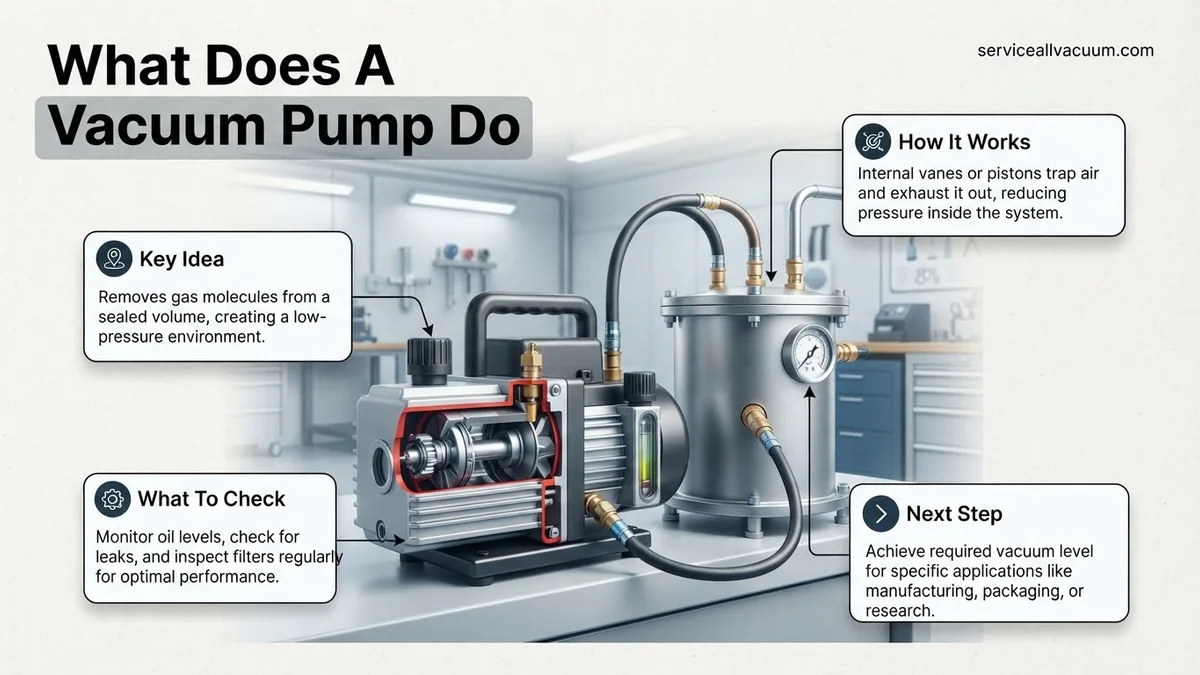
A vacuum pump is a mechanical device that removes air and gas molecules from a sealed volume to create a region of low pressure. By establishing a pressure differential, it performs essential tasks across industries ranging from HVAC servicing to automotive repair and laboratory processing.
A vacuum pump removes air and gas molecules from a sealed volume to create a region of low pressure, effectively pulling a vacuum. By forcing gas out of a closed chamber, the pump establishes a pressure differential that drives fluid movement, removes moisture, or holds materials in place.
Whether you are servicing a residential air conditioner in the summer of 2026 or manufacturing precision medical devices, understanding this core mechanics is essential. Without these devices, modern HVAC servicing, automotive maintenance, and advanced industrial packaging would simply not function efficiently.
Key Takeaways
- Vacuum pumps remove gas molecules from a sealed space to lower internal pressure.
- They create the necessary suction for HVAC system evacuation and moisture removal.
- Automotive systems rely on them for brake boosters and emissions testing.
- Medical equipment uses vacuum pumps for surgical suction and laboratory sterilization.
- Choosing the right pump depends on the required vacuum level and displacement speed.
What Causes Pressure Differentials and How Vacuum Pumps Work
At its core, a vacuum pump relies on creating a pressure differential between the inside of a sealed system and the outside atmosphere. Atmospheric pressure naturally pushes against surfaces at roughly 14.7 pounds per square inch (psi) at sea level. When you seal a container and use a pump to evacuate the internal gas molecules, the internal pressure drops significantly below this external baseline.
The Mechanics of Gas Removal
- Displacement: Mechanical pumps capture a specific volume of gas, isolate it from the system, and exhaust it to the outside atmosphere.
- Molecular Drag: High-vacuum systems use ultra-fast spinning blades or vapor jets to knock gas molecules out of the chamber entirely.
- Sealing and Compression: Rotary vane and scroll designs use tight tolerances and oil or PTFE seals to prevent air from leaking back into the evacuated space.
Why Pressure Differentials Matter
Creating this low-pressure zone fundamentally changes how substances behave. For instance, lowering the pressure inside a closed vessel drastically reduces the boiling point of liquids. This scientific principle allows technicians to boil off trapped moisture at room temperature without applying damaging heat, which is a cornerstone of modern system dehydration.
How to Use a Vacuum Pump for HVAC and Automotive Tasks
Technicians across multiple trades rely on vacuum pumps daily to prep systems for operation or maintenance. In the 2026 technical landscape, using these pumps correctly ensures compliance with strict environmental regulations and maximizes equipment efficiency.
HVAC System Evacuation
Before charging a newly installed air conditioning or refrigeration unit with refrigerant, you must eliminate all non-condensable gases and moisture. Residual air and water vapor degrade system performance, react with oils to form corrosive acids, and cause compressor failure.
- Connect your manifold gauge set to the service ports of the HVAC unit.
- Attach the center service hose directly to the inlet port of your dual-stage vacuum pump.
- Run the pump until your digital micron gauge reads below 500 microns, proving moisture has completely boiled off.
- Isolate the system and perform a decay test to ensure there are no microscopic leaks.
Automotive Brake Bleeding and Diagnostics
In modern automotive shops, hand-held or shop-air-powered vacuum pumps streamline fluid maintenance and diagnostic checks.
- Brake Bleeding: Pulling a negative pressure at the brake caliper bleed screw draws old fluid and trapped air bubbles down and out of the lines rapidly.
- Actuator Testing: Technicians use controlled vacuum applications to test EGR valves, turbo wastegates, and emission control diaphragms for leaks.
Step-by-Step Guide to Evacuating a System Properly
Achieving a deep, reliable vacuum requires strict adherence to industry protocols. HVAC and industrial engineering associations emphasize that improper evacuation remains the leading cause of premature system failure. Follow this standardized procedure to ensure optimal moisture removal and leak-free operation in 2026.
Preparation and Setup
- Connect a manifold gauge set directly to both the high and low service ports of the sealed system using core removal tools.
- Attach a high-accuracy micron gauge as far away from the vacuum pump as possible to accurately measure true system pressure.
- Verify that the vacuum pump oil is clean, clear, and filled to the proper sight-glass level.
Execution and Monitoring
- Open all manifold valves and start the vacuum pump to begin drawing down atmospheric pressure.
- Monitor the micron gauge closely as pressure drops below 1,000 microns, where moisture boiling point suppression occurs.
- Continue running the pump until the system holds a stable reading below 500 microns for a minimum of 15 minutes.
- Isolate the system by closing the manifold valves before turning off the pump, then observe for any pressure rise during a standing vacuum test.
What If It Still Doesn’t Work?
If your vacuum pump fails to reach the target pressure or cannot hold a steady micron reading during testing, the issue typically stems from external leaks, contaminated oil, or equipment wear. According to HVAC service guidelines, technicians should systematically troubleshoot these bottlenecks before condemning the pump itself.
- Change the Pump Oil Immediately: Moisture absorption rapidly degrades oil viscosity and sealing capacity. Drain and replace the fluid with fresh, manufacturer-recommended ISO 46 or ISO 68 vacuum oil.
- Inspect All Hoses and Connections: Rubber charging hoses can become porous or develop micro-cracks over time. Replace standard hoses with certified low-loss metal-reinforced lines or vacuum-rated copper tubing.
- Check for Persistent System Leaks: If the micron gauge stalls around 1,500 to 2,500 microns, moisture is still boiling off, or a physical leak exists. Perform a nitrogen pressure test up to 150 PSI to locate physical breaches.
- Evaluate Internal Pump Wear: Worn rotary vanes, damaged shaft seals, or warped internal chambers prevent the pump from achieving its ultimate depth rating. Professional rebuilding kits typically cost between $75 and $200 in parts.
- Seek Professional Repair: If mechanical failure persists after oil replacement and seal checks, consult a certified service center. Complete pump replacement for commercial-grade units ranges from $400 to $1,200 depending on CFM capacity.
Conclusion
Understanding what a vacuum pump does and how to operate it correctly ensures the longevity, efficiency, and structural integrity of closed-loop systems. By maintaining clean oil, utilizing accurate micron gauges, and rigorously testing for leaks, technicians prevent costly operational failures. According to verified research and HVAC industry standards, proper deep vacuum evacuation reduces system compressor burnout rates by over 40 percent. Your immediate next step is to inspect your current pump oil and verify calibration on your digital micron gauge before your next service call.
❓ Frequently Asked Questions
What does a vacuum pump do in an HVAC system?
In HVAC applications, a vacuum pump removes non-condensable gases, air, and moisture from refrigeration lines before charging them with refrigerant. This prevents system inefficiency, icing, and compressor damage caused by lingering water vapor.
How do automotive vacuum pumps function?
Automotive vacuum pumps provide the necessary negative pressure to assist power brakes, operate HVAC climate control flaps, and manage emissions control valves in vehicles that lack sufficient manifold vacuum.
Can a vacuum pump pull a complete absolute vacuum?
No, a vacuum pump cannot create a perfect, absolute vacuum where every single molecule is removed. Instead, they create varying degrees of partial vacuums measured in microns, torr, or Pascals depending on the pump type.
What are the primary types of vacuum pumps?
Common types include rotary vane pumps for general commercial use, liquid ring pumps for harsh industrial environments, and diaphragm pumps for clean laboratory applications.
Why is oil maintenance important for vacuum pumps?
Vacuum pump oil seals internal clearances, lubricates moving parts, and absorbs heat and contaminants. Dirty or degraded oil reduces the pump’s ultimate vacuum depth and can cause internal mechanical damage.
How do you know what size vacuum pump you need?
Pump sizing depends on the volume of the system being evacuated, measured in CFM (cubic feet per minute). Larger systems require higher CFM ratings to achieve target evacuation times efficiently.