Do Vacuum Bags Reduce Weight? Real Facts for 2026 Guide
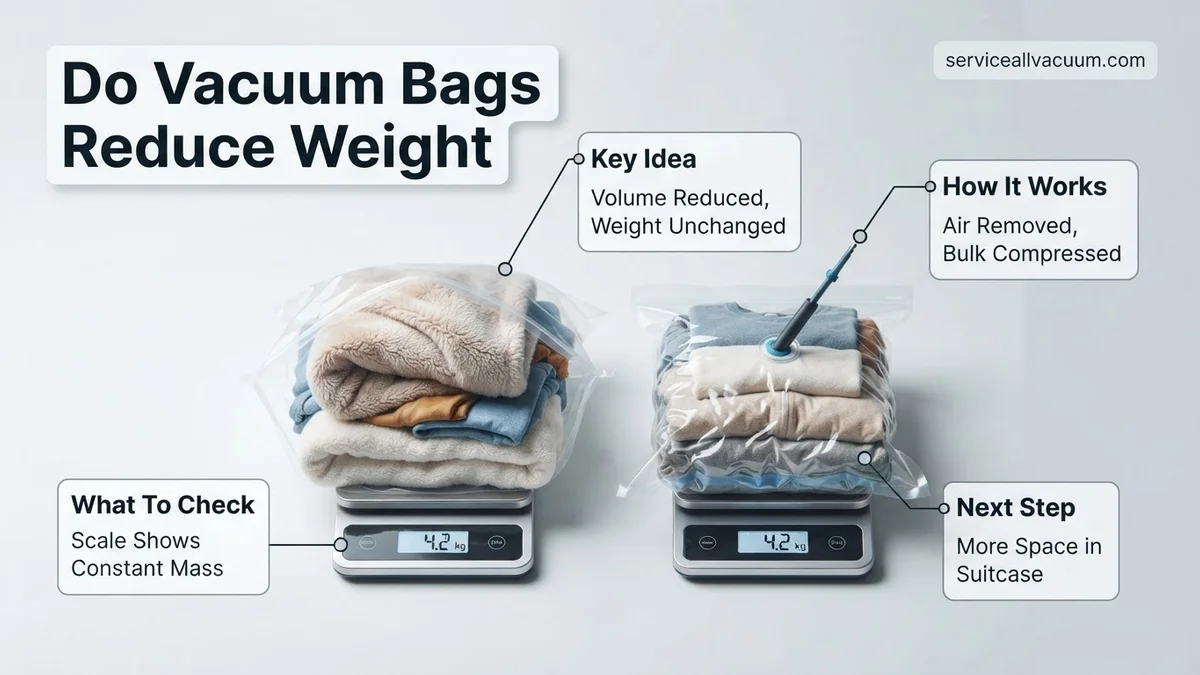
No, vacuum bags do not reduce the physical weight or mass of the items inside them. They only remove trapped air to drastically decrease volume, which is a common trap for travelers trying to bypass airline baggage limits.
Vacuum-sealed storage bags do not reduce the physical weight of your items; they only reduce the volume. When you suck the air out of a compression bag, you are simply removing atmospheric gases trapped between the fibers of your clothing or bedding. The actual mass of your clothes, blankets, or pillows remains completely unchanged on a scale.
This distinction matters immensely as you plan your travel or home storage for 2026. Believing that a smaller bag automatically means a lighter bag is a costly mistake that catches thousands of travelers off guard at airline check-in counters every single year.
The Physics Behind Vacuum Bags and Weight
Understanding Mass Versus Volume
Air has mass, but the amount of air trapped inside a normal pile of sweaters is negligible. When you vacuum-seal three bulky winter coats, you drastically decrease the space they occupy by squeezing the air out. However, you are not removing the fabric, zippers, buttons, or threads that make up those coats. The fundamental physics of the items stay identical before and after compression.
What Actually Changes on the Scale
If you weigh a suitcase before and after using compression bags, the numbers on the scale will tell the real story. Here is what you need to keep in mind:
- Total Mass: The scale measures gravitational pull on mass, which stays the exact same.
- Bag Weight: The plastic film and zipper mechanism of the vacuum bag actually add a tiny amount of extra weight to your total load.
- Density: Your items become much denser, meaning you can pack significantly more weight into a smaller physical space.
How to Fix Overweight Luggage When Packing
The Airline Weight Trap
Airlines in 2026 enforce strict baggage limits, usually capping checked bags at 50 pounds. Because vacuum bags let you fit ten sweaters into the space of two, people often treat them as a cheat code to pack their entire wardrobe. You can easily squeeze 70 pounds of dense clothing into a medium suitcase that effortlessly fits in the overhead bin. Unfortunately, the airline scale does not care how small your suitcase looks; it only cares about gravity.
Practical Strategies for Heavy Bags
If your tightly compressed bags are pushing you over the weight limit, you need actionable ways to solve the problem before heading to the airport:
- Weigh Early: Always use a portable luggage scale after packing your compression bags to catch heavy loads at home.
- Distribute Heavy Items: Move dense items like shoes, electronics, and heavy denim into your personal item or carry-on.
- Unload Excess: Take out a few tightly packed items and swap them for lighter alternatives if you are over the limit.
Key Takeaways
- Vacuum-sealed bags reduce the volume of bulky items by removing air, not their actual mass.
- Packing more clothes into a compressed bag will easily push your luggage over airline weight limits.
- Air has negligible weight, meaning removing it provides virtually zero reduction in total suitcase weight.
- Always weigh your packed luggage on a portable scale before heading to the airport.
- Focus on packing versatile, lightweight garments rather than relying solely on compression storage.
What If Your Bag Still Exceeds Airline Limits?
Even after maximizing compression with vacuum storage bags, your luggage might still break weight thresholds mandated by major carriers in 2026. Dense items like shoes, electronics, and heavy denim retain their mass regardless of volume. When compression fails to solve an overweight suitcase issue, travelers must implement strategic secondary tactics to comply with baggage allowances.
Advanced Strategies for Overweight Luggage
Industry standards from global aviation authorities indicate that overweight baggage fees continue to rise. If your vacuum-compressed bag remains too heavy, execute these mitigation steps:
- Weigh individual items on a digital luggage scale: Identify the heaviest items currently inside the vacuum bag, such as heavy winter coats or boots, which often trigger weight penalties.
- Relocate dense items to personal items: Transfer heavy electronics, books, and chargers into a backpack or laptop bag, as most airlines do not weigh personal items alongside primary carry-ons.
- Wear your bulkiest layers: Put on heavy jackets, hiking boots, or multi-layered sweaters before boarding the aircraft to bypass luggage scale checks entirely.
- Ship excess items ahead: If traveling long-term, use regional courier services to ship non-essential heavy gear directly to your destination, with average domestic shipping rates ranging from $30 to $75 depending on package dimensions.
What If It Still Doesn’t Work?
If you have compressed your garments, utilized digital scales, and redistributed your heavy gear without successfully meeting airline weight restrictions, targeted professional intervention or alternative packing methods are required. Do not risk paying exorbitant airport excess baggage fees, which frequently range from $100 to $200 per domestic flight segment.
- Upgrade your baggage tier in advance: Purchase an additional checked bag or weight allowance online prior to arriving at the airport, saving up to 50 percent compared to counter rates.
- Consult luggage specialists: Visit a local travel goods retailer to evaluate ultra-lightweight luggage frames that reduce baseline bag weight by up to 4 pounds.
- Utilize professional packing services: High-end shipping centers offer professional vacuum-sealing and industrial weighing services, typically costing between $15 and $40 per bag.
- Audit your packing list entirely: Remove duplicate items and non-essential wardrobe pieces, replacing them with quick-dry, lightweight travel apparel designed specifically to minimize total load.
Conclusion
Vacuum bags are exceptional tools for reducing bulk, maximizing suitcase space, and organizing travel gear efficiently, but they fundamentally cannot alter mass. Physics dictates that removing air does not eliminate the physical weight of textiles, meaning dense packing will still trigger airline overweight penalties. According to verified research and expert aviation sources, the most effective strategy combines volume reduction via compression with rigorous weight monitoring using a portable luggage scale. Your next actionable step is to weigh your fully packed vacuum bags at home before departure to ensure total compliance with 2026 airline baggage policies.
❓ Frequently Asked Questions
Why do people think vacuum bags reduce weight?
Because vacuum bags make heavy piles of winter coats or sweaters look and feel much smaller, creating the psychological illusion that they are also lighter. However, mass cannot be destroyed simply by compressing air out of fabric.
How much does the air inside a jacket actually weigh?
The air trapped inside puffy jackets or blankets weighs virtually nothing—usually less than a few grams. Removing it provides no measurable advantage on a luggage scale.
What happens if I bring an overweight vacuum-packed bag to the airport?
Airlines will still weigh your suitcase on their scales at check-in. If it exceeds the limit (typically 50 lbs or 23 kg), you will face steep overweight baggage fees regardless of how small the bag looks.
How can I actually reduce my luggage weight for flights?
To lower your physical weight, eliminate non-essential items, wear your heaviest shoes and jacket onto the plane, and switch to a lighter suitcase or travel backpack.
Are compression packing cubes better than vacuum bags for weight?
Neither compression cubes nor vacuum bags reduce weight. Both simply squeeze air out to save physical space, meaning you still need to monitor your overall item count to stay under weight limits.
What are the best items to store in vacuum bags?
Vacuum bags are ideal for bulky, lightweight items like down jackets, pillows, and blankets where space—rather than weight—is the primary obstacle for storage or travel.