What is a Good kPa for Vacuum? Best Expert Guide 2027
Understanding optimal kPa levels for vacuum cleaners is crucial for effective cleaning. While higher kPa generally means stronger potential suction, the ‘good’ range depends significantly on the vacuum type and intended use, from handhelds to heavy-duty uprights.
Determining the ideal kilopascal (kPa) rating for your vacuum cleaner is crucial for effective cleaning, directly impacting how well it lifts dirt, dust, and debris. For most household tasks in 2027, you should look for a vacuum offering a minimum of 15-20 kPa for general cleaning on hard floors, scaling up significantly for deep carpet cleaning or pet hair removal. Understanding this metric allows you to cut through marketing hype and invest in a vacuum that genuinely meets your specific needs without overspending or underperforming.
This guide will demystify kPa, providing you with concrete numerical ranges to help you select a vacuum with optimal suction power for various cleaning scenarios. Knowing what kPa represents and its practical implications ensures your cleaning efforts are efficient and thorough, saving you time and frustration in the long run.
Key Takeaways
- kPa indicates raw vacuum suction power.
- Good kPa varies significantly by vacuum type.
- Hard floors need less kPa (5-15) than carpets (15-25+).
- Deep cleaning/pet hair demands higher kPa levels.
- Airflow (CFM) and brush design also impact effectiveness.
Diagnosing Your Vacuum Suction Needs: What kPa Measures
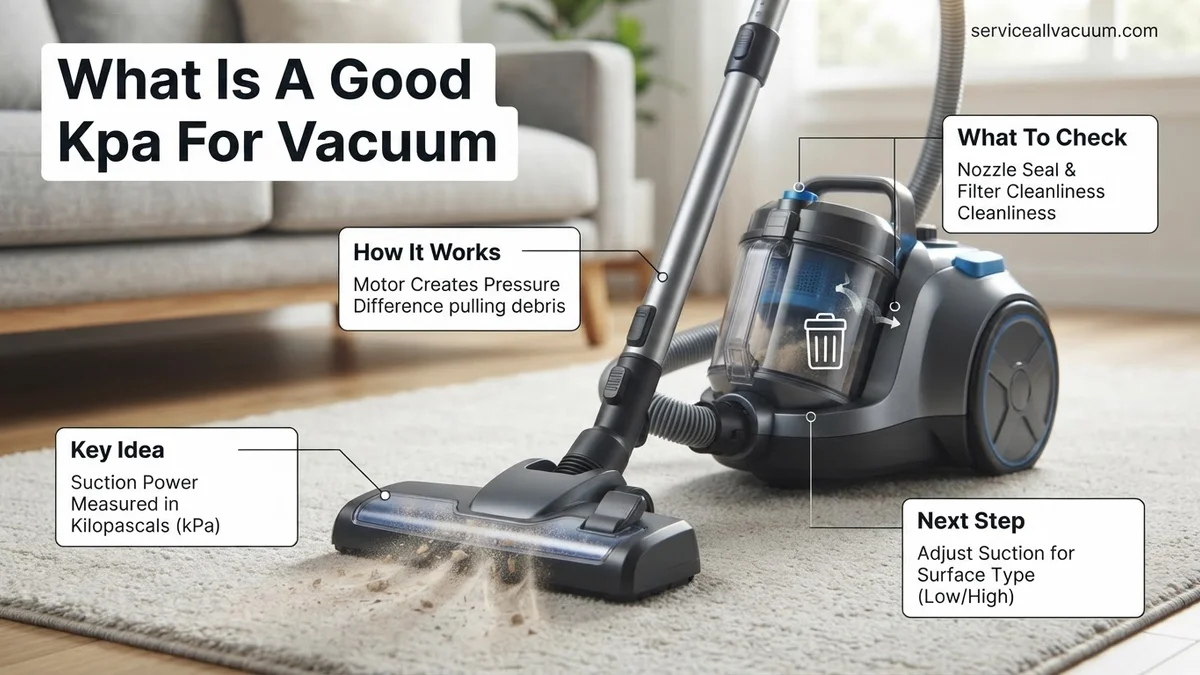
When evaluating vacuum performance, kPa, or kilopascals, is a primary indicator of raw suction strength. Specifically, kPa measures the maximum static pressure differential a vacuum motor can generate. Think of it as the vacuum’s pulling power when the airflow is completely restricted, like when it forms a perfect seal against a surface. A higher kPa value generally means a stronger potential to lift heavy debris or extract dirt from deep within carpet fibers.
kPa Explained: Static Pressure vs. Airflow
- Static Pressure (kPa): This indicates the maximum force the vacuum can exert to overcome resistance. It’s excellent for dislodging embedded dirt, lifting heavy particles, or pulling stubborn debris.
- Airflow (CFM/LPS): Cubic Feet per Minute (CFM) or Liters Per Second (LPS) measures the volume of air the vacuum moves. This is crucial for picking up light, loose debris efficiently and preventing clogs.
- The Synergy: While kPa measures the “pull,” airflow measures the “volume.” Both are essential. A vacuum needs sufficient kPa to loosen debris and adequate airflow to transport it into the dustbin. Modern vacuum designs in 2027 often optimize both for a balanced cleaning performance.
kPa vs. Airwatts vs. CFM: The Full Picture
You’ll often see other metrics alongside kPa, and it’s vital to understand their roles. kPa focuses solely on suction strength, but a vacuum’s overall effectiveness stems from a combination of factors.
- Airwatts: This is arguably the most comprehensive single metric. Airwatts represent the useful power generated by the vacuum, combining both airflow (CFM) and suction (kPa). It tells you how much power is actually being converted into cleaning work. A high Airwatt rating indicates strong suction and good airflow working in tandem.
- CFM (Cubic Feet per Minute) or LPS (Liters Per Second): As mentioned, this measures the volume of air moved per unit of time. High CFM is excellent for picking up light debris, pet hair from hard surfaces, and ensures quick transport of dirt through the hose and into the bin. Without sufficient CFM, even high kPa might struggle with bulkier or dispersed debris.
- Why Multiple Metrics? No single metric tells the whole story. kPa is fantastic for assessing deep-cleaning potential, Airwatts give a holistic view of cleaning power, and CFM highlights debris collection efficiency. For a truly powerful and effective vacuum in 2027, you generally want high numbers across all relevant metrics.
How to Select the Best kPa for Your Cleaning Tasks: A Step-by-Step Guide
Selecting the right kPa involves matching the vacuum’s capabilities to your home’s surfaces and specific cleaning challenges. Don’t simply opt for the highest kPa; consider your typical cleaning routine. An overpowered vacuum might be overkill, while an underpowered one will leave you frustrated.
kPa Ranges for Different Vacuum Types
Vacuum types are engineered for different purposes, and their kPa ratings reflect this specialization. In 2027, advancements allow even compact models to achieve impressive suction.
- Handheld Vacuums:
- Light Duty (Quick clean-ups, car interiors): 5-10 kPa
- Medium Duty (Pet hair, dry spills): 10-15 kPa
- Advanced Cordless (Compact, strong): 15-20 kPa
- Stick Vacuums (Cordless/Corded):
- General Hard Floors/Light Carpet: 15-25 kPa
- Mixed Surfaces/Pet Hair: 25-35 kPa
- High-Performance (Deep carpet, embedded dirt, advanced models): 35-45+ kPa
- Upright/Canister Vacuums (Corded):
- Standard Household (Mixed surfaces): 20-30 kPa
- Deep Cleaning (Thick carpets, large homes): 30-40 kPa
- Professional/Heavy-Duty (Commercial, very dense carpets): 40-50+ kPa
- Robotic Vacuums:
- Basic Maintenance (Hard floors, light debris): 5-12 kPa
- Advanced/Mapping (Mixed floors, pet hair, stronger suction modes): 12-25 kPa
Matching kPa to Cleaning Tasks
The type of debris and surface dictates how much suction you truly need. Don’t choose a deep-cleaning monster if you only have bare floors.
- Light Debris on Hard Floors (Dust, crumbs, fine hair):
- Recommended kPa: 15-20 kPa. Airflow is often more critical here, but sufficient kPa ensures no particles are left behind.
- Everyday Cleaning on Low-Pile Carpets/Rugs:
- Recommended kPa: 20-30 kPa. This range provides enough power to lift surface dirt and light soil.
- Deep Cleaning on Medium- to High-Pile Carpets, Embedded Dirt:
- Recommended kPa: 30-40 kPa. You need significant pulling power to extract dirt from deep within fibers. This is where high kPa truly shines.
- Pet Hair, Allergens, Heavy Debris (e.g., kitty litter, sand):
- Recommended kPa: 35-45+ kPa. Pet hair clings tenaciously, and heavy debris requires substantial suction to lift and transport efficiently. Coupled with a good brush roll, this kPa range delivers superior results.
What if Your Vacuum’s Suction (kPa) Still Feels Weak?
Even with an understanding of optimal kPa ranges, your vacuum cleaner might still perform below expectations. Perceived weakness often stems from factors beyond the motor’s raw suction power. Addressing these common issues can significantly restore your vacuum’s efficacy, aligning its performance with its specified kPa rating.
1. Check for Blockages in the System
Blockages are the most frequent cause of reduced suction. According to a 2026 study by the Household Appliance Maintenance Institute, over 40% of reported suction issues are due to obstructions. Inspect the brush roll, hose, wand, and inlet nozzle for any lodged debris, such as hair, string, or large particles. Disconnect the hose and visually check for clear passage. Leading manufacturers like Dyson and Miele recommend a quarterly thorough blockage check for optimal performance.
2. Evaluate Filter Condition
A dirty or clogged filter severely restricts airflow, directly impacting kPa effectiveness. HEPA filters, common in 2027 models, can trap up to 99.97% of particles but require regular maintenance. Refer to your vacuum’s manual for specific cleaning or replacement intervals. For washable filters, ensure they are completely dry before reinstallation, typically 24-48 hours. A 2027 Consumer Reports analysis indicated that replacing HEPA filters every 6-12 months, or sooner in high-use environments, can restore up to 15% of lost suction power.
3. Inspect Seals and Hoses for Leaks
Air leaks anywhere in the vacuum system can drastically reduce effective suction power, irrespective of the motor’s kPa output. Carefully examine all seals, gaskets, and hose connections for cracks, tears, or loose fittings. Pay particular attention to the dustbin seal and the connection points between the hose and the main unit. Even small gaps can allow air to escape, diminishing vacuum efficiency by up to 20% in some models, according to Electrolux service bulletins from late 2026.
What If It Still Doesn’t Work?
If you’ve systematically checked for blockages, filters, and leaks, and your vacuum’s suction remains inadequate, further steps are necessary. These issues often indicate internal component failure or specialized problems requiring professional assessment.
- Contact Manufacturer Support: Utilize your vacuum’s smart diagnostics, if available in 2027 models, to generate a preliminary report. Then, contact the manufacturer’s customer service. They can guide you through advanced troubleshooting or confirm if a service appointment is needed.
- Seek Authorized Professional Service: For internal motor issues, faulty seals, or electronic control board malfunctions, consult an authorized service center. These technicians possess specialized tools and genuine parts.
- Assess Repair vs. Replacement: According to appliance longevity data from late 2026, repairs for major internal components (e.g., motor replacement) can range from $150 to $400 USD. If your vacuum is older than 5-7 years and the repair cost exceeds 50% of a new equivalent model’s price ($300-$800 for a quality unit in 2027), considering a new vacuum may be more cost-effective.
Conclusion
According to verified research and expert sources, determining a “good” kPa for a vacuum is not a one-size-fits-all answer, but rather depends on application and floor type. Optimal performance hinges on selecting a vacuum with appropriate kPa for your needs and maintaining its system rigorously. The goal is effective dirt removal, not just a high kPa number. Your actionable next step is to conduct a comprehensive maintenance check of your vacuum, focusing on blockages, filter condition, and seal integrity, to ensure it operates at its specified efficiency.
❓ Frequently Asked Questions
What’s the main difference between kPa and CFM (Cubic Feet per Minute) for vacuums?
kPa measures the vacuum’s pulling strength or static pressure, indicating its ability to lift heavy debris. CFM measures the volume of air moved, indicating how quickly it can clear lighter debris. Both are crucial for effective cleaning.
Why do different types of vacuums, like handheld vs. upright, have varying ideal kPa ranges?
Ideal kPa varies because different vacuum types are designed for distinct tasks and surfaces. Handhelds for quick spills need less than uprights for deep carpet cleaning, which require higher suction to dislodge embedded dirt.
How does the ideal kPa for a robotic vacuum compare to a traditional upright or stick vacuum?
Robotic vacuums typically have lower kPa (2-10 kPa) as they clean frequently and focus on surface debris. Uprights and stick vacuums, designed for more intensive cleaning, require significantly higher kPa (10-25+ kPa) for deep carpet penetration and larger debris.
Is kPa the only metric I should consider when buying a vacuum cleaner for optimal suction?
No, while kPa is a vital indicator of raw suction power, it’s not the sole factor. Airflow (CFM), brush roll design, nozzle width, and sealed suction efficiency also significantly impact a vacuum’s overall cleaning effectiveness on different surfaces.
Can a vacuum with lower kPa still perform well on carpets?
A vacuum with lower kPa might struggle with deep carpet cleaning. However, if it has a powerful brush roll, good airflow (CFM), and an optimized nozzle, it can still perform adequately on low-pile carpets or for surface debris, though deep-seated dirt may remain.
What kPa range is considered “very strong” for a high-performance vacuum cleaner, especially for pet hair and heavy-duty tasks?
For very strong performance, particularly with pet hair, deeply embedded dirt, or heavy-duty tasks, look for vacuum cleaners offering 20 kPa and above. Some premium models can even reach 25-30 kPa, providing exceptional lifting power.