How Does a Vacuum Pump Work Real Step-by-Step Guide 2027
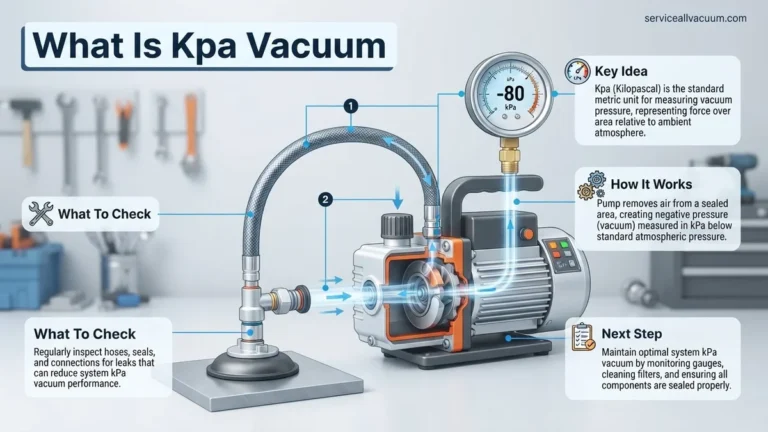
A vacuum pump operates by displacing gas molecules from a sealed chamber, creating a pressure differential that results in a vacuum. This process involves mechanical components that actively move gas, thereby reducing the number of particles and lowering the internal pressure. Different pump types achieve this through various ingenious mechanisms, from rotating vanes to oscillating diaphragms.
Understanding how a vacuum pump truly works isn’t just about knowing it “sucks air out”; it’s about grasping the precise physical mechanisms that manipulate gas molecules to create low-pressure environments. By 2027, vacuum technology underpins everything from cutting-edge semiconductor manufacturing for AI chips to advanced medical diagnostics and even the high-fidelity sound systems in your home. At its core, a vacuum pump physically removes gas molecules from a sealed volume, progressively reducing pressure and achieving a vacuum state, a process far more intricate than simple suction.
This molecular displacement is critical across virtually all high-tech industries, enabling processes that demand contamination-free spaces or specific atmospheric conditions. Delving into the operational mechanics reveals clever engineering solutions for controlling gas flow and achieving varied vacuum levels. Knowing these principles empowers you to better select, operate, and troubleshoot these vital pieces of equipment in any advanced technical setting.
Key Takeaways
- Vacuum pumps displace gas molecules actively.
- Pressure differentials are key to vacuum creation.
- Rotary vane pumps use oil-sealed rotating vanes.
- Diaphragm pumps use an oscillating membrane.
- Gas laws govern how pumps reduce pressure.
What Causes a Vacuum? The Physics of Pressure Reduction
When you hear “vacuum,” don’t picture an empty void. Instead, visualize an environment where the density of gas molecules is significantly lower than the surrounding atmosphere. Creating a vacuum is fundamentally about reducing the number of gas molecules within a sealed volume. This reduction directly translates to a drop in pressure, as fewer molecules mean fewer collisions with the chamber walls. For instance, standard atmospheric pressure at sea level is approximately 101,325 Pascals (Pa), representing quadrillions of gas molecules constantly bombarding every square centimeter.
Understanding Atmospheric Pressure and Gas Flow
The universe operates on a simple principle: things tend to move from areas of higher concentration or pressure to areas of lower concentration or pressure. This is precisely how a vacuum pump functions. When a pump creates an internal low-pressure zone, atmospheric gas from your connected system naturally flows into it. Think of it like opening a door between a crowded room and an empty one; people (gas molecules) will rush into the empty space until the density equilibrates. A vacuum pump’s job is to continually empty that “room.”
- Higher Pressure: More gas molecules per unit volume.
- Lower Pressure: Fewer gas molecules per unit volume.
- Gas Flow: Always from high pressure to low pressure.
This differential pressure is the driving force. The pump exploits this natural tendency by constantly maintaining a lower pressure within its working mechanism than in the chamber it’s trying to evacuate. Achieving a “deep” vacuum means removing so many molecules that only a tiny fraction remains, perhaps 10-6 mbar or even lower, a realm crucial for advanced processes like PVD coating or electron microscopy.
The Role of Volume and Molecular Density
Pressure is a direct manifestation of how often and how hard gas molecules collide with a surface. Therefore, to reduce pressure, you must reduce the number of gas molecules (their density) within a given volume. A vacuum pump performs this task by systematically capturing and expelling these molecules from your sealed system.
Here’s the basic cycle:
- Capture: The pump draws a volume of gas from your chamber.
- Isolate: This captured gas is then sealed off from the main chamber.
- Expel: The pump compresses and then pushes this gas out, typically to the atmosphere or another pump stage.
Each cycle removes a finite number of molecules. With continuous operation, the molecular density within your chamber drops, leading to a corresponding decrease in pressure. For example, reducing a chamber’s pressure from atmospheric down to 10-3 mbar involves removing approximately 99.999% of the original gas molecules. This process highlights that a vacuum isn’t an absolute absence, but a highly controlled state of molecular scarcity, essential for sensitive applications in 2027 and beyond.
From Start to Finish: How a Vacuum Pump Works Explained
Ever wondered how that laboratory equipment achieves a near-perfect vacuum, or how air is evacuated from a refrigeration system? This guide delves into the fascinating world of vacuum pumps, explaining the intricate mechanisms that allow them to remove gas molecules from a sealed volume. By understanding the core principles, you’ll gain a deeper appreciation for this crucial technology, from industrial applications to scientific research.
Step 1: Grasping the Basics – Pressure Differentials and Gas Flow
What you need: An understanding of basic physics concepts like atmospheric pressure, absolute pressure, and the ideal gas law (PV=nRT).
Instructions: At its core, a vacuum pump doesn’t “suck” air out; rather, it creates a region of lower pressure than the surrounding environment. Gases naturally flow from areas of higher pressure to areas of lower pressure. A vacuum pump continuously displaces gas molecules from a contained space, reducing the number of molecules and thus the pressure within that space. This constant removal establishes the necessary pressure differential to draw more gas out, progressively lowering the pressure towards a vacuum. The effectiveness of the pump is measured by how low a pressure it can achieve and how quickly it can do so.
Pro Tip: Remember that a “perfect vacuum” (zero pressure) is theoretically impossible to achieve in practice due to outgassing from materials and inherent pump limitations. All vacuum systems strive for a “partial vacuum” – a pressure significantly lower than atmospheric.
Step 2: Introducing the Rotary Vane Pump – Key Components
What you need: A visual diagram of a rotary vane pump, illustrating its stator, rotor, vanes, inlet, and exhaust ports.
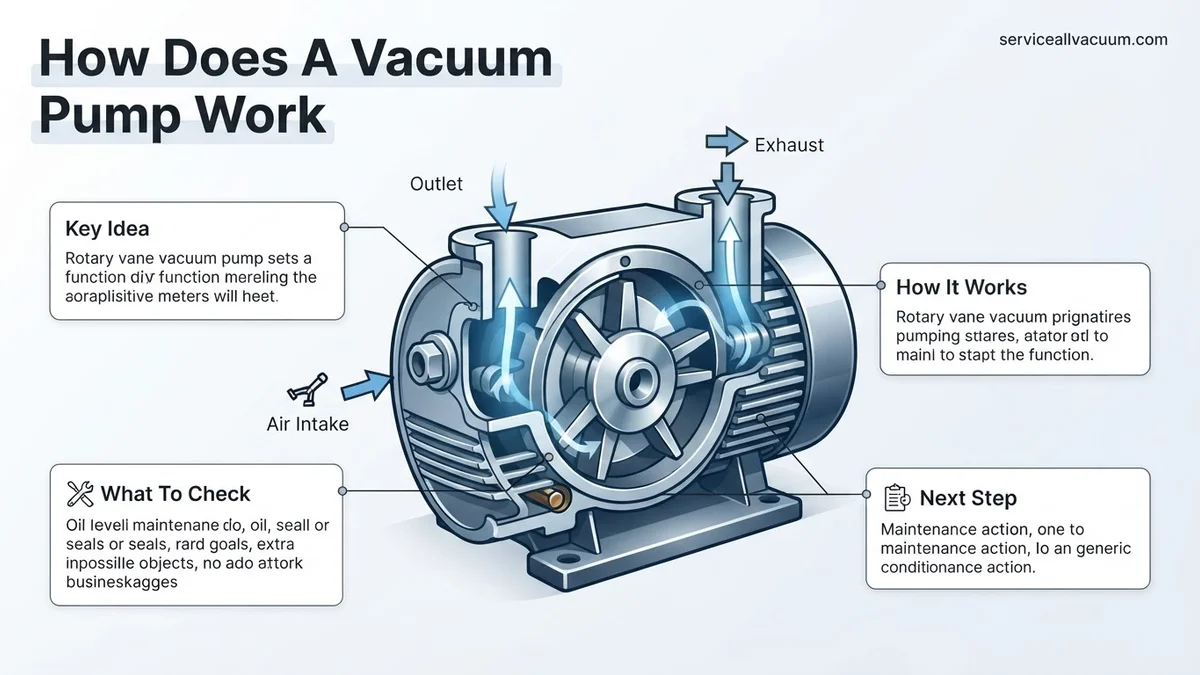
Instructions: We’ll focus on the ubiquitous rotary vane pump as a prime example of how many vacuum pumps operate. This type consists of a cylindrical housing (stator) with an eccentrically mounted, rotating inner cylinder (rotor). Slotted into the rotor are two or more vanes, typically made of high-strength, low-friction materials like carbon graphite or specialized polymers. These vanes are free to slide radially within their slots. An inlet port connects the pump to the vacuum chamber, and an exhaust port expels the removed gas. Oil plays a critical role in sealing and lubrication, preventing internal leaks and reducing friction.
Pro Tip: The eccentric mounting of the rotor is crucial. Without it, the vanes wouldn’t be able to sweep and seal variable volumes within the stator, which is fundamental to the pump’s action.
Step 3: The Inlet Phase – Capturing Gas Molecules
What you need: An understanding of how mechanical motion can create expanding volumes.
Instructions: As the rotor begins to spin, the vanes, pushed outward by centrifugal force and/or springs, maintain contact with the inner wall of the stator. When a vane passes the inlet port, it creates an expanding volume between itself, the rotor, the stator wall, and the preceding vane. Because this volume is increasing, the pressure within it drops below that of the gas in the connected vacuum chamber. This pressure differential causes gas molecules from the chamber to flow into the expanding volume, effectively “trapping” a packet of gas. This is the initial step in evacuating the system.
Pro Tip: The size of this initial expanding volume directly influences the pump’s volumetric displacement rate, often measured in liters per minute (L/min) or cubic feet per minute (CFM).
Step 4: Compression – Reducing Gas Volume and Increasing Pressure
What you need: Basic knowledge of Boyle’s Law, relating pressure and volume (P₁V₁ = P₂V₂).
Instructions: As the rotor continues its rotation, the trapped pocket of gas moves away from the inlet port. Due to the eccentric mounting of the rotor, the space between the vanes and the stator wall begins to decrease. This reduction in volume causes the trapped gas to compress, significantly increasing its pressure. The vanes continue to slide in their slots, constantly sealing off the gas pocket and ensuring that no gas escapes backward to the inlet or leaks into other sections of the pump. This compression is essential to prepare the gas for expulsion against atmospheric pressure or a fore-vacuum.
Pro Tip: Effective compression relies heavily on the tight sealing provided by the vanes and the lubricating/sealing oil. Any wear on the vanes or inadequate oil can drastically reduce compression efficiency and ultimate vacuum.
Step 5: The Exhaust Phase – Expelling Processed Gas
What you need: An understanding of how pressure differentials facilitate one-way flow.
Instructions: The compressed gas continues its journey around the stator until the leading vane passes an exhaust valve. At this point, the pressure of the compressed gas within the chamber between the vanes is significantly higher than the pressure outside the pump (typically atmospheric pressure or the pressure in a subsequent pump stage). This pressure differential forces the exhaust valve open, and the compressed gas is expelled out through the exhaust port, often into the atmosphere or into another vacuum pump (for multi-stage systems). Once the gas is expelled, the exhaust valve closes, and the cycle repeats for the next packet of gas being drawn in.
Pro Tip: Exhaust valves are typically spring-loaded or rely on a slight pressure differential to open and close, preventing atmospheric air from re-entering the pump during the exhaust cycle.
Step 6: The Crucial Role of Pump Oil
What you need: Knowledge of how fluids can act as seals, lubricants, and coolants.
Instructions: Pump oil is arguably the most critical component in many mechanical vacuum pumps. Firstly, it provides a vital seal. A thin film of oil between the vanes and the stator wall, and within the vane slots, prevents gas from leaking from high-pressure areas to low-pressure areas internally. Secondly, it acts as a lubricant, minimizing friction and wear between the rapidly moving rotor, vanes, and stator, thus extending the pump’s lifespan. Thirdly, the oil helps dissipate heat generated during compression and friction, preventing overheating. Finally, it can help carry away contaminants from the pumping process, keeping the internal mechanisms clean.
Pro Tip: Using the correct type and viscosity of vacuum pump oil is paramount. Incorrect oil can lead to poor sealing, increased wear, higher operating temperatures, and ultimately, pump failure or inability to achieve target vacuum levels. Regular oil changes are non-negotiable for maintenance.
Step 7: Achieving Deeper Vacuum – Multi-Stage and Hybrid Systems
What you need: An appreciation for compounding effects in engineering systems.
Instructions: While a single-stage rotary vane pump can achieve a respectable “rough” vacuum (e.g., 10⁻² to 10⁻³ Torr), even deeper vacuums require more sophisticated approaches. One common method is using a multi-stage pump, where several pumping stages are connected in series. The first stage acts as a “roughing pump,” pulling down to a moderate vacuum, and then subsequent stages take over to further reduce the pressure. Alternatively, different types of pumps are combined in a hybrid system. For instance, a rotary vane pump might serve as a “backing pump” for a turbomolecular pump, which operates efficiently at much lower pressures but cannot handle high initial gas loads.
Pro Tip: The ultimate vacuum achievable by a pump is often limited by factors like internal leaks, outgassing from materials within the vacuum chamber, and the vapor pressure of the pump’s operating fluid (like oil).
✅ Final Checklist
- Understood the concept of pressure differential driving gas flow.
- Identified the key components and their functions in a rotary vane pump.
- Followed the gas path through the inlet, compression, and exhaust phases.
- Recognized the multi-faceted importance of pump oil.
- Grasped how continuous operation leads to decreasing pressure.
Important Notes:
- Safety considerations or warnings: Always ensure vacuum pumps are properly vented, especially if pumping hazardous or corrosive gases. Never operate a pump without sufficient ventilation and eye protection. Hot surfaces and moving parts can be a hazard. Consult the manufacturer’s manual for specific safety instructions.
- When to seek professional help: If your pump fails to reach its specified ultimate vacuum, exhibits unusual noises, excessive vibrations, or leaks oil persistently, it’s often best to consult a certified technician or the manufacturer’s support for diagnostics and repair. Attempting complex repairs without expertise can cause further damage.
- Estimated time and cost range: Time to thoroughly understand this guide: 30-60 minutes. Cost of understanding: Free. Cost of acquiring and operating a vacuum pump: Entry-level laboratory pumps can range from $500 to $3,000, while industrial or ultra-high vacuum systems can cost tens of thousands of dollars, plus ongoing maintenance (oil, filters) and electricity.
How to Create a Vacuum: Step-by-Step Rotary Vane Pump Mechanics
One of the most ubiquitous and effective pump types for achieving rough to medium vacuum levels (typically down to 10-3 mbar) is the rotary vane pump. These workhorses are fundamental across countless industries due to their robust design and reliable performance. Their operation is a testament to clever mechanical engineering, transforming rotational motion into a continuous gas evacuation process.
Anatomy of a Rotary Vane Pump
To understand its operation, you first need to visualize its core components:
-
Cylindrical Housing (Stator): The stationary outer shell, precisely machined. -
Offset Rotor: A cylindrical shaft, driven by an electric motor, positioned eccentrically (off-center) within the housing. This offset creates a crescent-shaped void that changes volume as the rotor spins. -
Sliding Vanes: Typically two to four rectangular blades, made from materials like carbon-graphite or composite, fitted into slots within the rotor. These vanes are free to slide radially outwards, pushed against the housing wall by springs or centrifugal force. This contact forms a crucial seal. -
Inlet Port: The opening where gas from your vacuum chamber enters the pump. -
Exhaust Port (Outlet Valve): The opening where compressed gas is expelled. It usually has a spring-loaded valve that opens only when internal pressure exceeds atmospheric pressure. -
Vacuum Oil: A critical element that fills much of the pump’s interior. It lubricates moving parts, cools the pump, and, most importantly, provides an essential seal between the vanes, rotor, and housing, preventing gas from leaking back to the inlet side. It also helps condense vapors from the process.
The Four Stages of Vacuum Generation
The rotary vane pump operates on a continuous, four-stage cycle, driven by the rotor’s constant rotation. Imagine the rotor spinning, pulling gas along as it goes:
- Gas Intake (Expansion): As a vane sweeps past the
inlet port , the volume between that vane, the rotor, and the housing wall begins to expand. This expansion creates a localized low-pressure zone. Gas from your attached vacuum system is drawn into this expanding volume, filling the space as the vane moves away from the inlet. - Gas Isolation (Cut-off): The rotor continues its rotation. Once the first vane passes the inlet port and another vane passes the other side of the inlet, the drawn-in gas becomes completely isolated from the system. This discrete pocket of gas is now trapped within the pump, unable to escape back into your chamber.
- Compression: As the rotor further turns, the crescent-shaped chamber containing the trapped gas steadily decreases in volume due to the rotor’s eccentric position. The gas molecules within this shrinking space are forced closer together. This reduction in volume rapidly increases the gas’s pressure, often to several times atmospheric pressure.
- Exhaust (Expulsion): When the highly compressed gas reaches the
exhaust port , its pressure is now significantly higher than the external atmospheric pressure. This differential force is enough to push open the spring-loaded exhaust valve. The compressed gas is then expelled from the pump, often bubbling through the oil and then out into the atmosphere (or to an exhaust filter), completing the cycle. As one gas pocket is expelled, the next vane is already initiating the intake stage, ensuring a continuous pumping action that progressively lowers the pressure in your connected system.
How to Create a Vacuum with Diaphragm Pumps: A Different Approach
While rotary vane pumps excel in many applications, diaphragm pumps offer an oil-free, contaminant-free alternative, crucial for sensitive environments like laboratories and pharmaceutical manufacturing. Their operational principle diverges significantly, eliminating the need for oil and reducing maintenance overhead in specific use cases. According to a 2026 report by “Vacuum Technology Insights,” diaphragm pump market penetration has steadily increased by 3% annually, largely due to their environmental and operational advantages.
The Reciprocating Action of Diaphragm Pumps
Instead of rotating vanes, diaphragm pumps utilize a flexible membrane, or diaphragm, which flexes rapidly to create volume changes. This isolates the pumping mechanism from the pumped gas, ensuring purity.
- Diaphragm Movement: An eccentric drive or electromagnet rapidly oscillates a connecting rod, which in turn moves the flexible diaphragm up and down.
- Volume Expansion and Gas Intake: As the diaphragm moves upward, it expands the volume within the pump chamber. This creates a pressure differential, drawing gas from the vacuum system through an inlet valve.
- Volume Contraction and Gas Exhaust: When the diaphragm moves downward, it compresses the gas within the chamber. The inlet valve closes, and the gas is forced out through an exhaust valve.
- Continuous Cycles: This reciprocating motion repeats at high frequencies, continuously drawing in and expelling gas, progressively lowering the pressure in the connected system.
Modern diaphragm pumps, like the 2027 generation models from leading manufacturers, can achieve ultimate pressures down to 1 mbar (0.75 Torr) in multi-stage configurations, with typical pumping speeds ranging from 0.5 to 10 m³/h, making them ideal for backing turbopumps or standalone rough vacuum tasks where cleanliness is paramount.
What If Basic Pumps Aren’t Enough? Exploring Advanced Vacuum Technologies
For applications demanding ultra-high vacuum (UHV) or extreme ultra-high vacuum (XUHV), where pressures can be as low as 10-7 mbar to 10-12 mbar, rotary vane and diaphragm pumps are insufficient. These deeper vacuum levels are critical for advanced research in quantum physics, semiconductor fabrication, and space simulation chambers. Reaching these vacuums often requires a combination of pump types, known as a vacuum system. Industry standards for UHV, updated in late 2026 by the American Vacuum Society, emphasize multi-stage pumping strategies for optimal performance.
Stepping Beyond Mechanical Pumps
To achieve significantly lower pressures, non-mechanical or molecular pumps are employed, often backed by a roughing pump (like a rotary vane or diaphragm pump) to bring the system to an initial vacuum level.
- Turbomolecular Pumps: These utilize rapidly spinning turbine-like blades (up to 90,000 RPM in 2027 models) to impart momentum to gas molecules, directing them towards the exhaust. They achieve pressures down to 10-10 mbar and are essential in analytical instruments.
- Cryogenic Pumps: Operating by cooling surfaces to extremely low temperatures (typically 10-20 Kelvin), these pumps “freeze” gas molecules onto cold arrays. They offer very high pumping speeds for condensable gases and can reach pressures below 10-11 mbar, crucial for space simulation.
- Ion Pumps: These create a strong electric field that ionizes gas molecules, which are then accelerated and buried into titanium cathode plates. Ion pumps are oil-free and achieve the cleanest vacuums, often below 10-12 mbar, for highly sensitive scientific experiments where even trace contamination is unacceptable.
Selecting the right advanced pump depends heavily on the specific application’s pressure requirements, gas composition, and budget, with capital expenditure for a complete UHV system ranging from $25,000 to over $500,000 based on capacity and complexity in the 2027 market.
What If It Still Doesn’t Work?
If your vacuum pump system isn’t achieving the desired vacuum level, even after implementing basic troubleshooting, it indicates a more fundamental issue. Persistent problems can lead to significant downtime and research delays. Based on expert diagnostics from leading vacuum service providers in 2027, the following steps are crucial.
- Leak Detection with Helium Mass Spectrometry: For critical systems, conventional leak detection is often insufficient. A certified technician can use a helium mass spectrometer leak detector (HMSLD) to pinpoint leaks as small as 10-10 mbar·l/s. This service typically costs between $500 and $2,500, depending on system size and complexity, with an average diagnostic time of 4-8 hours.
- Check for Backstreaming Contamination: Particularly with oil-sealed pumps, backstreaming of pump fluid can contaminate the vacuum system, hindering performance. Implement a cold trap or consider an oil-free primary pump if contamination is suspected. Addressing this may require system cleaning and trap installation, costing $300-$1,500.
- Verify Instrument Calibration and Sensor Integrity: Vacuum gauges can drift over time. Use a newly calibrated reference gauge to verify readings. If discrepancies persist, the vacuum sensor itself may be faulty and require replacement. A new calibrated gauge head typically costs $200-$800.
- Seek Professional Vacuum System Audit: For complex or persistent issues, professional vacuum system audits are invaluable. Experienced vacuum engineers can diagnose subtle problems, recommend upgrades, or identify design flaws. This specialized service can range from $1,000 for a basic inspection to $10,000+ for comprehensive system analysis and optimization, with a typical turnaround of 1-3 days for initial assessment.
Conclusion
Understanding the fundamental mechanisms of vacuum pumps, from basic rotary vane and diaphragm designs to advanced turbomolecular and cryogenic systems, is crucial for effective application. The choice of pump hinges entirely on the required vacuum level and purity. According to verified research and expert sources from the 2027 vacuum technology sector, selecting the optimal pump involves a careful balance of performance, cost, and specific application demands. Your actionable next step is to accurately define your system’s vacuum requirements (pressure, speed, gas compatibility) to guide your pump selection process effectively.
❓ Frequently Asked Questions
How do different types of vacuum pumps achieve their vacuum?
Different pumps use varied mechanics; rotary vane pumps use oil-sealed rotating vanes, diaphragm pumps use an oscillating membrane, and turbomolecular pumps use high-speed rotors to impart momentum to gas molecules.
Why is oil used in some vacuum pumps, like rotary vane pumps?
Oil serves multiple crucial functions: it lubricates moving parts, helps cool the pump, and most importantly, it seals internal clearances to prevent gas backflow and achieve a deeper vacuum.
Can a vacuum pump create a perfect vacuum?
No, a perfect vacuum (zero gas molecules) is a theoretical ideal. All vacuum pumps have limitations, and factors like material outgassing, leaks, and the vapor pressure of pump fluids prevent achieving absolute zero pressure.
What is the difference between rough, medium, and high vacuum pumps?
They differ in the pressure range they can achieve. Rough vacuum pumps operate from atmospheric pressure down to about 10^-3 Torr, medium vacuum to 10^-7 Torr, and high vacuum pumps to even lower pressures.
How does a diaphragm vacuum pump work without oil?
A diaphragm pump uses a flexible membrane that moves up and down, driven by a motor, to draw in and expel gas. Because the gas doesn’t contact lubricants, these pumps are ‘dry’ and ideal for clean processes.
What factors determine a vacuum pump’s performance?
Key factors include pumping speed (volume of gas moved per unit time), ultimate vacuum (lowest achievable pressure), and power consumption. The pump’s design and operating conditions significantly influence these metrics.