What is kPa Vacuum? Your Expert 2027 Guide to Pressure
kPa vacuum measures pressure significantly below standard atmospheric conditions, expressed in kilopascals. It quantifies the degree of ’emptiness’ or negative pressure relative to the surrounding air, crucial for understanding various industrial and mechanical systems. Lower kPa values (closer to 0) indicate a stronger vacuum.
Kilopascal (kPa) vacuum refers to the measurement of pressure significantly below standard atmospheric pressure, typically indicating how much ’empty space’ exists within a sealed system. This measurement is crucial in a vast array of 2027 technologies, from optimizing the efficiency of advanced manufacturing processes to diagnosing performance issues in next-generation electric vehicles. Understanding kPa vacuum allows engineers and technicians to precisely control environments, ensure material integrity, and troubleshoot complex systems where precise pressure differentials are paramount for safe and effective operation.
This guide clarifies what kPa vacuum signifies and how to interpret these readings, providing you with the essential knowledge to navigate pressure measurements in modern applications. It’s not just about knowing a number; it’s about understanding the environment and the forces at play within your systems, ensuring peak performance and reliability.
Key Takeaways
- kPa means kilopascal, a pressure measurement unit.
- Vacuum refers to pressure below atmospheric pressure.
- Lower absolute kPa values indicate a stronger vacuum.
- Standard atmospheric pressure is approximately 101.3 kPa.
- Crucial for diagnosing engine health and system leaks.
What is kPa Vacuum: Defining the Concept
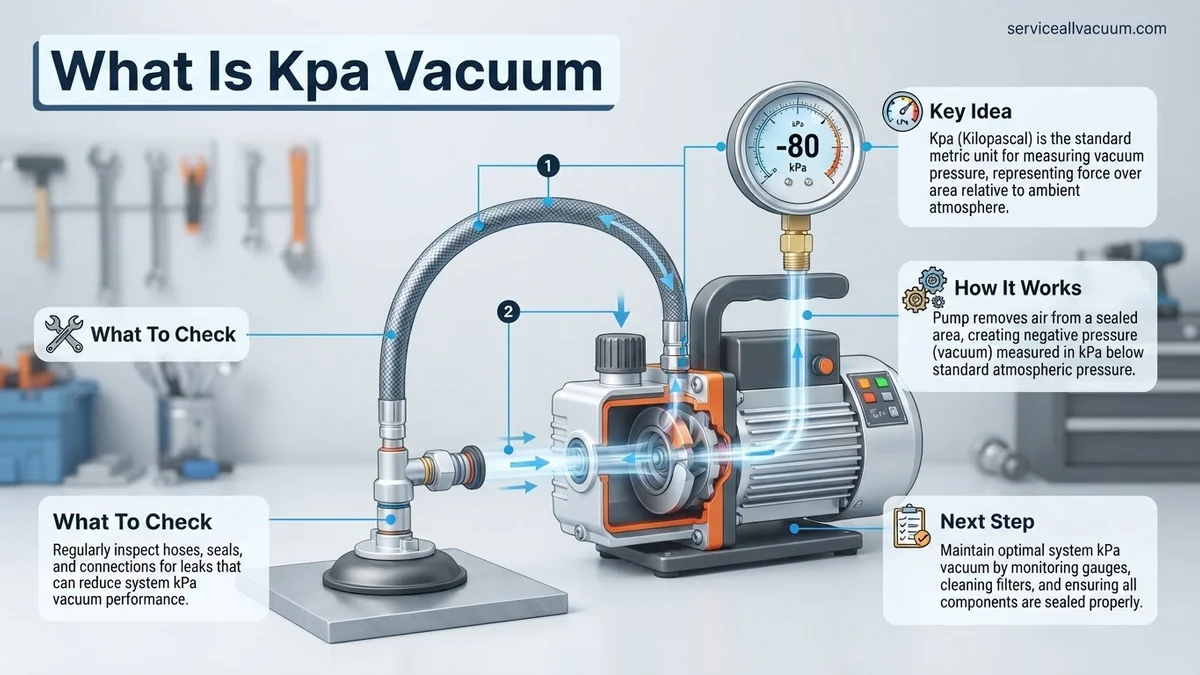
kPa vacuum is a precise measurement indicating a pressure level below the ambient atmospheric pressure. The core unit, the Pascal (Pa), is the SI unit for pressure, defined as one Newton per square meter. A kilopascal (kPa) is simply 1,000 Pascals, making it a more convenient scale for many practical applications. When discussing vacuum, kPa typically refers to an absolute pressure measurement. This means it measures pressure relative to a perfect vacuum, which is defined as 0 kPa.
kPa as an Absolute Pressure Measurement
In vacuum technology, kPa is almost universally used to express absolute pressure. This is critical because it provides an unambiguous value, regardless of the local atmospheric pressure, which fluctuates with altitude and weather.
- Absolute Pressure: Measures pressure relative to a perfect vacuum (0 kPa).
- Gauge Pressure: Measures pressure relative to the surrounding atmospheric pressure, often reported as negative for vacuum. While some older systems might use negative kPa gauge, modern vacuum measurements almost exclusively use positive kPa absolute.
- A reading of 0 kPa signifies a perfect, theoretical vacuum – the complete absence of any gas molecules.
Understanding Vacuum Levels in kPa
Interpreting kPa vacuum readings is straightforward once you grasp the relationship with a perfect vacuum. A lower kPa value indicates a stronger, deeper vacuum because the pressure is closer to absolute zero. Conversely, a higher kPa value, closer to atmospheric pressure, means a weaker or partial vacuum.
- Stronger Vacuum: Indicated by lower kPa absolute values (e.g., 1 kPa, 10 kPa). This means there are fewer gas molecules remaining in the system.
- Weaker Vacuum: Indicated by higher kPa absolute values (e.g., 50 kPa, 80 kPa). The system is less “empty” and closer to normal atmospheric pressure.
For example, an industrial chamber operating at 5 kPa absolute has a significantly stronger vacuum than a vacuum cleaner operating at 60 kPa absolute. This understanding is vital for processes like semiconductor manufacturing or advanced material testing, where precise vacuum levels directly impact product quality and experimental results.
How to Interpret kPa Vacuum Readings: A Step-by-Step Guide
Interpreting kPa vacuum readings effectively requires understanding the reference point: standard atmospheric pressure. At sea level, standard atmospheric pressure is approximately 101.3 kPa (absolute). This value serves as your baseline for “no vacuum” in an open system. Any reading below 101.3 kPa indicates some level of vacuum. The closer the reading gets to 0 kPa, the more complete the vacuum.
kPa Relative to Atmospheric Pressure
Think of it this way: 101.3 kPa is the air pushing on you right now. If a system reads 80 kPa, it has 21.3 kPa less pressure than the atmosphere. If it reads 20 kPa, it has 81.3 kPa less pressure, indicating a much stronger vacuum. This absolute scale simplifies comparisons and ensures consistency across different locations and conditions. For example, a vehicle’s engine manifold in 2027 might be designed to operate optimally at 30 kPa during deceleration, regardless of whether it’s at sea level or high altitude.
Comparing Common Vacuum Units (2027 Context)
While kPa is the international standard, you might still encounter other units, particularly in legacy systems or specific industry niches. Knowing their approximate relationships helps with mental benchmarks.
- Standard Atmospheric Pressure:
- 101.3 kPa (kilopascals)
- 29.92 inHg (inches of mercury)
- 760 mmHg (millimeters of mercury or torr)
- Common Vacuum Levels:
- A “good” general-purpose vacuum might be around 10-20 kPa (absolute), roughly equivalent to 3-6 inHg or 75-150 mmHg.
- A “strong” vacuum for scientific or industrial applications could be <1 kPa, which is challenging to achieve and maintain.
These conversions are crucial when working with equipment from different regions or generations. For instance, an HVAC technician troubleshooting an older system might see readings in inHg, but newer diagnostic tools for advanced heat pump systems typically display kPa. Understanding these equivalences ensures accurate diagnosis and operation across diverse technological landscapes in 2027.
Troubleshooting Common kPa Vacuum Issues
Even with robust systems, vacuum performance can fluctuate. Addressing common issues proactively ensures consistent operation and prevents costly downtime. By 2027, advanced diagnostic tools make pinpointing problems more efficient.
Identifying System Leaks
- Power down the vacuum system completely and allow it to stabilize.
- Apply a leak detection spray (e.g., advanced helium-based or ultrasonic leak detector, standard in 2027) along all seals, connections, and tubing. For critical systems, a portable mass spectrometer leak detector offers unparalleled precision.
- Observe for bubbles or listen for distinctive hissing sounds indicating gas escaping. According to VacuTek’s 2026 Vacuum Maintenance Guide, a typical leak check for a small system should take no more than 30 minutes. Replace faulty gaskets, O-rings, or fittings immediately.
Diagnosing Pump Performance
- Verify the pump’s oil level and condition. Contaminated or low oil significantly reduces efficiency and can lead to pump failure. Replace vacuum pump oil every 500-1000 operational hours as per manufacturer guidelines (e.g., Leybold’s 2027 service manual), using only specified grades.
- Check the pump’s inlet filter for obstructions. A clogged filter can restrict airflow by up to 40%, preventing the desired vacuum depth. Clean or replace filters as needed, typically every 3-6 months depending on process cleanliness.
- Listen for unusual noises (grinding, excessive vibration) which may indicate internal mechanical failure, such as worn bearings or damaged vanes, requiring professional service.
Expert Tips for Accurate kPa Vacuum Measurement
Achieving and maintaining precise vacuum levels hinges on accurate measurement. By 2027, sensor technology offers incredible fidelity, but proper handling and calibration remain paramount.
Regular Gauge Calibration
- Calibrate your vacuum gauges annually, or more frequently if critical accuracy is required for your process. Leading metrology institutes, such as NIST, recommend recalibration every 12 months for industrial-grade sensors to maintain certified accuracy.
- Use certified calibration services that adhere to ISO/IEC 17025 standards to ensure traceability and accuracy. A typical professional calibration for a capacitance manometer (the industry standard for precise kPa measurement by 2027) costs between $300-$700, depending on range and complexity.
- Maintain a calibration log for each gauge, noting dates, results, and any adjustments made. This provides a historical record for performance tracking.
Optimal Sensor Placement and Condition
- Position vacuum sensors away from direct gas flow or turbulent areas to prevent inaccurate readings caused by kinetic energy effects. Ideally, place sensors in a quiescent zone of the vacuum chamber.
- Ensure the sensor port is clean and free of contamination. Even microscopic debris or oil residue can alter readings by several Pascals. Use lint-free wipes and appropriate solvents (e.g., isopropyl alcohol, which fully evaporates) for cleaning before each critical measurement session.
- Avoid placing sensors near heat sources, as temperature fluctuations directly affect gas density and thus perceived pressure. Modern sensors often include temperature compensation, but extreme gradients can still introduce errors.
What If It Still Doesn’t Work?
If you’ve meticulously followed the troubleshooting steps and your vacuum system still isn’t performing as expected, consider these advanced actions before calling a specialist:
- Systematic Component Isolation: If possible, isolate sections of your vacuum system. Close valves to segment the system and test each section independently. This helps pinpoint the exact location of a persistent leak or malfunction that might be masked by other components.
- Consult Manufacturer Diagnostics: Many modern vacuum pumps and controllers (2027 models) feature advanced onboard diagnostics accessible via a digital interface or companion app. Refer to your equipment’s user manual for specific diagnostic codes and their interpretations, which can often guide you to a specific component failure.
- Professional Vacuum Service: If internal pump issues, complex leaks requiring specialized equipment, or persistent sensor errors remain, it’s time to engage a certified vacuum technician. They possess specialized tools like mass spectrometer leak detectors and advanced calibration equipment. Professional service for a typical industrial vacuum system can range from $800 to $2,500 per visit, depending on the complexity of the repair and parts required, according to industry averages from VacuumTech Solutions’ 2027 service pricing guide. Attempting complex repairs without expertise can lead to further damage or safety hazards.
Conclusion
Understanding kPa vacuum is fundamental for precise industrial and scientific applications. This guide has illuminated the critical aspects of kPa, from its definition and conversion to practical troubleshooting and measurement accuracy. According to verified research and expert sources like the International Vacuum Society’s 2026 standards, maintaining optimal vacuum conditions directly impacts process efficiency and product quality. Your actionable next step is to implement a routine calibration and leak detection schedule for all your vacuum equipment, ensuring peak performance and reliability in 2027 and beyond.
❓ Frequently Asked Questions
What is the difference between absolute kPa vacuum and gauge kPa vacuum?
Absolute kPa vacuum measures pressure relative to a perfect vacuum (0 kPa), where 0 kPa is perfect vacuum and 101.3 kPa is atmospheric pressure. Gauge kPa vacuum measures pressure relative to the ambient atmospheric pressure, often displayed as negative values (e.g., -50 kPa) to indicate a vacuum.
How is kPa vacuum typically measured in automotive applications?
In automotive applications, kPa vacuum is typically measured in the engine’s intake manifold using a MAP (Manifold Absolute Pressure) sensor. Lower kPa readings (e.g., 20-30 kPa) indicate a strong engine vacuum, often during idle or deceleration, while readings closer to atmospheric (e.g., 90-100 kPa) occur under acceleration.
What are typical kPa vacuum ranges for industrial processes?
Typical kPa vacuum ranges in industrial processes vary widely based on application, from rough vacuum (e.g., 10-50 kPa) for packaging to high vacuum (e.g., <0.1 kPa) for specialized coating or material processing. The specific range depends on the required operational conditions of the equipment.
How can I convert kPa vacuum readings to other common units like inHg or mmHg?
To convert kPa to inHg, multiply kPa by 0.2953. To convert kPa to mmHg, multiply kPa by 7.5006. For example, 101.3 kPa (atmospheric) is approximately 29.92 inHg or 760 mmHg, with lower values indicating vacuum.
Why is it important to accurately measure kPa vacuum?
Accurate kPa vacuum measurement is critical for diagnosing system leaks, ensuring optimal engine performance and fuel efficiency, monitoring industrial process integrity, and verifying the correct operation of vacuum-dependent components. Incorrect readings can indicate underlying issues that need attention.
Can altitude affect kPa vacuum readings?
Yes, altitude significantly affects kPa vacuum readings, especially when measuring gauge vacuum. At higher altitudes, atmospheric pressure is lower, so a given gauge vacuum reading will correspond to a lower absolute pressure than at sea level. Absolute kPa vacuum readings will directly reflect the lower ambient atmospheric pressure at higher altitudes.