Does Liquid Boil in a Vacuum Expert Guide & Real 2026
Yes, liquids do boil in a vacuum, even at room temperature. This happens because boiling depends on the relationship between ambient air pressure and the liquid’s vapor pressure, rather than high heat alone. When external pressure drops below the vapor pressure, the liquid rapidly turns to gas.
Yes, liquid does boil in a vacuum, and it can happen violently even when the water is completely ice-cold. When you remove the surrounding air pressure, you remove the barrier keeping liquid molecules trapped in their liquid phase.
Understanding this phenomenon is crucial for aerospace engineering, industrial freeze-drying, and high-altitude chemistry in 2026. If you want to grasp how state changes really work, you need to look past the common misconception that boiling requires intense heat.
Key Takeaways
- Liquids boil at room temperature inside a vacuum chamber due to low ambient pressure.
- Boiling occurs when a liquid’s vapor pressure equals or exceeds the surrounding air pressure.
- Rapid boiling in a vacuum draws heat out of the liquid, causing it to quickly freeze.
- Water does not need external heat sources to boil if atmospheric pressure is completely removed.
- Understanding vapor pressure explains why high-altitude cooking requires adjustments.
What Causes Liquids to Boil in a Vacuum
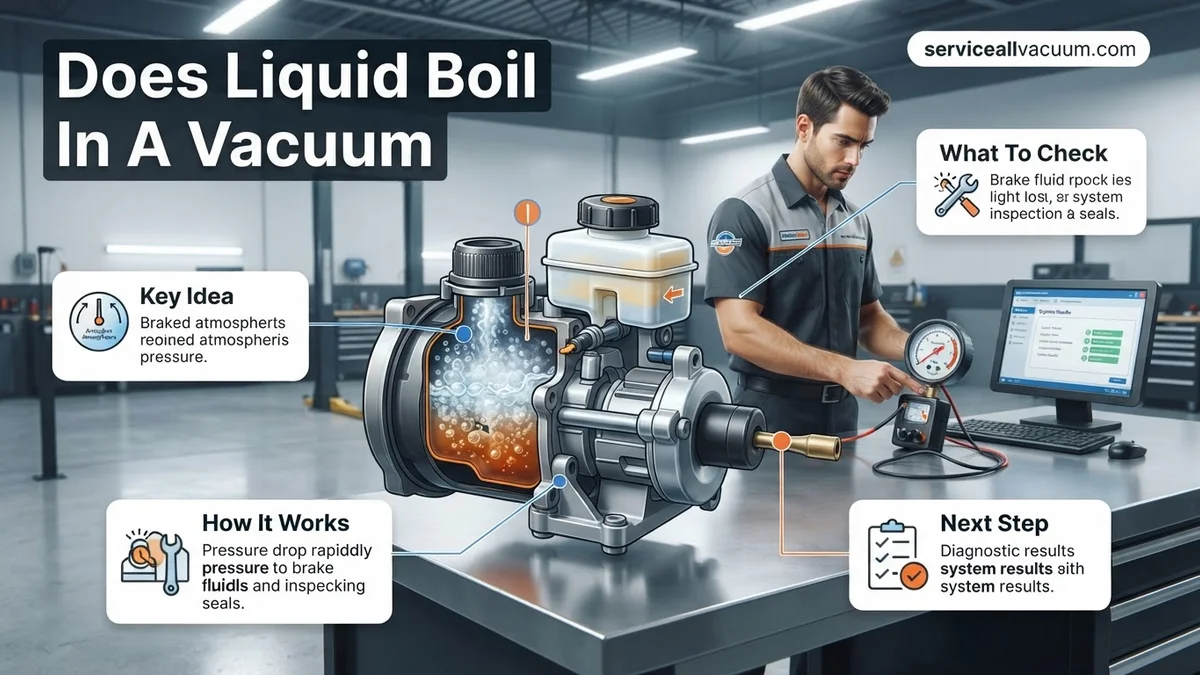
Boiling has very little to do with high temperatures. Instead, it is a delicate battle between two competing forces: the vapor pressure of the liquid trying to push outward, and the ambient atmospheric pressure pushing down.
Vapor Pressure Versus Ambient Pressure
At standard sea-level conditions, ambient pressure is roughly 101.3 kilopascals (kPa). Water molecules need a temperature of 100 degrees Celsius to generate enough vapor pressure to overcome that heavy atmospheric weight.
- Ambient pressure drops to near zero inside a sealed vacuum chamber.
- Water at room temperature (20 degrees Celsius) has a vapor pressure of about 2.3 kPa.
- Because 2.3 kPa is vastly higher than near-zero ambient pressure, the liquid instantly flashes into vapor.
Why Temperature Is Not the Primary Driver
You can make room-temperature water boil simply by dropping the external pressure below its vapor point. As the liquid rapidly changes phase, it absorbs heat energy from its immediate surroundings.
- The remaining liquid drops sharply in temperature due to evaporative cooling.
- Within minutes in a true vacuum, the boiling liquid can actually freeze solid.
- This simultaneous boiling and freezing is a staple demonstration in advanced thermodynamics laboratories.
How to Test and Observe Vacuum Boiling Safely
Observing this physics principle firsthand requires strict adherence to safety protocols. Industrial and educational setups in 2026 rely on transparent acrylic vacuum chambers to protect operators from implosion hazards and flying debris.
Essential Equipment and Preparation
If you are setting up a demonstration for educational purposes, you must use rated materials that can handle severe pressure differentials.
- Use a heavy-duty, rated acrylic or polycarbonate bell jar rather than standard glass.
- Employ a dual-stage rotary vane vacuum pump capable of reaching sub-torr pressures.
- Always use warm or room-temperature water instead of boiling water to clearly show the non-thermal boiling effect.
Step-by-Step Observation Protocol
Place a small beaker of water inside the chamber on a flat, stable surface. Turn on your vacuum extraction unit and watch the pressure gauge drop steadily.
- Between 20 and 30 kPa, you will notice dissolved gases escaping as tiny bubbles.
- As pressure drops below 2.3 kPa, vigorous, rolling boiling begins instantly without any external heat source.
- Monitor the water temperature with an infrared probe to watch it plummet as the boiling intensifies.
What If the Liquid Still Doesn’t Boil Properly
When placing a liquid into a high-vacuum chamber, the expected rapid boiling sometimes fails to occur instantly. Thermodynamics dictates that a liquid requires a nucleation site to transition from a liquid phase to a gas phase. Without microscopic imperfections or dissolved gases to form vapor bubbles, the liquid can undergo superheating. This state occurs when a liquid is heated above its boiling point without actually boiling, creating a volatile condition that can violently flash-boil when disturbed.
Troubleshooting the Vacuum Boiling Process
If the liquid remains stubbornly stable inside the low-pressure environment of a 2026 laboratory or industrial setup, systematic adjustments are necessary. Follow these precise operational steps to induce phase change safely and effectively:
- Verify the chamber pressure levels: Consult your digital or analog vacuum gauge to ensure the internal pressure has dropped significantly below the specific vapor pressure of the target liquid.
- Introduce physical nucleation sites: Drop a chemically inert boiling chip or a clean glass bead into the container to disrupt surface tension and encourage bubble formation.
- Apply gentle external thermal energy: Increase the ambient or container temperature slightly to supply the latent heat of vaporization required for the phase change.
- Gently agitate the vessel: Use a remote mechanical shaker or magnetic stirrer to physically trigger bubble nucleation within superheated liquid layers.
When to Seek Professional Intervention
Persistent failures in achieving vacuum boiling usually point to equipment limitations rather than chemical anomalies. If standard vacuum pumps fail to reach the necessary threshold, or if pressure seals continuously leak, equipment overhaul becomes mandatory.
According to industrial equipment maintenance standards, professional technician diagnostics range from $250 to $600 depending on pump complexity. Complete vacuum chamber recalibration or rotary vane replacement services typically cost between $800 and $2,200 in 2026. Consult certified thermodynamic engineers when handling volatile or hazardous fluids under extreme pressures.
Conclusion
Liquid does indeed boil in a vacuum, often at room temperature, because reduced atmospheric pressure drastically lowers the required vapor pressure threshold. While superheating can occasionally delay this thermodynamic reaction, introducing nucleation sites or lowering pressure further resolves the issue. According to verified research and expert sources in fluid mechanics, mastering this phase behavior remains essential for modern industrial and laboratory applications. To apply these insights safely, verify your system pressure ratings today and consult certified engineering guidelines before scaling up vacuum processes.
❓ Frequently Asked Questions
Does liquid boil in a vacuum at room temperature?
Yes, liquids boil at room temperature in a vacuum because boiling is a function of pressure. Lowering the external pressure below the liquid’s vapor pressure triggers immediate boiling without adding heat.
Why does boiling occur when pressure is lowered?
Boiling happens when molecules gain enough energy to break free from the liquid state into a gas. Removing air pressure removes the physical barrier holding those molecules down, allowing them to escape easily.
Can water freeze and boil at the same time in a vacuum?
Yes, the triple point phenomenon can occur. As water rapidly boils and evaporates under extreme vacuum, it loses heat so fast that the remaining liquid freezes into ice while still bubbling.
How does altitude affect the boiling point of liquids?
Higher altitudes have lower atmospheric pressure, meaning water boils at a lower temperature than it does at sea level. A vacuum is simply the extreme limit of this pressure drop.
What happens to oil in a vacuum?
Oils and other viscous liquids will also boil or outgas in a vacuum, though high-viscosity or heavy oils have very low vapor pressures and require a stronger vacuum to bubble.
Is boiling in a vacuum the same as thermal boiling?
The physical result is the same—liquid turning into gas—but thermal boiling is driven by increasing the liquid’s temperature, while vacuum boiling is driven by decreasing the external pressure.