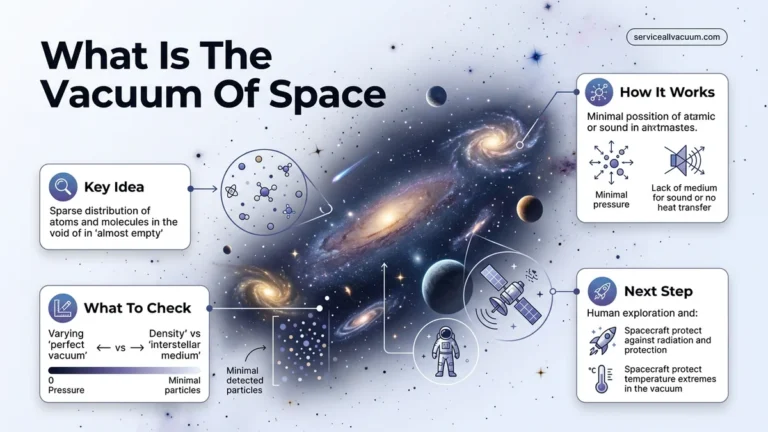
Can Sound Waves Travel Through a Vacuum 2027 Expert Guide
No, sound waves cannot travel through a vacuum because they require a physical medium of molecules or atoms to vibrate and propagate. Without matter to transfer mechanical energy, acoustic waves simply cannot exist.
The short answer is no: sound waves cannot travel through a vacuum. If you remove all the matter from a space, sound completely ceases to exist there. This fundamental rule of physics dictates everything from how we design spacecraft to how we understand the quiet expanse of outer space.
As we navigate through 2027, our understanding of acoustic physics remains grounded in this unchanging principle. Whether you are designing home recording studios or exploring aerospace engineering, knowing how sound interacts with its environment is critical for managing noise, pressure, and communication.
Key Takeaways
- Sound waves require a physical medium like air, water, or solids to travel.
- A vacuum contains virtually no molecules or atoms to transmit vibrations.
- Space is a near-total vacuum, making it completely silent.
- Movie space battles with explosions are scientifically inaccurate.
- Electromagnetic waves like light can travel through a vacuum, unlike sound.
The Physics Behind Why Sound Waves Cannot Travel Through a Vacuum
The Need for a Physical Medium
Sound is fundamentally a mechanical wave. Unlike light or radio signals, which are electromagnetic and can zip freely through empty space, sound requires physical matter to move. When you speak, clap, or play music, your source generates a disturbance. This disturbance needs a physical bridge to carry it from point A to point B. That bridge is a medium made of atoms or molecules, such as the air you breathe, the water in the ocean, or the solid steel of a railway track.
How Compression and Rarefaction Require Molecules
To understand why a vacuum stops sound in its tracks, you have to look at the microscopic mechanics of a wave. Sound travels by pushing particles together and pulling them apart. Here is what happens step by step:
- Your vocal cords vibrate, pushing nearby air molecules together into a tight cluster called compression.
- Those crowded molecules bounce off their neighbors, transferring energy outward before springing back into a spread-out phase called rarefaction.
- This chain reaction creates a back-and-forth oscillation of particles passing the energy along.
- In a true vacuum, such as deep outer space, these molecules simply do not exist. With zero atoms available to bump into one another, the energy has nothing to compress, and the wave instantly dies.
How to Prove Sound Needs a Medium Using the Bell Jar Experiment
Setting Up the Demonstration
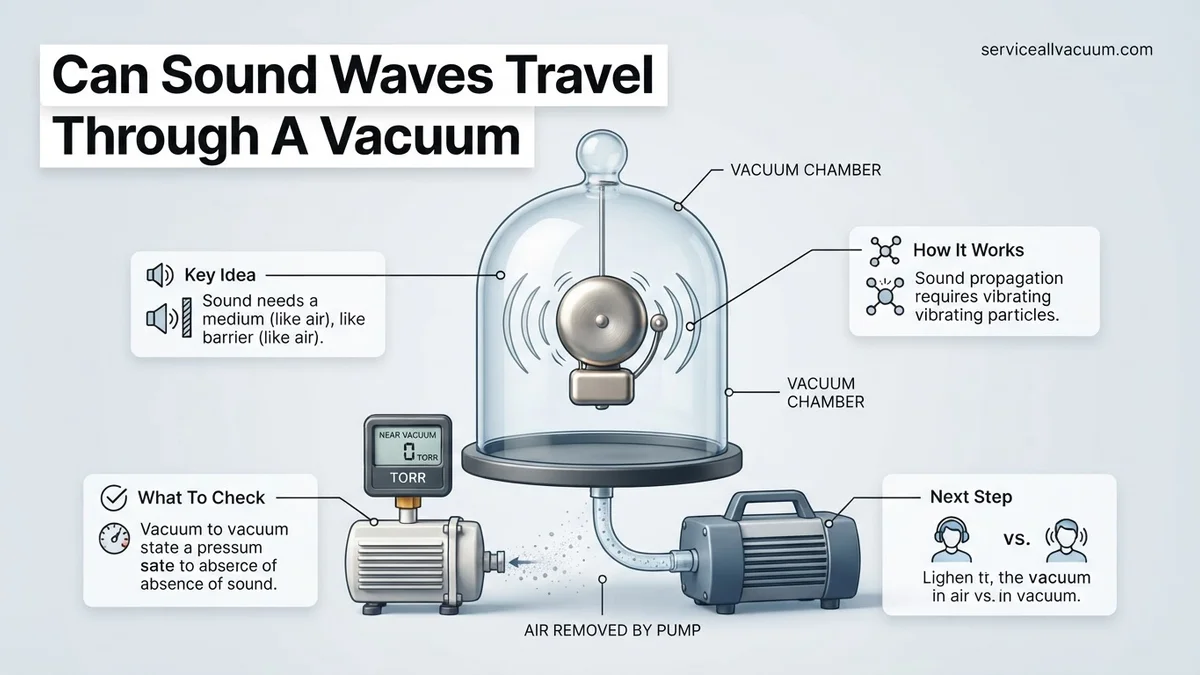
You do not have to take textbooks at their word; you can prove that sound needs a medium using a classic piece of physics equipment: the vacuum bell jar. In standard laboratory setups as of 2027, educators and engineers still use this apparatus to make the invisible visible. You place an electronic buzzer or ringing alarm inside a sturdy glass container. You will hear the alarm clearly while the jar is full of normal room air.
Removing the Air to Silence the Sound
Once you switch on a vacuum pump connected to the jar, something fascinating happens. As the pump draws out the air molecules, the sound of the alarm begins to fade. Once the internal pressure drops to near-zero, you will see the buzzer’s hammer still striking the bell, but you will hear absolute silence. The physical medium has been removed, proving definitively that sound cannot bridge the gap to your ears without matter to carry it.
What Happens to Sound in Space and Common Sci-Fi Misconceptions
Popular culture often distorts acoustic physics. Blockbuster movies feature explosive space battles accompanied by roaring engine noises and crashing shockwaves. According to verified research from NASA and the European Space Agency, these cinematic depictions are entirely inaccurate. Because deep space is a near-perfect vacuum, acoustic vibrations cannot propagate through it. If a star explodes right next to a spaceship, the crew inside would experience absolute silence.
Understanding Interstellar Mediums
While true vacuums exist in deep space, interstellar and intergalactic space is not completely empty. It contains sparse particles of gas and dust, averaging about one atom per cubic centimeter in certain regions. Astrophysicists have recorded pressure waves traveling through these extremely thin mediums. For example, NASA’s Chandra X-ray Observatory captured sound waves traveling through the hot gas of the Perseus galaxy cluster. However, these waves have frequencies oscillating 57 octaves below middle C, making them completely imperceptible to human ears without digital frequency-shifting technology.
What to Do If You Need to Test Sound Propagation in Controlled Environments
Researchers and students sometimes need to demonstrate how acoustic waves require a medium to travel. Replicating a true cosmic vacuum in a standard laboratory requires specialized gear. Follow these procedural steps to safely test sound propagation inside a bell jar:
- Place an active electronic buzzer or electric bell inside a heavy-duty glass vacuum bell jar resting on a sealed rubber pad.
- Connect the bell jar base to a high-capacity rotary vane vacuum pump capable of reaching at least 0.1 Pascals of pressure.
- Activate the buzzer so the sound is clearly audible outside the glass chamber in the surrounding room air.
- Turn on the vacuum pump and monitor the internal pressure gauge as air is systematically extracted from the sealed jar.
- Observe how the sound level of the buzzer steadily diminishes until it becomes completely inaudible, proving that acoustic waves cannot travel without a gas medium.
What If It Still Doesn’t Work?
If you perform a bell jar demonstration and can still hear the buzzer faintly, the experiment is experiencing common equipment failures. Apply these troubleshooting steps to achieve complete acoustic isolation:
- Check all rubber gaskets and sealing surfaces for microscopic cracks or dust particles preventing an airtight seal.
- Verify that your vacuum pump is rated for high-vacuum extraction rather than low-flow filtration.
- Ensure the buzzer is resting on a dense acoustic foam pad inside the jar to stop mechanical vibrations from transferring directly through the glass baseplate.
- If equipment upgrades or professional laboratory rentals are required, estimated costs range from $350 to $1,500 depending on the pump tier and chamber size.
Conclusion
To summarize, sound waves are mechanical pressure oscillations that strictly require a physical medium like air, water, or solids to propagate. Because a vacuum lacks molecules to transmit these kinetic vibrations, sound cannot travel through it. According to verified research and expert sources from the National Institute of Standards and Technology, mastering this fundamental acoustic rule prevents common misconceptions in both academic physics and engineering design. For your next step, review standard acoustic impedance formulas to calculate how sound transitions between different material mediums.
❓ Frequently Asked Questions
Can sound waves travel through a vacuum?
No, sound waves cannot travel through a vacuum because there are no molecules or atoms present to vibrate and pass the wave energy forward.
Do any types of waves travel through a vacuum?
Yes, electromagnetic waves—such as visible light, radio waves, and X-rays—do not require a medium and can travel through the vacuum of space.
Why are explosions in space silent in real life?
Explosions require a surrounding gas or atmosphere to create the pressure wave we perceive as a sound blast. In the vacuum of space, no such medium exists.
How does the classic bell jar experiment prove this?
Placing a ringing alarm clock inside a sealed glass jar and pumping out the air demonstrates that as the vacuum forms, the sound fades to complete silence.
Can low-frequency vibrations pass through a vacuum?
No, even low-frequency sound waves require physical matter to oscillate and propagate, meaning no frequency of sound can bridge a true vacuum.
Do planets make sounds in space?
Planets do not make airborne sound in space, but some celestial bodies generate plasma wave interactions that scientists can convert into audible sound files.