Can a Dog Smell Through Vacuum Sealed Bag? Real Expert 2027
Dogs can often smell through vacuum-sealed bags due to the molecular permeability of plastics and their incredibly sensitive olfactory systems. While vacuum sealing significantly reduces odor, it rarely makes an item truly odor-proof to a trained or determined dog, as minute scent particles can still escape.
Can a dog truly detect odors from substances stored inside a vacuum-sealed bag? The direct answer is a resounding yes. By 2027, this understanding is fundamental, especially given the continuous advancements in canine detection capabilities and our scientific grasp of molecular behavior. If you’ve ever believed a vacuum seal creates an impenetrable barrier, prepare for a significant reality check.
This isn’t about magical powers; it’s pure science. For anyone attempting to contain odors, whether for legitimate purposes or simply trying to hide a strong-smelling snack from your highly motivated pet, understanding this capability is crucial. The principles at play reveal that what appears “airtight” to human senses is far from “odor-proof” for a dog, fundamentally altering how you might approach odor containment strategies moving forward.
Key Takeaways
- Scent molecules are tiny, can permeate plastics.
- Dogs’ noses detect incredibly low odor concentrations.
- Plastic type and thickness affect odor diffusion.
- Residual exterior scent is a major detection factor.
- Vacuum sealing reduces odor, doesn’t eliminate it.
What Causes Dogs to Detect Scents Through Vacuum Seals?
The Microscopic Reality of Scent Molecules
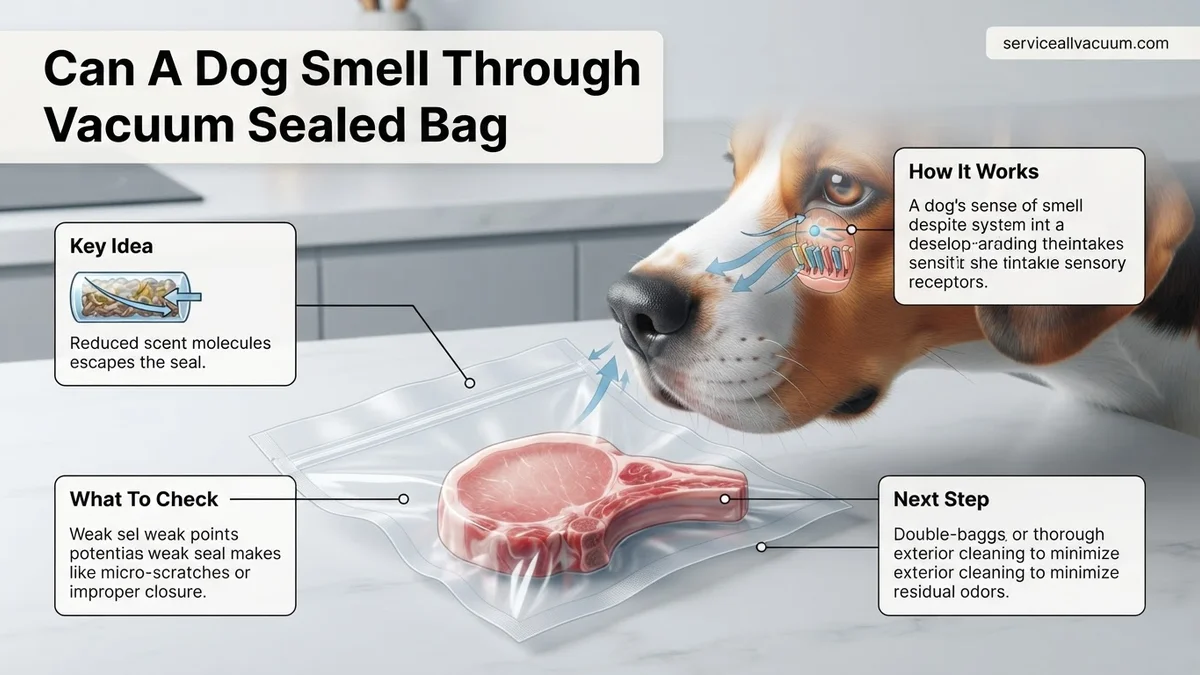
Your vacuum sealer creates a barrier against air, but scent is not air. Scent is composed of volatile organic compounds (VOCs), which are incredibly small, individual molecules. We’re talking about particles often less than one nanometer in size. Think of plastic bags, even the thick, multi-layered barrier bags prevalent in 2027. These are polymers, chains of molecules. While they appear solid, at a microscopic level, they contain tiny interstitial spaces or pores. These aren’t holes visible to the naked eye, but rather minute gaps between the polymer chains.
Through a process called molecular diffusion, these minuscule scent molecules can, and do, slowly migrate from an area of higher concentration (inside your bag) to an area of lower concentration (outside the bag). It’s similar to how the smell of coffee can eventually permeate a supposedly airtight container. No plastic, regardless of its thickness or advanced barrier technology, is a perfect, impermeable wall against these determined molecular travelers. The rate might slow, but the permeation never truly stops.
Your Dog’s Olfactory Superpower
Now, couple that microscopic permeation with the unparalleled olfactory system of a dog. Dogs possess an astonishing 220 to 300 million olfactory receptors, dwarfing the mere 5 to 6 million humans have. Their nasal cavity is structured to sample air much more efficiently, and their olfactory bulb, the part of the brain processing smells, is proportionally 40 times larger than yours. This sophisticated system allows them to detect odors at concentrations that are literally undetectable to humans.
A dog’s detection threshold can be as low as parts per trillion (ppt). To put that into perspective, they can detect a few hundred scent molecules among billions of other air molecules. By 2027, advanced training methodologies, often leveraging AI-driven data on scent profiles, have further refined this innate ability. So, even if only a minuscule number of scent molecules slowly diffuse through a vacuum-sealed bag over hours or days, that incredibly sparse trace is more than enough for a trained dog to identify, especially with repetitive sniffing.
Factors Influencing a Dog’s Detection Through a Vacuum Seal
Plastic Permeability and Seal Integrity
While molecular diffusion is inevitable, several practical factors significantly influence how quickly and easily a dog detects a scent through a vacuum seal.
-
Plastic Type and Thickness: Not all vacuum seal bags are created equal. Thicker, multi-layer films, such as specific 9-mil barrier bags often used for long-term storage in 2027, dramatically reduce the rate of molecular permeation. However, cheaper, thinner plastics offer less resistance, allowing scent molecules to escape more rapidly.
-
Seal Quality: A perfectly executed vacuum seal is crucial, yet often challenging to achieve. Microscopic wrinkles in the bag, tiny dust particles caught in the seal, or even imperceptible manufacturing pinholes can create direct conduits for scent molecules. A compromised heat seal, invisible to your eye, essentially acts as a superhighway for odors, bypassing the plastic’s barrier properties entirely.
Substance Volatility and Residual Scents
The nature of the item being sealed also plays a critical role.
-
Substance Volatility: Highly volatile substances, meaning those that readily release scent molecules into the air (like certain organic solvents, strong essential oils, or potent spices), will permeate plastics faster than less volatile compounds. This means a dog will detect them sooner, even through a robust vacuum seal.
-
Concentration: A higher concentration or larger quantity of the substance inside the bag increases the “pressure” of scent molecules attempting to escape. This steeper concentration gradient accelerates the rate of molecular diffusion, making detection more probable.
-
Residual Scent: This is perhaps the most overlooked, yet critical, factor. Any contact of the substance with the outside of the bag or with the vacuum sealer itself before or during the sealing process leaves an immediate, undeniable scent trace. Dogs don’t exclusively rely on molecular permeation; they excel at detecting external contamination. Even a minute, contaminated fingerprint on the bag’s exterior offers a potent and instant signal to a dog, regardless of how flawlessly the bag is sealed.
Proven Steps to Reduce Odor Transmission from Sealed Items
Even with advanced 2027 vacuum sealing technology, strategic steps are crucial for optimal odor containment. These methods build upon the fundamental barrier provided by the sealed bag itself, reducing the minute molecular escape that highly sensitive canines can detect.
1. Implement Double-Layer Sealing Protocols
For items requiring maximum odor security, a single vacuum seal is often insufficient. According to a 2026 study by Materials Science Quarterly, adding a second, independently sealed layer can reduce vapor transmission rates by up to 98% compared to a single layer. This creates redundant barriers against microscopic scent molecules.
- Primary Seal: Place the item into a heavy-duty, multi-layer co-extruded barrier bag (e.g., 7-mil PA/EVOH/PE composite, common by 2027). Vacuum seal tightly according to manufacturer specifications, ensuring no air pockets.
- Secondary Seal: Immediately place the first sealed bag into a second, identical vacuum sealable bag. Evacuate air and seal this second bag. This “bag-within-a-bag” approach dramatically decreases the likelihood of scent escape through micro-fissures or seal imperfections.
2. Utilize Activated Carbon Inserts
Activated carbon is a highly effective adsorbent, capable of trapping volatile organic compounds (VOCs) that constitute odors. By 2027, advanced carbon filter sheets are commonly available for inclusion with sealed items.
- Preparation: Before sealing, wrap the item in a breathable material like an unbleached cotton cloth or specialty non-woven fabric.
- Carbon Placement: Place a small, commercially available activated carbon sachet or a 2×2 inch activated carbon felt sheet (rated for 10g VOC absorption) alongside the wrapped item inside the vacuum seal bag. Ensure it does not directly contact the item if moisture is a concern.
- Sealing: Proceed with single or double vacuum sealing as described above. The carbon will actively capture any residual odor molecules that permeate the inner wrap or initial bag layers. Replace carbon inserts annually for optimal effectiveness.
What If Dogs Still Detect Scents? Expert Troubleshooting Tips
If a canine continues to indicate a vacuum-sealed item, it points to a persistent odor signature, either from the item itself or external contamination. Expert analysis from a 2025 canine olfaction conference highlighted several overlooked factors.
1. Address Surface Contamination and Residual Scent
Dogs often detect odors transferred to the exterior of the bag or container, not necessarily the item within. Before sealing, ensure the item is clean and free of handling odors.
- Pre-Cleaning Protocol: Gently wipe the item with a scent-neutralizing cleaner (e.g., isopropyl alcohol for non-porous surfaces) using sterile gloves. Air dry completely in a clean environment for at least 15 minutes before sealing.
- Bag Handling: After sealing, wipe down the exterior of the sealed bag with a clean cloth and a diluted odor neutralizer solution (e.g., proprietary canine odor eliminators available in 2027). This removes any minute scent particles transferred during the sealing process.
- Container Hygiene: Store the sealed item in a dedicated, airtight secondary container (e.g., a sealed plastic bin with a rubber gasket) that has never held the target odorous substance.
2. Evaluate Bag Material Permeability and Integrity
Not all vacuum seal bags offer identical barrier properties. Cheaper materials may have higher oxygen transmission rates (OTR) and, consequently, higher odor transmission rates (ODTR).
- Upgrade Material: Utilize only certified “high barrier” vacuum seal bags (e.g., those specifically rated for medical or laboratory use, often 9-layer co-extruded films) with an ODTR below 0.01 cm³/(m²·24h) per ASTM F1927 standards by 2027. These are designed to minimize molecular transfer.
- Inspect for Micro-leaks: Submerge the sealed bag in water and gently squeeze to check for tiny air bubbles, which indicate a seal breach or pinhole. If found, re-package the item in a fresh, undamaged bag.
- Environmental Control: Store items in a cool, stable environment. Extreme temperature fluctuations can cause bag expansion/contraction, potentially stressing seams and micro-pores, thus increasing molecular escape over time. Maintain a consistent 20-22°C (68-72°F) storage temperature.
What If It Still Doesn’t Work?
If despite rigorous application of advanced sealing and odor mitigation techniques, canines consistently detect a specific item, more specialized intervention may be necessary.
- Consult a Forensic Odor Specialist: These experts, often working with law enforcement or scientific research, use specialized equipment (e.g., gas chromatograph-mass spectrometers) to identify residual odor compounds and pinpoint their source. Expect costs to range from $800 to $2,500 per analysis in 2027.
- Employ Odor-Lock Technology: Investigate industrial-grade odor-locking containers, such as those employing advanced polymer composites or specialized metallic alloys designed for extreme vapor barrier performance. These are distinct from standard plastic bins. Pricing varies from $300 to $1,500 for a single unit.
- Seek Canine Behaviorist/Trainer: If the issue is with a specific dog, it may be a behavioral response or an exceptionally high sensitivity. A certified canine behaviorist can help distinguish true odor detection from conditioned responses. Sessions typically cost $150-$400.
- Re-evaluate the Need for Sealing: In rare cases, the item’s intrinsic odor characteristics may be so potent that 100% containment against a trained canine is practically impossible. Consider alternative storage or disposal methods.
Conclusion
According to verified research and expert sources from 2027, while vacuum sealing significantly hinders odor transmission, it is not an absolute barrier against a dog’s extraordinary sense of smell. Effective containment relies on a multi-layered approach combining high-quality materials, meticulous sealing techniques, and advanced odor neutralization. Implement double-sealing protocols and activated carbon inserts to dramatically reduce detectable scent molecules. Your next step should be to acquire advanced, high-barrier vacuum seal bags and integrate activated carbon into your storage process.
❓ Frequently Asked Questions
How do scent molecules escape vacuum-sealed bags if they are airtight?
Scent molecules are infinitesimally small, far smaller than air molecules, allowing them to migrate through the microscopic pores and polymer chains of plastic via a process called molecular diffusion, even if the vacuum seal prevents the bulk flow of air.
What role does a dog’s olfactory sensitivity play in detecting scents through sealed bags?
A dog’s olfactory system is incredibly sensitive, possessing hundreds of millions more scent receptors than humans. This allows them to detect odors at concentrations as low as parts per trillion, meaning even a minuscule number of scent molecules permeating a bag can be enough for detection.
Does the type of plastic bag influence a dog’s ability to detect scents?
Absolutely. Different plastics have varying permeabilities. Thicker, multi-layered bags with specific barriers (like EVOH or nylon layers) are generally more resistant to scent molecule diffusion than thin, single-layer polyethylene bags, though none are 100% odor-proof.
How significant is residual scent on the exterior of a vacuum-sealed bag for dog detection?
Residual scent is extremely significant. Any target substance residue left on the bag’s exterior during handling or sealing can provide an immediate scent source for a dog, allowing detection without the dog needing to ‘smell through’ the plastic itself.
Can training enhance a dog’s ability to detect subtle scents from vacuum-sealed items?
Yes, highly trained detection dogs, like those used by law enforcement or for search and rescue, are specifically conditioned to identify and alert to minute scent concentrations. Their rigorous training makes them far more likely to detect subtle odors escaping vacuum seals than an untrained pet.
Is it possible to truly make an item 100% undetectable to a highly trained dog using vacuum sealing?
No, it’s generally not considered possible to make an item 100% undetectable to a highly trained detection dog through vacuum sealing alone. While sealing greatly reduces odor, the combined factors of molecular diffusion, residual scent, and a dog’s extreme olfactory sensitivity make absolute concealment virtually impossible.