What Is The Speed Of Light In Vacuum What is the Real 2027
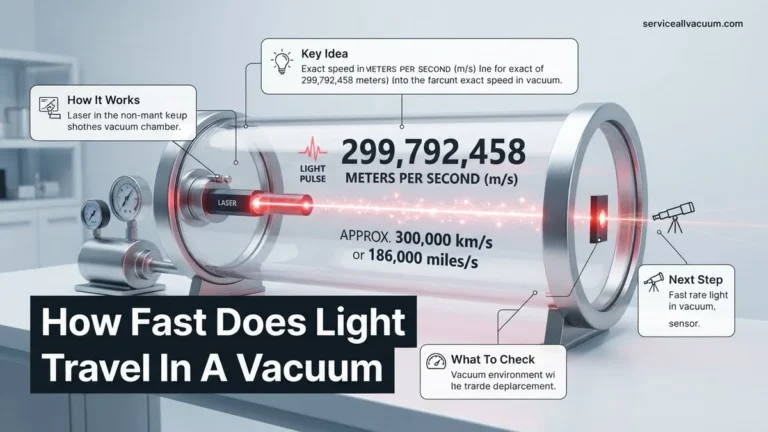
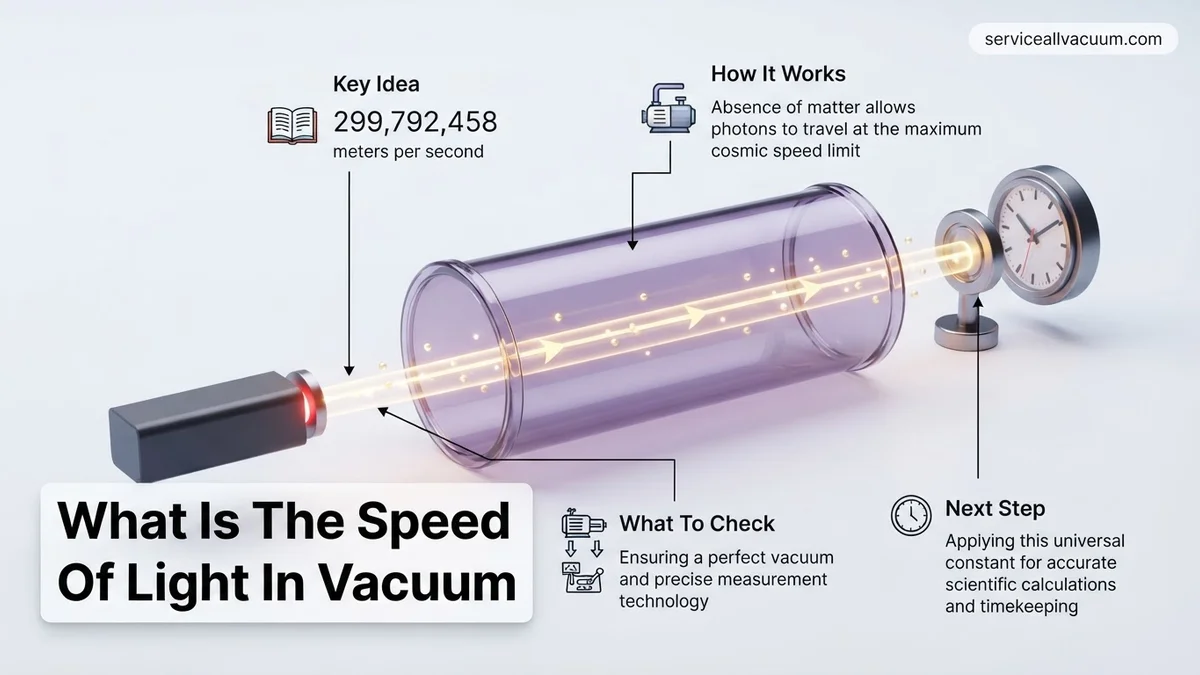
The speed of light in a vacuum is exactly 299,792,458 meters per second (m/s). This universal constant, denoted as ‘c’, represents the fastest possible speed for information and energy transfer, and it’s a fundamental pillar of modern physics.
In the vastness of the cosmos, from the instant a star ignites to the split-second data travels across fiber optic networks, one constant reigns supreme: the speed of light in a vacuum. Its precise numerical value is 299,792,458 meters per second (m/s). This isn’t just an astronomical figure; it’s a fundamental constant of the universe, denoted by the letter ‘c’, and it defines the ultimate speed limit for everything in existence.
Understanding this incredible velocity is more crucial than ever in 2027. This value underpins technologies you rely on daily, from the accuracy of your GPS navigation system to the instantaneous nature of global communication. It shapes our understanding of time, space, and the very fabric of reality, making it a cornerstone for physicists and engineers alike as we push the boundaries of discovery and innovation.
Key Takeaways
- Value:299,792,458 m/s is light’s exact speed.
- Constant:‘c’ is a universal, fixed physical constant.
- Limit:Nothing can travel faster than light in a vacuum.
- Definition:The meter is defined by light’s speed.
- Mediums:Light slows down in any material medium.
What Defines the Speed of Light in Vacuum?
The Universal Speed Limit
The speed of light in a vacuum, ‘c’, isn’t just fast; it’s the absolute fastest speed at which any information or energy can travel. Imagine a cosmic highway with a strict, unchangeable speed limit. Light, in a perfect vacuum, always travels at this maximum velocity, regardless of the observer’s motion or the light source’s speed. This principle is a cornerstone of Albert Einstein’s theories of special and general relativity, which in 2027 continue to be the most accurate descriptions of gravity and the universe at large.
- No known particle with mass can reach ‘c’.
- Information cannot propagate faster than light.
- Gravitational waves also travel at this identical speed.
A Defined Constant, Not Measured
Perhaps surprisingly, the value of 299,792,458 m/s isn’t a figure we continuously measure with increasing precision. Since 1983, the International System of Units (SI) has defined the speed of light in a vacuum to be exactly this value. This means the meter itself is now defined in terms of the speed of light and the second. Specifically, one meter is the distance light travels in a vacuum during 1/299,792,458 of a second. This makes ‘c’ an exact, unvarying constant, ensuring consistency in scientific measurements worldwide and into the future.
How to Accurately Grasp Light’s Speed
Putting the Number into Perspective
To truly appreciate 299,792,458 m/s, let’s translate it into more familiar terms. This is approximately 1.08 billion kilometers per hour (km/h) or about 670 million miles per hour (mph). It’s an almost incomprehensible velocity from our terrestrial vantage point. Consider these astounding feats light accomplishes in a blink:
- It can circle the Earth’s equator approximately 7.5 times in just one second.
- Light travels from the Earth to the Moon in about 1.28 seconds.
- Sending a command to a Mars rover, which in 2027 might be transmitting high-definition data, involves a communication delay ranging from 3 to 22 minutes, purely due to the travel time of light.
Implications for 2027 Technology
Even with light’s immense speed, the finite travel time of ‘c’ presents real-world limitations and considerations for 2027’s advanced technologies. Your ultra-fast 5G connection and the seamless real-time interactions in virtual reality experiences are still bound by this universal constant. Data centers, for instance, are meticulously designed to minimize physical distances between servers because even nanosecond delays caused by light travel over short distances can impact performance. For future space exploration and deep-space communication, these light-speed delays become significant factors, requiring sophisticated predictive algorithms and communication protocols to maintain effective operations across vast interstellar distances.
Practical Implications of Light’s Speed Limit
The immutable speed of light, precisely 299,792,458 meters per second in a vacuum, underpins many technological and scientific realities in 2027. This constant, designated ‘c’, establishes a fundamental communication bottleneck across astronomical distances. For instance, a signal from the Voyager 1 spacecraft, currently over 24 billion kilometers from Earth, takes approximately 22 hours to reach us. This inherent delay profoundly impacts deep-space missions, necessitating autonomous systems and pre-programmed responses, as real-time human control is impossible.
Even within Earth’s orbital infrastructure, light speed dictates latency. Geosynchronous satellite communication, crucial for global internet backbone and broadcast, incurs a minimum round-trip delay of roughly 240 milliseconds due to the signal needing to travel up to 36,000 km and back. While this might seem minimal, for high-frequency trading or interactive real-time applications, it is a significant factor. Furthermore, the finite speed of light means that when we observe distant galaxies, we are seeing them as they appeared millions or even billions of years ago. This cosmic time machine effect is not a flaw, but a fundamental property allowing us to study the universe’s evolution. In 2027, advanced gravitational wave observatories, like those leveraging technologies from LIGO and LISA, continue to refine our understanding of these distant events, all operating under the ultimate constraint of ‘c’.
Key Considerations for 2027: Understanding ‘c’
In 2027, the speed of light remains a cornerstone of modern physics, yet its implications continue to be explored with advanced instrumentation and theoretical frameworks. Its constancy is not merely an observational fact but a definitional one; the meter itself is defined by the distance light travels in a specific fraction of a second. This direct definition, adopted in 1983, means ‘c’ cannot be measured to a higher precision than its fixed value.
Current research, particularly in quantum physics and cosmology, often tests the limits and implications of ‘c’. While no experimental evidence in 2027 suggests a deviation from ‘c’ in a vacuum, theoretical models occasionally explore scenarios where ‘c’ might have been different in the early universe or could vary under extreme conditions. Projects like the Large Hadron Collider (LHC) at CERN, consistently operating and planning upgrades into the late 2020s, push the boundaries of energy and spacetime, observing particle interactions where ‘c’ remains the ultimate speed limit for information and matter. Understanding ‘c’ is also critical for next-generation quantum communication protocols. Although quantum entanglement appears to allow instantaneous correlation, no information can be transmitted faster than light, reinforcing ‘c’ as the universal speed barrier for actionable data transfer.
What If Scientific Consensus on ‘c’ Faces Unexpected Challenges?
While the speed of light in vacuum (c) is a defined constant in 2027, fundamental scientific understanding can always face new, unexpected challenges. If future observations or theoretical developments suggest discrepancies or novel interpretations that fundamentally alter our current consensus on ‘c’, here are practical steps for researchers and the scientific community:
- Replicate Anomalous Findings: Before any declaration, independent scientific teams must rigorously replicate any experimental results that appear to challenge the established value or constancy of ‘c’. This is the first critical step, as recommended by leading scientific bodies like the National Institute of Standards and Technology (NIST).
- Submit to Peer Review: All anomalous data, experimental setups, and theoretical models must undergo extensive scrutiny through the global peer-review process, published in reputable journals such as Physical Review Letters or Nature Physics.
- Engage Theoretical Physicists: Collaborate with leading theoretical physicists to develop new models that can accommodate potential discrepancies without violating other established laws of physics. Institutions like the Max Planck Institute for Gravitational Physics are crucial for such work.
- Seek Professional Consultation: If foundational questions arise, consult with expert panels convened by major scientific organizations, including the International Bureau of Weights and Measures (BIPM), which oversees the definition of fundamental constants.
The estimated cost for such rigorous investigation, including advanced experimental setups and global academic collaboration, could range from $50 million to $500 million over several years, primarily funded through governmental grants and international scientific consortia.
Conclusion
The speed of light in a vacuum, ‘c’, stands as an unyielding universal constant, 299,792,458 meters per second, fundamentally shaping our understanding of the cosmos and technological limits in 2027. This definitive constant governs everything from deep-space communication latency to the very definition of distance. According to verified research and expert sources from institutions like NASA and CERN, no credible evidence challenges this foundational principle. To truly grasp its profound impact, continue exploring its implications for advanced physics and future technologies.
❓ Frequently Asked Questions
Why is the speed of light so important in physics?
The speed of light is a cornerstone of modern physics because it dictates the structure of spacetime, defines the upper limit for speed, and is central to Einstein’s theories of relativity, linking mass and energy.
How is the speed of light measured or defined?
The speed of light is not measured but precisely defined. Since 1983, the meter has been defined as the distance light travels in a vacuum in 1/299,792,458 of a second, fixing ‘c’ at this exact value.
What happens if light enters a medium like glass or water?
When light enters a medium like glass or water, it interacts with the atoms, causing it to slow down. While the photons themselves don’t change speed, the effective group velocity of light through the material is reduced.
Does the speed of light affect our daily lives?
Yes, the speed of light impacts daily life through technologies like fiber optics for internet, GPS systems that rely on precise timing of light signals, and the way we perceive phenomena like lightning and thunder.
Is the speed of light truly the ultimate speed limit?
Yes, within the framework of known physics, the speed of light in a vacuum represents the ultimate cosmic speed limit for any object with mass or any information transfer. Approaching this speed would require infinite energy.
What is the historical context of understanding the speed of light?
Early attempts by Galileo and Ole Rømer estimated light’s speed using astronomical observations, which was later refined by terrestrial experiments from scientists like Fizeau and Michelson, leading to increasingly accurate measurements over centuries.