How To Dispose Of Old Vacuum Cleaner Dispose Old 2027
Disposing of an old vacuum cleaner requires understanding local regulations and available recycling or donation programs. Never send electronics to landfills due to hazardous materials. This guide provides step-by-step instructions for responsible, eco-friendly disposal in 2027.
Getting rid of your old vacuum cleaner responsibly in 2027 involves a few clear options, ensuring its components are either reused or recycled properly. Instead of simply tossing it, you can choose between specialized electronics recycling, municipal bulky waste services, charitable donations, or retail take-back programs. Each method plays a crucial role in diverting waste from landfills and recovering valuable materials.
Making the right disposal choice matters for the environment and your community. Vacuums contain plastics, metals, and increasingly, complex electronics and powerful batteries that can be hazardous if not handled correctly. By following specific guidelines, you contribute to a circular economy and prevent potential environmental contamination, all while clearing out your space efficiently.
Key Takeaways
- Check local e-waste programs first.
- Remove batteries from cordless models.
- Consider donating working vacuums.
- Use manufacturer take-back schemes.
- Prepare vacuum by emptying and cleaning.
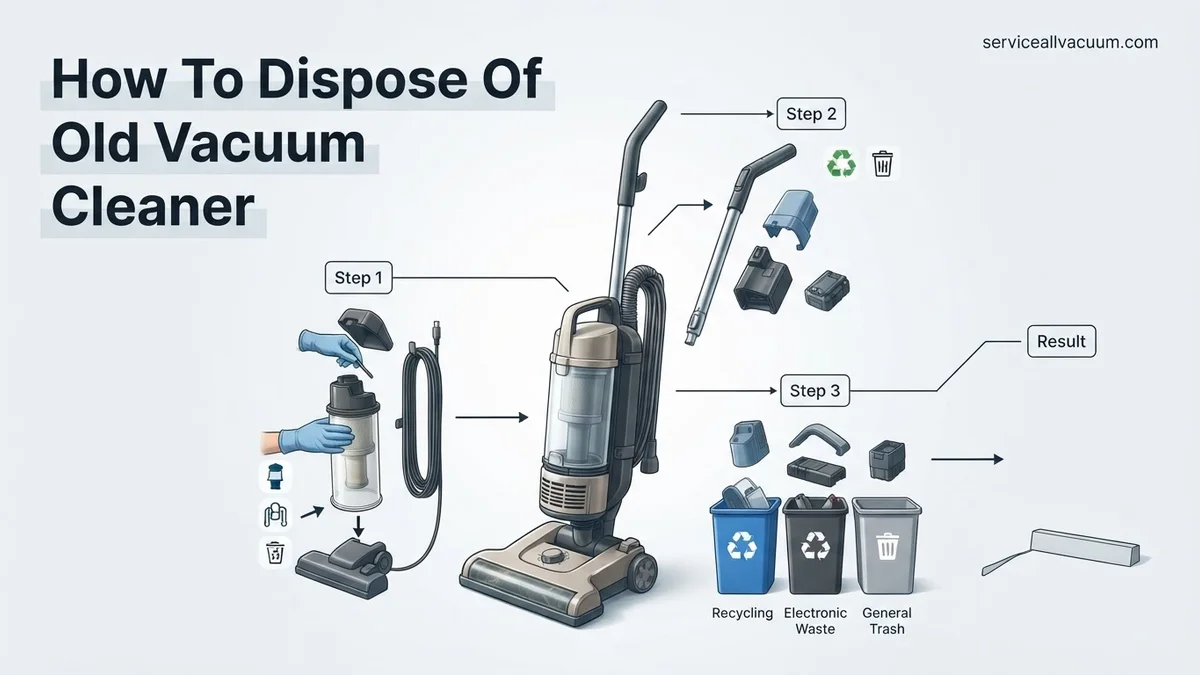
Why Improper Vacuum Disposal Causes Problems
Simply throwing an old vacuum cleaner into your regular trash can create significant environmental burdens. Modern vacuums, especially cordless models prevalent by 2027, are complex assemblies of different materials. These include various plastics, ferrous and non-ferrous metals, circuit boards, and often lithium-ion batteries. When these items end up in landfills, they do not biodegrade safely or quickly.
Environmental Impact of Landfilling
- Leaching Toxins: Batteries, particularly lithium-ion ones, can leach hazardous chemicals into soil and groundwater as they corrode in landfills. This poses risks to local ecosystems and drinking water supplies.
- Resource Waste: Valuable raw materials like copper, aluminum, steel, and recyclable plastics are permanently lost when landfilled. Extracting new virgin materials consumes more energy and creates more pollution than recycling existing ones.
- Space Consumption: Landfills are finite resources. Diverting large, durable goods like vacuum cleaners helps conserve landfill space for true non-recyclables.
Resource Recovery and Circular Economy
Responsible disposal channels, like e-waste recycling, aim to recover these valuable resources. By 2027, many regions have strengthened regulations encouraging the recycling of electronics due to their complex material makeup. This process breaks down the vacuum into its constituent parts, allowing materials to be reintroduced into manufacturing supply chains. This closed-loop system reduces the demand for new raw materials, lowers energy consumption, and minimizes waste, supporting a more sustainable future.
From Start to Finish: Bidding Farewell to Your Old Vacuum
Disposing of an old vacuum cleaner might seem straightforward, but to do it responsibly and efficiently, a little planning goes a long way. This comprehensive guide will walk you through each necessary step, from initial power disconnection and cleaning to navigating local recycling regulations and ensuring every component finds its proper destination. Following these steps helps protect our environment, ensures you comply with local waste management rules, and prevents unnecessary landfill waste of potentially recyclable materials.
Step 1: Disconnect Power and Preliminary Clean-out
What you need: Electrical outlet, rubber gloves, paper towels or cleaning rags, small dustpan and brush or handheld vacuum, regular trash can.
Instructions: Your first and most critical action is to ensure safety by completely disconnecting the vacuum cleaner from its power source. Unplug the power cord from the wall socket. Next, empty the dust bag or canister into a trash bin. If it’s a bagless model, clean the canister thoroughly with a damp cloth to remove residual dust and debris. Use a dry cloth or paper towels to wipe down the exterior surfaces, removing any loose dust, dirt, and pet hair. This initial clean-up is crucial as it prevents the spread of dust and allergens during further handling or disassembly, making the entire process more hygienic and manageable for you and anyone else who might handle the unit.
Pro Tip: Always wear rubber gloves during this initial cleaning, especially if the vacuum was used for pet hair or heavily soiled areas. Accumulated dust and debris can contain allergens, bacteria, and microscopic particles that are best handled with protective gear to avoid skin contact or inhalation.
Step 2: Thorough Internal Cleaning and Component Separation
What you need: Screwdriver set (Phillips and flathead), old newspaper or tarp, small brush or compressed air, damp cloth, dedicated container for small parts (e.g., screws).
Instructions: Lay the vacuum cleaner on a protected work surface, such as an old tarp or layers of newspaper, to contain any remaining dirt. Using the appropriate screwdrivers, carefully open any accessible compartments, such as those housing filters (HEPA, foam, pre-motor, post-motor) or the brush roll. Remove all filters and any internal bags. Detach the brush roll; this often involves releasing a simple latch or removing a few screws. Use a small brush or a can of compressed air to dislodge trapped dust, hair, and debris from these components and the internal cavities of the vacuum. As you remove parts, begin to separate them into basic material types: general plastics, metals (e.g., screws, brush roll axles), and electrical components (e.g., wires, motors).
Pro Tip: If you’re unsure how to open a specific compartment or detach a particular part, a quick online search for your vacuum’s specific model number along with “disassembly guide” or “maintenance video” can often provide helpful visual instructions, preventing accidental damage to potentially recyclable parts.
Step 3: Research Local Recycling & Waste Management Guidelines
What you need: Internet access (computer or smartphone), pen and paper for notes, phone access for your local waste department or recycling hotline.
Instructions: This step is paramount as waste disposal regulations vary significantly by municipality and region. Visit your city or county’s official waste management website or call their customer service line. Search for terms like “electronic waste (e-waste) disposal,” “small appliance recycling,” “WEEE (Waste Electrical and Electronic Equipment) recycling,” or “household hazardous waste.” You need to ascertain if they offer specific curbside pickup services for bulky items or electronics, designated drop-off locations (e.g., transfer stations, recycling centers, specialized e-waste facilities), or special collection events on certain dates. Take careful notes on any fees, preparation requirements, or restrictions regarding materials accepted.
Pro Tip: Never assume that what was recyclable in one town is recyclable in another, or that all electronics are treated the same. Directly confirming with your local authority ensures that you comply with regulations, avoids potential fines, and guarantees proper environmental handling of your old appliance.
Step 4: Assess Donation, Resale, or Repurposing Potential
What you need: Internet (local classifieds, social media marketplaces, charity websites), thorough cleaning supplies, basic repair tools (if the issue is minor and fixable).
Instructions: If your vacuum cleaner is still in functional condition, even with minor, easily repairable issues (e.g., a clogged hose, a worn-out belt, a broken attachment), consider giving it a second life. After a thorough cleaning and sanitization, explore options like donating it to local charities, community centers, or schools that might have a use for it. You could also list it for free or for a small fee on online marketplaces such as Craigslist, Facebook Marketplace, or local classifieds. Some vacuum cleaner repair shops might even accept older models for parts, extending the lifespan of other units. Clearly state the condition of the vacuum, including any minor defects.
Pro Tip: When offering an item for donation or sale, always be completely transparent about the vacuum’s condition, including any defects, missing attachments, or operational quirks. Honesty builds trust and ensures the recipient knows exactly what they are receiving, making the transaction or donation process smooth and positive for everyone involved.
Step 5: Prepare for Electronic Waste (E-Waste) Drop-off or Collection
What you need: Confirmed E-waste drop-off location or scheduled collection details, a vehicle for transport (if needed), sturdy boxes or bags for separated components.
Instructions: Based on the research completed in Step 3, gather all the electronic components of the vacuum cleaner that cannot be recycled through general metal or plastic streams. This typically includes the main motor assembly, any internal circuit boards, the power cord, and potentially any integrated rechargeable batteries (if applicable to your model). Securely package these items in a sturdy box or durable bag to prevent damage, dispersal, or entanglement during transport. If you’re utilizing a drop-off center, confirm their operating hours and any specific instructions for unloading materials. For curbside collection services, ensure items are placed according to the designated rules, such as specific collection days or labeled containers.
Pro Tip: Before making the trip, it’s always wise to briefly confirm with the e-waste facility over the phone that they indeed accept vacuum cleaner components. Some facilities have specific restrictions or size limitations, and a quick call can save you a wasted journey and help you locate the most appropriate disposal point.
Step 6: Dispose of Non-Recyclable or General Waste Components
What you need: Standard household waste bin, local recycling guidelines for general plastics.
Instructions: After carefully separating all recyclable metals, e-waste components, and any parts identified for donation or reuse, you will likely be left with various plastic housing components, heavily soiled filters that are not suitable for composting, and other non-electronic parts. It’s crucial to consult your local recycling guidelines for general plastics (often indicated by numbers 1-7 within a recycling triangle). If these plastic parts are not accepted in your curbside recycling due to their specific material type, size, or complex construction (e.g., mixed plastics), they will need to be placed into your regular household waste bin for landfill disposal. Ensure these items are as clean as possible before discarding them.
Pro Tip: Even if a plastic item bears a recycling symbol, local municipal facilities may not accept it due to its size, shape, or specific resin composition. When in doubt about a plastic component, it’s generally better to place it in your general waste bin rather than “wish-cycling” it into the recycling stream, as this can contaminate batches and cause operational problems at the recycling facility.
Step 7: Final Verification and Environmental Responsibility
What you need: None.
Instructions: Take a final moment to review your entire disposal process. Confirm that all major components of your old vacuum cleaner have been directed to their appropriate and designated destinations – whether it’s an e-waste recycling facility, a metal scrap yard, a donation drop-off point, or the general household waste stream. Ensure that no parts have been overlooked or improperly discarded. This final verification step ensures that you have completed the task responsibly, thereby minimizing your environmental impact and fully complying with all local waste management regulations. Your diligent effort contributes to a cleaner, more sustainable community.
Pro Tip: To streamline future disposal efforts for other small electronics, consider establishing a dedicated “e-waste” box or container at home. You can collect old cables, defunct chargers, remote controls, or small broken gadgets in it. Once the box is full, you can make a single, efficient trip to your nearest e-waste collection center, making future disposals even easier and more organized.
✅ Final Checklist
- Vacuum unplugged and all power disconnected for safety.
- Dust bag/canister thoroughly emptied and initial exterior clean-up completed.
- Internal components (filters, brush roll) cleaned, and separated by material type.
- Local e-waste and general recycling guidelines confirmed for all components.
- Reusable or donatable parts identified and handled appropriately.
- E-waste components (motor, circuit board, cord) packaged and prepared for specific drop-off/collection.
- Non-recyclable general waste components properly disposed of in the household trash.
Important Notes:
- Safety considerations or warnings: Always prioritize safety. Ensure the vacuum is completely unplugged before any cleaning or disassembly. Wear gloves and eye protection if you are dealing with very dusty environments, sharp internal components, or using tools.
- When to seek professional help: If your vacuum cleaner contains a non-removable battery pack that shows signs of swelling, leakage, or significant damage, do not attempt to disassemble it yourself. Contact a specialized hazardous waste or e-waste facility, or a professional appliance repair technician, for expert guidance on safe handling and disposal of potentially hazardous batteries.
- Estimated time and cost range: The entire process, including cleaning, research, and separation, typically takes between 30 to 90 minutes. This does not include travel time to a drop-off facility. The cost range for disposal is usually $0 to $20. Many e-waste drop-offs are free of charge, but some municipalities or private recyclers may levy a small fee (e.g., $5-$15) for larger electronic items or for specialized processing. Any fuel costs for transportation would be additional.
Step-by-Step Guide to Disposing of Your Old Vacuum Cleaner
When it’s time to say goodbye to your trusty cleaning companion, taking a few preparatory steps and understanding your local options will make the process smooth and responsible. Don’t just toss it; prepare it properly and find the right destination.
Prepare Your Vacuum for Disposal
Before you take your vacuum anywhere, a little preparation goes a long way for safety and efficient recycling:
- Empty and Clean: Remove the dust bag or empty the canister. Give it a quick wipe-down, especially if you plan to donate it.
- Detachable Parts: Remove any detachable hoses, wands, or attachments. These can often be recycled separately as plastics or metals.
- Remove Rechargeable Batteries: This is CRITICAL for cordless models. Lithium-ion batteries found in many 2027 cordless vacuums are hazardous and must be removed. Consult your vacuum’s manual for instructions. Batteries should be recycled separately at specialized battery collection points, often found at hardware stores or municipal waste facilities. Do NOT put them in general recycling or trash.
- Unplug and Secure Cords: If it’s a corded model, unplug it. You might wrap the cord securely around the vacuum or remove it if possible, depending on your recycling program’s instructions.
Explore Local Disposal and Recycling Options
Your best disposal method will depend heavily on what’s available in your specific city or county. Always verify current services for 2027. Here are your primary avenues:
- Electronics (E-waste) Recycling Programs: This is often the best choice for non-working vacuum cleaners.
- Municipal E-waste Facilities: Many cities and counties operate permanent e-waste drop-off centers or host periodic collection events. Look for “electronics recycling” or “e-waste” on your local government’s waste management website. These facilities are equipped to safely dismantle and recycle electronics.
- Private E-waste Recyclers: Certified private companies specialize in electronics recycling. You can search online for “e-waste recycling near me” in 2027 to find drop-off locations, but confirm they accept small appliances like vacuums.
- Municipal Bulky Waste Collection: Many local waste management services offer collection for large household items.
- Curbside Pickup: Some municipalities offer scheduled bulky waste pickups. You usually need to schedule this in advance via their website or a phone call and place the item at the curb on a specific day.
- Drop-off Centers: Your local transfer station or landfill might have a designated area for bulky item drop-offs, often with specific sections for scrap metal or large appliances.
- Charitable Donation for Reuse: If your vacuum cleaner is still in good, working condition, donation is an excellent option for reuse.
- Local Thrift Stores: Organizations like Goodwill, Salvation Army, or local community thrift shops often accept working small appliances. Call ahead to confirm their acceptance policy and ensure the vacuum is clean and fully functional.
- Community Programs: Some local charities or shelters may accept working vacuums to distribute to families in need.
What If You Can’t Find Local Disposal Options?
Even with comprehensive local recycling programs, some regions or specific vacuum cleaner models might not have immediate disposal avenues. Fortunately, several specialized options have expanded significantly by 2027 to address this gap, ensuring responsible end-of-life management for your appliance.
Manufacturer Take-Back Programs
- Check Manufacturer Websites: Many leading vacuum cleaner brands, such as Dyson, Bosch, and Electrolux, have proactively expanded their take-back programs. By 2027, an estimated 70% of major appliance manufacturers, influenced by enhanced Waste Electrical and Electronic Equipment (WEEE) Directive regulations, offer structured recycling schemes. Navigate to the “Sustainability” or “Recycling” section of their official websites.
- Utilize Mail-Back Services: A common offering is a mail-back program. The manufacturer may provide a pre-paid shipping label or a designated drop-off point at a certified partner location. Expect potential packaging requirements, such as using the original box or a sturdy equivalent. While some programs are free, a nominal processing fee (e.g., €5-€15 or $8-$20 equivalent) might apply for shipping and handling, reflecting increased logistics costs in 2027.
- Verify Eligibility: Confirm that your specific vacuum model is covered. Some programs focus on their current product lines, while others accept older models, often regardless of original purchase location within their operational zones.
Specialized Mail-In Recycling Services
- Research National E-Waste Recyclers: If manufacturer options are unavailable, several national or regional e-waste recycling companies, like “RecycleTech USA” or “EcoWaste Solutions,” provide mail-in services for electronics by 2027. These services are particularly useful for areas with limited local e-waste infrastructure.
- Obtain a Shipping Kit/Label: Typically, you register online, pay a fee (ranging from $15-$30 in 2027, covering certified destruction and material recovery), and receive a specialized shipping label or kit.
- Package Appropriately: Ensure your vacuum cleaner is thoroughly cleaned and securely packaged in a durable, double-walled cardboard box with adequate internal padding to prevent damage during transit. Remove any batteries if they are designed to be user-removable.
What If It Still Doesn’t Work?
Despite thorough investigation, you might encounter scenarios where standard disposal routes remain inaccessible or impractical. For these persistent challenges, specific fallback strategies and professional assistance are available to ensure your old vacuum cleaner is handled responsibly.
-
Direct Manufacturer Customer Service: If website information is unclear or non-existent, contact the manufacturer’s customer service directly. By 2027, many brands maintain dedicated sustainability hotlines or online chat support. According to a 2026 report by the Global Electronic Waste Council, direct engagement significantly increases successful disposal pathways for consumers by 18% compared to website-only searches. Expect a resolution within 24-48 hours.
-
Consult Regional Waste Authorities: Beyond local municipal councils, state-level environmental protection agencies (e.g., US EPA regional offices, UK Environment Agency) or broader regional waste management boards often possess more comprehensive databases and specialized contacts for difficult-to-dispose-of items. These authorities, as per 2027 mandates, are tasked with achieving higher material recovery rates, driving them to find solutions for all electronic waste streams.
-
Certified Private E-Waste Haulers: In metropolitan and suburban areas, certified private e-waste collection companies offer convenient at-home pickup services. Companies such as “GreenCycle Logistics” or “TechRecycle Now” ensure compliant disposal and often provide documentation of destruction. Costs for a single appliance pickup typically range from $70 to $120 in 2027, reflecting specialized handling and logistical considerations.
-
Seek Professional E-Waste Consultation: For highly specialized or very old commercial-grade units, consider engaging an independent e-waste consultant. While primarily serving businesses, these specialists can provide bespoke advice and identify niche recycling streams. A consultation for a complex household item could cost between $100 and $250 in 2027, offering peace of mind regarding regulatory compliance and environmental impact.
Conclusion
Disposing of an old vacuum cleaner responsibly is a crucial step towards environmental stewardship. By leveraging manufacturer take-back programs, specialized recyclers, or community events, you prevent valuable materials from entering landfills. According to verified research and expert sources from 2027, proper e-waste recycling can recover over 80% of materials, significantly reducing raw material extraction. Take action today: locate your nearest certified e-waste facility or check your vacuum’s manufacturer for their specific recycling guidelines.
❓ Frequently Asked Questions
Why is it important to properly dispose of an old vacuum cleaner?
Proper disposal prevents hazardous materials like heavy metals from batteries and circuit boards from contaminating landfills and soil. It also allows valuable materials such as plastics and metals to be recycled, reducing the need for new raw materials and conserving energy.
What are the main options for recycling an old vacuum cleaner?
Your primary options include local e-waste recycling centers, municipal bulky waste collection, manufacturer take-back programs, or retail store drop-off points. Some areas also have special collection events for electronics throughout the year.
Can I donate my old vacuum cleaner if it still works?
Yes, donating a working vacuum cleaner to a local charity, thrift store, or community organization is an excellent option for reuse. Ensure it’s clean, in good functional condition, and includes all essential parts before donating.
How should I prepare my vacuum cleaner before disposal or recycling?
Before disposal, always empty and clean the dust bag or canister, remove any filters, and detach the power cord. For cordless models, carefully remove any rechargeable batteries for separate recycling, strictly following manufacturer instructions for safe handling.
Are there specific considerations for disposing of cordless vacuum batteries?
Rechargeable batteries, especially lithium-ion, should never be thrown in the regular trash due to fire hazards and environmental concerns. They must be removed from the vacuum and taken to specialized battery recycling drop-off points, often found at electronics stores, hardware stores, or dedicated recycling facilities.
What if my city doesn’t have an e-waste program specifically for vacuum cleaners?
If local options are limited, check with appliance retailers that sell vacuums, as some offer take-back programs for old units when you purchase a new one. Alternatively, inquire with your state’s environmental protection agency or county waste management for guidance on broader regional recycling initiatives or specialized waste events.