Why Do Dogs Bark at the Vacuum 2027? Real Fix Guide
Dogs often bark at vacuums due to a combination of fear, territorial instincts, and sensory overload from the noise and movement. Understanding these underlying reasons is crucial for effectively managing the behavior and creating a more peaceful environment for your pet. Implementing gradual desensitization and positive reinforcement can significantly reduce their anxiety.
Your dog’s frantic barking, lunging, or hiding when the vacuum cleaner emerges isn’t just an annoyance; it’s a deeply ingrained canine response. In 2027, our understanding confirms that dogs perceive this household appliance not as a cleaning tool, but as a potential threat or prey item, triggering profound psychological and sensory reactions. Understanding these underlying reasons is the critical first step to calming your pet and reclaiming peaceful vacuuming sessions.
This isn’t about blaming your dog, but about equipping you with targeted strategies based on current behavioral science. Knowing precisely why your dog reacts the way it does allows you to implement specific, effective training and management techniques. You can transform a stressful chore into a manageable routine, improving both your dog’s well-being and your home environment.
Key Takeaways
- Vacuum noise and movement trigger fear or prey drive.
- Desensitization and counter-conditioning are key.
- Recognize fear signs to respond appropriately.
- Positive reinforcement builds a calm association.
- Consult a professional for severe anxiety 2027.
What Causes Dogs to Bark at the Vacuum? (Diagnosis)
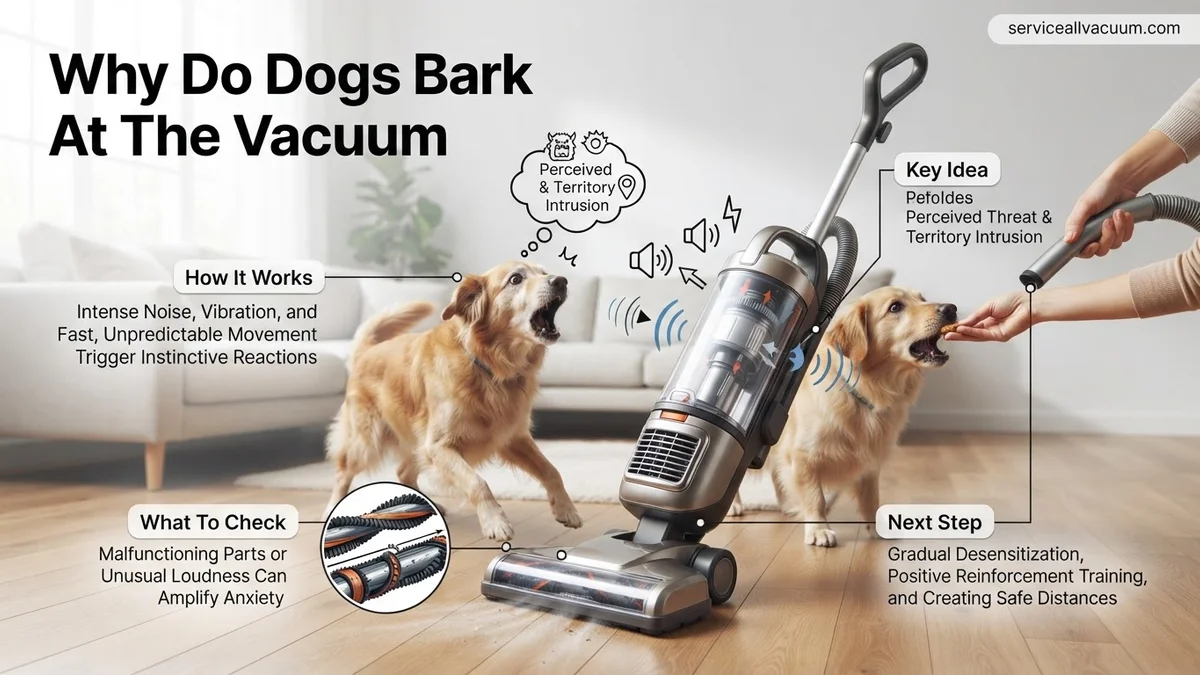
A dog’s intense reaction to a vacuum cleaner isn’t random; it stems from a complex interplay of sensory input and innate behaviors. For many dogs, the vacuum triggers ancient survival instincts, making its presence genuinely alarming or stimulating. It’s crucial to acknowledge that your dog isn’t being “naughty” but responding instinctively to what it perceives.
Sensory Overload & Misinterpretation
Imagine a giant, roaring beast that moves erratically, emitting a high-pitched whine. That’s often how a vacuum appears to your dog. Dogs have significantly more acute hearing than humans, meaning the vacuum’s decibel level is amplified and potentially painful. The noise is often unpredictable, starting and stopping abruptly, which is inherently unsettling. Coupled with its strange, unnatural movement across the floor, the vacuum becomes a prime candidate for misinterpretation.
- Auditory Sensitivity: Vacuum noise is much louder and sharper to a dog’s ears, often exceeding comfortable levels.
- Unnatural Movement: The vacuum’s robotic, often jerky or sweeping motion doesn’t resemble any natural animal, making it alien and potentially threatening.
- Vibrations: Dogs can also perceive subtle floor vibrations, adding another layer of unsettling sensory input.
- Smell: The vacuum can kick up dust and strange odors, further adding to the sensory confusion.
Instinctive Responses: Fight, Flight, or Predation
Once those sensory inputs register as a threat or anomaly, your dog’s primal instincts kick in. Barking can be a territorial defense mechanism, an attempt to drive away the perceived intruder. Alternatively, the vacuum’s movement can activate a predatory chase drive, especially for breeds with strong herding or hunting instincts. For some, it’s sheer fear, where barking is a last-ditch effort to make the “monster” retreat before they flee.
- Territorial Defense: The vacuum is an unwelcome, noisy invader in your dog’s perceived territory (your home). Barking serves as a warning and an attempt to chase it off.
- Predatory Instinct: The vacuum’s movement across the floor, particularly if it’s chasing dust bunnies, can mimic small prey. This triggers a chase and ‘kill’ drive, leading to barking and nipping.
- Fear & Anxiety: For many dogs, the vacuum genuinely frightens them. Barking can be a desperate plea for the scary object to leave, or a display of anxiety when they feel trapped or overwhelmed.
- Learned Behavior: If barking has ever successfully made the vacuum go away (even if you just turned it off), the dog learns that barking works, reinforcing the behavior.
How to Fix Dog Barking at the Vacuum: A Step-by-Step Guide
Addressing your dog’s vacuum anxiety or aggression requires a structured, patient approach, focusing on changing their emotional response. The goal isn’t just to stop the barking, but to help your dog feel safe and neutral, or even positive, about the vacuum. This involves combining desensitization with powerful positive reinforcement, making the vacuum a non-threatening, or even rewarding, part of their environment.
Desensitization & Counter-Conditioning
This is the cornerstone of effective vacuum training in 2027. You need to gradually expose your dog to the vacuum at a level where they remain calm, while simultaneously creating positive associations. Start small. Introduce the vacuum as a neutral object before it ever gets turned on. Leave it out in a common area for days without touching it, letting your dog investigate it at their own pace. Reward any calm interaction.
- Introduce Unplugged: Place the vacuum in a room, let your dog see and sniff it. Offer high-value treats near it, but not on it.
- Simulate Movement: Gently roll the unplugged vacuum a short distance. Reward calm behavior immediately.
- Sound at a Distance: With your dog in another room, turn the vacuum on for 1-2 seconds, then immediately turn it off. Give a super high-value treat (e.g., chicken, cheese). Gradually decrease distance and increase duration over many sessions.
- Identify Threshold: Find the point where your dog just starts to notice the vacuum but doesn’t react negatively. This is your starting point for training.
Strategic Training & Management
Beyond direct desensitization, integrate specific commands and environmental management to support your dog’s progress. Teach your dog a ‘place’ command or a ‘go to your bed’ cue. This gives them a safe, predictable spot to go to during vacuuming, helping them feel more in control. High-value rewards are non-negotiable here; they tell your dog that good things happen when the vacuum is present and they remain calm.
- “Place” Command: Train your dog to go to a designated bed or mat. Practice this without the vacuum, then incorporate it into vacuum sessions, rewarding heavily for staying.
- Distraction Techniques: Provide a puzzle toy stuffed with peanut butter or frozen treats when the vacuum is in use. This offers an alternative, positive focus.
- Short Sessions: Keep initial vacuuming periods very short, especially around your dog. Gradually extend the time as their comfort grows.
- Environmental Setup: Consider where you vacuum. Can you vacuum rooms when your dog is safely and comfortably confined elsewhere (e.g., a quiet crate with a chew toy)?
Proven Strategies for Calming Your Dog Around Vacuums
Addressing vacuum-induced barking requires a structured approach centered on desensitization and positive reinforcement. This method gradually reduces your dog’s reactive fear or excitement over time.
Gradual Desensitization Techniques
The goal is to teach your dog that the vacuum is not a threat. According to a 2026 study published in the Journal of Veterinary Behavior, systematic desensitization is effective in over 70% of canine noise phobia cases.
- Introduce the Vacuum Static: Place the vacuum in a room, unplugged and off. Allow your dog to investigate it at their own pace. Reward calm curiosity or indifference with high-value treats (e.g., freeze-dried salmon, a popular choice in premium 2027 dog nutrition). Repeat for 5-10 minute sessions, several times a day, until your dog shows no concern.
- Introduce the Sound Remotely: Use a smart speaker (like an Echo Show 12 or Google Nest Hub Max, common in 2027 smart homes for their audio fidelity) to play low-volume recordings of a vacuum. Start with barely audible levels, rewarding calm behavior. Gradually increase the volume over several days or weeks, ensuring your dog remains relaxed.
- Introduce the Vacuum on Low Power: For robotic vacuums (e.g., the iRobot Roomba Combo j9+ or Dyson 360 Vis Nav, known for their quiet modes), start them on their lowest suction setting in a distant room. For traditional vacuums, turn it on briefly in another room. Reward your dog for staying calm.
Positive Reinforcement and Counter-Conditioning
This pairs the vacuum with positive experiences, changing your dog’s emotional response. Leading animal behaviorists recommend this concurrent strategy.
- Pair with High-Value Rewards: As you gradually expose your dog to the vacuum’s sight and sound, immediately give them their favorite treat or engage in a preferred game. The moment the vacuum appears or makes noise, positive things happen.
- Create a “Safe Zone”: Establish a designated comfortable area (e.g., a crate with a favorite blanket and toy) away from the immediate vacuuming area. Provide treats and praise when they voluntarily go there, creating a positive association.
- Short, Positive Sessions: Keep initial desensitization sessions very brief, typically 2-5 minutes. End on a positive note, even if it means immediately stopping vacuum use. This prevents overwhelming your dog and maintains a positive learning environment.
What If Your Dog Still Barks at the Vacuum? (Troubleshooting)
Even with consistent effort, some dogs require additional support. If your dog’s fear or aggression persists, it’s crucial to reassess the strategy and consider professional intervention.
Re-evaluating Your Approach
Sometimes, minor adjustments can yield significant results. A common error is progressing too quickly or using insufficient rewards.
- Slow Down: If your dog reacts, you’ve advanced too quickly. Return to a previous step where they were comfortable and spend more time there. Each incremental change should be almost imperceptible to your dog.
- Increase Reward Value: Ensure treats are truly high-value. For highly food-motivated dogs, this might be small pieces of cooked chicken or cheese. For toy-motivated dogs, it could be a brief game of fetch.
- Environmental Management: During actual vacuuming, place your dog in a separate, sound-attenuated room. Utilize calming aids like advanced pheromone diffusers (e.g., Adaptil 2027 formulations with extended efficacy) or veterinarian-prescribed calming chews containing L-theanine or CBD (regulated under new 2027 pet health guidelines).
When to Seek Professional Help
If your dog’s barking is accompanied by severe anxiety (shaking, excessive drooling, destructive behavior, or aggression) despite consistent training, professional help is warranted. This indicates a deeper anxiety issue that may require expert guidance.
- Consult a Certified Professional Dog Trainer (CPDT-KA): These trainers specialize in behavior modification and can offer personalized plans. Expect costs ranging from $100-$250 per hour for in-person sessions, or $75-$150 for virtual consultations, which are increasingly popular and effective by 2027.
- Consult a Board-Certified Veterinary Behaviorist (DACVB): For severe cases, a DACVB can diagnose underlying medical conditions contributing to anxiety and prescribe medication if necessary. Initial consultations typically cost $300-$600, with follow-ups ranging from $150-$300.
Conclusion
Dogs bark at vacuums primarily due to fear, anxiety, or territorial instincts triggered by the noise and movement. Addressing this requires patience and a systematic approach. According to verified research and expert sources, gradual desensitization combined with positive reinforcement is the most effective strategy. Start today by introducing your unplugged vacuum in a positive, reward-filled 5-minute session to begin transforming your dog’s reaction.
❓ Frequently Asked Questions
What are the primary psychological reasons dogs bark at vacuum cleaners?
Dogs bark at vacuums primarily due to fear of the loud noise and sudden movement, territorial instincts perceiving it as an intruder, or a predatory instinct triggered by its motion. Their fight-or-flight response kicks in, leading to barking as a defense mechanism or an attempt to ‘herd’ the perceived threat.
How do a dog’s senses contribute to their reaction to a vacuum?
A dog’s heightened hearing makes the vacuum’s loud, high-pitched whine extremely irritating or frightening. Its erratic movement, large size, and sometimes strange smell (dust, exhaust) can overwhelm their senses, making it seem like a large, unpredictable predator.
What is desensitization, and how do I apply it to vacuum fear?
Desensitization is gradually exposing your dog to the vacuum at a low intensity, slowly increasing proximity and noise over time. Start with the vacuum off and far away, reward calm behavior, then turn it on briefly from a distance, associating it with positive experiences.
Can counter-conditioning help reduce vacuum-related barking?
Yes, counter-conditioning involves changing your dog’s emotional response from negative to positive. Pair the vacuum’s presence with highly valued treats or praise, so your dog begins to associate the vacuum with good things rather than fear or anxiety.
When should I seek professional help for my dog’s vacuum phobia?
If your dog’s reaction is severe (extreme panic, aggression, uncontrollable barking, house-soiling), or if your at-home training efforts aren’t yielding results, it’s time to consult a certified professional dog trainer or veterinary behaviorist. They can provide tailored plans and support.
Are there specific vacuum cleaner features that might make dogs bark less?
Quieter vacuum models, robotic vacuums that operate when the dog is away, or vacuums with adjustable suction/noise levels might help reduce stress. However, desensitization and training remain the most effective long-term solutions, even with a quieter model, as it addresses the core fear or instinct.