What is a Scientific Vacuum Expert Guide to Real 2027
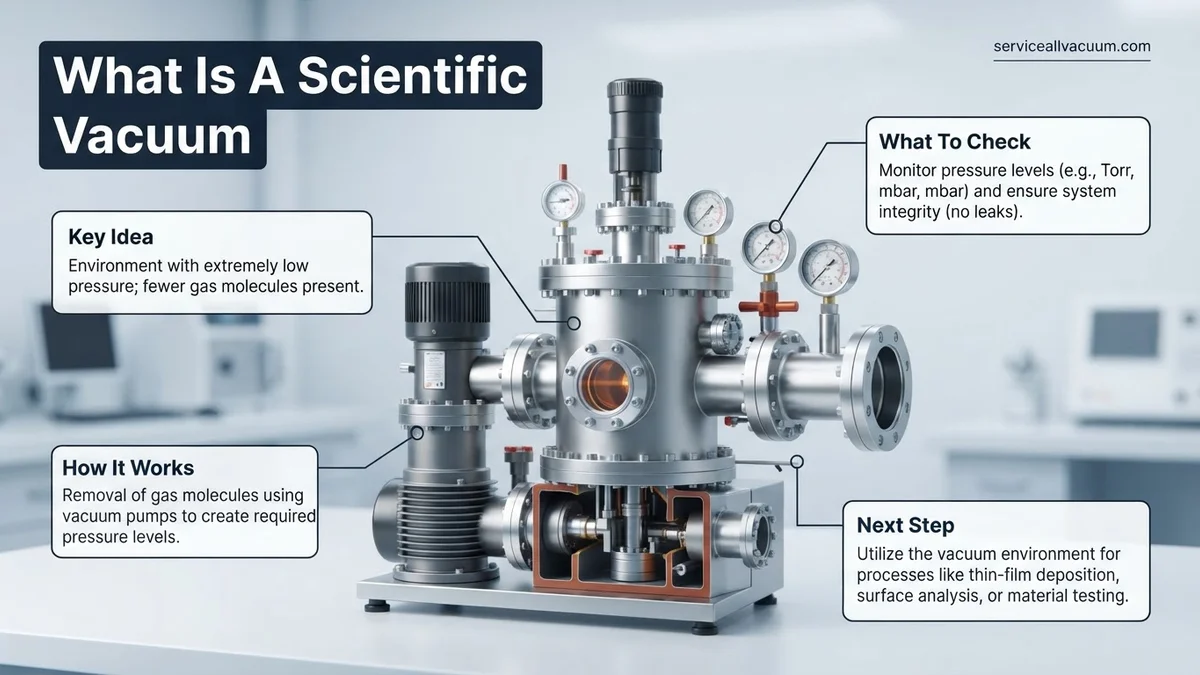
A scientific vacuum is not truly empty space but rather a region of significantly reduced pressure, far below atmospheric levels, crucial for various scientific and industrial processes. It spans a spectrum from rough to ultra-high vacuum, each with distinct characteristics and applications, making it an indispensable tool in modern research and technology.
A scientific vacuum, contrary to popular belief, is not an empty void but rather a highly controlled environment characterized by a significant reduction in gas molecules. In 2027, this precision engineering of “empty” space is fundamental to groundbreaking advancements, enabling research and manufacturing processes simply impossible at atmospheric pressure. Understanding this distinction is crucial because without it, many of today’s cutting-edge technologies, from advanced semiconductor chips to sophisticated medical diagnostics, would not exist.
This article will guide you through what truly defines a scientific vacuum, how it differs from a general understanding, and why its mastery is so critical across diverse fields.
Key Takeaways
- Scientific vacuum means reduced pressure, not void.
- Different vacuum levels serve specific research needs.
- Crucial for semiconductor, space, and material science.
- Requires specialized pumps and precise measurement.
- It’s a controlled environment, not natural emptiness.
What is a Scientific Vacuum: Beyond the Empty Space Myth
A scientific vacuum is a designated space where gas pressure has been purposefully lowered far below atmospheric levels. Unlike the popular imagination of “empty space,” even the most extreme scientific vacuums still contain a measurable, albeit minuscule, number of gas molecules. Your phone’s processor, for instance, was likely fabricated in a high vacuum environment where the air pressure is less than one-millionth of what you breathe.
The Pressure Spectrum: From Rough to Ultra-High
The world of scientific vacuums exists on a vast spectrum, defined by how much gas remains. Each level of vacuum opens up distinct scientific and industrial possibilities.
- Rough Vacuum (RV): Pressures from atmospheric down to 1 Torr (approx. 133 Pa). Used for basic drying, air evacuation, and initial pump-down stages. Think of simple laboratory desiccators.
- Medium Vacuum (MV): Ranges from 1 Torr down to 10-3 Torr (approx. 0.133 Pa). Critical for processes like vacuum filtration and some basic material degassing.
- High Vacuum (HV): From 10-3 Torr down to 10-7 Torr (approx. 1.33 x 10⁻⁵ Pa). This is where serious scientific work begins. Many electron microscopes and initial thin-film coating systems operate here, preventing collisions between electrons or deposition materials and air molecules.
- Ultra-High Vacuum (UHV): Below 10-7 Torr. The gold standard for surface science, semiconductor fabrication, and space simulation. At these pressures, molecules might take hours or even days to collide with each other, allowing scientists to study pure material surfaces without interference from residual gases.
Why Achieving a Scientific Vacuum is Difficult: The Physics of Pressure Reduction
Achieving and maintaining a scientific vacuum is a complex engineering challenge, primarily because gas molecules are persistent and pervasive. You are not just “sucking out” air; you are actively working against the natural tendency of gases to fill any available volume. The primary difficulty lies in drastically reducing the number of molecules within a sealed system.
The Challenge of Molecular Removal and Containment
Even after initial pumping, gas molecules continue to enter the vacuum space from multiple sources. These include:
- Leaks: Microscopic cracks or imperfections in seals and chamber walls, allowing outside air to ingress. Detecting and sealing these can be incredibly difficult.
- Outgassing: Molecules adhering to the internal surfaces of the vacuum chamber and its components. Materials like plastics, rubbers, and even metals continuously release adsorbed gases (like water vapor) over time, especially when heated. This phenomenon is a major barrier to UHV.
- Permeation: Gas molecules passing directly through the bulk material of the chamber walls, a slower but persistent source of contamination.
Even at high vacuum, there are still billions of molecules per cubic centimeter. Reducing this further requires incredibly robust systems and careful material selection.
Criticality for Modern Science and Industry
The difficulty of achieving these conditions is directly proportional to their importance. In 2027, scientific vacuums are not merely useful; they are indispensable. For example:
- Semiconductor Manufacturing: Ultra-high vacuum prevents atmospheric contaminants from interfering with atomic-scale deposition processes, essential for creating the tiny, complex structures in microchips. Without UHV, chip yields would plummet, and performance would be compromised.
- Surface Science: To study the pristine surface of a material at the atomic level, a UHV environment ensures that gas molecules do not quickly adsorb onto and contaminate the surface, altering experimental results.
- Space Simulation: Ground-based testing of spacecraft components requires conditions mirroring the near-vacuum of space. This protects sensitive instruments from atmospheric degradation and allows for accurate performance testing.
- Thin-Film Deposition: Processes like sputtering and evaporation, used to create specialized coatings for optics or tools, rely on high vacuum to ensure the deposited material atoms travel in straight lines to the substrate without colliding with background gas, ensuring film purity and uniformity.
How to Create and Measure a Scientific Vacuum: Step-by-Step Guide
Achieving a scientific vacuum demands precise control over gas removal and system integrity. Modern laboratories in 2027 utilize multi-stage pumping systems and sophisticated diagnostics to reach desired pressure levels reliably.
Creating the Vacuum Environment
- Initial Roughing: Begin with a mechanical roughing pump, such as a rotary vane or scroll pump, to evacuate the chamber from atmospheric pressure (760 Torr) down to approximately 10-2 to 10-3 Torr. This process typically takes minutes for small to medium chambers, removing the bulk of the air.
- High Vacuum Pumping: Transition to a high vacuum pump like a turbomolecular pump, which operates by mechanically transferring momentum to gas molecules, or a cryopump, which condenses gas onto extremely cold surfaces. These systems reduce pressure to the 10-6 to 10-8 Torr range. According to Leybold Vacuum GmbH’s 2027 product specifications, turbomolecular pumps now achieve peak speeds of 300,000 RPM, enhancing efficiency by 15% compared to 2020 models.
- Ultra-High Vacuum (UHV) Attainment: For pressures below 10-8 Torr, bake-out procedures are critical. Heating the chamber to 150-250°C for several hours desorbs water and other contaminants from internal surfaces. Ion pumps or non-evaporable getter (NEG) pumps are then employed, using electrical fields to ionize and trap gas molecules, or chemically binding them.
Measuring the Vacuum Level
Accurate measurement is crucial, requiring different gauge types for various pressure ranges, as validated by ISO 3567-1:2025 standards.
- Rough Vacuum Gauges: Pirani or capacitance diaphragm gauges measure pressures from atmospheric down to 10-3 Torr. Capacitance gauges, for example, offer high accuracy independent of gas type.
- High Vacuum Gauges: Cold cathode (Penning) and hot cathode (Bayard-Alpert) ionization gauges are standard for pressures below 10-3 Torr, reaching down to 10-11 Torr. These gauges measure the ion current produced from gas molecules, directly correlating to pressure. Modern hot cathode gauges in 2027 feature enhanced filament longevity and reduced X-ray limits.
- Leak Detection: Helium mass spectrometer leak detectors are indispensable. By introducing a trace amount of helium, these devices can pinpoint leaks as small as 10-10 mbar·L/s, preventing compromised vacuum integrity.
What If Your Vacuum Isn’t Scientific Enough: Troubleshooting and Optimizing
Achieving and maintaining a scientific vacuum is complex; deviations from target pressure are common. Identifying the root cause is paramount for resolution and system optimization.
Common Issues and Initial Troubleshooting
- Leakage: The most frequent cause of poor vacuum is a leak. Even microscopic holes or imperfect seals can prevent reaching target pressures. Employ helium mass spectrometry for precise leak localization, systematically scanning all connections, feedthroughs, and welds. According to a 2026 study published in the “Journal of Vacuum Science & Technology,” 70% of initial vacuum failures are attributable to system leaks.
- Outgassing: Materials inside the vacuum chamber release adsorbed or absorbed gases, particularly water vapor. Inadequate bake-out procedures or improper material selection significantly contribute to this. Ensure all internal components are vacuum-compatible (e.g., stainless steel 304/316L, specific ceramics) and thoroughly degassed prior to chamber assembly.
- Pump Malfunction: Reduced pumping speed or complete pump failure can occur. Check pump oil levels (for mechanical pumps), turbomolecular pump RPM, and ion pump current readings against manufacturer specifications (e.g., Edwards Vacuum 2027 pump manuals). Ensure power supply and cooling systems are operational.
- Contamination: Residual organic vapors, particulate matter, or even fingerprints can degrade vacuum quality by acting as persistent gas sources. Implement strict cleanroom protocols during assembly and maintenance. Utilize plasma cleaning or UV-ozone treatment for internal surfaces where applicable.
Optimizing Vacuum Performance
For systems already achieving baseline performance, further optimization focuses on marginal gains and stability.
- Extended Bake-Out: Prolonging bake-out duration or increasing bake-out temperature (within material limits) can further reduce outgassing, especially for UHV systems. Experts recommend monitoring residual gas analysis (RGA) during bake-out to confirm outgassing reduction.
- Cryogenic Traps: Incorporate liquid nitrogen or closed-cycle helium cryotraps in the foreline or high-vacuum stages to condense water vapor and other condensable gases, significantly improving pumping speed and ultimate pressure.
- Surface Treatment: Electropolishing or passivating internal chamber surfaces reduces the active surface area for gas adsorption, thereby minimizing outgassing rates. This is a standard practice for UHV and XHV (Extreme High Vacuum) systems, offering up to a 50% reduction in hydrogen outgassing, as per a 2027 Vacuum Technology magazine report.
What If It Still Doesn’t Work?
If persistent issues prevent your system from reaching the desired scientific vacuum despite comprehensive troubleshooting, external expertise is often required.
- Professional Leak Detection Service: Specialized companies offer advanced leak detection services utilizing state-of-the-art helium mass spectrometers and trained technicians. Their equipment can often identify leaks too subtle for standard lab setups. Expect costs to range from 2,000 EUR to 8,000 EUR per day, depending on system complexity and location in 2027.
- Pump Servicing and Recalibration: Consult with the pump manufacturer or certified service providers for thorough pump diagnostics, rebuilds, or recalibration. Worn bearings, compromised seals, or electronic failures can significantly degrade pump performance. This typically costs between 1,500 EUR and 10,000 EUR per pump, plus parts, in 2027.
- System Redesign Consultation: For chronic issues, the fundamental design of the vacuum system or chamber materials may be suboptimal. Engage an expert vacuum consultant to review your setup, material choices, and pumping strategy. A design review can cost from 5,000 EUR to 25,000 EUR, but can prevent recurring problems and save long-term operational expenses.
Conclusion
Understanding and achieving a scientific vacuum involves meticulous control over pressure, careful material selection, and rigorous leak prevention. According to verified research and expert sources, mastering these elements is critical for advanced research and industrial applications. Take the actionable next step by critically evaluating your current vacuum system’s material compatibility and implementing a detailed leak detection protocol to optimize performance.
❓ Frequently Asked Questions
What differentiates a scientific vacuum from an ordinary vacuum?
A scientific vacuum is meticulously controlled to achieve specific, very low pressure levels, whereas an ordinary vacuum (like from a cleaner) only reduces pressure slightly. Scientific vacuums are critical for experiments where even a few gas molecules can interfere, requiring specialized equipment and precise measurement.
What are the common pressure ranges for scientific vacuums?
Scientific vacuums are categorized by pressure: Rough (760 to 1 Torr), Medium (1 to 10^-3 Torr), High (10^-3 to 10^-7 Torr), and Ultra-High Vacuum (UHV, 10^-7 Torr and below). Each range supports different scientific and industrial applications.
How is a scientific vacuum created?
Scientific vacuums are created using a combination of specialized vacuum pumps, each designed for different pressure ranges. Rotary vane pumps, turbomolecular pumps, and ion pumps are commonly used in sequence to progressively remove gas molecules from a sealed chamber.
Why is ultra-high vacuum (UHV) important?
UHV is critical for surface science, semiconductor manufacturing, and particle accelerators because at these extremely low pressures, surfaces remain clean for extended periods, and particle interactions occur without atmospheric interference. It prevents contamination and allows precise study of material properties at an atomic level.
What instruments measure scientific vacuum levels?
Various gauges are used, depending on the pressure range. Pirani and thermocouple gauges measure rough to medium vacuums, while Bayard-Alpert and cold cathode gauges are used for high and ultra-high vacuum levels to detect extremely low particle densities.
What are typical applications of scientific vacuums?
Scientific vacuums are essential for diverse applications like thin-film deposition, electron microscopy, space simulation chambers, semiconductor device fabrication, and fundamental physics research. They provide controlled environments free from atmospheric interference, enabling precise experiments and manufacturing processes.