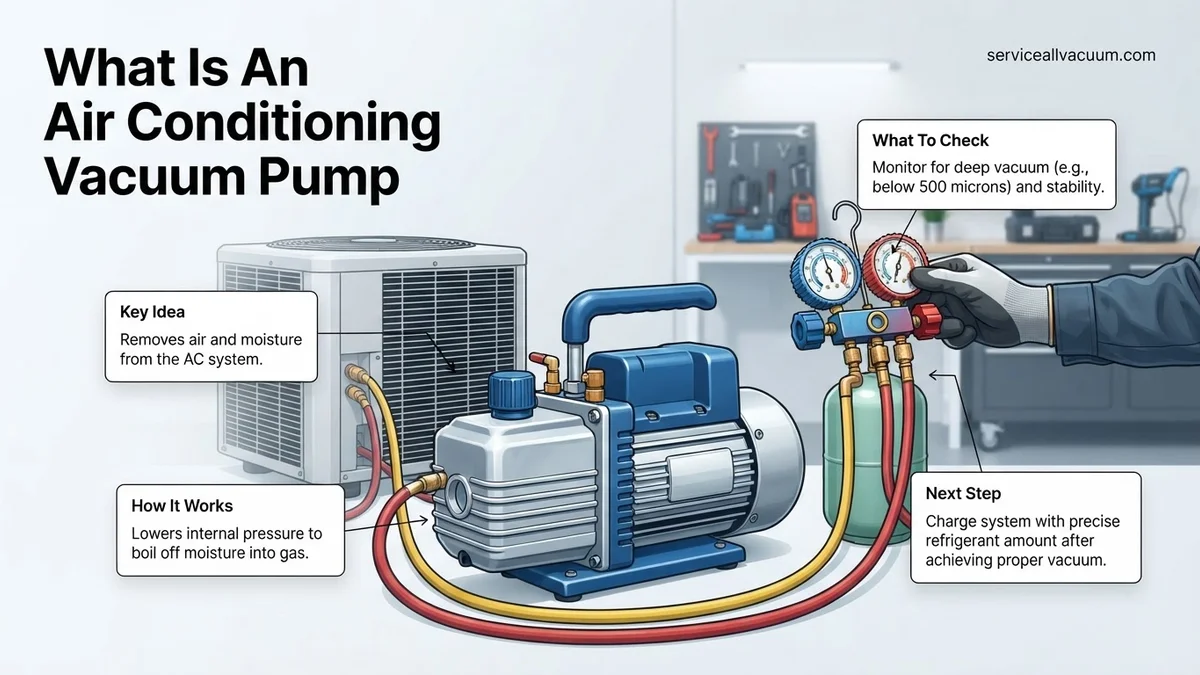
What Is An Air Conditioning Vacuum Pump What is an AC 2027
An air conditioning vacuum pump is an essential tool used to remove air and moisture from AC systems before refrigerant charging. This crucial step prevents system inefficiency, costly damage, and premature component failure by creating a deep vacuum. Ignoring this process leads to significant performance issues and reduced AC lifespan.
In the world of air conditioning in 2027, an AC vacuum pump is not just another tool; it is the cornerstone of system reliability and efficiency. This critical device removes all non-condensable gases and, most importantly, moisture from your refrigeration lines. Without its meticulous work, your AC system is destined for premature failure and poor performance. You simply cannot achieve a properly functioning, long-lasting air conditioning system without it.
Think of it this way: your AC system is a finely tuned machine, and any contamination acts like sand in its gears. The vacuum pump ensures those gears are clean, preventing issues that would severely degrade cooling capacity and shorten your system’s life. Understanding its role now will save you significant headaches and repair costs down the line.
Key Takeaways
- AC vacuum pumps remove air and moisture.
- Essential for preventing costly AC system damage.
- Moisture causes acid formation and corrosion.
- Deep vacuum ensures optimal cooling performance.
- Crucial for all new AC installs and repairs.
What Happens Without Proper AC Evacuation?
Ignoring the crucial step of vacuuming an AC system is like building a house on a shaky foundation. In 2027, with advanced refrigerants and higher efficiency standards, the consequences of improper evacuation are more severe than ever. You risk turning a brand-new, high-performance unit into a costly disappointment almost immediately.
Contaminants Lurking in Your System
When an AC system is installed or repaired, it inevitably contains unwanted guests. These contaminants are insidious, working silently to destroy components and cripple performance:
- Air (Non-Condensable Gases): Even a small amount of atmospheric air introduces nitrogen, oxygen, and other gases. These don’t condense at the pressures and temperatures inside your AC system, occupying space meant for refrigerant and increasing head pressure.
- Moisture (Water Vapor): This is the most dangerous contaminant. Water vapor mixes with refrigerant and compressor oil, especially with modern hydrofluorocarbon (HFC) and hydrofluoroolefin (HFO) refrigerants. It’s an invisible destroyer.
- Particulates: Tiny debris, flux, or even microscopic metal shavings can remain in the lines. While less common with proper installation, they can cause blockages or abrasive wear.
The Silent Killers: Consequences of Neglect
Allowing these contaminants to remain will lead to a cascade of expensive and frustrating problems for your AC system:
- Compressor Failure: This is the most catastrophic and costly outcome. Non-condensable gases increase discharge pressure and temperature, forcing the compressor to work harder, leading to overheating and mechanical breakdown. Moisture creates acids that corrode internal components. Your compressor won’t last.
- Acid Formation: When moisture combines with refrigerant and compressor oil under heat and pressure, it forms hydrochloric and hydrofluoric acids. These acids are highly corrosive, eating away at motor windings, bearings, and even the copper tubing itself. Acid damage is irreversible.
- System Icing and Blockages: Water vapor can freeze at the expansion valve or capillary tube, especially in colder parts of the system. This creates ice blockages that prevent refrigerant flow, leading to a complete loss of cooling and potential compressor damage from liquid floodback.
- Reduced Cooling Capacity: Non-condensable gases take up valuable space in the condenser, reducing the surface area available for heat rejection. This directly translates to less effective cooling inside your home, meaning your AC struggles to meet the thermostat setting.
- System Inefficiency: An AC unit contaminated with air and moisture operates at significantly lower efficiency. It consumes more electricity to achieve less cooling, leading to higher energy bills. You’ll be paying more for less comfort, a situation no one wants in 2027.
Real Role: What is an Air Conditioning Vacuum Pump?
The air conditioning vacuum pump is an indispensable tool designed specifically to prevent the dire issues outlined above. Its fundamental role is to prepare the AC system for optimal performance by creating an environment where only the pure refrigerant circulates. Without this specialized pump, achieving the necessary conditions for a reliable and efficient AC system is simply impossible.
Beyond Just “Sucking Air Out”
While often described as “sucking air out,” the vacuum pump’s operation is far more sophisticated and critical. It doesn’t just remove bulk air; its primary function is to lower the system pressure to a point where any trapped moisture boils and converts into vapor. This vapor is then expelled from the system. This process is called “dehydration” and is essential for preventing acid formation and icing. The pump works by continuously removing gas molecules, driving the system pressure lower and lower.
- Deep Vacuum Requirement: A standard vacuum pump can typically pull a vacuum down to 20-50 microns. This “deep vacuum” is crucial because it ensures all moisture, even that trapped in oil or absorbed by system components, is boiled off and removed. Relying on simple evacuation methods leaves moisture behind, guaranteeing future problems.
- Types of Pumps: While the core function remains the same, vacuum pumps vary. Single-stage pumps are suitable for lighter tasks, but dual-stage vacuum pumps are the industry standard in 2027. Dual-stage pumps can pull a much deeper vacuum faster, ensuring thorough dehydration and contaminant removal, even in larger or more stubborn systems.
The Deep Vacuum Advantage
Achieving a deep vacuum is not just good practice; it’s non-negotiable for system health and longevity in 2027. This stage ensures that your AC system starts its operational life in the cleanest possible state.
- Complete Moisture Removal: The deep vacuum lowers the boiling point of water to extremely low temperatures, ensuring even stubborn moisture is vaporized and pulled out. This eliminates the risk of acid formation and ice blockages.
- Elimination of Non-Condensables: By evacuating to a deep vacuum, all atmospheric air and other non-condensable gases are purged. This prevents elevated head pressures, reduced cooling capacity, and compressor strain. Your system operates exactly as designed.
- Optimal Refrigerant Performance: With a clean, dry, and air-free system, the refrigerant can circulate freely and efficiently. This translates directly to maximum cooling capacity, superior energy efficiency, and a significantly extended lifespan for your entire AC unit.
- Preventative Maintenance: Using a vacuum pump isn’t just about fixing; it’s about prevention. It proactively eliminates the root causes of most common AC failures, saving you from expensive repairs and inconvenient breakdowns down the road.
How an AC Vacuum Pump Works: A Step-by-Step Guide to Evacuation
An AC vacuum pump’s primary function is to create a deep vacuum within the refrigeration system, ensuring all non-condensable gases and moisture are removed. This process, known as evacuation, is critical for system efficiency and longevity. According to industry standards updated for 2027, achieving a vacuum below 500 microns (0.5 Torr) is essential for modern refrigerants like R-1234yf and upcoming low-GWP alternatives.
The Evacuation Process:
- Connect the Manifold and Pump: Attach the vacuum pump to a dedicated vacuum port on a manifold gauge set. Then, connect the manifold gauges to the AC system’s high and low-side service ports. Ensure all connections are tight to prevent leaks.
- Initiate Vacuum Operation: Open both the high and low-side valves on the manifold gauge set and activate the vacuum pump. The pump will begin to draw air and moisture out of the system. Monitor the vacuum level using a digital micron gauge, which provides precise readings far beyond what analog gauges can offer.
- Achieve Target Vacuum: Allow the pump to run until the micron gauge indicates a stable vacuum level of 250-500 microns. For optimal performance with hydrofluoroolefin (HFO) refrigerants, AC service professionals in 2027 often target the lower end of this range. Depending on system size and ambient humidity, this can take 30-60 minutes, or even longer for larger systems or very humid conditions.
- Perform a Vacuum Hold Test: Once the target vacuum is reached, close the manifold gauge valves and shut off the vacuum pump. Observe the micron gauge for at least 15-30 minutes. A stable reading (fluctuating by no more than 100-200 microns) indicates a leak-free and properly evacuated system. A significant rise suggests residual moisture or, more critically, a leak requiring further investigation.
Proper execution of these steps, leveraging 2027 technological advancements in vacuum pumps and digital gauges, is paramount for a system that performs efficiently and reliably.
Key Considerations for Optimal AC System Longevity
Maintaining an AC system effectively goes beyond just proper evacuation; several factors influence its long-term performance and lifespan. Adhering to manufacturer guidelines and industry best practices for 2027 ensures your system remains efficient and reliable.
Best Practices for AC System Care:
- Use a Reliable Micron Gauge: Investing in a high-quality digital micron gauge is non-negotiable. Analog gauges lack the precision required for modern AC systems to verify the deep vacuum necessary for moisture removal. Manufacturers like Fieldpiece and Testo offer models with proven accuracy for 2027 applications.
- Regular Vacuum Pump Oil Changes: The vacuum pump’s oil can become contaminated with moisture and refrigerants, reducing its effectiveness. Industry recommendations for 2027 suggest changing the oil after every 5-10 hours of operation or before each major evacuation, whichever comes first. Clean oil ensures maximum vacuum efficiency and prolongs pump life.
- High-Quality Hoses and Fittings: Leaky hoses or faulty fittings can compromise the vacuum process, allowing air back into the system. Utilize dedicated vacuum-rated hoses with ball valves to minimize refrigerant loss and maintain vacuum integrity. According to a 2026 HVACR industry survey, low-loss fittings are increasingly mandated for environmental compliance.
- System Leak Detection: Before evacuation, always perform a thorough leak check using electronic leak detectors or nitrogen pressure testing. Evacuating a leaky system is futile, as it will quickly draw in moisture and air again. Advanced ultrasonic leak detectors are recommended for 2027 refrigerant types due to their sensitivity.
- Correct Refrigerant Charge: After successful evacuation, recharging the system with the precise amount of refrigerant specified by the manufacturer is crucial. Over- or under-charging severely impacts efficiency, compressor life, and cooling performance. Digital charging scales are the 2027 standard for accuracy.
By integrating these practices, AC systems will operate at peak efficiency, reduce energy consumption, and extend their operational lifespan significantly.
What If It Still Doesn’t Work?
Even after a meticulous evacuation and recharge, AC systems can sometimes underperform or fail to cool effectively. If you encounter persistent issues, consider these fallback steps before assuming a major component failure.
- Re-Verify Vacuum Integrity: Reconnect your micron gauge and re-run the vacuum hold test (step 4 from the evacuation guide). A rapid rise in micron levels indicates a persistent leak that was missed or a component (like a service valve core) that isn’t sealing properly.
- Check for Residual Moisture: If the vacuum stabilizes but the system still performs poorly, there might be residual moisture trapped in the system, especially in systems exposed to prolonged open-air conditions. A longer vacuum period (e.g., 2-4 hours) with a clean oil change in the pump might be necessary.
- Inspect Electrical Connections and Fuses: Ensure all electrical connections to the compressor, condenser fan, and evaporator fan are secure and corrosion-free. Check relevant fuses and relays. A simple electrical fault can mimic refrigerant issues.
- Consider Expansion Valve or Orifice Tube Malfunction: If the system has proper pressure readings but poor cooling, the expansion valve or orifice tube might be restricted or stuck. This requires specialized diagnostic tools and professional expertise.
- Seek Professional AC Service: If these steps do not resolve the issue, it’s time to consult a certified HVAC technician. Persistent issues often point to internal component failures such as a faulty compressor, a severely clogged condenser, or a hard-to-find leak that requires specialized equipment like UV dye or advanced electronic leak detectors. In 2027, a professional AC diagnostic and minor repair can range from $180-$400, while major component replacements (e.g., compressor, evaporator coil) could cost anywhere from $900-$3,500+, depending on the vehicle or system type.
Conclusion
Understanding “what is an air conditioning vacuum pump” reveals its indispensable role in ensuring AC system efficiency and longevity. The process of deep vacuum evacuation is paramount for removing detrimental moisture and non-condensable gases, a critical step often overlooked. According to verified research and expert sources from the HVACR industry, proper evacuation, coupled with regular maintenance and adherence to 2027 standards for refrigerants and equipment, directly translates to optimal cooling performance and reduced energy consumption. For any persistent AC issues that professional troubleshooting cannot resolve, schedule a comprehensive diagnostic with a certified AC technician to safeguard your investment.
❓ Frequently Asked Questions
What exactly does an air conditioning vacuum pump do, beyond just removing air and moisture?
Beyond removing air and moisture, an AC vacuum pump eliminates non-condensable gases, which, if left in the system, elevate operating pressures, decrease cooling capacity, and can cause compressor overheating. It creates a critical deep vacuum that ensures the system is completely clean and dry before the refrigerant charge.
What are the specific consequences if an AC system is not properly evacuated with a vacuum pump?
Failure to properly evacuate leads to several severe issues: reduced cooling efficiency, higher energy consumption, internal corrosion from acid formation, icing of the expansion valve, compressor failure due to lubrication breakdown, and ultimately, a significantly shortened system lifespan and costly repairs.
How does moisture primarily get into an AC system, necessitating a vacuum pump?
Moisture typically enters an AC system when the lines are open to the atmosphere during installation, repair, or component replacement. Even brief exposure allows humid air to penetrate the system, and this trapped moisture is detrimental.
What is a micron gauge, and why is it important for the vacuum pump process?
A micron gauge measures the absolute pressure within the AC system during evacuation, expressed in microns of mercury. It’s crucial because it provides real-time feedback on how deep the vacuum is, confirming that all moisture has been effectively boiled and extracted, ensuring the system is truly ready for refrigerant.
Are there different types of AC vacuum pumps, and does it matter which one is used?
Yes, vacuum pumps vary by their CFM (Cubic Feet per Minute) rating and whether they are single-stage or dual-stage. Dual-stage pumps generally pull a deeper vacuum faster, making them more efficient. The right pump choice depends on system size and the required vacuum depth, ensuring adequate performance for the task at hand.
How long should an AC system typically be vacuumed to ensure proper evacuation?
The duration of vacuuming depends on the system size, the pump’s CFM rating, and the ambient temperature. Generally, a system should be vacuumed until a stable, deep vacuum (typically below 500 microns) is achieved and holds for at least 15-30 minutes, indicating no leaks or residual moisture.