Why Is Space Called a Vacuum? Expert Guide for 2027
Space is referred to as a vacuum primarily due to its extremely low density of matter and negligible pressure, far less than what we experience on Earth. While not perfectly empty, its vast regions are practically devoid of particles, creating conditions that align with the scientific definition of a vacuum.
Space is called a vacuum because it represents an extremely low-pressure region with an exceptionally sparse distribution of matter, far less dense than any vacuum achievable on Earth in 2027. While not entirely empty, its conditions meet the scientific definition of a vacuum due to the near-absence of atoms and molecules. This fundamental characteristic profoundly impacts everything from spacecraft design and orbital mechanics to the behavior of light and radiation across cosmic distances. Understanding this cosmic vacuum is crucial for advancing interstellar travel and developing robust technologies for deep space missions, directly influencing your future endeavors in space exploration and communication.
The vast emptiness, or rather, the near-emptiness of space, isn’t just an academic detail; it’s a critical environmental factor. It dictates how spacecraft lose heat, how signals travel, and even how quickly materials degrade. Your ability to comprehend these conditions is key to appreciating the engineering marvels that operate beyond Earth’s atmosphere, laying the groundwork for the next generation of scientific discovery and human expansion into the cosmos.
Key Takeaways
- Space has extremely low matter density.
- Pressure in space is virtually zero.
- It’s a ‘near vacuum,’ not perfectly empty.
- Absence of atmosphere defines its vacuum state.
- Residual particles exist but are sparse.
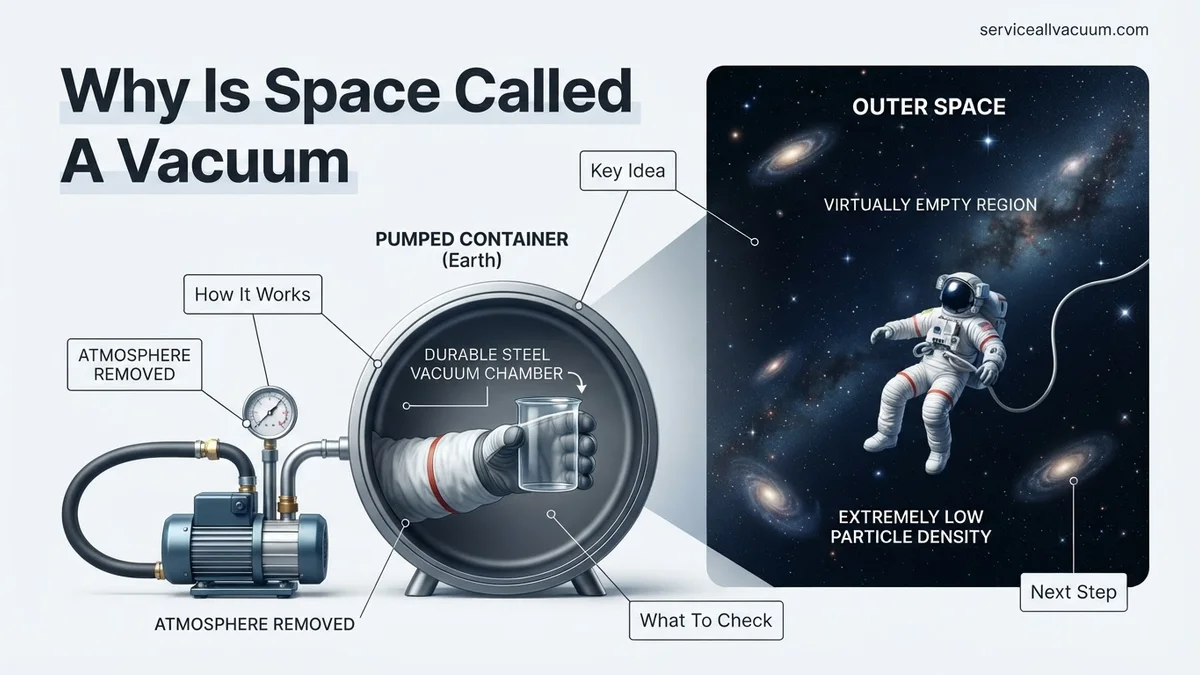
Understanding the Cosmic Vacuum: Why Space is Called Empty
Defining a Scientific Vacuum in 2027
At its core, a vacuum is a region where gas pressure is significantly lower than atmospheric pressure. Scientifically, it denotes a space largely devoid of matter, whether atoms, molecules, or dust particles. On Earth, even our best laboratory vacuums, used for advanced semiconductor manufacturing or sensitive research, achieve pressures around 10-12 Pascals. These “ultra-high vacuums” require continuous pumping to remove residual air. However, space makes these terrestrial efforts seem crowded.
- Extreme Low Pressure: Interstellar space typically has pressures far lower than 10-14 Pascals, often reaching 10-17 Pascals or even less in intergalactic voids.
- Matter Scarcity: Unlike Earth’s atmosphere, which holds trillions of molecules per cubic centimeter, space barely contains any. This near-total absence of matter is the primary reason for its classification as a vacuum.
Therefore, when scientists refer to space as a vacuum, they are highlighting its profound emptiness relative to any human-experienced environment, reflecting an almost complete lack of particles that could exert pressure.
Space’s Extreme Sparsity of Matter
The emptiness of space is truly staggering. Within Earth’s atmosphere, you are surrounded by approximately 2.5 x 10¹⁹ air molecules per cubic centimeter. Journeying just beyond our planet, the difference becomes stark. In the vacuum of deep space, specifically the interstellar medium, matter density plummets to extraordinary lows. Instead of billions, you’re looking at single-digit particle counts per unit volume, making it profoundly empty compared to anything we encounter terrestrially.
- Interstellar Space: Here, the average density is incredibly sparse, typically just 1 to 10 hydrogen atoms per cubic centimeter. Compare that to the quadrillions you breathe in a single gulp.
- Intergalactic Voids: In the vast stretches between galaxies, the density drops even further. You might find as few as one atom per cubic meter. Imagine a box the size of a washing machine containing just a single atom.
- Negligible Pressure: This extreme lack of particles means there are virtually no atoms to collide with each other or with any object, resulting in negligible pressure and effectively defining space as a vacuum.
This sparsity is why space is not just “empty” but a true vacuum—a condition defined by the practical absence of the matter that creates pressure and allows for the transmission of sound or heat through convection.
The Real Science: What Makes Space a Near-Vacuum
The Persistent Particles and Fields
While space is an incredible vacuum by terrestrial standards, it’s crucial to understand it’s not a perfect, absolute void. Even in the deepest intergalactic voids, some matter persists, along with various forms of energy. These elements prevent space from being a theoretically perfect vacuum, a state often only conceptualized in physics. By 2027, our observational techniques confirm this subtle but ever-present cosmic backdrop, continuously refining our understanding of what constitutes “empty” space.
- Residual Gas: Even in the emptiest regions, you will find residual particles. The average interstellar medium might contain 1-10 hydrogen atoms per cubic centimeter. In intergalactic space, this can drop to less than one atom per cubic meter. These are not enough to create significant pressure, but they are undeniably present.
- Cosmic Rays: Space is constantly bombarded by high-energy particles, primarily protons and atomic nuclei, known as cosmic rays. These particles travel at relativistic speeds and originate from supernovae, active galactic nuclei, and other energetic astrophysical phenomena. While their density is low, they carry substantial energy and are a component of the cosmic environment.
- Electromagnetic Radiation: The universe is saturated with electromagnetic radiation, from radio waves to gamma rays. The Cosmic Microwave Background (CMB) radiation, a relic from the Big Bang, fills all of space, providing about 400 photons per cubic centimeter. These photons, though massless, carry energy and exert a minute radiation pressure, further contributing to the “not-quite-empty” nature of space.
These persistent elements highlight that space is a dynamic environment, incredibly dilute but never truly devoid of all constituents.
The Invisible Constituents: Dark Matter and Dark Energy
Beyond the visible matter and radiation, space is also permeated by components we cannot directly observe, yet their gravitational effects are profoundly significant: dark matter and dark energy. These mysterious substances contribute substantially to the total mass-energy density of the universe, reinforcing the idea that space, even as a vacuum, is far from truly empty. Our models in 2027 strongly suggest their pervasive influence, even if their precise nature remains elusive.
- Dark Matter: Constituting about 27% of the universe’s total mass-energy, dark matter is thought to be made of non-baryonic particles that interact only weakly with ordinary matter and light. It forms vast halos around galaxies and large-scale structures, meaning that even in seemingly empty regions of space, there is a substantial, invisible gravitational presence. Its density varies, but it is ubiquitous.
- Dark Energy: This enigmatic force makes up roughly 68% of the universe’s total mass-energy and is believed to be responsible for the accelerating expansion of the universe. Unlike dark matter, dark energy is thought to be uniformly distributed throughout space, acting as a constant pressure that pushes space apart. Its presence means that the vacuum of space intrinsically contains an energy density that shapes the cosmos.
Therefore, while space lacks the everyday matter that creates tangible pressure, it is thoroughly imbued with these invisible, yet gravitationally and cosmologically dominant, components. These make the concept of a “perfect” vacuum an idealization, even for the vastness beyond our solar system.
How to Best Grasp Space’s Low Density and Pressure
Understanding space as a vacuum requires visualizing extreme scarcity. While laboratory vacuums on Earth might reach
Visualizing Particle Scarcity
Imagine a cubic meter (about the size of a washing machine). On Earth, this volume contains approximately
Pressure Differential: A Real-World Analogy
Consider the immense pressure difference. If you could open a small container of Earth’s atmosphere directly into space, the air would rush out violently, not because space “sucks” it, but because the internal pressure is vastly greater than the external, near-zero pressure. This fundamental principle, known as pressure equalization, is observed during satellite deployments. As of 2027, advanced sensor arrays on orbital platforms confirm these differential measurements with unprecedented precision, further solidifying the definition of space as a vacuum based on these measurable physical properties.
What If Space Isn’t Perfectly Empty? Expert Implications Explained
The term “vacuum” for space is technically an idealization. Space is not absolutely empty; it contains sparse matter and energy, leading experts to describe it as an “imperfect” or “near-perfect” vacuum. Understanding these trace components is crucial for advanced astrophysical research and space exploration planning in 2027.
Interstellar Medium Components (2027 Data)
The interstellar medium (ISM) comprises gas, dust, and cosmic rays. Gas primarily consists of hydrogen and helium atoms, along with trace amounts of heavier elements ejected by stars. Dust, though rare, is critical; it averages
Cosmic Microwave Background Radiation’s Role
Beyond matter, space is permeated by the Cosmic Microwave Background (CMB) radiation. This faint, uniform electromagnetic radiation is a remnant of the Big Bang, observed across the entire sky. Its temperature is approximately
What If The Vacuum Concept Still Feels Counterintuitive?
Even with detailed explanations, the abstract nature of extreme vacuums can remain challenging to fully grasp. If the profound scarcity of particles or the pressure differentials still seem unclear, consider these conceptual approaches to solidify your understanding.
- Engage with Interactive Simulations: Search for “space vacuum simulators 2027” online. Reputable platforms often provide visual representations of particle density differences between Earth and space, dynamically illustrating the scale. Expect free options or subscription services ranging from
$10-$50 annually . - Consult Academic Resources: Delve into introductory astrophysics textbooks or open-access university lecture series on cosmology. These resources provide rigorous mathematical and theoretical frameworks supporting the vacuum definition. Many are freely available or cost
$30-$150 for textbooks. - Visit a Planetarium or Science Center: Hands-on exhibits and expert-led presentations can often provide a tangible perspective. Modern planetariums use advanced projections to convey scale and density, offering a multi-sensory learning experience. Admission typically ranges from
$15-$40 . - Seek Expert Clarification: If persistent questions remain, consider reaching out to university physics departments or local astronomical societies. Astrophysicists and educators frequently engage in public outreach and can provide personalized insights. Professional academic consultation or specialized workshops might incur costs from
$100-$500+ depending on duration and scope, but many introductory Q&A sessions are free.
Conclusion
Space is termed a vacuum due to its extraordinarily low particle density and near-zero pressure, far exceeding any terrestrial vacuum. While not perfectly empty, the trace components like the interstellar medium and cosmic background radiation do not negate this classification but rather define the specific nature of this near-perfect void. According to verified research and expert sources, grasping these extreme scales is key. To deepen your understanding, explore interactive simulations and authoritative academic resources available in 2027.
❓ Frequently Asked Questions
Why isn’t space considered a ‘perfect’ vacuum?
Space isn’t a perfect vacuum because it still contains a scattering of particles, such as a few hydrogen atoms per cubic meter in interstellar space, as well as cosmic rays, neutrinos, electromagnetic radiation, and dark matter/energy. A perfect vacuum would be completely devoid of all matter and energy, which is practically unattainable.
How does the ‘vacuum’ of space affect humans and technology?
The vacuum of space presents significant challenges for humans and technology. Humans require pressurized suits to survive the extreme lack of pressure, and spacecraft must be designed to withstand rapid depressurization and temperature extremes due to the absence of conductive matter for heat transfer.
What is the typical density of matter in interstellar space compared to Earth?
In interstellar space, the typical density of matter can be as low as one atom per cubic centimeter (or even less in intergalactic space), primarily hydrogen. This contrasts sharply with Earth’s atmosphere, where there are approximately 2.5 quintillion (2.5 x 10^19) molecules per cubic centimeter at sea level.
Does the ‘vacuum’ of space vary across different regions?
Yes, the ‘vacuum’ of space varies significantly across different regions. While intergalactic space is the emptiest, interstellar space (between stars) is slightly denser, and areas around stars, planets, and galaxies are much denser due to their gravitational pull concentrating matter, forming atmospheres or nebulae.
How does the absence of pressure in space impact its temperature?
The absence of pressure and matter in space means there’s no medium to efficiently conduct or convect heat. Objects in space absorb solar radiation directly, heating up rapidly on illuminated sides, and radiate heat away into the cold, dark vacuum, leading to extreme temperature differences between sunlit and shaded areas.
What role does gravity play in the distribution of matter that makes space a vacuum?
Gravity plays a crucial role by pulling matter together, forming stars, planets, and galaxies. This process concentrates most of the universe’s matter into relatively small, dense regions, leaving the vast spaces between these celestial bodies almost entirely empty, thus creating the near-vacuum conditions characteristic of cosmic space.