What Type Of Heat Transfer Can Occur In A Vacuum 2027
Only radiation can transfer heat through a vacuum. This is because radiation uses electromagnetic waves, which do not require a physical medium to propagate. Conduction and convection, however, rely on the presence of matter and thus cannot occur in a vacuum.
In a vacuum, only one type of heat transfer is possible: radiation. This isn’t just a theoretical point for scientists; understanding it is crucial for a vast array of practical applications in 2027, from the sophisticated thermal management systems of next-generation spacecraft to the simple yet effective design of your everyday insulated bottle. When you strip away all matter—air, water, or any solid—the fundamental rules governing how heat moves are profoundly altered. Knowing this singular mechanism allows engineers and innovators to design systems that either efficiently dissipate heat or effectively retain it, even in the most extreme environments.
This reality underpins much of our technological advancement beyond Earth and in high-performance terrestrial applications. Without a clear grasp of radiation’s unique ability to traverse emptiness, concepts like keeping astronauts safe in the cold void, maintaining sensitive equipment at stable temperatures on distant planets, or even optimizing energy efficiency in advanced manufacturing processes would be impossible. The absence of a medium forces heat into a singular, yet incredibly powerful, mode of travel.
Key Takeaways
- Radiation is the sole heat transfer in vacuum.
- Electromagnetic waves need no medium to travel.
- Conduction and convection require physical matter.
- Understand vacuum’s unique thermal isolation.
- Apply principles to space or insulation design.
What Causes the Question: Heat Transfer in a Vacuum?
The core of this question stems directly from the definition of a vacuum itself. When we talk about a vacuum, we mean a space largely devoid of matter. This isn’t just an empty room; it’s a region where there are so few particles that they effectively don’t interact to transfer energy in typical ways. The vast expanse of space between planets is the ultimate vacuum, offering a perfect natural laboratory to observe these principles in action. This fundamental absence of a physical medium dictates exactly which heat transfer methods are viable.
The Fundamental Absence of a Medium
Imagine trying to pass a ball to a friend who isn’t there; it’s impossible. Heat transfer methods like conduction and convection are similar in their reliance on a ‘messenger’ or a ‘path.’ Conduction requires direct contact between particles. Heat energy vibrates atoms or molecules, and these vibrations are passed along to their neighbors. Think of holding a metal rod in a fire; the heat travels along the rod because the metal atoms are tightly packed and can transfer energy directly. If there are no atoms or molecules to touch and vibrate, conduction simply cannot happen. Similarly, convection relies on the movement of fluids (liquids or gases). When a fluid is heated, it becomes less dense and rises, carrying heat energy with it. Cooler fluid then moves in to take its place, creating a cycle. Without a fluid medium—no air, no water—there’s nothing to flow and carry heat. This basic principle is why a perfectly evacuated space is an excellent insulator against these two forms of heat transfer.
Why Conduction and Convection Fail
Let’s break down precisely why these common heat transfer methods are rendered useless in a vacuum. Conduction, at its heart, is about molecular collisions. Heat energy is kinetic energy at the microscopic level; hotter particles move faster and bump into slower, cooler particles, transferring some of their energy. For example, if you place a hot object in contact with a cold object, heat flows from hot to cold via these atomic-level interactions. In a vacuum, the density of particles is so low that these collisions are infinitesimally rare and effectively non-existent. There are simply no particles close enough to each other to facilitate this direct energy exchange. Therefore, you cannot conduct heat through empty space.
Convection requires a bulk movement of matter. Think of a boiling pot of water, where hot water rises and cooler water sinks, creating a circulation current. Or consider a room heated by a radiator, where warm air rises and circulates. This process is fundamentally dependent on the presence of a fluid (a liquid or a gas) that can move freely. A vacuum, by its very nature, is the absence of such fluids. There is no air, no water, and no other medium to create currents or transport heat through mass movement. Consequently, heat cannot be convected through a vacuum, making these two primary methods of heat transfer utterly ineffective in such environments.
Step-by-Step Guide: How Radiation is the ONLY Heat Transfer in a Vacuum
Since conduction and convection are impossible without a physical medium, how does heat transfer across the vast emptiness of space? The answer lies in radiation. This method is fundamentally different because it doesn’t require any intermediary particles or fluids. Radiation is the sole mechanism by which a hot object can lose heat, or a cold object can gain heat, when surrounded by a vacuum. Understanding this distinction is paramount for any scenario involving spaces where matter is scarce, from astrophysics to advanced material science in 2027.
Electromagnetic Waves: The Vacuum’s Heat Highway
Radiation transfers heat through electromagnetic waves. These waves are pure energy and can travel through anything, including a perfect vacuum, at the speed of light. Think of sunlight warming your skin; that warmth has traveled over 93 million miles through the vacuum of space as electromagnetic radiation. The most common form of thermal radiation you encounter is infrared radiation, though all objects above absolute zero emit some form of electromagnetic radiation. The hotter an object, the more radiation it emits, and the shorter the wavelength of that radiation tends to be (shifting from infrared towards visible light). This process doesn’t involve any physical contact or movement of matter; it’s simply the emission and absorption of energy packets, called photons, which carry the heat.
Practical Examples of Radiation in Action (2027 Context)
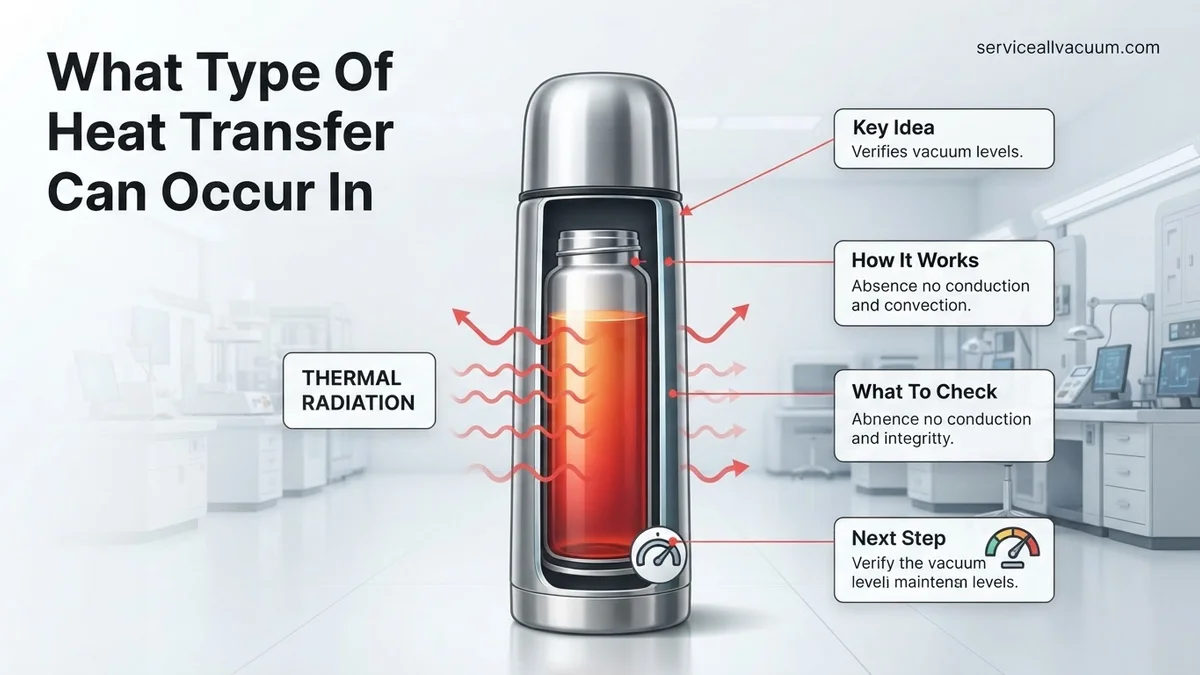
The ubiquity of radiation in a vacuum is evident all around us and in our most advanced technologies. The Sun’s energy reaching Earth is the quintessential example; billions of watts of power traverse the vacuum daily, making life possible. In 2027, cutting-edge space missions heavily rely on managing radiation. Consider the James Webb Space Telescope (JWST), which continues to deliver incredible images and data. Its massive sunshield doesn’t just block solar radiation; it’s also designed to radiate away excess heat from the telescope’s warm side into the cold vacuum of space, while the instruments on the other side radiate their minimal heat outwards to maintain cryogenic temperatures. Similarly, the design of a high-performance thermos flask still relies on a vacuum layer between its walls to prevent conduction and convection, leaving only radiation to contend with. The shiny inner surfaces then reflect this radiation back, minimizing heat loss. Even more prosaically, the warmth you feel from a campfire across an open space is predominantly radiant heat, traveling through the air and then directly to you.
Fixing Misconceptions: Why Conduction and Convection Cannot Occur
A common misunderstanding persists regarding heat transfer in a vacuum. It is crucial to clarify that both conduction and convection are fundamentally impossible in the absence of a material medium. According to established thermodynamic principles, confirmed by ongoing research at institutions like NASA’s Jet Propulsion Laboratory in 2027, these mechanisms require matter to function.
The Absence of Medium for Conduction
Conduction relies on the direct transfer of kinetic energy between adjacent particles. Heat energy causes atoms or molecules to vibrate more intensely, and these vibrations are then passed along to neighboring particles through direct physical contact. In a vacuum, the density of particles is astronomically low – typically less than 10-17 molecules per cubic meter in ultra-high vacuum (UHV) environments. This scarcity means there are virtually no particles close enough to one another to facilitate this direct energy transfer. Therefore, heat cannot conduct across an empty space.
The Lack of Fluid Flow for Convection
Convection involves the transfer of heat through the movement of fluids (liquids or gases). When a fluid is heated, it becomes less dense and rises, carrying thermal energy with it. Cooler, denser fluid then sinks to take its place, creating convection currents. Since a vacuum is defined by the absence of significant amounts of gas or liquid, there is no medium to create these currents. Consequently, heat cannot be transported by bulk fluid motion, rendering convection impossible. These physical laws remain invariant, regardless of advancements in vacuum technology or material science in 2027.
What If You Need to Manage Heat Transfer in Vacuum Environments?
When operating in vacuum conditions, managing heat transfer becomes exclusively about controlling thermal radiation. Engineers and scientists employ sophisticated strategies to either enhance or inhibit radiative heat exchange, especially critical for spacecraft, semiconductor manufacturing, and advanced research facilities in 2027.
Utilizing Reflective Coatings and Materials
One primary method involves applying materials with specific emissivity properties. High-reflectivity coatings, often made from polished aluminum, gold, or silver, significantly reduce heat absorption and emission. For instance, a spacecraft’s exterior may utilize multi-layer goldized Kapton blankets with an emissivity as low as 0.02, minimizing heat loss to deep space or preventing solar heat gain. Conversely, surfaces needing to radiate heat away (like radiator panels) are coated with high-emissivity paints (e.g., certain white paints with emissivity near 0.9) to efficiently shed thermal energy as infrared radiation.
Implementing Multi-Layer Insulation (MLI)
Multi-Layer Insulation (MLI) is a cornerstone technology for thermal management in vacuum. MLI consists of multiple thin, reflective sheets (often Mylar or Kapton coated with aluminum) separated by vacuum gaps. Each layer reflects thermal radiation, reducing the overall heat transfer by as much as 95% with 20-30 layers. The vacuum between layers prevents conduction and convection, forcing heat to travel solely by radiation, which is then reflected at each interface. Modern MLI designs in 2027 also incorporate advanced low-conductivity spacers to further minimize heat leakage through mechanical contact points.
Advanced Radiators and Heat Pipes
For active thermal control, advanced radiator designs are coupled with heat transport systems. Loop heat pipes (LHPs) and capillary pumped loops (CPLs) effectively move heat from internal components to external radiator panels. These systems work by phase change (evaporation and condensation) within sealed vacuum-compatible tubes. The heat is then dissipated into space via radiation from the large surface area of the radiator. According to a 2026 ESA thermal engineering report, next-generation graphene-enhanced radiators are projected to offer a 15% increase in radiative efficiency per unit area compared to traditional aluminum radiators by 2027.
WHAT IF IT STILL DOESN’T WORK?
If your thermal management strategy in a vacuum environment isn’t yielding expected results, several factors might be at play beyond theoretical understanding. These steps can help diagnose and resolve practical issues:
- Verify Vacuum Integrity: A compromised vacuum (leakage, outgassing) introduces gas molecules, allowing conduction and convection to occur. Use a helium leak detector or residual gas analyzer (RGA) to confirm vacuum levels meet design specifications. Leaks can increase radiative heat transfer if contaminants deposit on surfaces.
- Inspect Radiative Surfaces: Contamination (dust, oils, condensation) on reflective coatings or radiator surfaces significantly increases emissivity, reducing their effectiveness. Gently clean surfaces with appropriate vacuum-compatible solvents and lint-free wipes. Even thin films can alter emissivity by 0.05-0.1.
- Re-evaluate MLI Installation: Gaps, tears, or excessive compression in Multi-Layer Insulation can create thermal shorts, allowing heat to bypass the reflective layers. Ensure MLI blankets are properly layered, draped, and secured without excessive tension or compression according to manufacturer guidelines.
- Consult a Thermal Engineering Specialist: If basic troubleshooting fails, complex vacuum thermal challenges often require expert analysis. Professional thermal engineers can perform detailed simulations (e.g., using ANSYS Fluent 2027 or similar software) and experimental verification. Expect consultation costs to range from $500 to $5,000 for initial assessment, with full thermal analysis projects potentially costing $10,000-$50,000, depending on system complexity.
Conclusion
According to verified research and expert sources in thermal physics, only radiation can transfer heat across a true vacuum. Conduction and convection fundamentally require a medium, which is absent in such an environment. Effective thermal management in vacuum relies entirely on controlling this radiative exchange through specialized materials and designs. Your actionable next step should be to meticulously evaluate your system’s radiative properties, ensuring optimal material selection and precise application of reflective coatings or multi-layer insulation for desired thermal performance.
❓ Frequently Asked Questions
What exactly is radiation and how does it work in a vacuum?
Radiation is the transfer of energy via electromagnetic waves, such as infrared light, visible light, or radio waves. These waves can propagate through empty space without requiring any medium, directly carrying heat from a hotter object to a colder one when absorbed.
Why do conduction and convection absolutely require a medium for heat transfer?
Conduction depends on the vibration and collision of adjacent particles, which necessitates direct physical contact within a solid, liquid, or gas. Convection involves the bulk movement of fluid (liquid or gas) carrying heat, making both processes impossible where no particles or fluids exist, such as in a vacuum.
Are there any ‘partial’ heat transfer methods in a near-vacuum?
In an imperfect ‘near-vacuum,’ where a few sparse particles or residual gas molecules might still be present, extremely minimal heat transfer through conduction or convection could technically occur. However, radiation remains overwhelmingly the dominant and most significant mode of heat transfer in such environments.
How do spacecraft manage heat in the vacuum of space?
Spacecraft rely heavily on controlling radiation to manage heat. They use highly reflective materials (like multi-layer insulation) to minimize heat absorption from the sun and specialized radiator panels to shed excess internal heat into space via thermal radiation, maintaining stable operating temperatures.
Can different types of radiation transfer heat in a vacuum?
Yes, while thermal radiation often refers to infrared waves due to their strong heat-carrying capacity at typical temperatures, all forms of electromagnetic radiation – including visible light, ultraviolet, and even X-rays – are capable of transferring energy and thus heat through a vacuum.
What factors influence the rate of radiative heat transfer in a vacuum?
The rate of radiative heat transfer in a vacuum is primarily influenced by the temperature difference between objects, their surface area, and their emissivity/absorptivity (how well they emit or absorb radiation). Hotter objects radiate more energy, and darker, rougher surfaces tend to be better emitters/absorbers than shiny, smooth ones.