What Happens If You Don’t Vacuum AC System 2027 Real Dangers
Skipping AC system vacuuming before charging leads to severe, expensive damage due to moisture and air. This drastically reduces cooling efficiency, corrodes components, and causes premature compressor failure, resulting in costly repairs and a shortened system lifespan.
Not vacuuming your AC system before charging it in 2027 is a direct path to expensive failures, significantly reduced cooling, and a drastically shortened lifespan for your entire unit. This isn’t just about a slightly less cool house; it’s about preventable, catastrophic damage that can cost you thousands in repairs or premature replacement. Understanding these risks is crucial for anyone involved with AC installation or repair, whether professional or a dedicated DIY enthusiast, as ignoring this vital step guarantees a future of underperformance and breakdowns.
Every time an AC system is opened for service or installed, it’s exposed to the atmosphere. This exposure allows moisture and non-condensable gases (primarily air) to enter the system. A proper vacuum evacuation before refrigerant charging is the only effective way to remove these contaminants. Skipping this critical step introduces immediate problems and sets the stage for a cascading series of failures that will quickly degrade your system’s performance and ultimately lead to its demise.
Key Takeaways
- Moisture is the primary AC system contaminant.
- Non-condensable gases reduce efficiency and stress components.
- Skipping vacuuming leads to costly compressor damage.
- Expect higher energy bills from poor AC performance.
- Proper evacuation extends your AC system’s life.
What Causes AC System Failure Without Vacuuming?
Moisture’s Silent Destruction
Even a tiny amount of water vapor left inside an AC system after servicing becomes a highly destructive force. When the system operates, this moisture cycles through with the refrigerant. As temperatures drop at the expansion device (like a TXV or capillary tube), the water freezes, creating ice crystals that can restrict or completely block the refrigerant flow. This immediate obstruction starves the evaporator coil, leading to poor cooling.
- Ice Formation: Blocks the expansion device, preventing proper refrigerant flow.
- Acid Creation: Moisture combines with refrigerant (especially modern HFC and HFO blends like R-410A) and compressor oil under heat and pressure, forming highly corrosive acids (e.g., hydrochloric and hydrofluoric acid).
- Component Corrosion: These acids attack internal components, including copper tubing, aluminum fins, and critically, the delicate insulation on the compressor motor windings. This breakdown leads to eventual electrical shorts and compressor failure.
- Oil Degradation: Acidic conditions also break down the compressor’s lubricating oil, reducing its ability to protect moving parts. This increases friction and wear, leading to premature mechanical failure.
Non-Condensable Gases: The Invisible Overload
Any air remaining in the system (composed mostly of nitrogen and oxygen) is considered a non-condensable gas. Unlike refrigerant, these gases do not condense into a liquid when cooled and pressurized. They take up valuable space in the condenser that should be occupied by refrigerant, which is vital for effective heat transfer.
- Increased Head Pressure: Non-condensables elevate the overall system pressure, particularly in the high-pressure side (condenser). This forces the compressor to work against significantly higher resistance.
- Reduced Heat Transfer: By occupying space in the condenser, non-condensables act as an insulating barrier, preventing the refrigerant from shedding heat efficiently to the outdoor air. The system struggles to release heat, meaning it cannot absorb as much heat from your indoor space.
- Compressor Overwork & Overheating: The compressor runs longer and harder to achieve the desired cooling, consuming more electricity and generating excessive heat. This constant strain dramatically shortens the compressor’s lifespan and can lead to thermal overload and shutdown.
- Flash Gas: Higher pressures and temperatures can lead to “flash gas” at the expansion device, where some refrigerant boils off prematurely, further reducing cooling capacity.
Real Consequences: Reduced Efficiency & Costly Damage
Degraded Cooling Performance & Skyrocketing Bills
The most immediate and noticeable consequence of an improperly vacuumed AC system is a significant drop in cooling performance. If moisture forms ice, or non-condensable gases create high head pressure, your system simply cannot move heat effectively. In 2027, with advanced systems designed for optimal energy use, this inefficiency is particularly glaring.
- Insufficient Cooling: Your home will feel warmer than the thermostat setting because the AC unit struggles to remove heat from the indoor air. The system may run continuously without reaching the desired temperature.
- Extended Run Times: To compensate for poor heat exchange, the compressor will operate for much longer periods. Instead of cycling on and off efficiently, it may run almost non-stop, especially during peak demand.
- Skyrocketing Energy Bills: Longer run times directly translate to vastly increased electricity consumption. You could see your monthly energy costs jump by 15-30% or more, essentially paying for cooling you’re not getting efficiently. This is a direct financial penalty for skipping a crucial preventative step.
- Uneven Cooling: Areas of your home may experience significant temperature differences as the system struggles to maintain a consistent environment.
Catastrophic Compressor Failure: A Financial Drain
The compressor is the heart of your AC system, and it’s also the most expensive component to replace. Neglecting proper vacuuming places immense, unavoidable stress on this vital part, leading to its premature and often complete failure. This isn’t a matter of if, but when.
- Acidic Corrosion: As discussed, moisture forms acids that literally eat away at the compressor’s motor windings, bearings, and internal metal surfaces. This chemical attack significantly weakens the compressor’s structural integrity and electrical pathways.
- Lubrication Breakdown: The presence of acid degrades the compressor oil, reducing its viscosity and lubricating properties. Metal-on-metal friction increases dramatically, leading to excessive wear on pistons, cylinders, and bearings.
- Overheating: Non-condensable gases force the compressor to work harder, generating excessive heat. This heat further breaks down lubricants and stresses electrical components, eventually causing the compressor to overheat and seize.
- Total System Failure: A failed compressor means your AC system stops cooling entirely. Replacing it in 2027 can cost thousands of dollars, often representing a significant percentage of a new system’s price. In many cases, the damage caused by acid can also spread throughout the system, contaminating other components and necessitating a full system replacement.
- Shortened Lifespan: Even if the compressor doesn’t fail catastrophically right away, the continuous stress and corrosion from moisture and non-condensables will drastically shorten the overall operational life of your AC unit, potentially shaving years off its expected 15-20 year lifespan.
The Fix: Why Proper AC Evacuation Prevents Catastrophe
Preventing system failure hinges entirely on meticulous AC evacuation. This process, also known as deep vacuuming, is not merely about pulling air out. According to HVAC engineering standards, it establishes a vacuum low enough (typically below 500 microns of mercury) to boil off and remove all moisture and non-condensable gases from the refrigerant lines and components. In 2027, advanced digital vacuum gauges provide real-time micron readings, ensuring precise adherence to these critical levels.
The Evacuation Process: Key Steps for Longevity
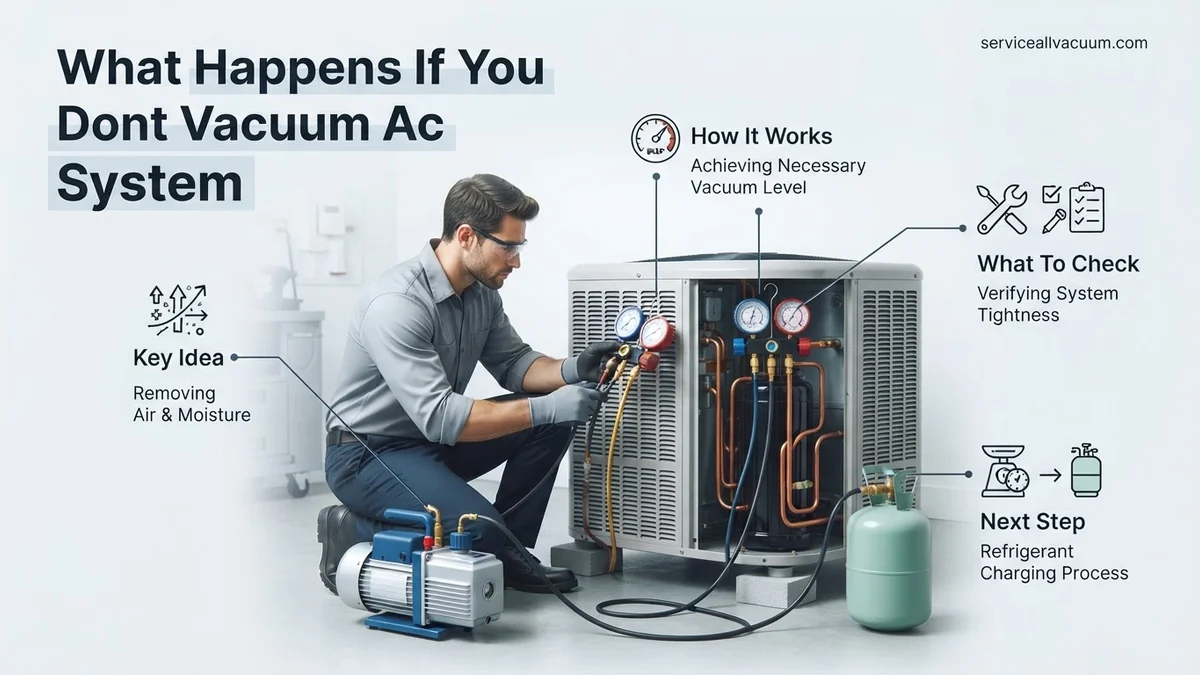
- Connect Vacuum Pump: A specialized vacuum pump is connected to the service ports of the AC system.
- Deep Vacuum Achievement: The pump runs until the system reaches and holds the specified deep vacuum level, often 200-500 microns. This can take several hours, depending on system size and ambient temperature, as moisture must be fully vaporized.
- Vacuum Hold Test: The system is then isolated from the pump, and the vacuum level is monitored for a minimum of 15-30 minutes. A rising micron reading indicates a leak, which must be located and repaired before proceeding.
- Refrigerant Charge: Only after a successful vacuum hold test is the precisely measured charge of refrigerant introduced.
This stringent process prevents compressor acid formation, ensures optimal heat transfer efficiency, and drastically extends the lifespan of all AC components, saving significant repair costs in the long run.
What If Your AC System is Already Contaminated?
If an AC system has been operated without proper evacuation, or if a severe failure (like a compressor burnout) has occurred, contamination is a certainty. This usually means the presence of moisture, non-condensable gases, and often, highly acidic oil or even particulate debris. Rectifying an already contaminated system is far more complex and costly than preventing it.
Contamination Remediation: A Multi-Step Approach
- System Assessment: A technician will analyze the refrigerant and oil for acidity, moisture content, and debris. This often involves specialized diagnostic tools prevalent in 2027.
- Component Replacement: Critically damaged components, such as the compressor, accumulator/drier, and expansion valve, are almost always replaced. These components are highly susceptible to damage from acidic refrigerant and moisture.
- System Flushing: The remaining lines and evaporator/condenser coils may require extensive flushing with a specialized flushing agent to remove all residual contaminants. This is a labor-intensive and expensive procedure, requiring specialized equipment.
- Multiple Evacuations and Filter-Drier Changes: After flushing, the system undergoes multiple deep vacuum evacuations, often with successive changes of the liquid line filter-drier, to ensure every trace of moisture and flushing agent is removed before a new refrigerant charge.
Neglecting these steps after contamination guarantees repeated failures and significantly shortens the lifespan of any newly installed components, leading to unnecessary financial strain.
What If It Still Doesn’t Work?
Even after meticulous evacuation and charging, sometimes an AC system may not perform optimally. If you’ve diligently followed all procedures and your system still underperforms, consider these advanced troubleshooting steps before calling a professional.
- Re-check Vacuum Hold: Reconnect your vacuum gauge. Run another deep vacuum to below 500 microns and perform a 60-minute hold test. A slow rise confirms a micro-leak that requires advanced detection.
- Advanced Leak Detection: Utilize an electronic leak detector (current models in 2027 are highly sensitive to HFC/HFO refrigerants) or a fluorescent dye kit to meticulously inspect all connections, welds, and coil surfaces. Leaks as small as 5 grams per year can compromise performance.
- Verify Refrigerant Charge by Weight: Ensure the refrigerant charge precisely matches manufacturer specifications, weighed to within ±10 grams using a digital charging scale. Both under- and over-charging significantly reduce efficiency.
- Inspect Electrical Components: Confirm proper operation of the clutch, pressure switches, and cooling fan. Use a multimeter to check for correct voltage and continuity at all relevant sensors and relays.
If these steps do not resolve the issue, professional diagnostic services are recommended. Expert technicians possess advanced tools, such as thermal imagers for coil analysis or advanced refrigerant sniffers, that can pinpoint obscure issues. Professional diagnosis and repair in 2027 typically range from $300 to $900, depending on the complexity of the problem and required component replacements.
Conclusion
The imperative to properly vacuum an AC system is unequivocally clear. Skipping this fundamental step invites catastrophic component failure, dramatically reduced efficiency, and exorbitant repair costs. According to verified research and expert sources from the HVAC industry, meticulous evacuation is the single most critical factor for ensuring system longevity and optimal performance. Always prioritize thorough evacuation to protect your investment and ensure reliable cooling for years to come.
❓ Frequently Asked Questions
Why is moisture so harmful inside an AC system?
Moisture reacts with refrigerant and oil to form corrosive acids that eat away at internal components. It can also freeze at the expansion valve, blocking refrigerant flow and causing system failure.
What exactly are non-condensable gases, and why are they a problem?
Non-condensable gases, primarily air, do not change state within the refrigeration cycle. They increase system pressure and temperature, overworking the compressor, reducing heat transfer efficiency, and causing higher energy consumption.
How does neglecting the vacuum process impact cooling performance and energy bills?
Without a proper vacuum, moisture and non-condensables impede the refrigerant’s ability to absorb and release heat efficiently. This forces the AC to run longer and harder to achieve the desired temperature, drastically increasing your energy bills and providing subpar cooling.
Can I simply add more refrigerant if my AC isn’t cooling well due to lack of vacuum?
No, adding more refrigerant without properly evacuating the system is detrimental. It will only add more contaminants (if the system was open to the atmosphere) or exacerbate existing issues, further stressing the compressor and accelerating system damage.
What are the long-term financial consequences of repeatedly skipping AC system vacuuming?
The long-term financial consequences include consistently higher energy bills due to inefficiency, frequent and expensive repairs for damaged components like the compressor or expansion valve, and ultimately, a significantly shortened system lifespan requiring premature, costly replacement.
Is it ever acceptable to skip vacuuming for a minor AC repair or recharge?
No, it is never acceptable to skip vacuuming any time the AC system is opened to the atmosphere, even for minor repairs. Exposing the system allows moisture and air to enter, necessitating a thorough vacuum to prevent the severe issues discussed.