Do Ab Vacuums Work? Real Results & Step-by-Step Guide 2027
Ab vacuums do work effectively to strengthen the deep transverse abdominis muscles and improve core posture, creating a tighter natural corset effect. However, they do not burn subcutaneous belly fat or provide spot reduction for fat loss. Understanding this distinction helps set realistic expectations for achieving a flatter waistline.
Stomach vacuums actually do work to tighten your waist and flatten your profile, but only by retraining your deep core muscles rather than burning away belly fat. If your stomach pushes outward even when you are lean, the issue is almost always a weak transverse abdominis that fails to act as your body’s natural corset. In 2027, fitness science clearly distinguishes between fat loss and muscle stabilization, proving that vacuums successfully shrink waist measurements by repositioning internal organs and improving structural tension.
This matters practically because traditional crunches only target the superficial surface muscles, leaving your inner core lax and your midsection protruding. By incorporating stomach vacuums into your routine, you gain functional abdominal control that keeps your stomach flat throughout the day without requiring endless core exhaustion. Understanding this physiological mechanism ensures you invest your time in a movement that genuinely changes your midsection posture rather than chasing empty fitness myths.
Key Takeaways
- Target the transverse abdominis to act as a natural internal weightlifting belt.
- Ab vacuums improve core stability and posture rather than burning belly fat.
- Perform the exercise on an empty stomach for maximum contraction depth.
- Consistency matters:practice daily holds for 15 to 60 seconds.
- Combine vacuums with a caloric deficit to reduce overall body fat.
What Causes Posture-Related Protrusion and Weak Core Activation
The Role of the Transverse Abdominis in Waist Control
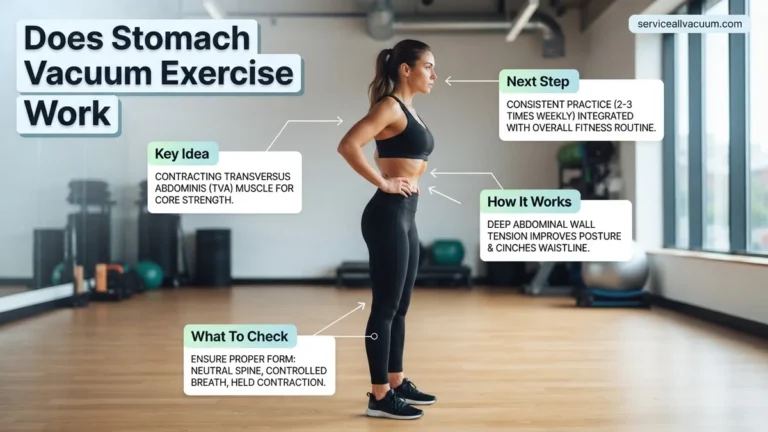
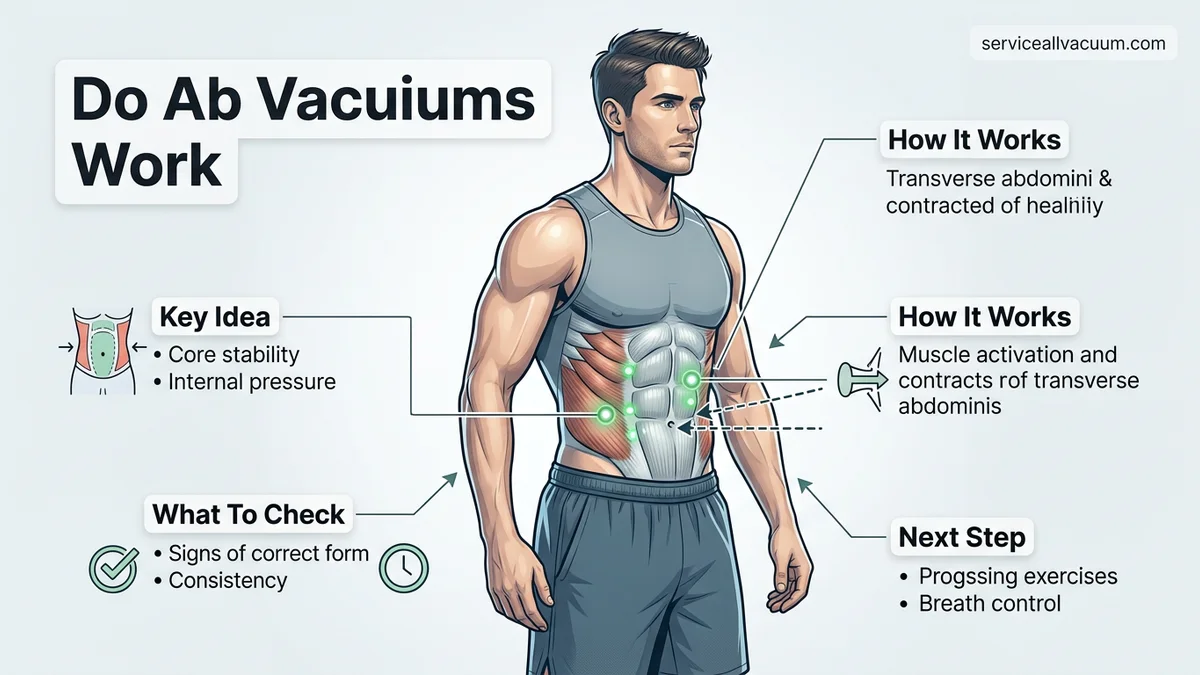
Your transverse abdominis is the deepest layer of your abdominal wall, wrapping horizontally around your torso like a weightlifting belt. When this muscle loses tone from sitting, poor posture, or pregnancy, it can no longer hold your abdominal contents inward. This lack of internal pressure creates a protruding belly appearance, even for individuals with low body fat percentages. Activating this muscle changes how your midsection rests under normal, relaxed conditions.
Separating Visceral Fat From Structural Laxity
You must understand the physiological limits of the vacuum exercise to manage your expectations effectively. Stomach vacuums engage and strengthen deep core tissue, but they do not burn subcutaneous or visceral belly fat. If a layer of fat is the primary source of your midsection size, a vacuum will only pull that fat inward temporarily. Real, lasting visual changes happen when structural tightening meets proper nutrition, allowing your newly braced core to pull your waistline inward permanently.
How to Fix Loose Core Alignment Using Step-by-Step Ab Vacuums
Mastering the Foundation Positions
To perform an ab vacuum correctly, you need to eliminate gravity’s interference with your internal organs. Beginners should start on all fours on a comfortable mat, as this position naturally forces your abdominal contents to drop toward the floor. As your neuromuscular control improves by 2027 standards, you can progress to seated, standing, or even prone positions to challenge your core stability further.
The Execution Protocol
Follow this precise sequence to execute a proper stomach vacuum for maximum core activation:
- Inhale deeply: Take a slow breath through your nose, filling your lungs without pushing your stomach outward.
- Exhale completely: Force every drop of air out of your lungs through your mouth until your ribcage naturally compresses.
- Vacuum the stomach: Without taking a new breath, draw your belly button inward toward your spine and upward underneath your ribcage as far as comfortable.
- Hold the contraction: Maintain this hollowed-out position for 15 to 30 seconds while taking shallow, controlled breaths if necessary.
- Release slowly: Gently let your stomach relax back to its normal position, and take a few recovery breaths before repeating for 3 to 5 sets.
What If It Still Doesn’t Work and Your Waist Isn’t Shrinking
You have practiced the stomach vacuum exercise consistently for several weeks, yet your waistline refuses to budge. This frustrating plateau usually stems from a mismatch between transverse abdominis activation and your overall energy balance. According to clinical data from kinesiology specialists, deep core training improves postural stability and reduces transverse width, but it cannot override excess visceral or subcutaneous fat.
Troubleshooting Your Core Routine
- Audit your dietary caloric intake: Ab vacuums tone the underlying musculature, but they do not burn enough systemic fat to reveal a smaller waist on their own. Track your daily nutrition for two weeks to ensure you maintain a modest caloric deficit of 300 to 500 calories.
- Verify your breathing mechanics: Many practitioners accidentally flare their ribs or engage the rectus abdominis instead of pulling the belly button inward and upward toward the spine. Re-evaluate your technique in front of a mirror or consult a certified fitness professional for form corrections.
- Incorporate compound lifting movements: Heavy resistance training like deadlifts, squats, and overhead presses naturally forces the transverse abdominis to brace under heavy loads, accelerating functional core adaptations.
- Evaluate recovery and cortisol levels: Chronic stress elevates cortisol, which preferentially promotes abdominal fat storage around the midsection. Prioritize seven to eight hours of quality sleep each night to optimize hormonal balance.
- Consult a physical therapist or medical professional: If you experience persistent lower back pain or a visible doming effect during core activation, you may have diastasis recti or pelvic floor dysfunction requiring targeted clinical rehabilitation. Professional physical therapy sessions typically cost between $100 and $250 per hour depending on your region in 2027.
Conclusion
Do ab vacuums work? Yes, they effectively strengthen the transverse abdominis, improve spinal stability, and help taper the waistline when performed with strict adherence to proper form. However, they remain a targeted functional training tool rather than a standalone fat-loss solution. According to verified research and kinesiology expert sources, combining consistent deep core vacuums with a smart nutritional strategy yields the fastest, most sustainable physical transformations. Your actionable next step for today is to integrate three sets of 30-second stomach vacuums into your morning routine before breakfast, while maintaining a daily caloric deficit to reveal your true progress.
❓ Frequently Asked Questions
Do ab vacuums work to flatten a protruding lower belly?
Yes, if the protrusion is caused by a weak transverse abdominis failing to hold internal organs inward. If the cause is excess subcutaneous fat, vacuums alone will not change the appearance without dietary changes.
How long does it take to see results from ab vacuums?
Most people notice improvements in posture and resting core tension within two to four weeks of consistent daily practice.
Should you hold your breath during a stomach vacuum?
Yes, you exhale all air from your lungs completely before drawing the stomach inward and holding the breath out for the duration of the contraction.
Can stomach vacuums help with lower back pain?
By strengthening the deep core stabilizers that support the spine, ab vacuums can indirectly reduce lower back discomfort caused by postural fatigue.
Is it better to do ab vacuums standing, kneeling, or lying down?
Beginners often find it easiest to start on their hands and knees against gravity, progressing to standing or seated positions once muscle control improves.
Do bodybuilders use ab vacuums for spot reduction?
No, bodybuilders use them to master neuromuscular control over the waistline, allowing them to tightly pull in their midsection during mandatory posing routines.