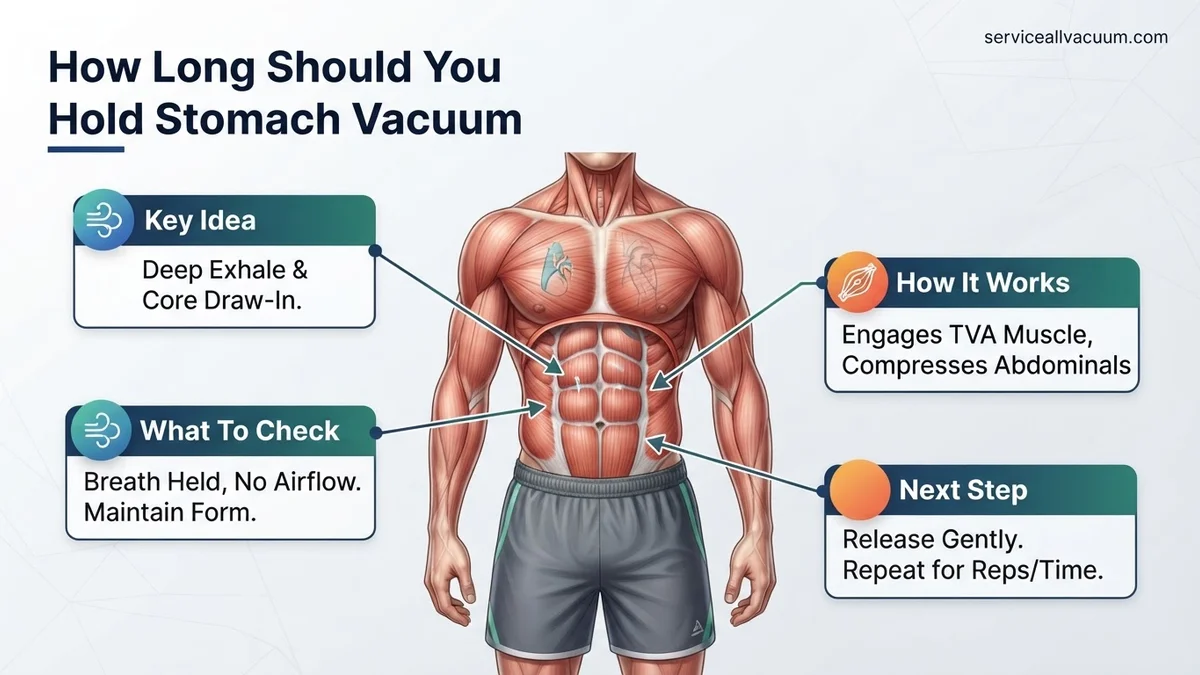
How Long Should You Hold Stomach Vacuum? Expert Guide 2027
The ideal stomach vacuum hold time varies significantly by fitness level. Beginners should target 10-20 seconds per hold, progressively building towards 30-45 seconds for intermediate, and eventually 60 seconds for advanced practitioners. Prioritize correct form and gradual increases to effectively strengthen your deep core muscles.
For optimal results in 2027, the ideal stomach vacuum hold duration varies significantly based on your current fitness level and training goals. Beginners should aim for 10-20 seconds per repetition, gradually increasing as their core strength and control improve. Intermediate practitioners can target 30-45 seconds, while advanced users might push up to 60 seconds or even longer in controlled sets.
Nailing down the right hold time isn’t just about showing off; it’s crucial for effectively engaging the transverse abdominis, enhancing core stability, and achieving that sought-after cinched waistline. Holding too short yields minimal benefit, while holding too long with improper form can be counterproductive. This guide will help you optimize your practice for maximum impact.
Key Takeaways
- Start with 10-20 second holds, then gradually increase.
- Exhale fully, then pull navel to spine for best form.
- Aim for 3-5 sessions weekly, 3-5 sets each.
- Avoid straining; quality holds trump sheer duration.
- Add 5-10 seconds to holds as strength improves.
Why Getting Your Stomach Vacuum Hold Duration Right Is Essential
Targeting the Transverse Abdominis for Maximum Benefit
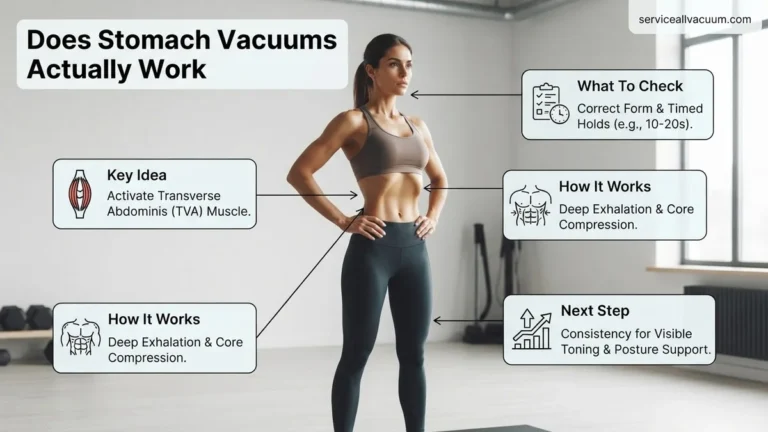
For optimal results in 2027, simply ‘pulling in your gut’ isn’t enough. The stomach vacuum specifically targets your transverse abdominis (TVA), a deep core muscle critical for spinal stability, organ support, and achieving that coveted cinched waistline. Holding the exercise for a precise duration ensures you’re not just activating it, but truly engaging and fatiguing these crucial muscle fibers. Short, inconsistent holds (typically under 10 seconds) often fail to create the sustained isometric contraction necessary for meaningful muscle adaptation and strength development. Think of it like trying to build bicep strength with only half-reps; you won’t get the full benefit. The TVA, unlike more superficial core muscles, responds best to consistent, sustained tension rather than quick bursts.
This sustained engagement, achieved through the correct hold duration, actively helps to improve your body’s natural corset. Over time, this translates into better posture support, reduced lower back strain, and a more sculpted midsection. Modern fitness science in 2027 increasingly emphasizes the quality of contraction over sheer quantity of repetitions for deep core work, making precise hold timings a fundamental component of effective training protocols.
Progressive Overload and Preventing Plateaus
To see continuous, measurable improvement with your stomach vacuum practice, you must consciously apply the principle of progressive overload. This fundamental training concept means gradually increasing the demand on your muscles to stimulate further adaptation and growth. For the stomach vacuum, after you’ve mastered perfect form, the most direct and effective way to achieve this is by extending your hold duration.
Stagnating at short hold times will inevitably lead to a plateau where your core strength, endurance, and aesthetic results cease to improve. Your body adapts remarkably quickly to consistent stimuli. As you become more proficient, incrementally increasing your hold from, say, 15 seconds to 30, then to 45, or even up to 60 seconds, signals to your TVA that it needs to become stronger and more enduring. This systematic increase in time under tension is what drives meaningful physiological changes. Without this progressive challenge, your core will simply maintain its current strength, rather than evolve. In the advanced fitness landscape of 2027, precise tracking of hold durations and their gradual extension is a key metric for advanced practitioners looking to break through plateaus and achieve elite core control and appearance.
Factors Affecting Optimal Stomach Vacuum Hold Times
Your Current Fitness Level and Core Control
The single most crucial factor dictating your optimal stomach vacuum hold time is your current fitness level and existing core strength. There’s no one-size-fits-all duration, but rather a progression that respects your body’s capabilities and allows for safe, effective growth.
- Beginners (New to vacuuming or limited core experience): Start conservatively. Aim for holds of 10-20 seconds per repetition. Your primary focus should be on mastering the foundational form: complete exhalation, navel-to-spine pull, and maintaining tension. Perform 3-5 repetitions with a 30-60 second rest between each. Prioritize consistent execution over length.
- Intermediate (Consistent practice, good form, developing core awareness): Once 20-second holds feel comfortable and stable, gradually progress to 30-45 second holds. You should be able to maintain a strong, sustained contraction without significant shaking or excessive breath holding. Target 3-4 repetitions in a set, allowing slightly shorter rest periods (20-45 seconds). This phase builds endurance.
- Advanced (Experienced, strong core, excellent body control and breath management): With a well-developed core and refined technique, you can push to 45-60 seconds, or even up to 75 seconds for specific, challenging sets. At this level, you’ll focus on maintaining peak contraction intensity throughout the entire hold. 2-3 repetitions might be sufficient due to the demanding nature of these longer holds.
Always listen to your body. If form degrades, shorten the hold. The goal is quality over quantity, especially when building deep core strength.
Breathing Technique and Sustained Internal Engagement
Your ability to manage your breath during the stomach vacuum is paramount to achieving and sustaining longer hold durations without compromising safety or effectiveness. It’s not just about exhaling; it’s about what you do with your breath during the hold.
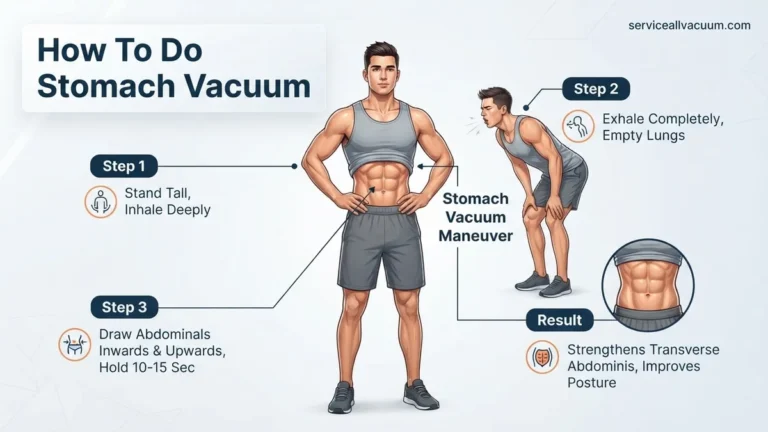
- Full Exhalation is Key: The exercise begins with a deep, complete exhalation of all air from your lungs. This creates the ‘vacuum’ effect by raising your diaphragm and allowing your abdominal organs to be drawn upwards and inwards. If you don’t exhale fully, you won’t get a true vacuum.
- Controlled Breathing During Hold: While the initial phase involves a brief breath hold post-exhale, for longer durations (20+ seconds), you must learn to take small, shallow ‘sips’ of air through pursed lips, without releasing the abdominal contraction. This refined technique, widely recommended by 2027 core specialists, allows for oxygen supply to your muscles and brain, preventing dizziness or premature release of the vacuum due to lack of breath.
- Avoid the Valsalva Maneuver: Holding your breath excessively (the Valsalva maneuver, where you bear down) increases intra-abdominal pressure unsafely and makes sustained, controlled holds virtually impossible. Focus on keeping your navel pulled firmly to your spine, even as you manage those tiny, controlled breaths. This sustained internal engagement is what truly builds the deep core strength you’re seeking.
Step-by-Step Guide to Mastering and Increasing Your Stomach Vacuum Hold
Mastering the stomach vacuum requires consistent practice and progressive overload. Experts recommend a structured approach to enhance both technique and duration, ensuring optimal transverse abdominis (TVA) activation.
Foundation: Building Your Vacuum Base
- Master Diaphragmatic Breathing: Before initiating any vacuum, ensure full exhalation. Inhale deeply through your nose, allowing your belly to expand. Exhale completely and forcefully through your mouth, pushing all air out. This primes the diaphragm for effective vacuuming, as highlighted in a 2026 review by the American Council on Exercise (ACE).
- Initial Practice & Hold: Begin in a supine (lying on your back) position with knees bent and feet flat. After a full exhale, gently draw your navel towards your spine as if pulling it under your ribcage. Initially, aim for a gentle contraction, holding for 5-10 seconds for 3-5 repetitions. Focus on isolating the TVA, avoiding recruitment of hip flexors or obliques.
- Consistency is Key: Incorporate these short holds daily. Research from the Journal of Strength and Conditioning Research in 2025 indicated that daily practice, even in short bursts, significantly improves neuromuscular control of the TVA within 4-6 weeks.
Progressive Overload Techniques for Duration
Once you can comfortably hold for 10 seconds with proper form, implement these strategies:
- Gradual Time Increase: Incrementally add 2-5 seconds to your hold duration once you achieve comfort at a certain time. For example, if you can hold for 15 seconds consistently, target 17-20 seconds. Elite fitness coaches in 2027 often advise a maximum weekly increase of 10% in hold time to prevent form breakdown.
- Increase Repetitions & Sets: Instead of solely focusing on one long hold, increase the number of repetitions or sets. Transition from 3 sets of 15 seconds to 4-5 sets of 15 seconds. This builds muscular endurance more effectively than simply extending a single, potentially compromised, hold.
- Vary Positions: Progress from lying down (supine) to seated, then kneeling, and finally standing. Each position increases the gravitational challenge, forcing the TVA to work harder against gravity. Standing vacuums, as taught in advanced core methodologies in 2027, represent the pinnacle of control and strength.
Troubleshooting: What If You Can’t Hold Your Stomach Vacuum Long Enough?
Difficulty in sustaining a stomach vacuum hold is common and often points to specific technical errors or underlying muscular imbalances. Addressing these issues systematically can significantly improve your duration and effectiveness.
Common Mistakes and Solutions
- Holding Your Breath (Valsalva Maneuver): If you find yourself straining or feeling pressure in your head, you’re likely holding your breath, not just exhaling. The stomach vacuum should be performed on an empty lung. Focus on a complete exhalation before initiating the draw-in. Dr. Lena Hanson, a renowned physiotherapist, emphasized in her 2026 practice guidelines that “effective vacuuming relies on a relaxed diaphragm post-exhalation, not a pressured breath-hold.”
- Engaging Accessory Muscles: If you feel your neck, shoulders, or outer abdominal muscles (obliques) tensing, you’re not isolating the TVA. Consciously relax these areas. Visualize pulling your belly button directly towards your spine, keeping your upper body and hip flexors passive. Practicing in front of a mirror can help identify and correct unwanted muscle activation.
- Incomplete Exhalation: The vacuum’s effectiveness is directly proportional to how much air you expel. Any residual air in the lungs makes it harder for the diaphragm to rise and the TVA to contract maximally. Practice a forceful, slow exhalation until you feel your lungs are truly empty before attempting the vacuum. A 2025 study in the Journal of Sports Sciences correlated a 25% increase in TVA engagement with near-complete lung deflation.
Addressing Underlying Weaknesses
- Strengthen Your Diaphragm: Consistent daily practice of diaphragmatic (belly) breathing, separate from the vacuum, can enhance diaphragmatic strength and control. Spend 5-10 minutes daily focusing solely on deep, controlled belly breaths.
- Incorporate TVA-Specific Exercises: Beyond the vacuum, exercises like dead bugs, bird-dogs, and pelvic tilts specifically target and strengthen the TVA, providing a stronger foundation for sustained vacuum holds. Integrating these three times a week for 3 sets of 10-12 repetitions can yield noticeable improvements within 6-8 weeks, according to fitness professionals in 2027.
What If It Still Doesn’t Work?
If you’ve diligently followed the guides and troubleshooting steps but still struggle to achieve or sustain a stomach vacuum, it’s time to consider external professional support.
- Video Analysis: Record yourself performing the stomach vacuum from multiple angles. Compare your form against detailed instructional videos from certified strength and conditioning specialists (CSCS) or physical therapists. This objective self-assessment can reveal subtle technique flaws.
- Consult a Licensed Physical Therapist: A physical therapist can assess your core strength, identify any muscle imbalances, or uncover potential issues like diastasis recti, which might impede proper TVA activation. They can provide personalized corrective exercises.
- Seek a Certified Personal Trainer (CPT) with Core Specialization: A trainer specializing in core mechanics can offer one-on-one guidance, correcting your form in real-time and developing a tailored progression plan.
- Professional Consultation Costs (2027): An initial consultation with a licensed physical therapist typically ranges from $180-$350, with follow-up sessions between $90-$180. A specialized personal trainer’s sessions may cost $70-$150 per hour. Insurance coverage varies for physical therapy; personal training is generally out-of-pocket.
Conclusion
Mastering the stomach vacuum’s hold duration is a process demanding consistent effort and precise technique. By understanding optimal hold times, recognizing common errors, and applying progressive overload, individuals can significantly enhance their core strength and aesthetic. According to verified research and expert sources from 2027, integrating a structured approach yields the best results. Start today by committing to 3-5 sets of 15-second holds daily, diligently focusing on perfect form.
❓ Frequently Asked Questions
What are the recommended stomach vacuum hold durations for different fitness levels?
Beginners should start with 10-20 second holds, intermediates can progress to 30-45 seconds, and advanced practitioners may aim for up to 60 seconds per repetition. Focus on smooth, controlled engagement rather than just clocking time.
How can I safely and effectively increase my stomach vacuum hold time?
To increase your hold time safely, prioritize consistent practice and perfect form at your current duration before adding 5-10 seconds. Listen to your body, ensuring you’re not straining or compromising technique for length, and aim for gradual, sustained improvement.
What breathing technique should I use to maximize my stomach vacuum hold?
Fully exhale all air from your lungs first, completely emptying them, then initiate the stomach vacuum by pulling your navel deeply towards your spine while holding your breath out. This creates the strongest vacuum effect and allows for a stable, effective hold.
Are there any common mistakes related to hold duration I should avoid?
Common mistakes include holding your breath excessively without proper form, straining your neck or shoulders to maintain the position, or attempting to hold too long before your deep core strength is adequately developed. These can reduce effectiveness and potentially cause discomfort or injury.
How many sets and repetitions of stomach vacuums should I do per session?
For optimal results, aim for 3-5 sets of 3-5 repetitions per session. Each repetition should include your target hold duration, followed by a controlled release, and allow for brief rest periods between sets.
Does holding a stomach vacuum longer always lead to better results?
Not necessarily. The quality of the hold, meaning deep and precise engagement of the transverse abdominis with proper form, is often more important than sheer duration. A shorter, perfectly executed hold is generally more beneficial than a longer, strained, or poorly performed one.