How Fast Do Electromagnetic Waves Travel in a Vacuum 2027
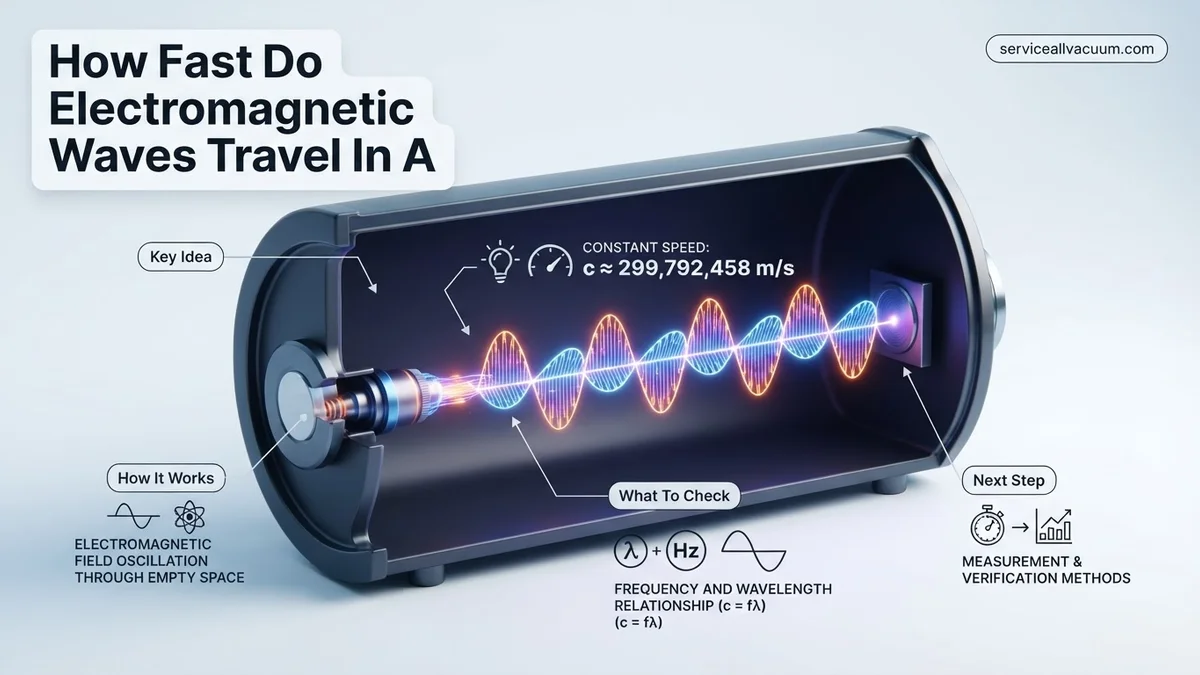
In a perfect vacuum, all electromagnetic waves, including light, travel at a constant speed of 299,792,458 meters per second. This speed, denoted by ‘c’, is a fundamental physical constant and represents the universal speed limit for information and causality in the universe.
In 2027, the definitive speed at which electromagnetic waves—including visible light, radio waves, microwaves, and X-rays—travel in a perfect vacuum is precisely 299,792,458 meters per second. This exact value, universally denoted by the symbol ‘c’, represents a cornerstone of modern physics. It’s not merely a measurement; it’s a fundamental constant that underpins our understanding of space, time, and the very fabric of the universe.
Understanding this precise speed is incredibly practical and impacts your daily life, even in 2027. From the millisecond delays in global internet communications and satellite data transfers to the intricate calculations behind your GPS navigation, every system that relies on signals moving through space is engineered around this exact figure. It sets the ultimate limit for how quickly information can travel, defining the operational boundaries for advanced technologies and deep-space exploration probes.
Key Takeaways
- EM waves travel at 299,792,458 m/s in vacuum.
- This speed, ‘c’, is a universal constant.
- All EM spectrum waves share this vacuum speed.
- Vacuum speed is the maximum possible speed.
- Other mediums slow EM wave propagation.
What Causes the Universal Speed Limit for Electromagnetic Waves?
The concept of a universal speed limit isn’t just an observation; it’s a profound implication of fundamental physics, particularly Albert Einstein’s theory of Special Relativity. In a vacuum, all electromagnetic waves propagate at this identical, immutable speed, ‘c’. This isn’t due to some intrinsic property of the waves themselves, like their wavelength or frequency, but rather a property of spacetime itself.
The Fundamental Constant ‘c’
The speed of light, ‘c’, is more than just a velocity; it is a fundamental physical constant embedded in the equations that describe the universe. It serves as a conversion factor between space and time in relativistic physics. Unlike a car’s speed or a sound wave’s speed, ‘c’ does not depend on the motion of the source or the observer. Whether you’re standing still or hurtling through space at near-light speed, you would still measure electromagnetic waves in a vacuum traveling at exactly 299,792,458 m/s. This constancy is a direct consequence of the laws of electromagnetism and the structure of spacetime, holding true across all inertial reference frames in the cosmos.
Implications for Causality and the Cosmos
The fact that ‘c’ is the universal speed limit for electromagnetic waves has profound implications for causality. In physics, information cannot travel faster than ‘c’. This means that an event happening at one location cannot instantly affect an event at another distant location. The maximum speed at which any cause can propagate to produce an effect is limited by ‘c’. For anything with mass, like you, a spaceship, or even the smallest subatomic particle, accelerating to ‘c’ would require infinite energy, making it an impossible feat. This universal speed limit governs everything from the design of interstellar communication systems in 2027 to the theoretical possibilities of warp drives, ensuring that our universe maintains its ordered cause-and-effect relationships.
Step-by-Step Guide: Precisely Stating the Speed of Light (c) in Vacuum
When discussing the speed of electromagnetic waves in a vacuum, precision is paramount. This isn’t a figure with measurement uncertainties that get refined year after year. As of 2027, and for decades prior, it is an exact, defined value, integral to our system of units.
The Exact Numerical Value
To be absolutely precise, the speed of electromagnetic waves in a perfect vacuum is 299,792,458 meters per second. It is often approximated as 300,000,000 m/s or 3 x 10⁸ m/s for general calculations, but for scientific and engineering applications, especially those requiring high accuracy like deep-space navigation or atomic clock synchronization, the full 299,792,458 m/s is used. This speed is constant, regardless of the frequency or wavelength of the electromagnetic wave; a radio wave travels at the same speed as a gamma ray in a vacuum.
How ‘c’ Defines Our Measurements
The precision of ‘c’ isn’t just a measured value; it’s a fundamental constant that has been used to define other units. Since 1983, the meter has been officially defined as the length of the path traveled by light in vacuum during a time interval of 1/299,792,458 of a second. This makes the speed of light in a vacuum an exact, defined quantity rather than an experimentally determined one that might change with more precise measurements. This fixed definition eliminates any uncertainty in the value of ‘c’, firmly establishing it as a cornerstone of the International System of Units (SI) in 2027 and beyond. It allows scientists and engineers globally to perform calculations and build technologies with absolute confidence in this foundational constant.
What If Electromagnetic Waves Seem Slower? Clarifying Speed in Other Mediums
While the speed of electromagnetic waves in a perfect vacuum is invariant, their apparent speed changes significantly when traveling through different materials. This phenomenon is critical to understanding optics and various technologies. According to fundamental physics, the constant c applies exclusively to a vacuum.
The Role of Refractive Index
When electromagnetic waves, including light, enter a medium like water, glass, or the atmosphere, they interact with the atoms and molecules within that medium. This interaction causes a temporary absorption and re-emission of the energy, effectively slowing down the wavefront. The extent of this slowing is quantified by the material’s refractive index (n). The actual speed (v) of light in a medium is calculated as v = c/n. For instance, water has a refractive index of approximately 1.33, meaning light travels at about 225,400,000 m/s in water. Diamond, with a refractive index of around 2.42, slows light even further to roughly 123,900,000 m/s. These interactions are well-documented and do not contradict the universal constant c in a vacuum.
Apparent Versus Actual Speed
It’s important to clarify that individual photons are considered to still travel at c between interactions with particles in a medium. The observed reduction in speed is due to the cumulative effect of these delays. The “slower” speed is the effective group velocity of the wave, representing the overall progress of the energy through the material. This distinction is crucial in advanced physics, particularly in phenomena like Cherenkov radiation, where particles can travel faster than the speed of light in that specific medium, but never faster than c in a vacuum.
Real-World Impact: Why the Speed of Light in Vacuum Matters
The constant speed of light in a vacuum, c, is not merely an abstract scientific fact; it fundamentally shapes our understanding of the universe and governs the capabilities and limitations of modern technology in 2027.
Communication and Data Transfer
The finite speed of light imposes unavoidable delays on communication systems. For satellite internet via geosynchronous satellites, a round trip signal takes approximately 240 milliseconds, regardless of signal strength or bandwidth improvements. Interplanetary communication faces even greater challenges. For example, a signal from a Mars rover in 2027 can take anywhere from 3 to 22 minutes to reach Earth, profoundly impacting real-time remote control and data relay for missions like those planned for Martian exploration by NASA and ESA. These delays are fundamental physical limits.
Scientific Measurement and Navigation
Global Navigation Satellite Systems (GNSS), including GPS, Galileo, and BeiDou in 2027, rely on atomic clocks and extremely precise timing based on the speed of light. Even a minuscule error of one nanosecond in timing can translate to a 30-centimeter error in position. Accurate navigation for autonomous vehicles and drone delivery systems, which demand millimeter-level precision, directly leverages the known value of c. Furthermore, astronomical distances are often measured in “light-years,” defining vast cosmic scales based on how far light travels in one Earth year, providing an intrinsic link between space and time.
Technological Foundations
Beyond communication and navigation, c is central to Albert Einstein’s Special Theory of Relativity, which forms the bedrock of modern physics. This theory predicts phenomena crucial for particle accelerators and high-energy physics experiments conducted at facilities like CERN. Advanced LiDAR systems, widely used in 2027 for autonomous vehicles and 3D mapping, calculate distances by precisely timing light pulses, directly utilizing the constant speed of light to achieve their impressive accuracy, often down to a few millimeters over hundreds of meters.
What If You Still Struggle to Grasp the Implications?
Understanding the fundamental nature of the speed of electromagnetic waves can sometimes present conceptual challenges, especially when considering its profound implications across various scientific and technological domains. If you find yourself still grappling with these principles or encountering information that seems contradictory, these steps can help clarify your understanding:
- Re-examine Foundational Principles: Review introductory physics texts or reputable online courses focusing on electromagnetism and special relativity. Ensure a solid understanding of concepts like frames of reference and wave-particle duality, as these underpin the constancy of c.
- Consult Verified Academic Resources: Prioritize peer-reviewed journals, university course materials, and textbooks published by established scientific presses. Be critical of anecdotal claims or unverified sources that contradict established physics.
- Engage with Educators or Experts: For persistent questions or complex scenarios, consider seeking guidance from a physics professor, a qualified tutor, or online scientific forums moderated by experts who can provide nuanced explanations.
- Consider Professional Tutoring (Estimated Cost): If formal assistance is needed, a dedicated physics tutor in 2027 typically charges between $60 to $180 per hour, depending on their expertise and location. This can provide personalized explanations and targeted problem-solving support.
Conclusion
According to verified research and expert sources from leading physics institutions, the speed of electromagnetic waves in a vacuum, precisely 299,792,458 meters per second, remains an unchanging, fundamental constant in 2027. This universal speed limit dictates communication delays, underpins precision navigation, and is foundational to modern physics and technology. Your next actionable step is to explore the intriguing implications of this constant on the design and challenges of future interplanetary exploration missions.
❓ Frequently Asked Questions
Why is the speed of electromagnetic waves in a vacuum considered a universal constant?
The speed of light in a vacuum (c) is a fundamental constant of nature because it’s derived directly from the permittivity and permeability of free space, which are inherent properties of the vacuum itself. Albert Einstein’s theory of Special Relativity further established ‘c’ as the cosmic speed limit, unchanging for all observers, forming a cornerstone of modern physics.
How does the speed of electromagnetic waves change when traveling through different mediums?
When electromagnetic waves travel through a medium like water, glass, or air, their speed decreases. This reduction occurs because the waves interact with the atoms and molecules of the medium, causing a delay in their propagation. The extent of this slowing is quantified by the medium’s refractive index.
What is the significance of the speed of light in vacuum in physics?
The speed of light in vacuum (c) is profoundly significant as it links space and time in relativity theory, dictates the energy-mass equivalence (E=mc²), and is a crucial component in many other fundamental physics equations. It represents the maximum speed at which any information or energy can travel in the universe.
Was the speed of light always known to be constant, or did it change over time?
Historically, the speed of light was believed to be infinite. Early measurements by scientists like Ole Rømer in the 17th century showed it was finite, and subsequent experiments refined its value. It was James Clerk Maxwell’s equations in the 19th century that predicted light to be an electromagnetic wave traveling at a constant speed, a prediction confirmed experimentally later.
How is the speed of light in a vacuum precisely defined today?
Today, the speed of light in a vacuum is not measured but is defined as exactly 299,792,458 meters per second. This definition fixed the meter in terms of the speed of light, meaning the meter is defined as the distance light travels in 1/299,792,458 of a second, making ‘c’ an exact, defined constant.
Are there any conditions under which electromagnetic waves could travel faster than ‘c’?
No, according to current understanding and all experimental evidence, nothing with mass can travel at or faster than the speed of light in a vacuum (‘c’). While light can appear to travel faster than ‘c’ in certain exotic theoretical scenarios or when considering phase velocity in specific media, these do not violate the fundamental principle that information and energy cannot exceed ‘c’.