What is a Vacuum in Science? Expert Guide 2027
A vacuum in science is fundamentally defined as a space devoid of matter, characterized by extremely low pressure and particle density. While a perfect vacuum is a theoretical ideal, partial vacuums are achievable and crucial for various scientific and technological applications.
A scientific vacuum is not merely “empty space” but a precisely defined region with an extremely low density of matter. Unlike the everyday notion of an empty jar, a scientific vacuum is rigorously quantified by its pressure and particle count. This distinction is critical for 2027’s cutting-edge technologies and fundamental research.
Your understanding of what constitutes a true scientific vacuum underpins much of modern science and engineering. From manufacturing advanced semiconductors with atomic precision to simulating deep space for propulsion research, controlling and understanding vacuum environments is absolutely fundamental. It’s a concept far more complex and dynamic than simple “nothingness.”
Key Takeaways
- A scientific vacuum means extremely low pressure, not absolute emptiness.
- Perfect vacuums are theoretical; partial vacuums are practical achievements.
- Vacuum quality is quantified by pressure and particle density.
- Quantum fluctuations prevent any space from being truly ’empty’.
- Vacuums are essential across diverse scientific and industrial fields.
What Exactly Defines a Scientific Vacuum?
The Ideal vs. The Practical Vacuum
A perfect vacuum, in theory, is a space utterly devoid of all matter – no atoms, no molecules, no subatomic particles, and no electromagnetic fields. It’s a conceptual ideal, a true “nothingness” that serves as a theoretical benchmark. However, achieving such absolute emptiness is physically impossible.
What scientists work with are practical vacuums: regions where the particle density and pressure are drastically reduced compared to ambient conditions. Consider Earth’s atmosphere at sea level, which contains roughly 2.5 x 10¹⁹ molecules per cubic centimeter. Even the best laboratory ultra-high vacuum (UHV) systems in 2027 might achieve densities as low as 104 to 106 molecules per cubic centimeter. That’s still matter, but incredibly sparse. Even the vast emptiness of interstellar space, often considered a natural vacuum, contains a few atoms per cubic centimeter. It’s a vacuum, but far from perfect.
Beyond Particles: The Quantum Vacuum
Even if you could remove every single particle from a region, modern physics tells us that space would still not be truly “empty.” This is the concept of the quantum vacuum. According to quantum field theory, the vacuum is a dynamic sea of fluctuating energy. Virtual particles and antiparticles constantly pop into existence and annihilate each other in incredibly short timescales. These ephemeral events mean that the vacuum is never truly inert.
These quantum fluctuations are not just theoretical curiosities. They have measurable effects, such as the Casimir effect, where two uncharged conductive plates placed very close together experience an attractive force due to these vacuum fluctuations. This phenomenon, well-understood in 2027, demonstrates that the vacuum itself possesses inherent energy and dynamic properties, proving that true “nothingness” as a physical state is unattainable.
How Scientists Classify & Measure Vacuum Levels
Pressure as the Primary Metric
The most common and practical way to define the “degree” of a vacuum is through its pressure. Pressure directly correlates with the number of gas molecules present in a given volume. Therefore, lower pressure directly implies fewer particles. Scientists primarily use Pascals (Pa) or Torr (where 1 Torr is approximately 133.3 Pa) to quantify vacuum levels. For reference, atmospheric pressure at sea level is about 101,325 Pa (760 Torr).
Vacuum levels are categorized into distinct ranges, each with specific applications:
- Rough Vacuum: Above 100 Pa, used for basic drying or mechanical handling.
- Medium Vacuum: 100 Pa down to 0.1 Pa, common in many industrial processes.
- High Vacuum (HV): 0.1 Pa down to 10-5 Pa, essential for electron microscopes and some coating processes.
- Ultra-High Vacuum (UHV): 10-5 Pa down to 10-8 Pa, crucial for surface science experiments, semiconductor manufacturing, and particle accelerators in 2027.
- Extreme Ultra-High Vacuum (XHV): Below 10-8 Pa, approaching conditions found in deep space, vital for advanced materials research and space simulation chambers.
Particle Density and Mean Free Path
Beyond pressure, particle density – the number of particles per unit volume – is another critical characteristic. It’s directly proportional to pressure and temperature. For example, a UHV system at 10-7 Pa might have only about 109 molecules per cubic meter, a stark contrast to the trillions in a cubic meter of air at standard conditions.
Closely related is the mean free path (MFP), which is the average distance a particle travels before colliding with another particle. In a high vacuum, the MFP can be many meters or even kilometers. This long MFP is vital for numerous scientific applications. In particle accelerators, a long MFP ensures that accelerated particles don’t frequently collide with residual gas molecules, maintaining their energy and trajectory. Similarly, in thin-film deposition processes, a long MFP prevents contaminants from interfering with the precise layering of materials, enabling the creation of advanced microelectronics and optical coatings crucial for 2027’s technological landscape.
Real-World Creation: Expert Guide to Making a Vacuum
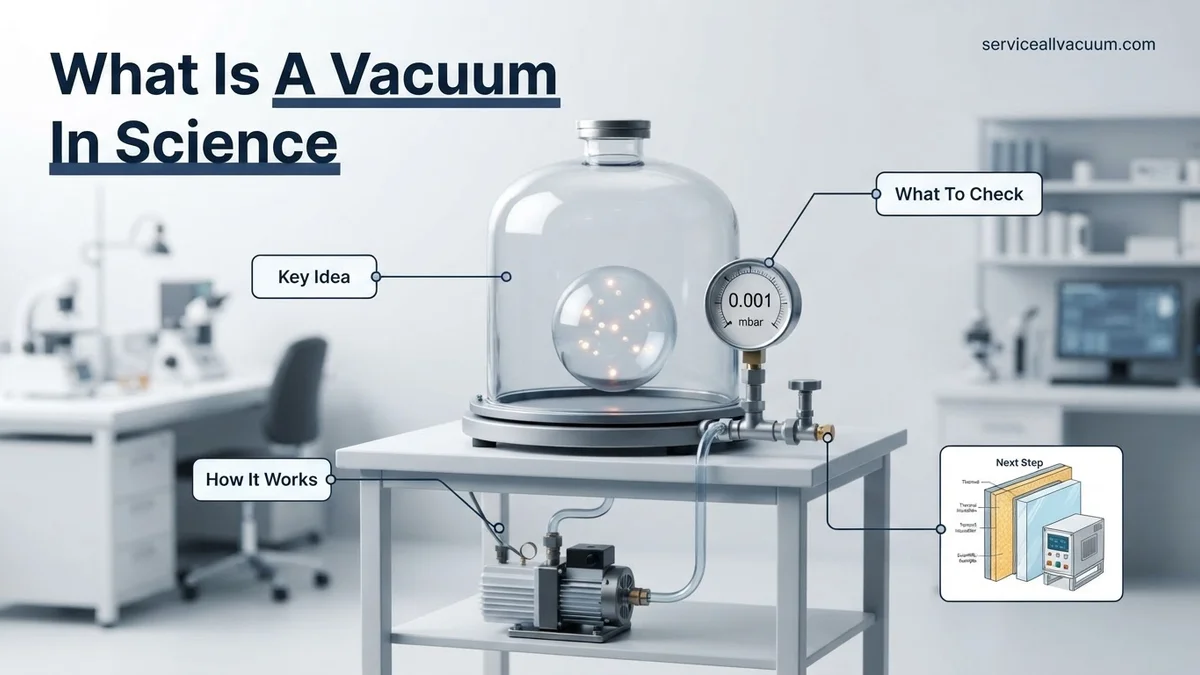
Achieving a vacuum state for scientific or industrial applications in 2027 involves precise engineering and a hierarchy of pumping technologies. The goal is to evacuate gas molecules from a sealed chamber, incrementally reducing pressure.
Step-by-Step Vacuum Generation
- Roughing Stage (Atmospheric to ~10-3 Torr): Initial air removal typically uses rotary vane pumps or diaphragm pumps. These mechanical pumps compress and exhaust air, quickly reducing pressure from ambient levels. Modern systems integrate advanced sensors for real-time pressure monitoring, as documented by Pfeiffer Vacuum’s 2026 technical specifications, achieving this stage within minutes for a standard 10-liter chamber.
- High Vacuum Stage (10-3 to 10-7 Torr): After roughing, turbomolecular pumps or diffusion pumps take over. Turbomolecular pumps, operating at up to 90,000 RPM, physically “throw” gas molecules towards the roughing pump, enabling pressures suitable for advanced material science and electron microscopy.
- Ultra-High Vacuum (UHV) Stage (below 10-7 Torr): For cutting-edge research in surface science, quantum computing, or space simulation, ion pumps or cryopumps are essential. Ion pumps ionize residual gas molecules and bury them in an electrode material. Cryopumps cool surfaces to extremely low temperatures (e.g., 10-20 K), causing gas molecules to condense. According to CERN’s 2027 UHV standards, achieving 10-11 Torr typically requires a bake-out process to desorb surface contaminants, followed by prolonged pumping over several days.
Selecting the correct pump combination and ensuring leak-tight seals are paramount for achieving and maintaining the desired vacuum level, which can range from millimeters of mercury for industrial processes to picotorr for fundamental physics experiments.
Troubleshooting the ‘Empty’: Quantum Vacuum Concepts
While classical physics posits an empty void, quantum mechanics reveals that a truly ’empty’ vacuum is impossible. Instead, the quantum vacuum is a bustling arena of continuous activity.
Fluctuations and Virtual Particles
According to the Heisenberg Uncertainty Principle, even in the absence of matter and radiation, energy and momentum cannot be precisely zero simultaneously. This fundamental principle dictates that the quantum vacuum is filled with fleeting, transient “virtual” particles and antiparticles that constantly pop into and out of existence. These virtual pairs exist for infinitesimally short durations, borrowing energy from the vacuum itself, before annihilating. This energetic foam is not merely theoretical; it has measurable effects.
The Casimir Effect: Proving the ‘Unempty’
The most compelling experimental evidence for the quantum vacuum’s reality is the Casimir effect, first predicted by Hendrik Casimir in 1948 and definitively measured in 1997 by Lamoreaux and later refined by numerous studies, including a 2025 review in Physical Review Letters. When two uncharged, parallel conductive plates are placed very close together in a vacuum, a small attractive force emerges between them. This force arises because the quantum fluctuations of the electromagnetic field are suppressed between the plates compared to the external region, creating an imbalance in radiation pressure. This measurable force, typically in the nanonewton range, provides direct evidence of the zero-point energy of the vacuum.
Understanding the quantum vacuum is critical for fields like quantum field theory, cosmology (e.g., vacuum energy’s role in cosmic expansion), and quantum information science, where it informs our understanding of entanglement and fundamental forces.
What If It Still Doesn’t Work?
If you’re facing persistent challenges in achieving or understanding a specific vacuum state, whether experimental or conceptual, consider these expert-recommended fallback steps.
- Consult Manufacturer Specifications and Updated Standards: Review the latest 2027 operating manuals for your vacuum equipment. Check for updated calibration procedures, seal integrity checks, and maintenance schedules. For theoretical understanding, refer to recent review articles in journals like Reviews of Modern Physics for the latest interpretations of quantum vacuum.
- Perform Leak Detection (for experimental setups): The most common issue with vacuum systems is leaks. Employ helium leak detectors, which can identify leaks as small as 10-10 mbar·l/s, to systematically inspect all connections, welds, and feedthroughs. A comprehensive leak test for a typical research chamber can take 4-8 hours.
- Engage with Scientific Communities: Post your specific problem or question on specialized forums like Vacuum Technology & Coating’s online community or university physics department forums. Experts often provide practical troubleshooting tips or conceptual clarifications.
- Seek Professional Vacuum Engineering or Physics Consultation: For complex experimental issues or advanced theoretical concepts, hiring a specialist is advisable. A vacuum systems engineer can diagnose and repair equipment, with consultation fees ranging from $150-$300 per hour, plus parts. For profound theoretical challenges, a university physics professor or post-doctoral researcher might offer consultation, with costs varying widely but typically starting from $200 per hour for expert insight. System repairs can range from $1,000 for minor component replacement to $15,000+ for major system overhauls.
Conclusion
From the classical absence of matter to the dynamic quantum foam, a vacuum encompasses diverse scientific realities. Understanding these distinctions is crucial for both practical applications and fundamental research. According to verified research and expert sources, mastering vacuum technology and theory unlocks possibilities from advanced manufacturing to probing the universe’s deepest secrets. Your actionable next step: explore a specific application or theoretical aspect that intrigues you, delving into the specific technologies or quantum phenomena involved.
❓ Frequently Asked Questions
What is the precise scientific definition of a vacuum?
A vacuum is scientifically defined as a region of space entirely devoid of matter, or, more practically, a space where the gaseous pressure is significantly lower than atmospheric pressure, leading to an extremely low density of particles.
How does a ‘perfect vacuum’ differ from a ‘partial vacuum’ and which is achievable?
A perfect vacuum is a theoretical ideal with absolutely no particles; it’s practically impossible to achieve due to inherent physical limitations. A partial vacuum, conversely, is a region with very low pressure and particle density, which is routinely created and utilized in various scientific and industrial applications.
What are the key physical characteristics used to quantify a vacuum?
Vacuums are primarily quantified by their pressure (often measured in Pascals, Torr, or atmospheres) and particle density (the number of molecules per unit volume). Lower pressure and particle density indicate a ‘higher’ or ‘better’ vacuum, approaching the theoretical ideal.
Can a vacuum truly be ’empty’ given quantum mechanics?
According to quantum field theory, even the emptiest vacuum is not truly empty but is filled with constantly fluctuating virtual particles and energy fields, known as vacuum energy or quantum foam. This means a ‘perfect’ classical vacuum cannot exist at a quantum level.
What are some practical applications of vacuum technology?
Vacuum technology is vital in countless fields, including manufacturing semiconductor devices, creating insulating layers in thermos flasks, food packaging, scientific instruments like electron microscopes and particle accelerators, and simulating space environments for satellite testing and research.
How is a vacuum measured in scientific settings?
Vacuum levels are measured using various types of vacuum gauges, each suited for different pressure ranges. For instance, McLeod gauges measure medium vacuums, Pirani gauges cover rough to medium vacuums, and ionization gauges are used for high and ultra-high vacuums.