What Is a Vacuum Space Expert Guide for 2026
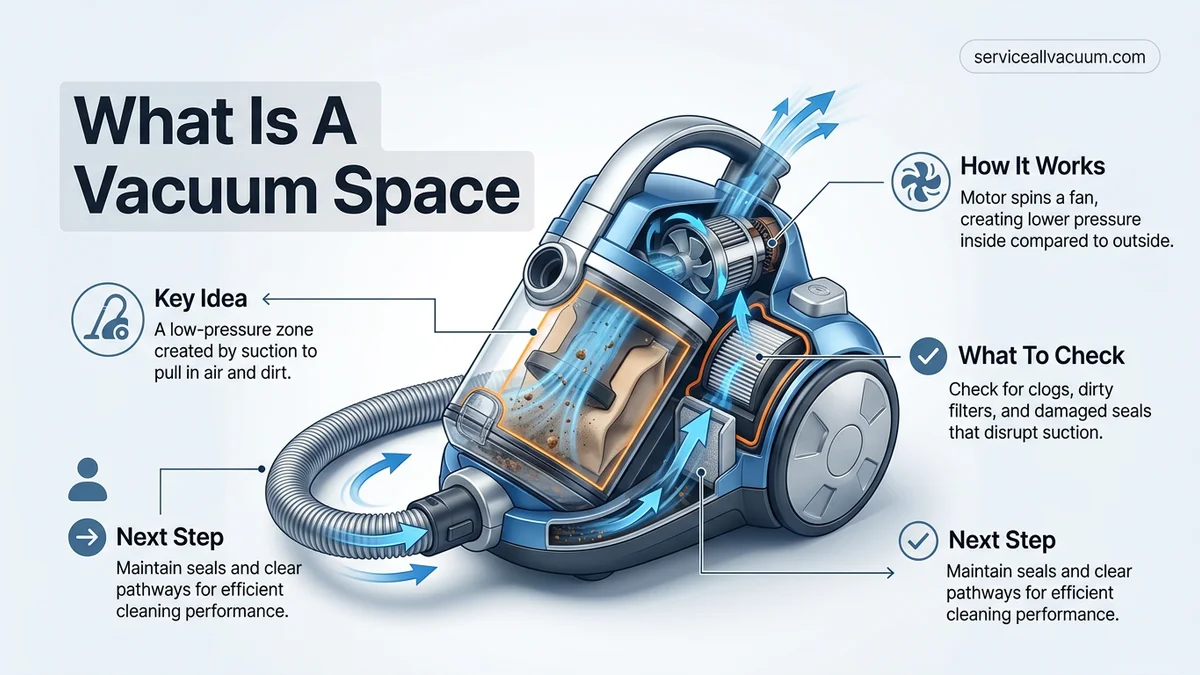
A vacuum space is fundamentally a volume of space that is entirely or partially devoid of matter, resulting in a gas pressure significantly lower than standard atmospheric pressure. While a theoretically perfect vacuum containing zero particles is practically impossible to achieve, both artificial laboratory setups and outer space come remarkably close.
A physical vacuum is a volume of space that is entirely or partially devoid of matter, meaning it contains virtually no atoms or molecules. In 2026, modern physics confirms that a truly “perfect” vacuum—a space with absolute zero particles—is practically impossible to achieve due to quantum fluctuations and the constant background presence of thermal radiation and electromagnetic fields.
Understanding this concept matters because vacuum technology drives modern innovation. From manufacturing computer microchips and fabricating advanced aerospace materials to powering fusion research and running particle accelerators, controlling the density of matter within a given space is a critical industrial and scientific necessity.
Key Takeaways
- A vacuum is defined as a space with a gas pressure lower than standard atmospheric pressure.
- A truly perfect vacuum is physically impossible to create due to quantum fluctuations and thermal radiation.
- Outer space is not truly empty; it contains sparse hydrogen atoms, plasma, magnetic fields, and starlight.
- Space does not literally ‘suck’ objects; higher pressure pushes matter toward areas of lower pressure.
- Vacuums are categorized by pressure levels, ranging from rough partial vacuums to extreme ultra-high vacuums.
What Causes Low Pressure and How a Vacuum Space Is Defined
The Mechanism of Pressure Reduction
To create a vacuum space, you must reduce the gas pressure inside a sealed container below the ambient atmospheric pressure at sea level (which is approximately 101,325 pascals or 760 Torr). This is typically achieved using specialized mechanical or chemical pumps that remove gas molecules from the enclosed volume. As you extract more particles, the density of the matter drops, and the mean free path—the average distance a molecule travels before colliding with another—increases dramatically. However, achieving a completely empty space remains out of reach because container walls continually outgas microscopic particles, and surrounding heat radiates into the enclosure.
Artificial Labs Versus Outer Space
It helps to distinguish between the artificial vacuums built in laboratories and the vast vacuum of outer space. While a high-end laboratory chamber can reduce particle counts significantly, it still contains vastly more matter per cubic centimeter than interstellar space. Yet, even deep space is not entirely empty. The cosmic vacuum contains:
- Trace gases, primarily sparse hydrogen and helium atoms drifting between star systems
- Free-floating subatomic particles and low-density plasma
- Cosmic microwave background radiation and high-energy photons
- Invisible dark matter and gravitational fields
How to Measure and Classify Different Types of Vacuum Spaces
Standard Vacuum Ranges and Classifications
Scientists and engineers categorize vacuum spaces based on how severely the pressure has been reduced compared to standard atmospheric conditions. Because the pressure scale spans many orders of magnitude, measuring a vacuum requires specialized instrumentation like ionization gauges, thermal conductivity gauges, and capacitance manometers. Different industrial applications require distinct vacuum levels to function correctly, ranging from basic packaging lines to extreme semiconductor manufacturing environments.
Key Vacuum Categories
- Rough or Low Vacuum: Ranges from 100 kPa down to about 1 kPa, commonly used in everyday industrial processes like food packaging and lifting heavy materials.
- Medium Vacuum: Spans from 1 kPa to 0.1 Pa, often utilized in freeze-drying operations and basic chemistry distillation setups.
- High Vacuum: Reaches from 0.1 Pa down to 10-5 Pa, essential for thin-film deposition, electron microscopy, and metallurgy.
- Ultra-High Vacuum (UHV): Extends below 10-5 Pa to less than 10-10 Pa, required for cutting-edge surface science and quantum computing hardware in 2026.
Step-by-Step Guide to Creating Artificial Vacuums in a Lab
Generating a high-vacuum or ultra-high-vacuum (UHV) environment requires specialized mechanical and physical equipment. Industrial processes and physics laboratories in 2026 rely on multi-stage pumping systems to eliminate atmospheric particles successfully.
1. Initial Roughing Stage
First, connect a rotary vane or scroll pump to your sealed chamber. This primary mechanical pump lowers the internal pressure from standard atmospheric pressure down to approximately 1 Pascal. This initial phase removes roughly 99 percent of the gas molecules present in the system.
2. High-Vacuum Transition
Next, activate a secondary high-vacuum pump, such as a turbomolecular pump or a diffusion pump. According to modern vacuum engineering standards, these devices spin at tens of thousands of RPM to physically strike gas molecules and drive them out of the chamber, achieving pressures down to 10-7 Pascal.
3. Bakeout and UHV Attainment
To reach ultra-high vacuum levels required for surface physics, technicians must heat the entire stainless steel chamber to roughly 150 to 300 degrees Celsius for 24 to 48 hours. This thermal bakeout forces trapped water vapor and hydrogen out of the metal walls so the ion pumps can permanently trap them.
What If Outer Space Still Contains Matter and Quantum Fields
Even though deep space is the closest natural approximation to a true vacuum, it is never completely empty. Modern astrophysics confirms that interstellar and intergalactic space contains trace matter, radiation, and quantum fluctuations.
Trace Matter and Particles
Deep space contains an average of about 0.5 to 1 hydrogen atom per cubic centimeter in the interstellar medium. Intergalactic space is even sparser, but it still holds stray photons, cosmic rays, and microscopic dust particles streaming from distant stars and supernovae.
Quantum Vacuum Fluctuations
At the subatomic level, quantum field theory dictates that a true zero-energy vacuum does not exist. Space is constantly boiling with virtual particles that continuously pop into and out of existence. These quantum fluctuations produce measurable physical phenomena, such as the Casimir effect.
What If It Still Doesn’t Work?
When attempting to achieve or maintain a stable vacuum state in laboratory settings, system failures are common. If your setup fails to reach target pressure, follow these troubleshooting steps:
- Check for Virtual Leaks: Inspect internal hardware components like screws, cables, and brackets that may trap tiny pockets of air, preventing the system from reaching high vacuum.
- Perform a Helium Leak Test: Spray helium gas around all external welds, viewports, and O-ring flanges while monitoring the system with a mass spectrometer leak detector.
- Replace Degraded O-Rings: Viton or elastomer seals can dry out, crack, or absorb moisture over time, requiring complete replacement with fresh, clean components.
- Bake Out Moisture: If base pressures stall in the medium-vacuum range, rerun the thermal bakeout protocol to eliminate stubborn water vapor trapped on chamber walls.
- Consult Professional Services: When pump failures or structural chamber defects persist, contact certified vacuum equipment engineers. Professional equipment servicing typically ranges from $1,500 to $5,000 depending on the scale of the system.
Conclusion
Understanding vacuum space requires looking beyond the simple absence of matter into the complex realities of thermodynamics and quantum mechanics. Whether engineering artificial ultra-high vacuum chambers for advanced semiconductor manufacturing or studying the vast, sparse expanses of deep interstellar space, controlling pressure remains a foundational pillar of modern physics. According to verified research and expert sources from leading technological institutes, mastering vacuum environments will remain critical for next-generation quantum computing and aerospace development through 2026 and beyond. Review your specific equipment manuals and establish a routine calibration schedule to maintain optimal vacuum integrity.
❓ Frequently Asked Questions
What is the scientific definition of a vacuum space?
Scientifically, a vacuum is a space where the pressure is lower than the standard atmospheric pressure at sea level. It is characterized by a very low particle density, meaning very few atoms or molecules occupy the given volume.
Why is a true, perfect vacuum impossible to achieve?
Even in the highest-grade artificial vacuum chambers, walls continuously release trapped gas molecules through outgassing. Furthermore, quantum mechanics shows that empty space constantly bubbles with virtual particle-antiparticle pairs.
How does the vacuum of outer space compare to laboratory vacuums?
Deep outer space features an extremely high vacuum with only a few hydrogen atoms per cubic centimeter. Some advanced laboratory chambers can actually achieve lower particle densities than interstellar space by using cryogenic and ion pumps.
How does pressure differential work in a vacuum?
A vacuum does not pull or suck objects toward it with an active force. Instead, the surrounding higher air pressure pushes matter into the lower-pressure region because gas molecules naturally expand to fill empty areas.
What are the different classifications of vacuums?
Vacuums are typically categorized by their pressure ranges, including rough or low vacuum, medium vacuum, high vacuum, and ultra-high vacuum (UHV), each requiring specialized equipment to achieve.
Do sound waves travel through a vacuum space?
No, sound waves require a medium like air, liquid, or solids to propagate through particle vibrations. Because a vacuum space lacks sufficient matter, acoustic waves cannot travel across it.