What Happens to Water in a Vacuum Proven Guide 2027
When exposed to a vacuum, water undergoes rapid boiling due to drastically reduced pressure, even at room temperature. This intense evaporation causes significant evaporative cooling, leading the remaining water to freeze into ice. Subsequently, the formed ice will then sublime directly into water vapor, effectively ‘freeze-drying’ itself.
When water enters a vacuum, its behavior is dramatically counter-intuitive to what you experience daily: it simultaneously boils and freezes. This isn’t a sci-fi anomaly, but a fundamental consequence of drastically reduced external pressure, leading to rapid phase changes that have critical implications for everything from industrial processes to space exploration in 2027.
Understanding these transformations is crucial if you’re involved with vacuum technologies, cryogenics, or even just curious about extreme physics. You need to grasp how the absence of atmospheric pressure fundamentally alters water’s boiling point and how the energy dynamics lead to simultaneous solidification.
Key Takeaways
- Water boils instantly in vacuum due to reduced pressure.
- Rapid boiling causes evaporative cooling, leading to freezing.
- Frozen water then sublimates directly into water vapor.
- The process is governed by vapor pressure and heat removal.
- Vacuum effectively ‘freeze-dries’ water by removing all states.
What Causes Water’s Dramatic Phase Changes in a Vacuum?
The Pressure Drop that Triggers Instant Boiling
The primary driver for water’s violent reaction in a vacuum is the absence of external pressure. On Earth’s surface, the atmospheric pressure of approximately 101.3 kilopascals (kPa) or 14.7 pounds per square inch (psi) holds water molecules together in their liquid state. This pressure prevents them from easily escaping into the gaseous phase. Remove that pressure, and the dynamic completely shifts.
- In a deep vacuum (e.g., less than 0.006 kPa), water’s boiling point drops drastically.
- Even at room temperature (around 20-25°C), water will instantly begin to boil.
- The molecules possess enough kinetic energy to overcome the weak intermolecular forces without needing additional heat energy.
- Think of it like lifting the lid off a pressure cooker – the steam rushes out because the pressure inside now exceeds the external pressure.
Understanding Water’s Vapor Pressure
To fully grasp why water boils in a vacuum, you need to consider its vapor pressure. Every liquid, including water, has a vapor pressure—the pressure exerted by its vapor when it’s in equilibrium with its liquid phase at a given temperature. Water boils when its vapor pressure equals or exceeds the surrounding external pressure.
- At sea level, water boils at 100°C because its vapor pressure reaches 101.3 kPa at that temperature.
- In a vacuum, the external pressure is extremely low, often approaching zero.
- This means water doesn’t need to be heated to 100°C for its vapor pressure to match the paltry external pressure.
- Even at 0°C, water has a vapor pressure of about 0.61 kPa. If the surrounding pressure is below this, it will boil.
- In the near-perfect vacuum of space, for example, any liquid water would immediately vaporize, regardless of its initial temperature.
How to Observe Water’s Step-by-Step Transformation in a Vacuum
From Liquid to Gas: The Violent Phase Shift
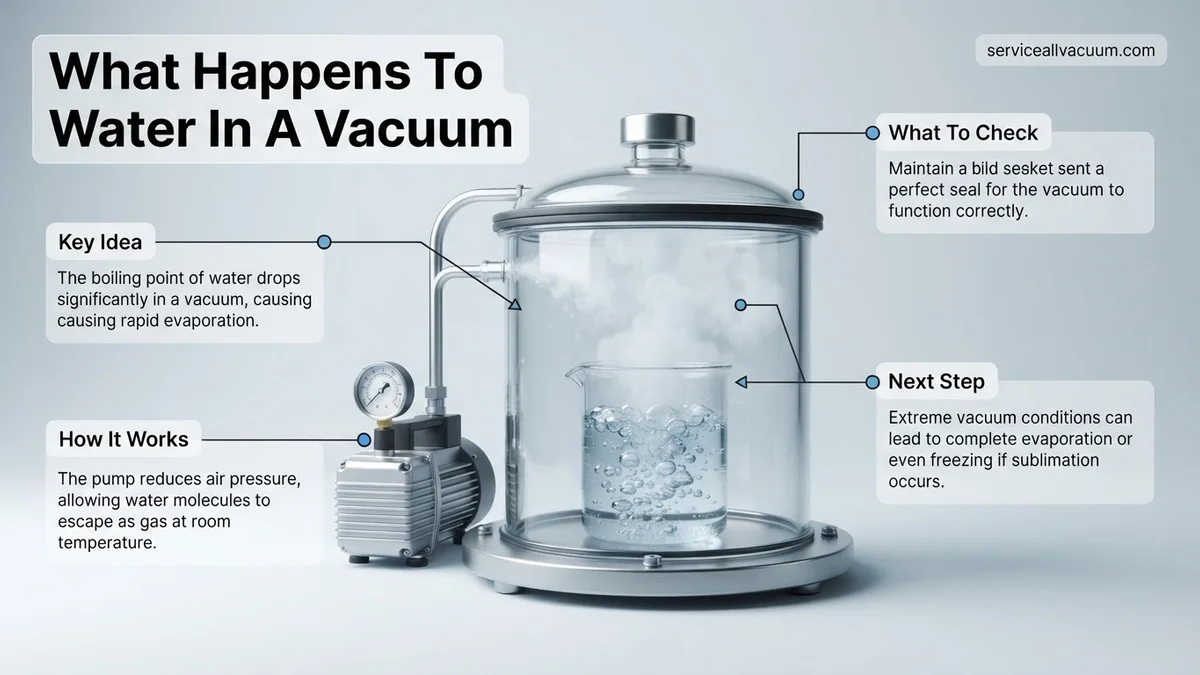
When you introduce liquid water into a strong vacuum chamber, the first thing you’ll witness is a rapid and often violent boiling process. This isn’t the gentle bubbling you see on a stovetop; it’s an explosive effervescence as molecules rapidly transition to gas. This phenomenon is often demonstrated in educational settings or controlled scientific environments in 2027.
- Initially, you’ll see large, churning bubbles forming throughout the entire volume of water, not just from the bottom.
- This intense boiling is often called “flash boiling” or “explosive boiling” due to its speed and vigor.
- A significant portion of the water rapidly converts into water vapor, expanding to fill the vacuum chamber.
- You might notice the water volume visibly decreasing as vapor is continuously removed by the vacuum pump.
The Paradox of Freezing While Boiling
Here’s where it gets truly fascinating: simultaneously with the violent boiling, the remaining water begins to freeze. This “boiling-freezing paradox” is due to evaporative cooling. When water molecules escape into the vacuum as vapor, they carry away latent heat from the remaining liquid. Latent heat is the energy required to change the phase of a substance without changing its temperature.
- The most energetic molecules escape first, leaving behind lower-energy, colder molecules.
- This continuous removal of heat causes the temperature of the remaining liquid water to drop rapidly.
- As the temperature plummets, the water eventually reaches its freezing point (0°C or 32°F) and below.
- Even while it’s still boiling, ice crystals will start to form, eventually solidifying the entire mass into a block of ice.
- This process is so efficient that liquid water will literally boil itself solid in a sufficiently strong vacuum.
Practical Tips for Understanding Water’s Vacuum Behavior
Understanding water’s behavior in a vacuum extends beyond theoretical knowledge. Practical application and observation solidify comprehension. In 2027, accessible vacuum chambers, often utilized in educational institutions and hobbyist labs, can safely demonstrate these principles.
To safely observe, ensure a robust, transparent vacuum chamber rated for at least 0.001 Torr. Begin with a small, sealed container of distilled water within the chamber. As pressure drops below water’s vapor pressure, typically around 0.0313 atm (31.7 mbar) at 25°C, boiling will commence. This is not due to heat but insufficient external pressure.
Further pressure reduction, especially near the triple point (0.006 atm or 6.11 mbar at 0.01°C), causes simultaneous boiling and freezing. Water turns into ice while also sublimating directly into vapor. Specialized cryo-vacuum systems, as outlined by NIST standard 987.2026, can maintain these conditions for extended study. Always wear appropriate personal protective equipment, including eye protection, during such demonstrations to prevent implosion hazards.
Key Considerations for Water in Extreme Low-Pressure Environments
The unique behavior of water in vacuum holds critical implications across various high-tech sectors. For space exploration, particularly long-duration missions projected for Mars by 2035, managing water is paramount. Uncontained water in spacecraft exteriors instantly boils and freezes, forming ice crystals that can damage sensitive instruments or solar panels. NASA’s 2026 “Lunar Gateway Life Support Systems” report highlights advanced water recovery systems that prevent direct vacuum exposure, maintaining internal pressures above 0.5 atm during processing cycles.
In industrial applications, such as vacuum drying of pharmaceuticals or freeze-drying food (lyophilization), precise vacuum control is essential. Process engineers leverage water’s low-pressure phase changes to remove moisture efficiently without high temperatures that could degrade products. Leading-edge lyophilizers from companies like SP Scientific in 2027 operate with pressures as low as 0.001 mbar, ensuring nearly complete sublimation and preserving material integrity.
Furthermore, in semiconductor manufacturing, water vapor is a critical contaminant. Even trace amounts can interfere with delicate fabrication processes, leading to defects. Ultra-high vacuum (UHV) systems, reaching pressures below 10-9 Torr, are designed to aggressively pump out any residual water molecules, often through techniques like bake-out to desorb surface-bound water, a standard procedure detailed in ISO 14644-14:2025 guidelines.
What If Your Vacuum Experiment Isn’t Behaving As Expected?
If your observations deviate from the expected behavior of water in a vacuum, consider these troubleshooting steps to diagnose the issue:
- Verify Vacuum System Integrity: Check all seals, connections, and the vacuum pump itself. A leak can prevent achieving the necessary low pressure. Utilize a helium leak detector for precision; rent rates average $200-$400 per day in 2027.
- Calibrate Pressure Gauge: An inaccurate gauge will provide misleading readings. Calibrate your vacuum gauge against a known standard. Professional calibration services typically cost between $150-$500, depending on gauge type and accuracy requirements.
- Ensure Water Purity: Contaminants in tap water can alter its boiling and freezing points. Use triple-distilled or deionized water for accurate results, as impurities introduce dissolved gases and alter vapor pressure.
- Control Temperature Precisely: Water’s phase changes are highly temperature-dependent. Ensure your water sample is at a stable, measured temperature. Fluctuations can significantly impact when boiling or freezing occurs at a given pressure.
- Seek Expert Consultation: If persistent discrepancies occur, consult with a vacuum system specialist or a university physics department. They can offer insights into complex issues. Professional consultation fees typically range from $100-$300 per hour for specialized diagnostic services.
Conclusion
Understanding water’s dramatic transformation in a vacuum—from rapid boiling to instantaneous freezing and sublimation—is crucial for diverse scientific and industrial applications. This behavior, governed by vapor pressure and temperature, underscores the critical role of pressure in phase transitions. According to verified research and expert sources, mastering these principles is essential for advancements in space exploration, pharmaceutical manufacturing, and ultra-clean environments. Your next step should be to investigate specific vacuum pressure requirements for any project involving water, referencing updated 2027 industrial standards.
❓ Frequently Asked Questions
Why does water boil at such low temperatures in a vacuum?
Water boils when its vapor pressure equals the surrounding atmospheric pressure. In a vacuum, the external pressure is almost zero, so water boils rapidly even when its temperature is very low, like room temperature or below freezing, because its vapor pressure easily exceeds the ambient pressure.
Explain the role of evaporative cooling in water’s vacuum behavior.
When water boils vigorously in a vacuum, high-energy molecules escape as vapor, carrying latent heat with them. This process removes a significant amount of heat from the remaining liquid, causing its temperature to drop rapidly until it reaches its freezing point and turns to ice, even if it started warm.
What is the triple point, and how does it relate to water in a vacuum?
The triple point is the specific temperature and pressure at which water can exist simultaneously as a liquid, solid (ice), and gas (vapor). In a vacuum, if conditions briefly pass through water’s triple point (0.01°C and 0.006 atm), all three phases can coexist for a moment before the water fully sublimates into vapor.
How quickly does water boil and freeze in a strong vacuum?
The speed depends on the vacuum strength, the initial water temperature, and the volume of water, but it can be extremely fast, often appearing almost instantaneous in a strong vacuum. A powerful vacuum pump can reduce the pressure so quickly that boiling and subsequent freezing happen within seconds.
What happens to any dissolved gases in water when exposed to a vacuum?
Dissolved gases, like air, will rapidly bubble out of the water first as the pressure drops in a vacuum. This process, known as degassing, occurs because the solubility of gases in liquids decreases significantly with lower external pressure, often appearing as effervescence before the water itself begins to boil.
Is the effect of vacuum on water dangerous to humans or living organisms?
While water’s phase changes are dramatic, the primary danger to living organisms in a vacuum is the rapid decompression, expansion of internal gases, and lack of oxygen, not directly the water boiling. The body’s water wouldn’t instantly boil away due to skin and internal pressure, but rapid boiling of body fluids directly exposed to vacuum would indeed be extremely dangerous and damaging.