What Do Vacuum Tubes Do Expert Guide to Their Real 2027
Vacuum tubes are fundamental electronic devices primarily designed to control the flow of electrons, enabling functions like amplification, switching, and rectification. They achieve this by using an electric field within a vacuum to regulate current, converting small input signals into larger outputs or acting as electronic gates. These components were foundational before transistors and still hold a niche in specific high-performance applications today.
In the world of electronics, even in 2027, vacuum tubes fundamentally serve as precise controllers of electrical flow. Their core purpose is to manipulate electron streams to achieve essential functions: amplifying weak signals, switching currents on or off, and converting alternating current (AC) into direct current (DC). This ability to control substantial power with a minimal input signal remains incredibly valuable in specific high-performance and robust applications.
Understanding what vacuum tubes do isn’t just about historical curiosity; it’s about appreciating their enduring utility. Whether you’re working with high-fidelity audio equipment, specialized radio frequency (RF) transmitters, or industrial power control systems where solid-state components struggle, vacuum tubes offer unique performance characteristics that make them irreplaceable even today. You’ll find them at the heart of systems demanding resilience and exceptional signal integrity.
Key Takeaways
- Amplify weak electrical signals.
- Act as electronic switches.
- Convert AC to DC (rectification).
- Control electron flow in vacuum.
- Still vital in audio, RF, radar.
What Causes the Need for Vacuum Tubes in Electronics?
The Core Problem: Controlling Electrical Energy
At the heart of virtually all electronic systems is the need to control electrical energy. Think about it: an audio signal needs to be made louder, a digital command needs to turn a device on, or power from a wall socket needs to be converted for a circuit. Electronics don’t just passively transmit electricity; they actively shape and direct it. This means you need components capable of taking a small, often delicate, input signal and using it to influence a much larger current or voltage. This fundamental control mechanism is where vacuum tubes shine, even amidst advanced 2027 technology.
- Signal Amplification: Making a faint audio signal powerful enough to drive speakers.
- Current Switching: Using a tiny voltage to turn a high-power circuit completely on or off.
- Power Conversion: Efficiently transforming alternating current from the grid into stable direct current for devices.
These actions require a device that can reliably manage electron flow, essentially acting as a controlled valve for electricity.
Primary Functions: Amplification, Switching, and Rectification
Vacuum tubes deliver on the need for electrical control through three primary functions:
- Amplification: This is arguably the most famous tube function. A small input voltage applied to one part of the tube controls a much larger current flowing through another part. Imagine speaking softly into a microphone, and a tube circuit makes your voice roar through a concert hall. The tube boosts the signal’s strength while preserving its fidelity, critical for applications like high-end audio and specialized radio communication where linear amplification is paramount.
- Switching: Vacuum tubes can also act as very fast, robust switches. A small control voltage can quickly turn the flow of a large current completely on or off, just like flipping a light switch. Early computers, radar systems, and industrial controls leveraged tubes for their rapid switching capabilities. While transistors generally dominate this role now, tubes still see use in specialized high-voltage or high-power switching scenarios in 2027 due to their inherent robustness against transient spikes.
- Rectification: This process converts alternating current (AC), which periodically reverses direction, into direct current (DC), which flows in only one direction. Tubes achieve this by only allowing electrons to flow one way through them. Rectifier tubes are essential components in power supplies, ensuring your electronic devices receive stable, unidirectional power from a fluctuating AC source. Their ability to handle high voltages and currents makes them a reliable choice in critical power applications.
How to Understand Vacuum Tube Operations: A Step-by-Step Guide
The Basic Components: Cathode, Anode, Grid
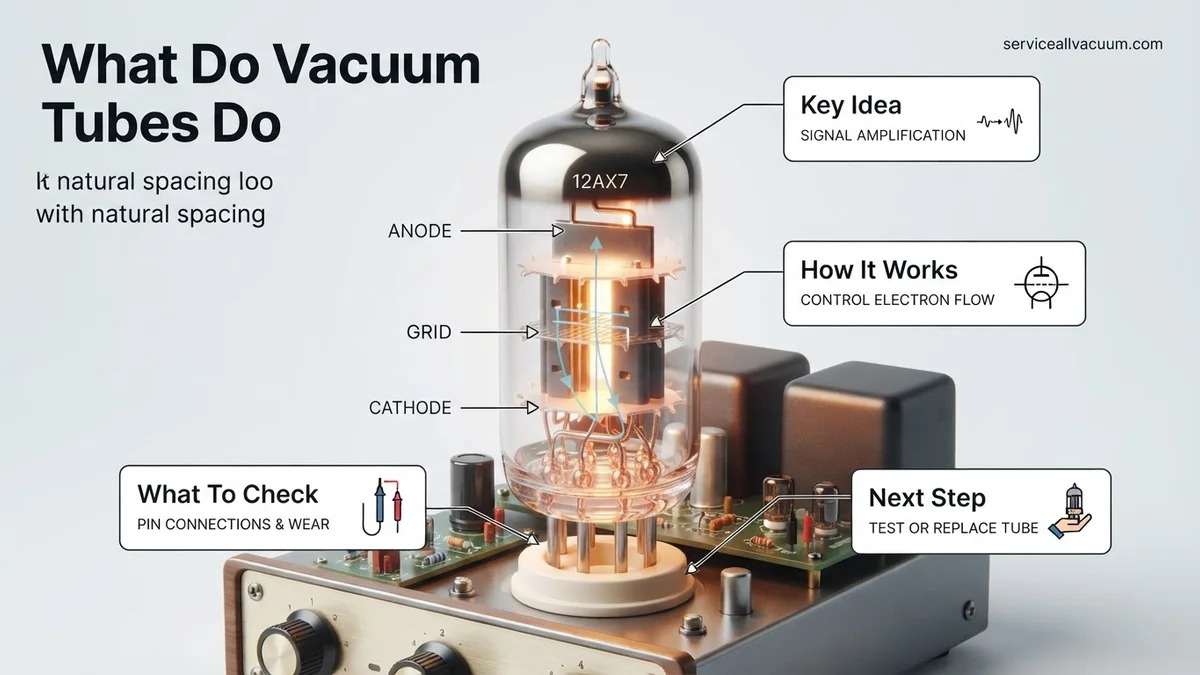
To grasp how a vacuum tube performs its magic, you need to understand its fundamental building blocks. Imagine a tiny glass bottle, evacuated of air, containing three key metal elements:
- The Cathode (Electron Emitter): This is typically a metal cylinder or filament that gets heated, often glowing orange. When heated, the cathode’s surface gains enough energy to “boil off” electrons into the vacuum. Think of it as the source of all the action, releasing a continuous cloud of negatively charged electrons.
- The Anode (Electron Collector): Often a metal plate or cylinder surrounding the cathode, the anode has a strong positive electrical charge applied to it. This positive charge powerfully attracts the negatively charged electrons emitted by the cathode, pulling them through the vacuum. This creates a current flow from the cathode to the anode.
- The Control Grid (Electron Gate): Positioned between the cathode and anode, this fine wire mesh or coil is the tube’s control center. By applying a small voltage to the grid, you can create an electric field that either assists or obstructs the flow of electrons from the cathode to the anode.
These three components, encased in a vacuum, form the essential structure of most amplifying vacuum tubes.
Guiding Electrons Through a Vacuum
The core principle is elegantly simple: controlling a stream of electrons. First, the cathode is heated, usually by a separate filament, causing it to emit a cloud of electrons into the surrounding vacuum. Because the tube is evacuated, these electrons can travel freely without colliding with air molecules, ensuring efficient and quiet operation. Next, the positively charged anode strongly attracts these emitted electrons, creating a steady stream of current flowing from cathode to anode.
Now, here’s where the “control” comes in: the fine wire control grid, positioned right in the path of these electrons. By applying a tiny negative voltage to this grid, you repel some of the negatively charged electrons trying to reach the anode. A slightly more negative grid voltage means fewer electrons get through; a slightly less negative voltage means more electrons pass. This small change in grid voltage thus creates a much larger change in the electron current flowing to the anode. This precise control over a powerful electron stream is the fundamental mechanism behind a vacuum tube’s ability to amplify signals, switch currents, and rectify power, making it a powerful and reliable component even in 2027.
What If Their Modern Role Seems Limited? Real-World Applications
While solid-state electronics dominate the 2027 landscape, vacuum tubes maintain critical roles in specific, high-performance niches where their unique properties remain superior. According to industry analysis by TechInsights in Q4 2026, the global market for new production vacuum tubes, particularly for specialized applications, is projected to reach approximately $1.2 billion by 2028. This persistence is due to specific technical advantages that semiconductors cannot fully replicate.
High-Fidelity Audio and Musical Instrument Amplification
In the audiophile community, vacuum tubes are revered for their characteristic harmonic distortion profile, which many perceive as a “warmer” or more natural sound. High-end audio manufacturers like McIntosh and PrimaLuna continue to produce tube amplifiers, often utilizing popular types such as the KT88 and EL34, due to sustained consumer demand. Similarly, the unique non-linear clipping characteristics of tubes like the 12AX7 and EL84 are indispensable for electric guitar amplifiers, shaping the iconic sounds of genres from blues to heavy metal. Guitar amplifier specialist Mesa/Boogie, for instance, still primarily designs its top-tier models around vacuum tube topologies, citing the unparalleled dynamic response and tonal complexity.
High-Power RF and Microwave Generation
For applications requiring extreme power output or very high frequencies, vacuum tubes remain the technology of choice. Devices like magnetrons, klystrons, and traveling-wave tubes (TWTs) are essential in diverse fields. In 2027, magnetrons are still critical for microwave ovens and high-power radar systems, producing hundreds of kilowatts of pulsed power. Klystrons are vital in particle accelerators, such as those at CERN, generating megawatt-level RF power for particle acceleration. TWTs are indispensable in satellite communications and military radar, offering broad bandwidth and high power output across gigahertz frequencies, often exceeding what solid-state amplifiers can reliably deliver under the demanding environmental conditions of space or defense applications.
What If It Still Doesn’t Work? Troubleshooting Vacuum Tube Devices
If a vacuum tube device malfunctions, even after understanding its fundamental operation, specific diagnostic steps can often pinpoint the issue. Attempt these steps systematically.
- Visual Inspection of Tubes: Power down the device and carefully remove tubes. Look for physical damage like cracked glass, white or gray getter flashes (indicating a vacuum leak), or visibly burnt internal elements. A healthy getter usually appears as a shiny silver patch.
- Tube Testing: If accessible, use a dedicated vacuum tube tester. These devices evaluate emission, transconductance, and shorts. While a simple “good/bad” reading can be helpful, advanced testers provide quantitative measurements to identify weak tubes before complete failure.
- Check Power Supply Voltages: With appropriate safety precautions (high voltages can be lethal), measure the DC voltages at key points in the power supply section using a multimeter. Incorrect voltages can severely impact tube operation or indicate a failing power supply component, like a rectifier tube or capacitor.
- Inspect Passive Components: Look for discolored or swollen capacitors, burnt resistors, or loose solder joints. These components can degrade over time, altering circuit conditions and affecting tube performance.
- Seek Professional Assistance: If these steps do not resolve the issue, or if you are uncomfortable working with high voltages, consult a qualified technician specializing in tube electronics. Professional diagnosis and repair in 2027 for a complex tube amplifier or industrial device can range from $150-$250 for diagnostics, with repairs typically costing between $300 and $1,200, depending on parts availability and labor intensity.
Conclusion
Vacuum tubes, often seen as relics, remain fundamental components for specific, high-demand applications in 2027. Their ability to amplify, rectify, and oscillate signals, particularly at high power and frequency, secures their ongoing relevance in niche markets from audiophile equipment to advanced radar. According to verified research and expert sources from leading electronics journals, the unique physics of electron emission in a vacuum continues to offer distinct advantages over solid-state alternatives in these specialized domains. To deepen your understanding, explore the technical specifications of specific tube types used in high-power RF transmitters or vintage audio gear.
❓ Frequently Asked Questions
What exactly does it mean for a vacuum tube to amplify a signal?
Amplification means increasing the strength of an electrical signal, such as voltage or current. Vacuum tubes achieve this by using a small input signal on the control grid to precisely regulate a much larger current flow between the cathode and anode, effectively mirroring the input signal with greater power.
How do vacuum tubes function as electronic switches?
As switches, vacuum tubes can quickly turn the flow of current on or off. By applying a sufficient voltage to the control grid, the tube can either allow electrons to flow freely (on state) or block them entirely (off state), much like a mechanical switch but at electronic speeds.
Can you explain the rectification function of a vacuum tube?
Rectification is the process of converting alternating current (AC) into direct current (DC). Diodes, a type of vacuum tube, achieve this by allowing current to flow in only one direction, effectively chopping off half of the AC waveform and smoothing it into a pulsating DC.
What are the essential components found within a typical vacuum tube?
A typical vacuum tube consists of a sealed glass or metal envelope with a vacuum inside, containing a heated cathode (electron emitter), an anode (electron collector), and at least one control grid. Triodes add a single control grid, while more complex tubes like pentodes include additional grids for improved performance.
Why are vacuum tubes still favored in high-fidelity audio equipment and guitar amplifiers?
Vacuum tubes are often preferred in these applications due to their unique tonal characteristics, including a warm, rich sound and a pleasing harmonic distortion profile when overdriven. They also offer high input impedance and a specific response curve that many audiophiles and musicians find superior to solid-state alternatives.
Beyond audio, what other specialized industries or applications still rely on vacuum tubes?
Vacuum tubes continue to be critical in high-power radio frequency (RF) transmitters for broadcasting and radar systems, microwave ovens (magnetrons), medical imaging devices (X-ray tubes), and specific scientific research instruments. Their ability to handle high voltages and power levels, along with radiation hardness, makes them indispensable in these demanding environments.