What is a Vacuum in Physics? Expert Guide 2027
In physics, a vacuum is fundamentally defined as a space utterly devoid of matter, particles, and electromagnetic radiation, resulting in zero pressure. While a perfect vacuum is a theoretical ideal, practical vacuums, even outer space, always contain some residual particles and energy.
In physics, a vacuum is far more nuanced than just “empty space” or the suction from a cleaning device. It represents a precise and profound concept: a region utterly devoid of matter, particles, and electromagnetic radiation. This fundamental definition is critical for understanding everything from the behavior of light to the very fabric of the cosmos, influencing advancements we’ll see by 2027, particularly in fields like quantum computing and advanced material science where such extreme conditions are engineered for groundbreaking research.
You might encounter the term daily, but its scientific interpretation underpins countless modern technologies and our deepest theories about the universe. Understanding the true nature of a vacuum in physics helps you grasp why certain experiments are only possible in highly controlled environments and why outer space, while seemingly vast and empty, still falls short of a perfect vacuum.
Key Takeaways
- Ideal vacuum is theoretical ‘nothingness’.
- Practical vacuums always contain some matter.
- Outer space is a high, not perfect, vacuum.
- Quantum vacuum has virtual particle fluctuations.
- Degrees of vacuum impact scientific uses.
Debunking Vacuum Myths: What It’s NOT
The “Empty Space” Misconception
You likely picture vast, dark outer space when thinking of a vacuum, equating it with emptiness. However, this common understanding deviates significantly from a physicist’s definition. Even the most remote regions of interstellar space are not truly empty. They contain scattered atoms, subatomic particles, cosmic dust, and a pervasive background of cosmic microwave radiation (CMB), a relic from the Big Bang. For instance, interstellar space might have just one hydrogen atom per cubic centimeter, but that’s still matter. The concept of absolute nothingness is extremely difficult to grasp, let alone achieve.
- Outer space contains residual matter and energy.
- It is far from the theoretical ideal of a perfect vacuum.
- CMB, neutrinos, and stray particles are always present.
More Than Just “Suction”
Another common misconception stems from everyday language: the “vacuum cleaner.” This appliance creates a partial vacuum to draw in dirt, but it’s fundamentally about pressure difference and airflow, not about achieving a state of emptiness. In physics, a vacuum is not a process or a tool; it’s a specific, quantifiable environmental condition characterized by the absence of substances. You can’t “suck” out everything to create a perfect vacuum; you’re fundamentally interested in the state of being empty, not the action of emptying.
- Physics defines a vacuum as a state of absence, not a method of removal.
- The term is often misapplied in daily conversation.
- Its scientific use refers to the properties of a space itself.
Expert Definition: How Physics Views a Real Vacuum
The Ideal Vacuum: A Theoretical Pinnacle
When physicists talk about an “ideal” or “perfect” vacuum, they are referring to a theoretical construct: a region of space entirely devoid of matter, including all particles (protons, electrons, neutrons, neutrinos), and completely free of any electromagnetic radiation (like light, radio waves, or X-rays). This ideal state would exhibit absolute zero pressure, as there would be no particles to exert force on boundaries. Crucially, sound would be impossible to transmit within an ideal vacuum because there would be no medium for its waves to propagate through. This theoretical benchmark is fundamental for developing complex models and understanding the universe’s most basic laws, driving advanced theoretical physics in 2027.
- An ideal vacuum has no matter, no particles, and no electromagnetic radiation.
- It entails zero pressure and cannot transmit sound.
- This perfect state is a theoretical concept, unachievable in reality.
Practical Vacuums: Degrees of Emptiness
While the ideal vacuum remains theoretical, physicists work with practical vacuums, which are categorized by their “degree of emptiness.” These are environments where the pressure has been reduced significantly below atmospheric levels, making them “empty enough” for specific applications. You’ll encounter terms like low vacuum, high vacuum (HV), ultra-high vacuum (UHV), and even extreme ultra-high vacuum (XUHV). For example, a UHV chamber, essential for manufacturing advanced semiconductor components for AI processors in 2027, might have residual gas densities around \(10^7\) molecules per cubic centimeter, vastly different from Earth’s atmosphere at \(10^{19}\) molecules per cubic centimeter. Even the best vacuums created on Earth for isolating quantum qubits only approach the emptiness of intergalactic space, which still contains about one atom per cubic meter. These engineered environments are critical for research and industry because they minimize interference from stray particles and gas molecules.
- Practical vacuums are categorized by residual gas density and pressure.
- Examples include low, high, ultra-high, and extreme ultra-high vacuum.
- They are “empty enough” for specific scientific and technological applications.
- UHV environments are vital for 2027’s cutting-edge tech, like advanced chip fabrication and quantum computing.
Proven Methods: Achieving & Measuring Vacuum Degrees
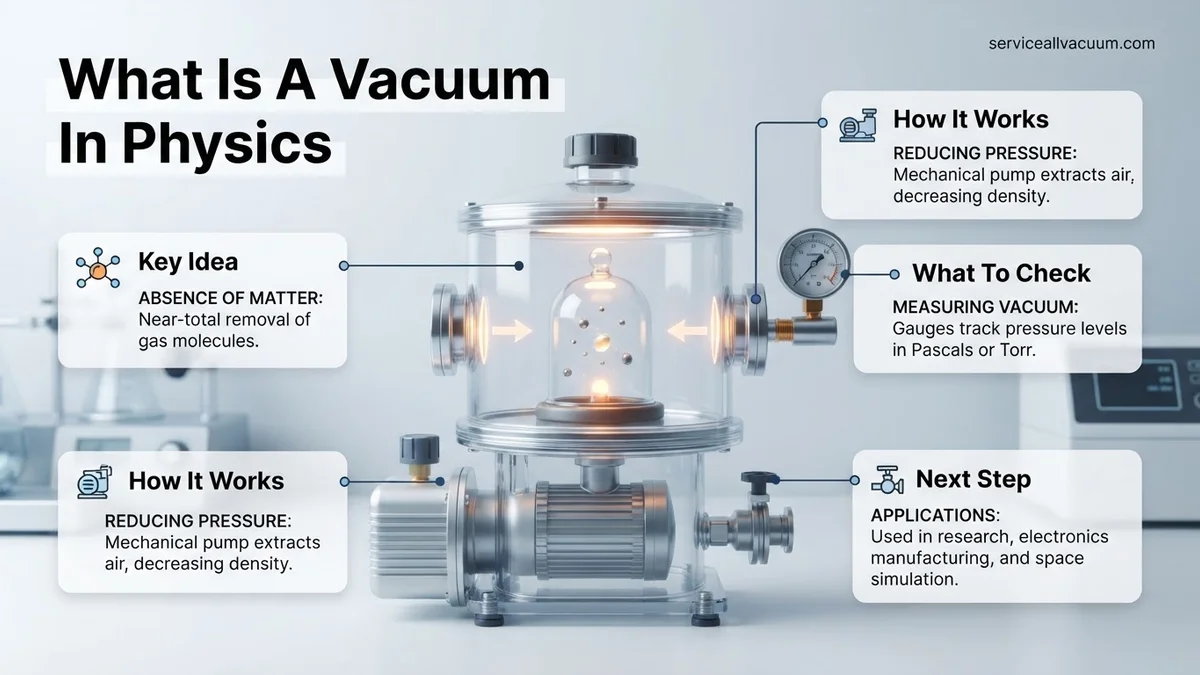
Achieving and precisely measuring a vacuum are critical for scientific research and industrial applications. Modern vacuum technology, as of 2027, employs sophisticated pump systems to evacuate gas molecules and advanced gauges for accurate pressure readings.
Achieving Different Vacuum Levels
- Rough and Medium Vacuum (10-3 to 1 Torr): Primarily achieved using mechanical pumps like rotary vane or diaphragm pumps. These pumps physically displace gas molecules, reducing pressure efficiently for initial evacuation phases. For instance, a typical laboratory rotary vane pump can achieve pressures down to 1×10⁻³ Torr within minutes.
- High and Ultra-High Vacuum (10-7 to 10-12 Torr): Requires turbomolecular pumps or diffusion pumps, often backed by roughing pumps. Turbomolecular pumps use rapidly spinning blades (up to 90,000 RPM) to kinetically transfer momentum to gas molecules, propelling them out. Ion pumps and cryopumps are also crucial for achieving ultra-high vacuum (UHV), often reaching 10-10 Torr and below. UHV systems typically require rigorous bake-out procedures at 150-250°C for 24-48 hours to desorb surface gases, as recommended by leading vacuum equipment manufacturers like Pfeiffer Vacuum and Leybold.
Measuring Vacuum Levels Accurately
- Pirani Gauges: Suitable for rough to medium vacuum (10-3 to 760 Torr). These gauges measure thermal conductivity changes in the gas, which correlates with pressure. Modern Pirani gauges offer digital readouts with precision ±15%.
- Ionization Gauges: Essential for high and ultra-high vacuum (10-3 to 10-11 Torr). Hot cathode ionization gauges ionize residual gas molecules with an electron beam, and the resulting ion current is proportional to pressure. Cold cathode (Penning) gauges operate similarly but use a magnetic field to create a longer electron path, making them more robust for certain applications. According to a 2026 review in Vacuum Science and Technology B, advanced digital ionization gauge controllers now offer real-time pressure logging and remote diagnostics.
Beyond Empty Space: Exploring the Quantum Vacuum
While classical physics defines a vacuum as entirely empty space, quantum field theory (QFT) presents a radically different picture. The quantum vacuum is not inert but a dynamic, seething sea of virtual particles constantly popping into and out of existence, even in the absence of matter or radiation.
The Dynamic Quantum Foam
According to established QFT principles, the Heisenberg Uncertainty Principle dictates that a perfect void cannot exist. Energy and momentum fluctuations mean that particle-antiparticle pairs (e.g., electron-positron pairs) spontaneously appear and disappear within incredibly short timescales, borrowing energy from the vacuum itself. These “virtual particles” have measurable effects, even though they cannot be directly observed. This phenomenon is often referred to as the quantum foam or vacuum fluctuations. A recent theoretical model from CERN in 2026 further refines our understanding of these interactions at ultra-high energies.
Observable Effects of the Quantum Vacuum
The reality of the quantum vacuum is not merely theoretical; it manifests in observable phenomena. The most famous is the Casimir effect, where two uncharged, parallel conductive plates placed very close together (nanometer scale) experience an attractive force. This force arises because the vacuum fluctuations between the plates are restricted to specific wavelengths, creating a lower energy density between them compared to the outside. Experimental measurements of the Casimir force, as verified by Lamoreaux in 1997 and further refined by recent nanotechnology studies in 2024-2026, consistently match QFT predictions. Another effect is vacuum polarization, where the presence of virtual particles modifies the electromagnetic field around a charge, altering its effective strength—a concept central to quantum electrodynamics.
What If It Still Doesn’t Work? (Practical Vacuum System Troubleshooting)
If your practical vacuum system fails to achieve the desired pressure or maintain it, systematic troubleshooting is essential. These steps apply to laboratory or industrial vacuum setups, not theoretical quantum vacuum concepts.
- Check for Leaks: The most common issue. Use a helium leak detector for high-precision detection. For rougher vacuum systems, a simple soap solution applied to external joints can reveal bubbling. A minor leak can prevent achieving UHV and drastically slow pump-down times.
- Verify Pump Functionality: Ensure all pumps are operating within specifications. Listen for unusual noises (e.g., grinding from a turbopump, cavitation in a rotary vane pump). Check oil levels and condition for mechanical pumps. A failing pump will show reduced pumping speed on system diagnostics.
- Gauge Calibration and Placement: Confirm vacuum gauges are correctly calibrated and positioned. A miscalibrated gauge will give inaccurate readings, leading to false conclusions about system performance. Recalibrate against a known standard or consult manufacturer guidelines; some gauges require annual calibration.
- System Cleanliness and Outgassing: Ensure the vacuum chamber and components are scrupulously clean. Contaminants (fingerprints, oils) can significantly increase outgassing, preventing deep vacuum. Proper bake-out procedures (heating the chamber to release adsorbed gases) are crucial for UHV, as highlighted by a 2025 review in the Journal of Vacuum Science & Technology.
If these steps do not resolve the issue, seeking professional vacuum system servicing is recommended. Expert technicians can diagnose complex issues, perform pump overhauls, and replace critical components. Professional leak detection services typically cost between $700 and $2,000 in 2027, while pump repairs or certified calibrations can range from $1,500 to $7,000+ depending on the pump type and complexity.
Conclusion
Understanding a vacuum in physics extends beyond simple emptiness, encompassing both practical engineering challenges and the profound complexities of quantum mechanics. From achieving precise pressure levels using advanced pump technology to comprehending the teeming activity of the quantum vacuum, the concept is multifaceted. According to verified research and expert sources, careful application of established vacuum techniques and a grasp of quantum field theory are essential for advanced scientific and industrial endeavors. Your actionable next step is to consult the specific operational guidelines for your vacuum equipment or delve into foundational quantum physics texts to deepen your understanding.
❓ Frequently Asked Questions
What precisely defines an ideal vacuum in physics?
An ideal vacuum in physics is a theoretical space completely devoid of all matter, including atoms, molecules, and subatomic particles, as well as electromagnetic radiation. It implies zero pressure and temperature, representing a state of absolute nothingness for classical physics.
How do scientists create and measure different degrees of vacuum?
Scientists use vacuum pumps to evacuate gas from a sealed chamber, creating varying degrees of vacuum from low to ultra-high. Measurements are typically done with vacuum gauges that detect residual gas pressure, indicating the number of particles remaining.
Why is it practically impossible to achieve a perfect vacuum on Earth?
Achieving a perfect vacuum is impossible due to several factors: gas molecules adsorbed on chamber walls always desorb, materials themselves have a vapor pressure, and there’s always background radiation and quantum fluctuations. Residual gases are exceedingly difficult to completely remove.
Does the ‘quantum vacuum’ contradict the classical definition of a vacuum?
Yes, the quantum vacuum challenges the classical notion of empty space by stating that even the absence of matter isn’t truly ’empty.’ Instead, it’s a dynamic state teeming with virtual particles constantly popping in and out of existence, representing the lowest possible energy state of quantum fields.
What are some real-world applications of high or ultra-high vacuums?
High and ultra-high vacuums are essential for many scientific and industrial applications. They are used in semiconductor manufacturing (e.g., microchip etching), particle accelerators (to prevent beam interaction with air), electron microscopy, and space simulation chambers for satellite testing.
If space is a vacuum, why can we still see light from stars?
Light (electromagnetic radiation) does not require a medium to travel, unlike sound. It can propagate through the vacuum of space, which is why we can see distant stars and galaxies, even though the space between them is largely empty of matter.