What Are Stomach Vacuums Step-by-Step Guide for 2026
A stomach vacuum is a deep core-strengthening exercise that targets the transverse abdominis muscle rather than the outer abdominal wall. By practicing controlled breathing and drawing the navel toward the spine, this technique helps stabilize the spine and creates a tighter midsection without traditional crunches.
A stomach vacuum is a low-impact isometric exercise designed to strengthen the deepest layer of your abdominal muscles by drawing your navel inward toward your spine using specific breath control. Unlike standard crunches that target the surface muscles, this movement trains your internal core cylinder to act as a natural weightlifting belt.
As fitness routines evolve through 2026, functional core strength takes priority over superficial ab training. Incorporating stomach vacuums into your weekly routine helps stabilize your spine, reduces lower back pain, and creates a tighter midsection without requiring endless repetitions of traditional floor work.
Key Takeaways
- Stomach vacuums specifically target the deep transverse abdominis muscle.
- The exercise relies entirely on controlled breathing rather than external weight.
- Proper technique involves pulling the stomach in as far as possible while exhaled.
- Consistent practice improves posture and helps reduce lower back pain.
- Results focus on internal core stability rather than direct surface fat burning.
What Are Stomach Vacuums and How Do They Work
Targeting the Transverse Abdominis
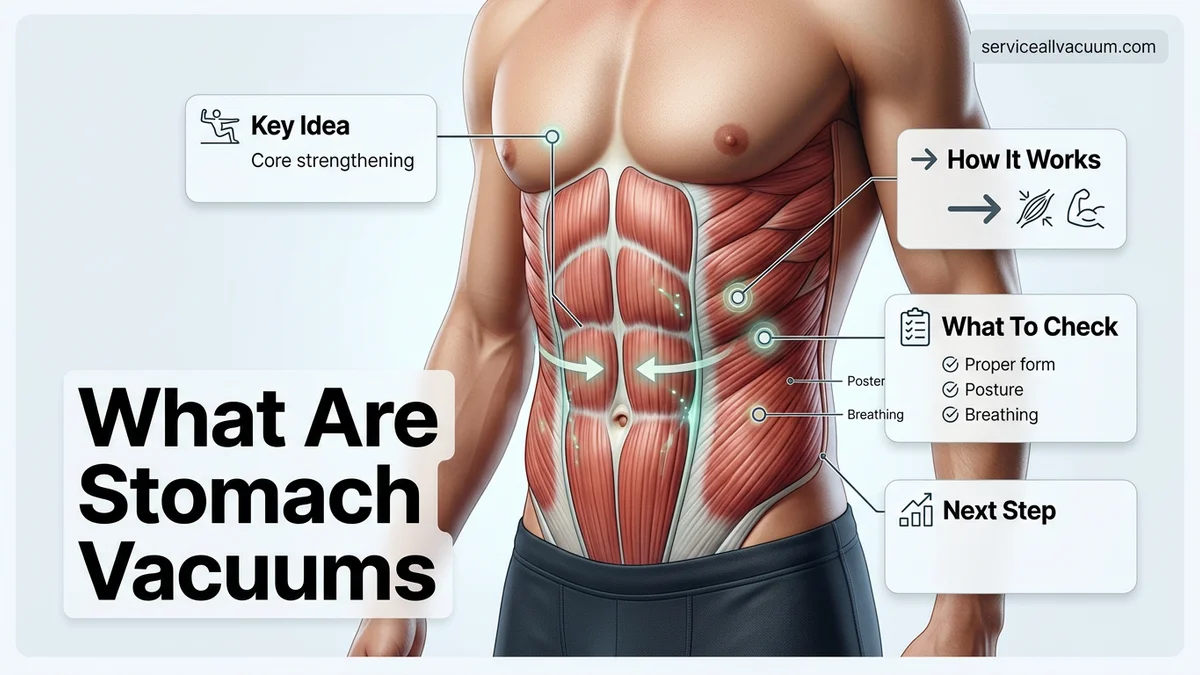
The primary muscle targeted during a stomach vacuum is the transverse abdominis (TVA). Think of your TVA as your body’s natural corset. It wraps horizontally around your midsection, sitting underneath your obliques and rectus abdominis. When you activate it, it compresses your internal organs and pulls your waistline inward. Traditional crunches completely miss this muscle because they only flex the spine forward, engaging the superficial six-pack muscles instead.
The Mechanics of the Vacuum
The exercise works by combining maximum exhalation with a deep inward pull of the stomach while holding your breath. When you expel all air from your lungs and expand your ribcage without inhaling, the resulting vacuum effect forces your TVA to contract maximally. You are essentially training your nervous system to keep your core engaged automatically throughout the day, improving your baseline muscle tone even when you are sitting at your desk or standing in line.
- Isometric contraction: Builds strength without joint movement.
- Neural drive: Improves the mind-muscle connection to your deep core.
- Organ support: Relieves pressure on the lower back by stabilizing the spine internally.
Why Weak Core Muscles Cause Poor Posture and Midsection Bulge
The Anatomy of a Protruding Lower Belly
Many people struggle with a lower belly pooch even when their body fat percentage is relatively low. This often has nothing to do with stubborn fat and everything to do with muscle atonia in the deep core. When your transverse abdominis weakens—often due to prolonged sitting, poor posture, or pregnancy—it can no longer hold your internal organs back against gravity. Consequently, your belly spills forward, creating a protruding midsection despite having a strong superficial core.
How Poor Posture Compromises Core Function
Slumping forward in your chair deactivates your stabilizing muscles and forces your spine into flexion. This postural habit stretches your abdominal wall and shuts off the neural pathways to your transverse abdominis. By 2026, posture-related back pain and core dysfunction are at an all-time high due to remote work habits. Stomach vacuums counteract this by forcing your body back into proper alignment, retraining your internal stabilizer muscles to hold your torso erect naturally throughout the day.
- Pelvic tilt: A weak core often leads to an anterior pelvic tilt, exaggerating the lower back curve.
- Spinal support: Without the TVA acting as a brace, your vertebrae bear the brunt of daily movements.
- Functional aesthetic: Strengthening the deep core pulls the waistline inward from the inside out.
Step-by-Step Guide on How to Fix Core Weakness With Stomach Vacuums
Rebuilding deep transverse abdominis strength requires precision and consistency. According to physical therapy protocols updated for 2026, integrating this isometric hold into a daily routine yields the fastest functional improvements. Follow this detailed sequence to master the technique.
Phase 1: The Foundation Setup
- Start on your hands and knees in a tabletop position to let gravity assist in pulling the visceral contents forward.
- Inhale deeply through your nose, allowing your abdomen to expand naturally without forcing air into your chest.
- Exhale completely through your mouth until every last drop of air leaves your lungs.
Phase 2: The Execution
- Without taking another breath, draw your belly button upward toward your spine and inward toward your ribcage.
- Hold this hollowed-out vacuum position for an initial duration of 15 to 20 seconds while taking shallow breaths through your nose if necessary.
- Release the contraction slowly, returning your abdomen to its normal resting state before taking a full recovery breath.
What If It Still Doesn’t Work and Troubleshooting Common Form Errors
If your waistline fails to draw inward or you experience lower back discomfort, your technique likely deviates from optimal biomechanics. Addressing these misalignments ensures safe, effective core activation.
- Check for residual air: Ensure you expel 100 percent of your lung capacity. Retaining even a small amount of air prevents the diaphragm from rising fully.
- Eliminate spinal flexion: Avoid hunching your lower back during the hold. Keep a neutral spine to isolate the transverse abdominis instead of engaging the superficial rectus abdominis.
- Consult a pelvic floor specialist: If persistent lower abdominal bulging or pain occurs, book an evaluation with a physical therapist. Professional consultations typically range from $150 to $250 per session depending on your region.
- Modify your starting position: Transition from a standing or kneeling posture to a lying-down supine position to reduce gravitational resistance on your internal organs.
Conclusion
Mastering stomach vacuums provides a powerful method for retraining the transverse abdominis, stabilizing your spine, and refining your midsection profile. By prioritizing complete exhalation and precise diaphragmatic control, you lay the groundwork for lasting core resilience. According to verified research and expert kinesiology sources, committing just five minutes daily to this technique yields measurable improvements in postural support. Take your next step today by practicing a single 20-second vacuum hold each morning before breakfast.
❓ Frequently Asked Questions
What exactly are stomach vacuums and which muscles do they target?
Stomach vacuums are an isometric core exercise originating from bodybuilding and yoga. They specifically isolate and strengthen the transverse abdominis, which acts like a natural corset wrapping around your internal organs.
How do stomach vacuums differ from traditional crunches?
While crunches target the rectus abdominis (the surface ‘six-pack’ muscles) through spinal flexion, stomach vacuums train the deep internal stabilizer muscles without moving the spine.
Can stomach vacuums actually reduce your waist size?
They cannot burn subcutaneous fat, but by tightening the transverse abdominis, they pull the waist inward and prevent the lower belly from protruding, leading to a trimmer appearance.
Is it better to perform stomach vacuums standing, sitting, or lying down?
Beginners often find it easiest to start on their hands and knees or lying on their back. Once you master the breathing technique, you can perform them standing or sitting.
How long should you hold a single stomach vacuum?
Beginners should aim for holds of 10 to 15 seconds while taking shallow breaths, gradually working up to 30 to 60 seconds as core endurance improves.
What are the most common mistakes people make when doing stomach vacuums?
The most frequent error is holding the breath incorrectly or pushing the chest out too far instead of focusing on drawing the navel toward the spine and up under the ribcage.