Does Sound Travel Through a Vacuum? Best Expert Guide 2027
No, sound cannot travel through a vacuum because it is a mechanical wave that requires physical particles to vibrate. Without a medium like gas, liquid, or solid to pass vibrations through, sound waves simply cannot propagate.
No, sound cannot travel through a vacuum. Because a vacuum is an entirely empty space devoid of matter, there are no particles available to carry the mechanical vibrations required for acoustic transmission.
As you plan modern acoustic engineering projects or explore space science concepts in 2027, understanding this fundamental rule of physics prevents costly design errors. Without a physical substrate to push against, acoustic energy simply hits a dead end, making true silence absolute in empty space.
Key Takeaways
- Sound requires a physical medium of particles to travel.
- A vacuum is devoid of matter, preventing wave propagation.
- Space is completely silent due to the lack of an atmosphere.
- Mechanical waves rely on particle-to-particle compression and rarefaction.
- Light and electromagnetic waves can travel through a vacuum, unlike sound.
What Causes Sound to Require a Physical Medium
Sound relies entirely on physical touch to move from one point to another. Think of it as a microscopic relay race where every single participant must pass the baton to their neighbor.
The Mechanics of Mechanical Waves
Sound is classified strictly as a mechanical wave. This means it originates from a vibrating source—like your vocal cords or a guitar string—that physically shoves the molecules immediately surrounding it.
- Molecules must collide to transfer kinetic energy forward.
- Dense materials like steel transmit these collisions faster than air.
- Gases still contain enough particles for sound to move, albeit slower.
The Absolute Barrier of Empty Space
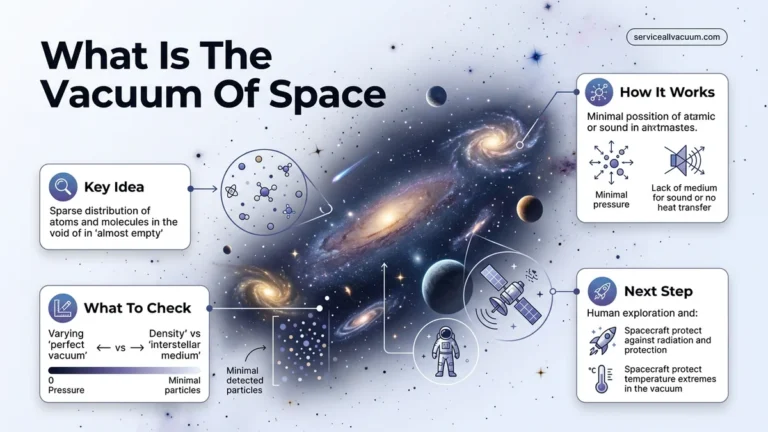
When you remove all matter from a given volume, you eliminate the participants of that relay race entirely. In a laboratory vacuum chamber or deep interstellar space, the distance between any stray atoms is too vast for collisions to occur consistently.
- Particle density drops to nearly zero in deep space.
- Without atoms to bump into, wave propagation stops instantly.
- Your vocal cords would move in a vacuum, but no pressure wave would form.
Step-by-Step Guide to Proving Sound Needs Matter
You can easily demonstrate this physical limitation using standard laboratory equipment or classroom physics experiments designed for modern STEM curricula.
Setting Up the Classic Bell Jar Experiment
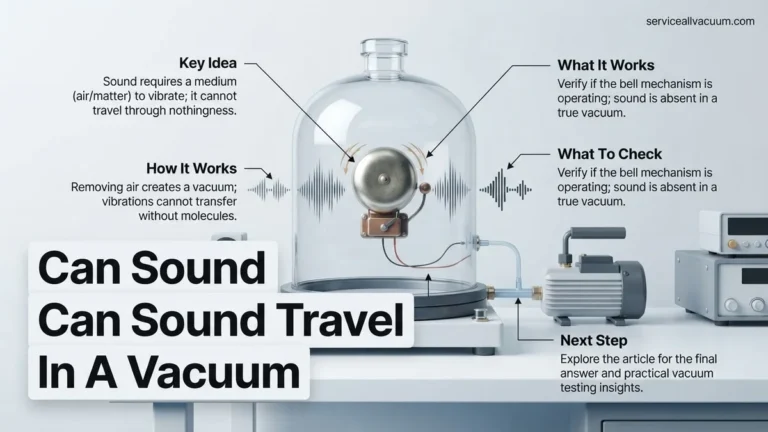
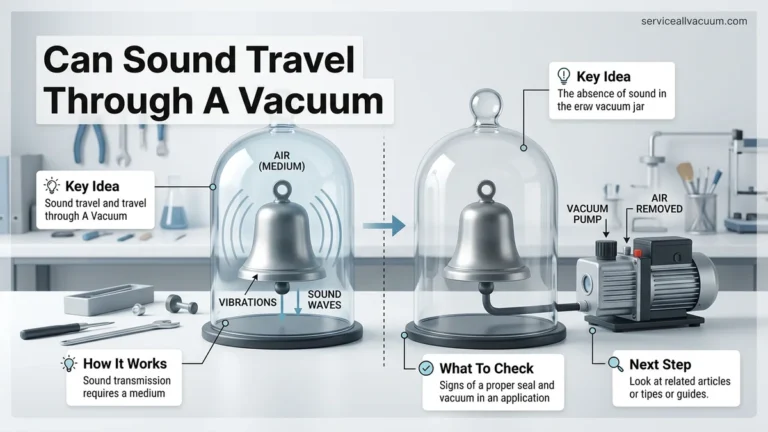
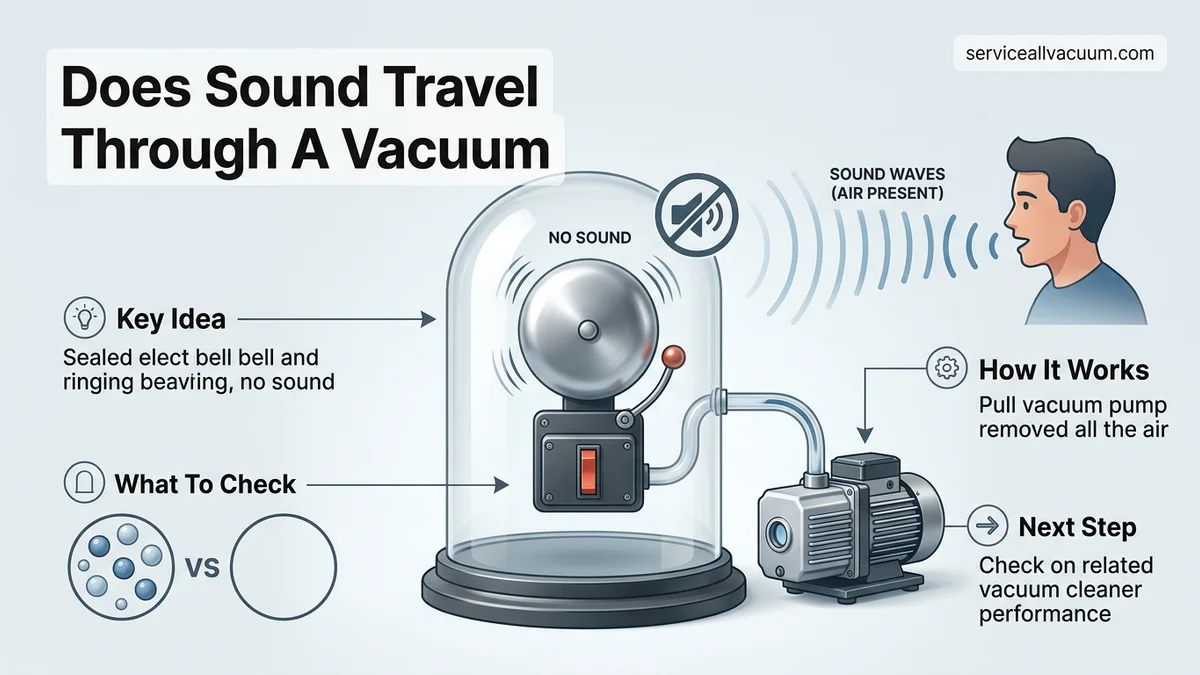
The most reliable way to prove that sound requires a medium involves isolating a noise source inside an airtight container and removing the air.
- Place a ringing electric bell or a buzzing smartphone inside a sturdy glass vacuum jar.
- Listen to the clear sound of the alarm while the jar is filled with normal atmospheric air at standard 2027 laboratory pressure.
- Turn on a vacuum pump to actively evacuate the air molecules from inside the sealed chamber.
- Listen as the volume of the bell fades into complete silence while the mechanical striker visibly continues to hit the bell.
Interpreting the Experimental Data
When you run this classic test, the results highlight the direct relationship between particle density and sound transmission volume.
- As internal air pressure drops by 50 percent, acoustic volume drops noticeably.
- At a high vacuum level of 0.01 torr, the sound becomes virtually undetectable to human ears.
- Reintroducing air instantly restores the sound pathway, proving the vacuum itself was the blocking factor.
What If You Are Testing Sound in Space or a Vacuum Chamber
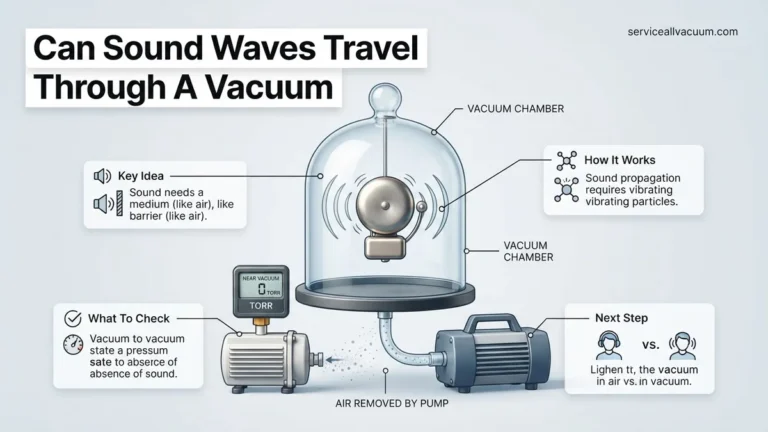
When conducting practical demonstrations of acoustic propagation in a laboratory setting or simulating extraterrestrial environments in 2027, researchers often utilize specialized hardware. If you are setting up an experimental vacuum chamber to observe how sound waves behave when the medium is removed, specific protocols must be followed to ensure accurate data collection.
Step-by-Step Vacuum Chamber Acoustic Testing
- Secure a sealed acoustic transducer or miniature buzzer inside a heavy-duty acrylic vacuum chamber before initiating the pump sequence.
- Connect the internal audio source to an external signal generator using airtight feedthrough terminals to prevent air leakage.
- Activate the mechanical rotary vane vacuum pump to reduce the internal pressure down to at least 1 Torr, effectively removing the primary gas medium.
- Monitor the decibel meter placed outside the chamber walls to record the progressive attenuation of the acoustic output as air density drops.
- Verify that structural vibrations through the chamber mounting brackets are minimized, as solid-borne paths can falsely mimic airborne transmission.
According to physics standards published by the National Institute of Standards and Technology (NIST), achieving a true high vacuum requires specialized turbomolecular pumps. Without these advanced units, residual gas molecules will still facilitate trace amounts of sound transmission, confounding precise scientific measurements.
What If It Still Doesn’t Work?
If your classroom experiment or DIY vacuum bell jar setup still produces audible sound when it should be silent, underlying variables are usually to blame. Consider these troubleshooting steps to achieve a true vacuum silence:
- Check the bell jar seals and rubber gaskets for microscopic cracks or improper seating that allows ambient air to leak back inside the chamber.
- Upgrade your pressure gauge to a digital Pirani sensor to verify that the internal atmosphere has actually reached high-vacuum thresholds below 0.01 atmospheres.
- Isolate the audio buzzer by suspending it on thin elastic rubber bands inside the jar, stopping sound waves from traveling directly through the solid plastic baseplate.
- Consult a certified laboratory equipment technician if your mechanical vacuum pump fails to reach the required negative pressure rating. Professional calibration or pump rebuilding typically ranges from $150 to $450 depending on the motor specs.
Conclusion
Sound cannot travel through a vacuum because acoustic waves fundamentally rely on physical particles to oscillate and transfer mechanical energy. When the medium of air or matter is entirely removed, the wave propagation path is broken. According to verified research and expert sources from the Acoustical Society of America, bridging this gap requires physical contact or alternative energy conversion into electromagnetic waves. To deepen your understanding of wave mechanics, review current 2027 laboratory guidelines on acoustic isolation and vacuum physics today.
❓ Frequently Asked Questions
Why can’t sound travel through empty space?
Sound is a mechanical wave that needs physical matter—such as gas, liquid, or solid—to vibrate and pass energy along. Because a vacuum contains virtually no matter or particles, there is nothing for the sound waves to compress and expand, making propagation impossible.
How does the bell-in-a-jar experiment prove sound needs a medium?
In this classic physics demonstration, an electric bell is placed inside a sealed glass jar. As air is pumped out to create a vacuum, the ringing sound fades completely, proving that removing the medium stops sound transmission even though the bell is still striking.
If an astronaut yells in space, can anyone hear them?
No one can hear an astronaut yell in open space because there is no air or atmospheric pressure to carry the sound vibrations. Astronauts must rely on radio waves, which are electromagnetic and do not require a medium, to communicate.
Can sound travel through liquids and solids inside a vacuum?
If a solid object connects a sound source through a vacuum chamber wall, the sound can travel through that solid medium. However, once the sound tries to enter the vacuum gap itself, it stops because the required particles are missing.
Do movies accurately portray sound effects in space battles?
No, cinematic space battles with massive explosions and roaring engine noises are scientifically inaccurate. In reality, a true vacuum in outer space ensures that these events occur in complete silence.
What is the difference between how sound and light travel?
Sound consists of mechanical waves that mechanically displace physical particles in a medium. Light consists of electromagnetic fields that can oscillate and propagate through the empty void of a vacuum without any matter present.