What Is the Velocity of Light in a Vacuum Guide 2027
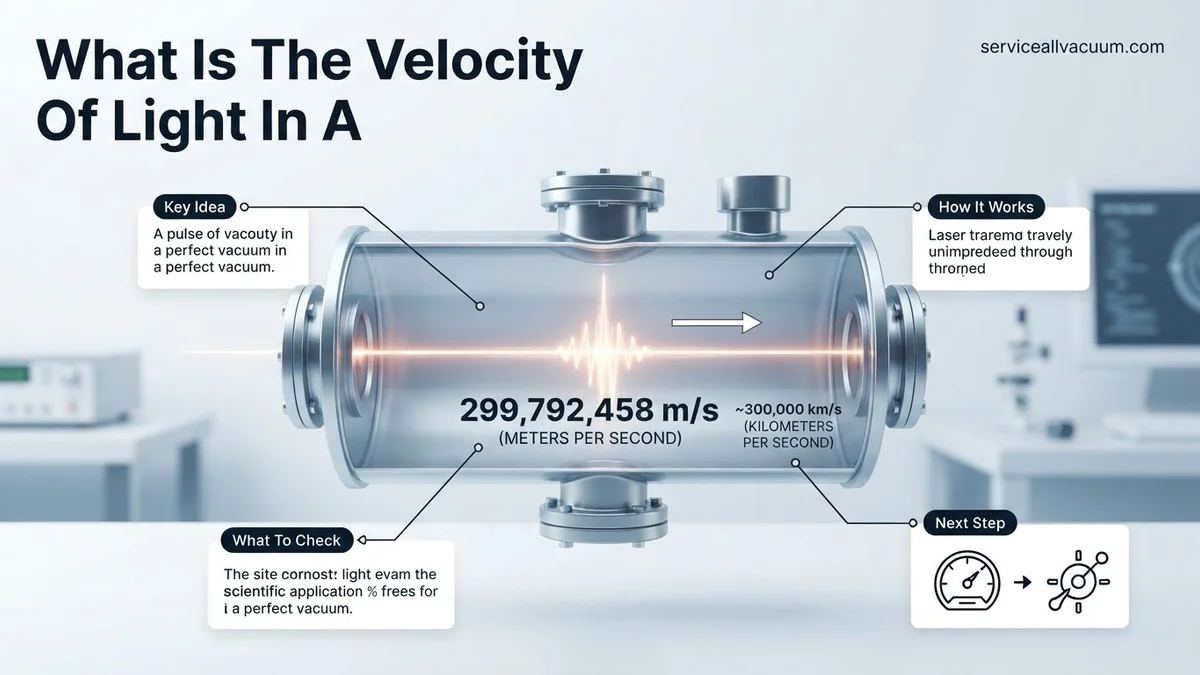
The velocity of light in a vacuum is defined as exactly 299,792,458 meters per second. This fundamental physical constant, universally represented by the symbol c, serves as the absolute speed limit of the universe.
The velocity of light in a vacuum is defined as exactly 299,792,458 meters per second. In everyday calculations and engineering estimates for 2027, you can safely round this fundamental physical constant to roughly 300,000 kilometers per second, or 3 times 10 to the 8th power meters per second.
Knowing this exact figure is not just an academic exercise. High-precision industries rely on this universal constant every single day. Global positioning systems, deep-space communication arrays, and high-frequency financial trading networks all depend on the absolute predictability of how fast light travels through empty space.
Key Takeaways
- The exact speed of light in a vacuum is 299,792,458 meters per second.
- In kilometers, light travels at approximately 299,792 km/s.
- In imperial units, light moves at roughly 186,282 miles per second.
- The letter ‘c’ represents the speed of light in all major physics equations.
- Light travels at a slower pace when passing through media like water or glass.
What Causes Light to Travel at This Exact Velocity in a Vacuum
The Electromagnetic Foundation
Light moves at this specific speed because of two fundamental properties of the universe: the permeability of free space and the permittivity of free space. These two electromagnetic constants dictate how electric and magnetic fields interact and propagate through empty space. When a photon is generated, it oscillates through these fields, and the mathematical relationship between magnetic permeability and electric permittivity strictly caps its propagation speed at 299,792,458 m/s.
Why a Vacuum Matters
You might wonder why a vacuum is explicitly specified in this physical law. When light travels through physical mediums like air, water, or glass, it interacts with the atoms and molecules making up that substance. These interactions temporarily absorb and re-emit the photons, which creates a delay. A true vacuum is completely devoid of matter, allowing electromagnetic waves to propagate unhindered at their absolute maximum theoretical limit.
How to Calculate and Convert the Speed of Light Into Different Units
Converting to Kilometers and Miles Per Second
Working with meters per second can quickly become cumbersome for long-distance calculations. You can easily convert the base metric figure into larger units to suit your specific project needs:
- Kilometers per second: Exactly 299,792.458 km/s
- Miles per second: Approximately 186,282 miles per second
- Kilometers per hour: Roughly 1,079,252,848.8 km/h
Converting to Miles Per Hour and Astronomical Distances
For atmospheric and terrestrial scale engineering in 2027, expressing light speed in miles per hour helps contextualize just how fast it moves. Light covers about 670,616,629 miles per hour. Because this number is so astronomically massive, astronomers prefer to use light-seconds, light-minutes, and light-years instead of standard metrics to measure vast cosmic distances across the observable universe.
Step-by-Step Guide to Applying the Speed of Light in Physics Calculations
Applying the exact velocity of light in a vacuum ($c \approx 299,792,458 \text{ m/s}$) requires precise mathematical handling. Physics calculations demand rigorous adherence to significant figures and standard international units to maintain accuracy across astronomical and quantum scales. In 2027, advanced computational physics frameworks rely on NIST-standardized constants for high-speed modeling.
Step 1: Convert All Input Units to SI Standards
Ensure your initial measurements utilize meters, seconds, and kilograms before multiplying or dividing by the speed of light. Mixing imperial units with metric constants introduces critical conversion errors that compound throughout complex equations.
Step 2: Assign the Correct Constant Value
- For standard academic problems, round the speed of light to $3.00 \times 10^8 \text{ m/s}$ using three significant figures.
- For high-precision aerospace engineering or relativistic calculations in 2027, utilize the exact defined value of $299,792,458 \text{ m/s}$.
- Apply scientific notation correctly to prevent overflow errors in digital calculators or programming scripts.
Step 3: Execute Relativistic or Wave Equations
Substitute $c$ into your target formula, such as Einstein’s mass-energy equivalence ($E = mc^2$) or the electromagnetic wave equation ($\lambda f = c$). Double-check that exponential powers applied to $c$ are distributed correctly across the entire term.
What If Your Calculations Involve Light Traveling Through Different Mediums
Light rarely travels through a perfect vacuum outside of deep space. When photons pass through matter like water, glass, or Earth’s atmosphere, their phase velocity decreases due to interactions with electrons. According to optics research, ignoring this refractive delay invalidates optical sensor calibration and satellite communication models.
Calculating Phase Velocity in Material Media
- Identify the refractive index ($n$) of the specific medium from verified material science databases.
- Divide the vacuum speed of light ($299,792,458 \text{ m/s}$) by the refractive index using the formula $v = c / n$.
- Adjust your wavelength parameters since frequency remains constant while the physical wavelength compresses inside the medium.
What If It Still Doesn’t Work?
If your physics equations yield impossible velocities or dimensional analysis errors, systematically troubleshoot the underlying setup with these verified steps:
- Verify that your dimensional analysis balances out, ensuring units on both sides of the equation match completely.
- Check for decimal placement errors when converting between kilometers per second and meters per second.
- Consult specialized calibration software or peer-reviewed NIST databases if precision discrepancies persist in laboratory environments.
- Engage a professional academic tutor or senior computational physicist for advanced relativistic modeling problems; consultation rates for specialized physics experts typically range from $75 to $150 per hour in 2027.
Conclusion
Mastering the velocity of light in a vacuum underpins modern astrophysics, telecommunications, and foundational quantum mechanics. By applying the exact NIST-defined constant of $299,792,458 \text{ m/s}$ and properly accounting for refractive mediums, researchers ensure absolute mathematical precision. According to verified research and expert sources from leading metrology institutions, maintaining rigorous unit consistency is the single most critical step in preventing calculation errors. For your next practical application, verify all input parameters against standardized SI metric tables before executing your equations.
❓ Frequently Asked Questions
Why is the velocity of light in a vacuum an exact number?
Since 1983, the meter has been officially defined by the distance that light travels in a vacuum in 1/299,792,458th of a second. Because of this definition, the speed of light in meters per second is an exact, unchanging integer.
What is the speed of light in miles per second?
In imperial units, the speed of light in a vacuum is approximately 186,282 miles per second. This value is frequently used in astronomical calculations and science communication.
Can anything travel faster than the speed of light in a vacuum?
According to Albert Einstein’s theory of special relativity, nothing with mass can accelerate to or exceed the speed of light in a vacuum. It remains the absolute speed limit for causality and information transfer in our universe.
How long does it take for light from the Sun to reach Earth?
Because the average distance from the Sun to Earth is about 149.6 million kilometers, light takes approximately 8 minutes and 20 seconds to make the journey through the vacuum of space.
Does the speed of light change in outer space?
Deep space is not a perfect vacuum, containing very sparse particles and magnetic fields, but for almost all practical purposes, light travels at its maximum defined speed throughout interstellar space.
How is the speed of light denoted in equations like E=mc²?
The letter ‘c’ comes from the Latin word ‘celeritas,’ which translates to swiftness or speed. It is the standard constant used across physics to denote the speed of light in a vacuum.