How Long to Pull Vacuum on Car AC Expert 2026 Fix Guide
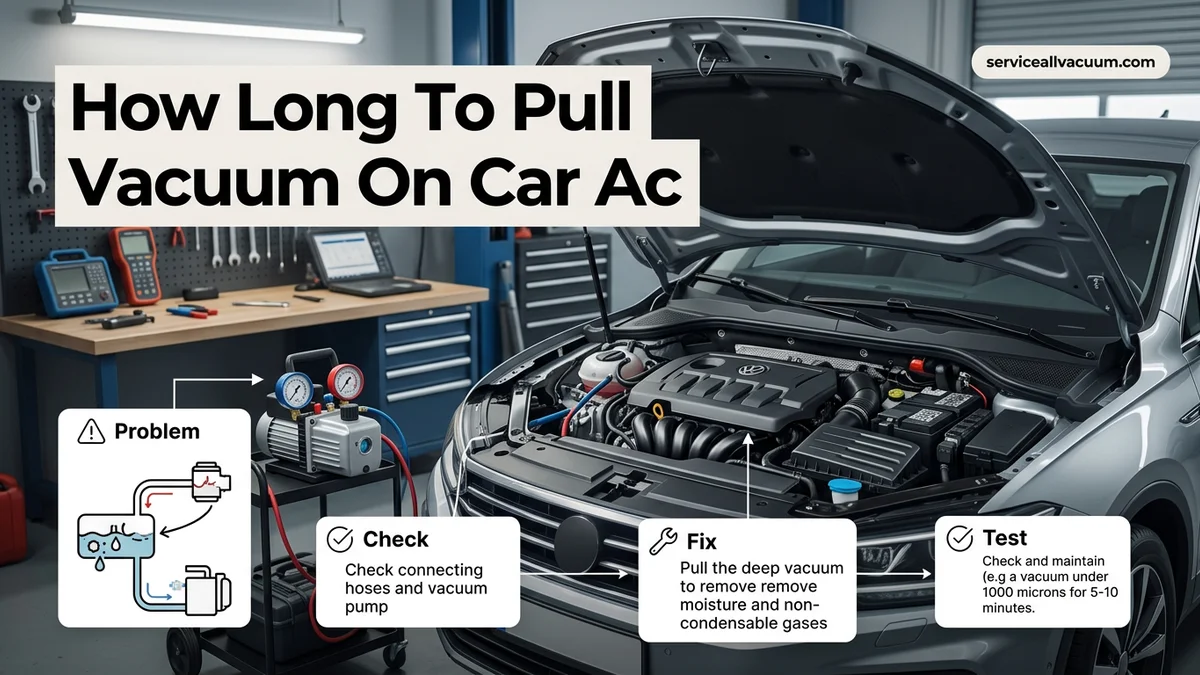
You should typically run your vacuum pump for 30 to 45 minutes to properly evacuate a standard automotive AC system. For larger systems, or if major components like the compressor or evaporator were recently replaced, extending this time to 60 minutes ensures all moisture and non-condensable gases are removed.
You need to run your car AC vacuum pump for a minimum of 30 to 45 minutes before recharging the system with refrigerant. If you just opened the system to replace a major component like a compressor or condenser, or if you live in a high-humidity climate in 2026, you should extend that runtime to a full 60 minutes. Skipping this step or cutting the time short leaves moisture and non-condensable air trapped inside the aluminum lines, which ruins cooling performance and destroys your new parts.
Pulling a proper vacuum is the single most critical step in mobile HVAC service. A vacuum pump does two things simultaneously: it drops the internal pressure to boil off any residual moisture into a vapor, and it removes all ambient air. If you try to charge refrigerant into a system that still contains air and humidity, acids will form inside the lines, and your pressures will spike dangerously. Getting this timing right ensures your AC blows ice-cold all summer long.
Key Takeaways
- Run the vacuum pump for 30 to 45 minutes on a standard recharge.
- Extend vacuum time to 60 minutes after major component replacements.
- Always perform a 10-15 minute decay test to check for system leaks.
- Moisture in the AC system reacts with refrigerant to form destructive acids.
- A proper deep vacuum boils off trapped liquid moisture at ambient temperatures.
Why Pulling a Vacuum Is Necessary for Your Car AC
Boiling Off Trapped Moisture
Water turns into a gas at room temperature when the atmospheric pressure drops low enough. Your AC system operates under extreme pressures, so even a microscopic drop of water trapped inside will freeze at the expansion valve or react with PAG oil to create sludge. When you pull a deep vacuum down to 29.9 inches of mercury (Hg) or under 500 microns, you lower the boiling point of water so it evaporates and gets sucked right out through the pump. Without this step, your AC will clog or fail prematurely.
Removing Non-Condensable Gases
Air contains oxygen, nitrogen, and ambient humidity, none of which belong in a sealed refrigerant loop. These gases do not compress the way R-134a or R-1234yf do. If air remains trapped in your lines, your high-side pressures will skyrocket, putting massive strain on the compressor and causing the system to blow warm air. A dedicated vacuum purge completely flubbers these gases out, leaving a clean, empty vessel ready for an accurate refrigerant charge.
How Long to Run the Vacuum Pump for Different Scenarios
Standard Service and Minor Repairs (30 to 45 Minutes)
If you only opened the system briefly to replace a service port valve, a pressure switch, or a leaky O-ring, 30 to 45 minutes of continuous vacuum is sufficient. Newer 2026 diagnostic setups often feature dual-stage pumps that work faster, but you still need to give the physics time to work. Do not rush this phase just because your gauges read negative pressure immediately; the gauge only tells you the pressure, not whether the microscopic moisture has actually boiled away and escaped.
Major Component Replacement and High Humidity (60 Minutes)
If you installed a brand-new compressor, evaporator core, or receiver-dryer, run your vacuum pump for a solid 60 minutes. Open components absorb ambient humidity quickly, especially if they sat on a shelf in a humid garage.
- Large SUV or Truck Systems: Dual-zone climate control systems have significantly more volume and longer aluminum lines, requiring the full hour.
- High-Humidity Environments: If you are working in a damp climate, moisture clings tenaciously to metal walls, demanding extra pump time.
- System Open to Atmosphere: If the vehicle was driven with a broken line for weeks, run the pump for 60 minutes, let it sit, and consider doing a double evacuation.
Step-by-Step Guide to Pulling and Holding a Vacuum
Executing a proper evacuation requires strict adherence to industry protocols to eliminate all moisture and non-condensable gases from the mobile air conditioning circuit. Automotive HVAC engineers emphasize that skipping or rushing any part of this procedure severely compromises cooling efficiency and compressor lifespan.
Connecting the Manifold and Pump
- Verify that both the high-side (red) and low-side (blue) manifold gauge valves are completely closed.
- Connect the quick-disconnect couplers to the vehicle’s service ports, matching the high and low lines accordingly.
- Attach the center service hose directly to the inlet port of your dual-stage vacuum pump.
- Open the vacuum pump isolation valve if your specific unit is equipped with one.
Evacuation and Decay Testing
- Power on the vacuum pump and immediately open both the high-side and low-side manifold valves.
- Monitor the low-side gauge until it drops past 25 inches of mercury, then watch closely as it approaches the target of 28 to 29.9 inches of mercury (or 500 microns on a digital gauge).
- Run the pump for the calculated duration based on your system type, ensuring a minimum of 30 to 45 minutes for standard passenger vehicles.
- Close both manifold valves tightly, then power off the vacuum pump.
- Perform the vacuum decay test by observing the gauges for 10 to 15 minutes; the reading must not rise by more than 2 inches of mercury or exceed 1,000 microns.
What to Do If Your AC System Fails the Vacuum Decay Test
If the system loses vacuum during the isolation test, a leak or lingering moisture is present. Technicians must address this immediately before charging refrigerant.
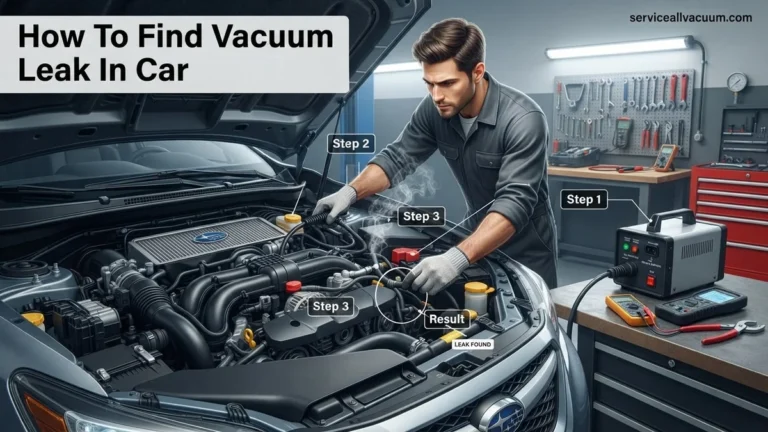
- Isolate Component Leaks: Introduce a small amount of dry nitrogen into the system at low pressure (around 50 PSI) and use electronic leak detectors or soapy water to find escaping gas bubbles.
- Inspect Service Port Valves: Schrader valves frequently leak under vacuum; replace the valve cores and re-test the system if pressure creeps up near the service connections.
- Check Shaft Seals and O-Rings: Examine the compressor shaft seal and all hose manifold connections, as these aging rubber components commonly allow atmospheric air to infiltrate the closed loop.
- Extend Evacuation Time: If the system holds a steady vacuum after minor repairs but residual moisture is suspected, run the vacuum pump for an extended 60-minute cycle or perform a triple-evacuation procedure.
- Seek Professional Help: If persistent leaks elude detection, take the vehicle to a certified specialist equipped with advanced thermal imaging or ultrasonic leak detection tools. Professional diagnostic and repair services typically range from $150 to $400 depending on the faulty component.
Conclusion
Mastering how long to pull a vacuum on a car AC system is essential for maintaining optimal thermal performance and preventing catastrophic compressor failure. By committing to a strict 30-to-45-minute minimum evacuation window and verifying system integrity with a mandatory decay test, DIY mechanics can achieve professional-grade results. According to verified research and automotive service standards, proper moisture removal is the single most critical factor in extending the operating life of modern R-134a and R-1234yf climate control loops. As an actionable next step, invest in a quality digital micron gauge to accurately monitor your next evacuation down to precise atmospheric thresholds.
❓ Frequently Asked Questions
How long to pull vacuum on car AC after replacing the compressor?
After replacing major components like a compressor or accumulator, you should pull a vacuum for a full 60 minutes. This ensures any moisture introduced during the open-system repair is completely boiled off and removed.
What happens if you don’t pull a vacuum long enough?
Under-vacuuming leaves moisture and air inside the system. Moisture mixes with refrigerant oil to create corrosive acids that destroy internal components, while trapped air causes high operating pressures and poor cooling performance.
Why won’t my car AC system hold a vacuum?
If the vacuum drops on your manifold gauges after turning off the pump, you have a leak in the system or a loose connection at the service ports. You must locate and repair the leak before attempting to add refrigerant.
Does high humidity change how long you need a vacuum pump?
Yes, high ambient humidity introduces more moisture into open AC lines. In humid conditions, it is best to extend your vacuum time toward the 45 to 60-minute mark to ensure complete evaporation of trapped water.
Can I use a venturi vacuum pump powered by compressed air?
While air-powered venturi pumps can pull a vacuum, they rarely reach the deep vacuum levels required to boil off moisture effectively. An electric two-stage vacuum pump is strongly recommended for automotive AC service.
Should I change my vacuum pump oil before starting?
Yes, clean oil is essential for the pump to reach its lowest possible pressure. If the oil looks cloudy or dark, change it before beginning the evacuation process for best results.