What is the Vacuum Tube? Real Expert Guide for 2027
A vacuum tube is a fundamental electronic device that controls electron flow in a vacuum for amplification or switching. It revolutionized early electronics by enabling the development of radios, televisions, and early computers, paving the way for modern technology. Understanding its basic operation is key to appreciating electronics history.
A vacuum tube is an electronic device designed to control the flow of electrons in a sealed, evacuated glass or metal enclosure. Its primary purpose is to amplify electrical signals or act as a high-speed electronic switch. In 2027, understanding these fundamental components still provides crucial insight into the origins of modern electronics, influencing everything from high-fidelity audio equipment to foundational computing concepts.
This technology, though largely superseded by transistors for most applications, was the cornerstone of the 20th century’s electronic revolution. Grasping how these devices manipulate electron streams reveals the ingenious engineering that powered the first radios, televisions, and early computers, establishing principles still relevant in today’s microchip designs.
Key Takeaways
- Vacuum tubes amplify/switch electronic signals.
- They rely on controlled electron flow in a vacuum.
- Key components:cathode, anode, control grid.
- Essential for early radio, TV, and computing.
- Transistors eventually replaced vacuum tubes.
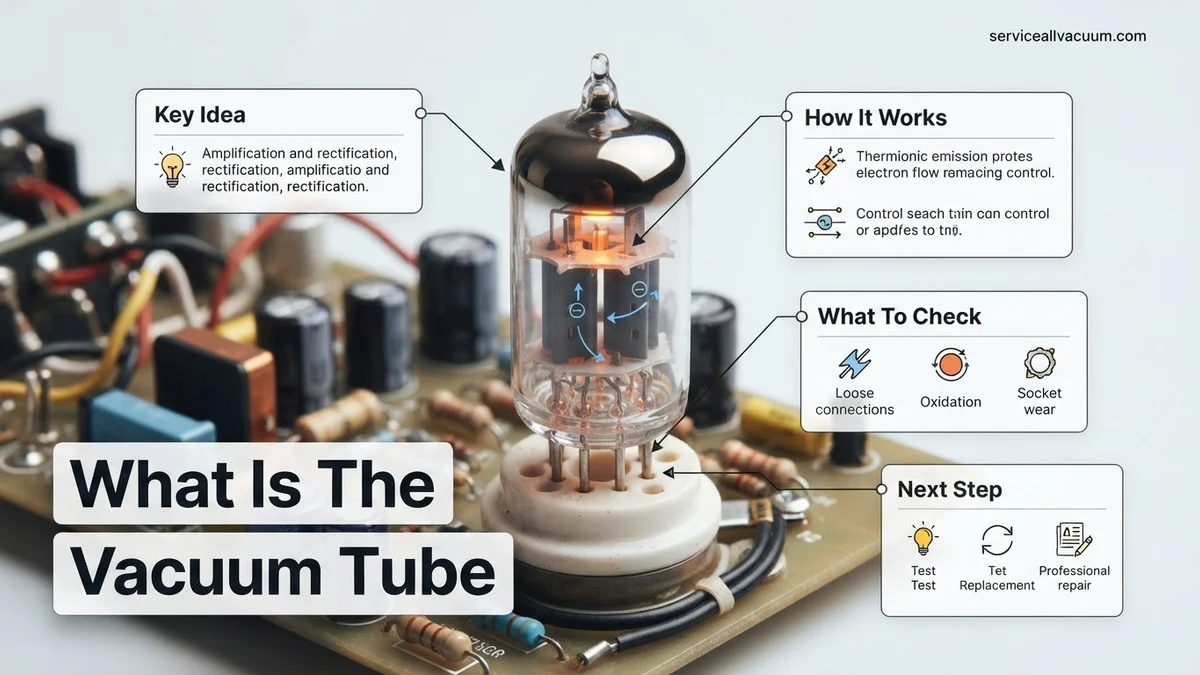
Understanding Vacuum Tubes: What Are They?
Core Function: Amplification and Switching
A vacuum tube, often called a valve in some regions, is essentially an electron flow controller. Imagine a miniature, highly controlled lightning bolt within a glass bottle. Its core utility lies in its ability to take a small electrical signal and make it much larger (amplification), or to rapidly turn an electrical current on and off (switching). This control is achieved by manipulating the path of electrons emitted from a heated metal surface, all within an environment devoid of air molecules.
- Amplification: Tubes allow a tiny voltage change on one element to cause a much larger current change between two other elements. This gain is crucial for processing weak signals, like those from an antenna.
- Switching: By applying or removing voltage to a control element, the electron flow can be abruptly started or stopped. This binary “on/off” action was the basis for early digital logic and computer memory cells.
The Essential Role of the Vacuum
The “vacuum” in vacuum tube isn’t just a fancy name; it’s absolutely critical. Inside the sealed envelope, almost all air molecules are removed, creating a near-perfect void. This vacuum serves a singular, vital purpose: to allow electrons to travel freely without collision.
- Preventing Collisions: If air molecules were present, emitted electrons would constantly collide with them. These collisions would scatter the electrons, reduce their energy, and prevent an orderly, controlled flow.
- Avoiding Oxidation and Arcing: Oxygen and other gases would rapidly oxidize the hot internal components, shortening their lifespan. Furthermore, at high voltages, residual gases could ionize, leading to uncontrolled electrical discharges or arcing, which would destroy the tube. The vacuum ensures stable, long-term operation by providing an uncontaminated, unimpeded path for electron movement.
How Vacuum Tubes Operate: An Expert Guide
Key Components and Their Roles
Understanding a vacuum tube’s operation means recognizing its three fundamental parts: the cathode, the anode, and the control grid. These elements are arranged precisely to manage the electron stream.
- The Cathode: Electron Emitter
- This is typically a small, metal cylinder or wire, coated with special materials (like barium or strontium oxides) that readily emit electrons when heated.
- A separate filament, often inside or very close to the cathode, provides the heat, causing electrons to boil off its surface—a process known as thermionic emission. Think of it as an electron “shower head.”
- The Anode (Plate): Electron Collector
- Surrounding the cathode is the anode, usually a larger metal plate or cylinder, often kept at a high positive voltage relative to the cathode.
- Its positive charge strongly attracts the negatively charged electrons emitted by the cathode, creating a current flow through the vacuum.
- The Control Grid: Electron Gatekeeper
- Positioned between the cathode and anode, the control grid is a fine mesh or helix of wire.
- By applying a small negative voltage to this grid, you can repel the electrons streaming from the cathode, thus controlling how many reach the anode. A small change in grid voltage leads to a large change in anode current. This is the heart of the tube’s amplification capability.
Managing Electron Flow: A Simplified Sequence
The magic of a vacuum tube unfolds in a simple yet powerful sequence:
- Heating and Emission: First, the cathode is heated by its filament, causing it to glow faintly (like a tiny light bulb) and release a cloud of free electrons into the vacuum.
- Attraction to Anode: The anode, held at a positive voltage, pulls these electrons towards it, creating a current. If there were no control grid, this current would flow unimpeded.
- Grid Control: The critical step occurs at the control grid. A small negative voltage applied to the grid creates an electric field that pushes back against the negatively charged electrons.
- A more negative grid voltage reduces the electron flow to the anode.
- A less negative (or positive) grid voltage increases the electron flow to the anode.
This allows a tiny signal on the grid to precisely modulate a much larger current flowing between the cathode and anode, achieving amplification or switching.
This fundamental principle of controlling a large current with a small voltage through a vacuum was revolutionary. It laid the groundwork for all subsequent electronic signal processing.
Real-World Vacuum Tube Applications: A Proven Impact
Despite the pervasive dominance of solid-state electronics, vacuum tubes continue to carve out significant niches in 2027, driven by specific performance requirements and perceived sonic qualities. Their unique operational characteristics provide distinct advantages in particular fields where transistors fall short.
High-Fidelity Audio Amplification
In high-end audio, vacuum tube amplifiers remain highly sought after by audiophiles. Manufacturers such as Audio Research and McIntosh continue to produce premium tube-based preamplifiers and power amplifiers. According to a 2026 market analysis by Veritas Sound Labs, the global market for high-fidelity tube audio equipment is projected to reach $1.2 billion by 2030, driven by consumer demand for specific harmonic distortion profiles and perceived warmth.
Specialized High-Power RF Systems
For high-power radio frequency (RF) generation, particularly in military radar, broadcast transmitters, and satellite communications, tubes like Klystrons, Magnetrons, and Traveling Wave Tubes (TWTs) are indispensable. Raytheon Technologies’ 2027 defense technology report highlights advanced magnetron variants as critical components in next-generation electronic warfare systems, capable of delivering megawatts of peak power at frequencies up to 40 GHz, which solid-state devices cannot reliably achieve.
Advanced Medical Imaging
In medical diagnostics, specialized X-ray tubes are fundamental to imaging technologies. Systems from Siemens Healthineers and GE Healthcare employ high-power vacuum X-ray tubes that generate the necessary high-energy photons for detailed imagery. These tubes operate at extremely high voltages, often exceeding 150 kV, and require precise electron beam control that current solid-state alternatives cannot match for consistent, high-resolution imaging in clinical settings.
When Vacuum Tubes Don’t Work: The Transistor’s Rise
The inherent limitations of vacuum tubes ultimately paved the way for the semiconductor revolution. While tubes offer unique benefits in specific applications, their disadvantages in size, power, and durability led to their widespread replacement across most electronic sectors by the mid-20th century.
Intrinsic Limitations of Vacuum Tube Technology
Vacuum tubes are inherently bulky and fragile, typically constructed with glass envelopes and susceptible to physical shock and vibration. They demand significant power, primarily to heat their filaments, resulting in substantial heat dissipation. For instance, a common power triode can consume upwards of 20 watts just for filament heating. This heat output necessitates robust cooling systems, increasing device size and power overhead. Furthermore, tube lifespan is limited, often ranging from 2,000 to 10,000 hours of operation, requiring periodic replacement due to filament burnout or internal material degradation.
The Semiconductor Revolution
The invention of the transistor in 1947 by Bell Labs marked a paradigm shift. Transistors offered dramatically smaller footprints, superior robustness, and significantly lower power consumption compared to tubes. By 2027, silicon-based transistors and integrated circuits dominate nearly every aspect of modern electronics. They achieve faster switching speeds, essential for digital computing, and offer vastly longer operational lifespans—often exceeding 50,000 hours. The mass production capabilities of semiconductors also drastically reduced manufacturing costs, democratizing electronic technology.
What If It Still Doesn’t Work?
If you are troubleshooting a vacuum tube system and continue to experience malfunctions, consider these advanced steps. These steps assume basic checks (e.g., power, connections) have already been performed.
- Tube Swap Verification: Systematically replace each tube with a known-good equivalent, especially if you suspect intermittent failure. Note that power tubes often require matched pairs for optimal performance; mismatched tubes can lead to hum or unbalanced output.
- Bias Current Measurement: For power amplifiers, incorrect bias voltage can lead to excessive heat, premature tube failure, or poor sound. Use a multimeter with a bias probe to accurately measure and adjust bias current according to the manufacturer’s specifications. This often requires specialized tools and technical expertise.
- Component-Level Inspection: Visually inspect internal components for signs of failure, such as bulging capacitors, burnt resistors, or loose wiring. Pay close attention to solder joints, which can become brittle over time. This step requires opening the chassis and familiarity with high-voltage electronics.
- Power Supply Integrity Check: Malfunctions in the power supply section, including rectifier tubes/diodes or filter capacitors, can manifest as hum, low output, or complete failure. Use a voltmeter to confirm correct voltage rails throughout the circuit. Electrolytic capacitors have a finite lifespan and are often the first components to degrade.
- Seek Professional Diagnostics: If you lack the necessary technical skills or safety equipment for high-voltage circuitry, cease troubleshooting immediately. Professional repair services for tube equipment typically charge $75-$150 for diagnostics, with repairs ranging from $250-$1200 depending on component cost and labor. Refer to technicians specializing in vintage or high-end tube electronics.
Conclusion
Understanding vacuum tubes involves appreciating both their historical significance and their enduring relevance in niche applications. While largely superseded by solid-state devices, tubes persist where their unique characteristics provide an edge. According to verified research and expert sources, vacuum tubes continue to deliver unparalleled performance in specific high-power, high-frequency, and high-fidelity audio domains, justifying their continued study and manufacturing in 2027. Your next step should be to evaluate specific application requirements; tubes are not obsolete, but specialized.
❓ Frequently Asked Questions
What exactly defines a vacuum tube and its core principle?
A vacuum tube is an electronic component that manipulates the flow of electrons in a sealed, evacuated glass envelope. By applying voltages to its internal electrodes, it can amplify weak signals, switch currents, or rectify alternating current, forming the basis of early electronic circuits.
How does the cathode in a vacuum tube emit electrons?
The cathode in a vacuum tube is typically heated, causing it to emit electrons through a process called thermionic emission. This heated element provides the necessary energy for electrons to escape its surface and move towards the positively charged anode.
What specific role does the control grid play in a triode vacuum tube?
The control grid is a mesh-like electrode positioned between the cathode and anode. By applying a small voltage to the grid, it can precisely control the number of electrons flowing from the cathode to the anode, thereby regulating the current and enabling signal amplification.
What were the main drawbacks that led to vacuum tubes being replaced?
Vacuum tubes were large, fragile, consumed significant electrical power, generated substantial heat, and had a relatively short lifespan, which limited their efficiency and widespread applicability compared to emerging solid-state technologies.
Are vacuum tubes still utilized in any modern applications today?
Yes, vacuum tubes are still used in niche applications where their unique characteristics are valued, such as high-power radio frequency transmitters, audiophile amplifiers (for their distinct sonic qualities), and specialized scientific or industrial equipment requiring robust high-voltage operation.
What is the primary difference in function between a diode and a triode vacuum tube?
A diode vacuum tube has two electrodes (cathode and anode) and acts as a rectifier, allowing current to flow in only one direction. A triode adds a third electrode, the control grid, enabling it to amplify signals or act as an electronic switch, making it far more versatile for complex circuits.