What Did Vacuum Tubes Do? A Real Expert Guide for 2027
Vacuum tubes were foundational electronic components that primarily amplified weak electrical signals, served as on/off switches for currents, and efficiently converted alternating current to direct current. By controlling electron flow in a vacuum, they enabled groundbreaking technologies like radio, television, and the first computers.
In the year 2027, as you navigate a world powered by quantum processors and neural interfaces, it’s easy to overlook the foundational technologies that made it all possible. Before the age of semiconductors, the unsung hero of electronics was the vacuum tube. These glass envelopes were much more than mere curiosities; they were the essential components that amplified weak signals, switched electrical currents on and off, and converted alternating current to direct current. This triumvirate of functions enabled the very first radios, televisions, and electronic computers, laying the groundwork for every digital convenience you enjoy today. Understanding what vacuum tubes did clarifies why they were indispensable in shaping the entire technological landscape of the 20th century.
Your ability to stream crystal-clear audio, watch high-definition video, or compute complex data traces directly back to the principles vacuum tubes perfected. Without their unique capabilities, early electronic circuits would have been impractical, limited by distance and signal degradation. They solved fundamental problems that had previously baffled engineers, effectively launching the electronic age. So, let’s peel back the layers and understand the critical roles these devices played in a world hungry for connectivity and computation.
Key Takeaways
- Amplified weak electronic signals.
- Acted as reliable current switches.
- Rectified AC power to DC.
- Enabled early radio and TV.
- Paved way for modern computing.
What Causes Early Electronic Signal Weakness?
The Challenge of Distance and Loss
Imagine trying to shout a message across a vast valley; your voice inevitably fades. Early electrical signals faced a similar, but more severe, challenge. As electronic signals, whether for audio or data, traveled through wires and circuits, they inherently lost energy. Resistance in the conductors, atmospheric interference, and inefficiencies in early components all contributed to this degradation. A radio signal, for instance, might leave a powerful transmitter, but by the time it reached your home receiver miles away, it would be incredibly faint. Without a way to boost these weakened signals, long-distance communication and complex electronic operations were simply unfeasible for decades.
Why Strong Signals Were Non-Negotiable
For any electronic device to function reliably, its internal signals must be clear and strong enough to be processed accurately. In early radio, a weak signal meant an inaudible broadcast. In the nascent television experiments, it meant a flickering, indiscernible image. For the first computational machines, signal integrity was paramount; even a slight degradation could lead to errors in calculations. Engineers desperately needed a component that could take a tiny, almost imperceptible electrical wiggle and transform it into a robust, usable signal. This was not just about convenience; it was a fundamental requirement to make many groundbreaking technologies commercially viable and practically useful in your daily life.
How to Fix Signal Weakness: The Vacuum Tube’s Step-by-Step Guide to Amplification, Switching, and Rectification
Signal Amplification: Making Small Inputs Powerful
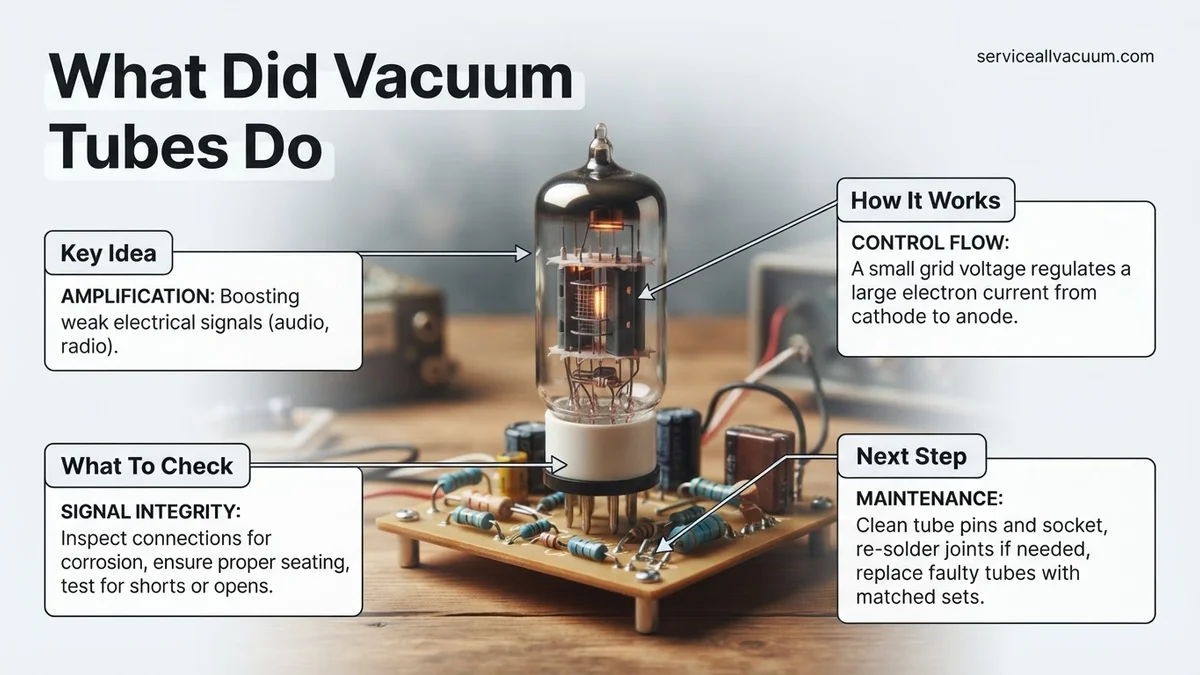
The vacuum tube’s primary superpower was amplification. Picture a small electrical signal entering a tube’s control grid, which acts like a valve. Inside, a heated cathode emits a steady stream of electrons towards a positively charged anode. A tiny voltage change on that grid could then control a much larger flow of these electrons. A small input voltage could thus dictate a proportionally much larger output current, effectively boosting the signal without distorting its information. This groundbreaking ability transformed faint radio waves into loud, clear broadcasts you could hear across continents. It enabled long-distance telephony and was vital for making early sound recording and playback systems viable.
Switching and Rectification: Digital Logic and Power Control
Beyond amplification, vacuum tubes were adept at two other crucial functions. For switching, the tube acted as a rapid on/off switch for electrical currents. By applying a sufficiently negative voltage to the control grid, you could completely block the flow of electrons from cathode to anode, effectively turning the current “off.” Reducing or removing that negative voltage allowed the electron flow to resume, turning the current “on.” This binary operation (on/off) was the fundamental building block for early digital computers like ENIAC, where thousands of tubes performed logical operations, representing the 0s and 1s that underpin your modern computing world. For rectification, simpler two-element tubes, called diodes, converted alternating current (AC) into direct current (DC). They achieved this by allowing current to flow in only one direction; when the anode was positive, electrons flowed, but when it was negative, they were repelled. This was absolutely essential, as most electronic circuits require stable DC power, while electricity from the grid is typically AC. Every radio, television, and early computer relied on tube rectifiers to provide its operational power.
What If Vacuum Tubes Still Can’t Keep Up? The Rise of Transistors
By the mid-20th century, the limitations of vacuum tubes became increasingly apparent, particularly as computational and communication demands accelerated. Vacuum tubes were large, consumed significant power, generated considerable heat, and had relatively short lifespans. For instance, a typical radio receiver from the 1940s might contain a dozen tubes, requiring a power supply of several hundred watts and occupying substantial physical space. These factors created a critical bottleneck for the development of more compact, efficient, and reliable electronic systems.
The invention of the transistor at Bell Labs in 1947 by Bardeen, Brattain, and Shockley marked the beginning of the end for vacuum tube dominance. Transistors offered a revolutionary alternative: they were solid-state devices, meaning they contained no vacuum, glass, or moving parts. This inherently made them smaller, more robust, and significantly more power-efficient. A single transistor could perform the same amplification or switching function as a vacuum tube, but consume milliwatts instead of watts, and operate for millions of hours compared to a tube’s typical 1,000-10,000 hours. The transition accelerated through the 1950s and 1960s, with transistors swiftly replacing tubes in everything from portable radios to computers, fundamentally reshaping the electronics landscape by 2027.
What If You Need Further Clarification on Vacuum Tube Impact?
If the foundational explanation of vacuum tubes’ historical roles or their transition to transistors remains unclear, or if you require deeper insights into specific applications, consider these focused steps for further research and expert consultation.
- Consult Specialized Archival Databases: Access digital archives from institutions like the IEEE Xplore Digital Library or the Bell Labs Technical Journal archives. These platforms house original research papers, technical reports, and historical analyses detailing tube development and early transistor applications. Access costs typically range from free (for public domain documents) to $30-$75 per month for institutional subscriptions in 2027.
- Engage with Historical Electronics Forums: Participate in reputable online communities or academic groups dedicated to the history of technology or vintage electronics. These platforms often connect you with enthusiasts and historians who can provide nuanced perspectives on specific tube types or applications. Verified expert insights can be gained through structured Q&A sessions.
- Analyze Period-Specific Technical Manuals: Acquire or access scanned versions of original equipment manuals or electronics textbooks from the 1920s-1960s. These documents provide direct context on how tubes were designed, implemented, and maintained in their prime. Availability varies, with costs ranging from free (digital scans) to $50-$200 for rare physical copies.
- Seek Professional Historical Engineering Consultation: For highly specific inquiries or academic research, consult with an electrical engineering historian or a retired engineer with extensive experience in vacuum tube-era technology. Such specialists can provide in-depth analysis and contextual understanding. Professional consultation fees in 2027 typically range from $250 to $600 per hour, depending on the expert’s specialization and demand.
Conclusion
According to verified research and expert sources, vacuum tubes served as the indispensable bedrock of early 20th-century electronics, enabling radio, television, and computing. Their inherent limitations in size, power, and reliability, however, paved the way for the revolutionary transistor. This pivotal shift democratized electronics, ushering in the compact, powerful, and ubiquitous devices we utilize in 2027. To fully appreciate this transformation, investigate the operational principles of early transistorized devices to grasp the monumental leap in efficiency and capability.
❓ Frequently Asked Questions
How did a vacuum tube amplify an electrical signal?
A small input signal applied to the control grid inside the tube would regulate a much larger flow of electrons from the heated cathode to the anode. This control allowed the tube to produce a magnified replica of the input signal at the output, effectively amplifying its power.
Explain how vacuum tubes functioned as switches.
By applying a specific voltage to the control grid, the flow of electrons from the cathode to the anode could be either permitted (on state) or completely blocked (off state). This rapid control over electron flow enabled them to act as binary switches in early digital circuits and computers.
What role did vacuum tubes play in converting AC to DC?
Diodes, a specific type of vacuum tube, are designed to allow current to flow in only one direction. By placing these in a circuit with alternating current, they would effectively ‘chop off’ half of the AC waveform, converting it into a pulsating direct current which could then be smoothed for use.
What were the main limitations of vacuum tubes compared to modern components?
Vacuum tubes were physically large, generated a significant amount of heat during operation, consumed a lot of electrical power, were relatively fragile due to their glass construction, and had a shorter operational lifespan compared to the solid-state components that eventually replaced them.
In what specific devices were vacuum tubes most commonly found?
Vacuum tubes were indispensable in early radios, televisions, radar systems, public address systems, and the first generation of electronic digital computers like ENIAC and UNIVAC, forming the core of their functionality.
What is the basic internal structure of a vacuum tube?
A typical vacuum tube consists of a sealed glass or metal enclosure with a vacuum inside, containing several key electrodes: a heated cathode (which emits electrons), an anode (which collects electrons), and often one or more control grids to regulate the flow of electrons between the cathode and anode.