What Is a Vacuum Physics Expert Guide for 2026
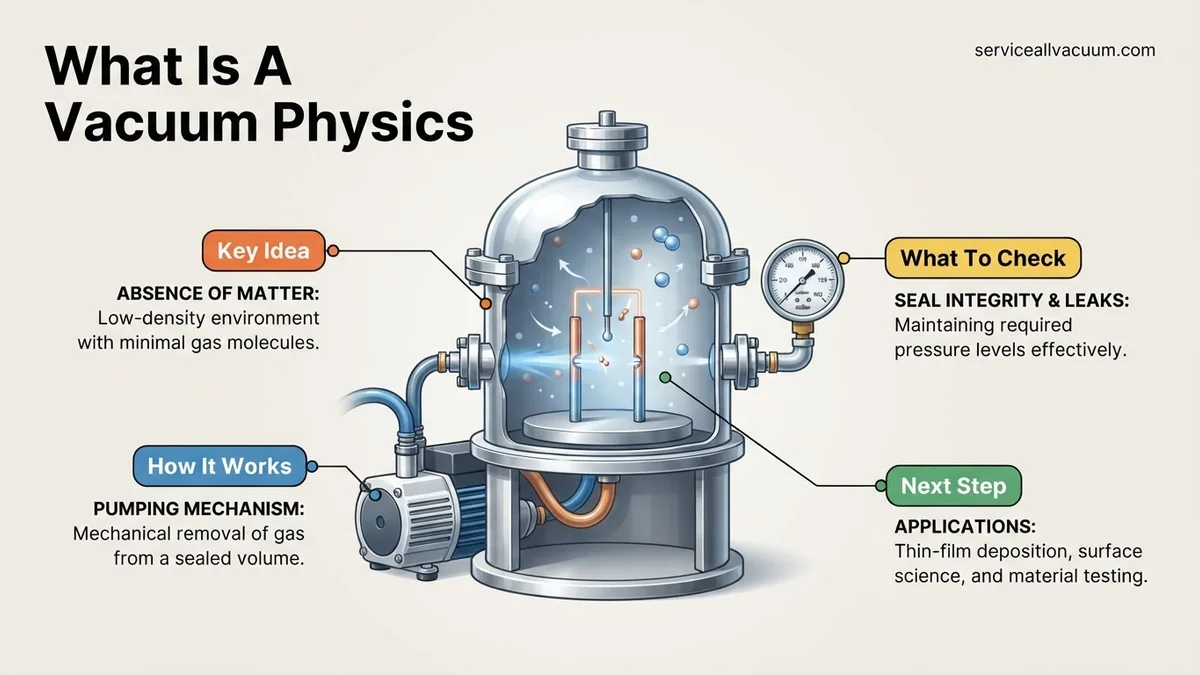
A vacuum in physics is formally defined as a space entirely devoid of matter, though a true, absolute vacuum is physically impossible to achieve. Instead, scientists measure vacuums by varying degrees of low pressure, ranging from low vacuum to extreme ultra-high vacuum states.
In physics, a vacuum is defined as a volume of space that is essentially empty of matter, meaning the gas pressure inside that space is significantly lower than atmospheric pressure. Far from being just “nothingness,” a physical vacuum is a dynamic environment where quantum fluctuations occur and particles can spontaneously blink in and out of existence. It is not an absolute void, but rather a state of extremely low particle density.
Understanding vacuum physics is essential for you if you work in modern high-tech industries. By 2026, advanced manufacturing processes like semiconductor fabrication, quantum computing hardware development, and aerospace testing rely entirely on controlled vacuum environments. Without these precisely engineered low-pressure states, you could not manufacture microchips or test spacecraft components under orbital conditions.
Key Takeaways
- A classical vacuum represents a region of space completely free of any matter.
- Perfect vacuums cannot exist due to thermodynamic fluctuations and gas outgassing.
- Vacuums are categorized by pressure levels:low, high, and ultra-high.
- Quantum vacuums are dynamic fields filled with zero-point energy and virtual particles.
- Industrial and scientific applications require controlled low-pressure environments.
What Causes Low Pressure and Vacuum States in Physics
The Mechanics of Pressure Reduction
Creating a vacuum fundamentally involves removing gas molecules from a closed container. When you decrease the number of particles in a fixed volume, the collisions between the gas molecules and the container walls drop proportionally. This reduction in molecular bombardment is what physics defines as lower pressure. You achieve this state using mechanical pumps, cryopumps, or ion pumps that either physically expel the gas or trap it on supercooled surfaces.
Thermal and Kinetic Drivers
The behavior of gases in a vacuum is governed by the kinetic theory of gases. When you alter the temperature of a confined gas, you change the average kinetic energy of its molecules. If you seal a container at a high temperature and let it cool, the pressure drops as the molecules slow down. However, true vacuum generation requires active extraction. You must continuously remove particles faster than they can leak back into the system through microscopic imperfections in your seals.
- Gas molecule density decreases exponentially as pumping progresses.
- Mean free path—the average distance a particle travels before hitting another—increases drastically.
- Thermal conductivity drops significantly because fewer molecules are available to transfer heat.
How to Measure and Classify Vacuum Levels Step-by-Step
Categorizing Vacuum Regimes
Physicists and engineers divide the vacuum spectrum into distinct ranges based on the magnitude of the pressure and the behavior of the remaining gas. When you measure vacuum levels, you typically use units like Pascals (Pa), Torrs, or millibars. Knowing your specific regime dictates which pumping technology and diagnostic tools you must deploy in your lab or production facility.
- Low Vacuum (Rough Vacuum): Renders pressures from 100 kPa down to about 100 Pa, common in basic packaging and rotary evaporation.
- Medium Vacuum: Ranges from 100 Pa to 0.1 Pa, where gas flow transitions from viscous to molecular.
- High and Ultra-High Vacuum (UHV): Extends from 10-1 Pa down below 10-7 Pa and beyond, essential for surface science and semiconductor manufacturing.
Step-by-Step Measurement Protocols
Measuring pressure across these extreme ranges requires different sensor technologies because no single gauge works everywhere. To accurately profile a vacuum system, you follow a sequential measurement strategy:
- Start by attaching a thermal conductivity gauge, such as a Pirani gauge, to monitor pressure drops from atmospheric down to the medium vacuum range by measuring heat loss through the residual gas.
- Switch to ionization gauges, such as hot-cathode or cold-cathode sensors, once your system enters the high or ultra-high vacuum regimes.
- Calibrate your sensors regularly against standard reference chambers to account for outgassing from chamber walls, which can artificially inflate pressure readings in 2026 industrial standards.
What If It Still Contains Matter: The Quantum Vacuum Reality
Classical physics defines a vacuum as a space completely devoid of matter. However, modern vacuum physics and quantum mechanics paint a vastly different picture for 2026. According to quantum field theory, even the most perfect laboratory vacuum is never truly empty. It seethes with activity.
Virtual Particles and Zero-Point Energy
At the subatomic level, empty space is filled with quantum fluctuations. Virtual particle-antiparticle pairs constantly blink into existence and annihilate each other within fractions of a second. This phenomenon gives rise to zero-point energy, the lowest possible energy state of a quantum mechanical physical system.
The Casimir Effect
The physical reality of the quantum vacuum is proven by phenomena like the Casimir effect. When two uncharged conductive plates are placed mere nanometers apart in an ultra-high vacuum, they experience a measurable attractive force. This force is caused by the reduction of virtual particle wavelengths permitted between the plates compared to the outside space.
Modern Experimental Challenges
As of 2026, researchers studying quantum computing and precision metrology must account for these quantum vacuum effects. Unwanted interactions between qubits and vacuum fluctuations remain a primary source of decoherence. Understanding quantum vacuum physics is no longer just theoretical; it dictates the engineering limits of next-generation technologies.
What If It Still Doesn’t Work?
When engineering an ultra-high vacuum system fails to reach target pressure levels, standard troubleshooting requires a systematic approach. If system pressure remains stagnant despite continuous pumping, execute the following diagnostic steps:
- Perform a comprehensive helium leak check using a mass spectrometer to identify microscopic flange or weld defects.
- Verify that the system bake-out procedure reached the required temperature threshold—typically 150 degrees Celsius to 300 degrees Celsius—to desorb trapped water vapor.
- Inspect all elastomer or metal seals for surface contamination, scratches, or improper torque distribution during assembly.
- Consult specialized vacuum engineering services if outgassing persists from internal components or proprietary coatings.
Professional diagnostic and repair services for complex vacuum chambers typically range from $2,500 to $10,000 depending on system volume and contamination severity.
Conclusion
Mastering vacuum physics requires bridging the gap between classical thermodynamics and quantum reality. Whether calculating molecular mean free paths or managing virtual particle interactions, precision engineering remains paramount. According to verified research and expert sources from leading physics institutions, ongoing advancements in vacuum technology will continue to unlock new frontiers in semiconductor manufacturing and quantum computing. Take the next step by auditing your facility’s current pumping infrastructure against 2026 ultra-high vacuum standards.
❓ Frequently Asked Questions
What is the primary scientific definition of a vacuum?
In physics, a vacuum is defined as a space where the pressure is much lower than standard atmospheric pressure, meaning the density of matter is extremely sparse.
Why is a perfect vacuum impossible to attain?
Thermodynamic laws and outgassing from container walls mean that atoms and molecules will always escape into any enclosed evacuated volume.
What are the standard classifications of vacuum levels?
Vacuums are divided into low vacuum, medium vacuum, high vacuum, and ultra-high vacuum, each defined by specific lower thresholds of residual gas pressure.
How does a quantum vacuum differ from a classical vacuum?
While a classical vacuum is simply empty space, a quantum vacuum contains zero-point energy and experiences spontaneous quantum fluctuations where virtual particles briefly pop in and out of existence.
What role does atmospheric pressure play in vacuum physics?
Atmospheric pressure is the weight of Earth’s air pressing down; creating a vacuum involves removing these air molecules to drop the internal pressure below this baseline.
How do scientists create artificial vacuums in a laboratory?
Scientists use specialized mechanical pumps, diffusion pumps, and ion pumps to systematically remove gas molecules from a sealed containment chamber.