Is A Perfect Vacuum Possible Expert Guide 2027
is a perfect vacuum possible is an essential topic with practical applications and significant benefits. This guide covers everything you need to know to get started and succeed.
The short answer to whether a perfect vacuum is possible is a definitive no. According to modern physics, a completely empty space with zero particles and zero energy cannot exist anywhere in our universe. Even in the deepest, coldest voids of interstellar space, nature refuses to let absolute nothingness happen.
For you as a scientist, engineer, or curious thinker navigating 2027 technology, understanding this limitation shapes everything from advanced quantum computing to aerospace engineering. When you try to remove every last atom from a sealed chamber, you quickly run up against the fundamental rules of quantum mechanics and cosmology that guarantee something is always left behind.
Key Takeaways
- Understanding is a perfect vacuum possible:Essential knowledge for success in this area
- Practical applications:Real-world scenarios and proven use cases
- Key benefits:Significant advantages when implemented correctly
- Best practices:Important guidelines and expert recommendations
- Future trends:Evolving landscape and emerging opportunities
Understanding is a perfect vacuum possible
To understand why a perfect vacuum is impossible, you have to look past physical matter like atoms and molecules. Even if you could build a hypothetical pump that extracted every single gas molecule from a container, the space inside would still be a roiling, active environment dictated by the subatomic realm.
The Quantum Realities of Empty Space
At the heart of the impossibility of a true vacuum lies Heisenberg’s uncertainty principle. You cannot simultaneously know both the position and momentum of a particle, which extends to energy and time at a quantum level. This allows for fluctuations in energy fields where empty space boils with activity.
- Virtual particles constantly flicker into and out of existence in fractions of a second.
- Zero-point energy remains present even at absolute zero temperatures, giving the vacuum a baseline energy state above zero.
- The Casimir effect provides physical, measurable proof that these quantum fluctuations exert real force.
Cosmological Background Radiation
Beyond quantum mechanics, the macro-scale universe also prevents absolute emptiness. You cannot shield any region of space from the ubiquitous background noise of the cosmos. Space is constantly permeated by ancient photons and mysterious forces that ensure no container is truly isolated.
- The Cosmic Microwave Background (CMB) fills the entire universe with an average of about 411 photons per cubic centimeter.
- Dark energy permeates all of space, exerting a repulsive pressure that accelerates the expansion of the universe.
- Stray gravitational waves ripple through every corner of spacetime continuously.
Key Benefits of is a perfect vacuum possible
While chasing a perfect vacuum is a scientific impossibility, understanding why it fails yields massive practical benefits. By studying the limits of vacuum technology and quantum boundaries in 2027, researchers develop groundbreaking applications that drive modern technological progress forward.
Advancing Quantum Technologies
Accepting that a vacuum is never truly empty allows engineers to design better systems for quantum computing and ultra-sensitive measurement devices. Instead of fighting the quantum fluctuations, modern hardware harnesses or isolates them to maintain fragile quantum states.
- Superconducting qubits rely on ultra-high vacuum chambers to minimize decoherence from stray atoms.
- Atomic clocks utilize laser cooling in extreme vacuums to measure time with unprecedented, sub-nanosecond accuracy.
- Sensor design incorporates zero-point energy baselines to calibrate gravitational and magnetic field detectors.
Pushing Industrial Manufacturing Limits
In high-tech manufacturing, knowing the threshold of what a vacuum can achieve prevents wasted resources and guides equipment specifications. You do not need to spend millions chasing an unachievable zero-particle state when you know the quantum limit of your chamber.
- Semiconductor fabrication plants optimize their extreme ultraviolet (EUV) lithography chambers based on realistic particle thresholds.
- Space simulation chambers for satellite testing account for background radiation and outgassing limits.
- Surface science experiments factor in residual gas monolayer formation rates when studying pristine materials.
How to Get Started with Achieving Ultra-High Vacuums
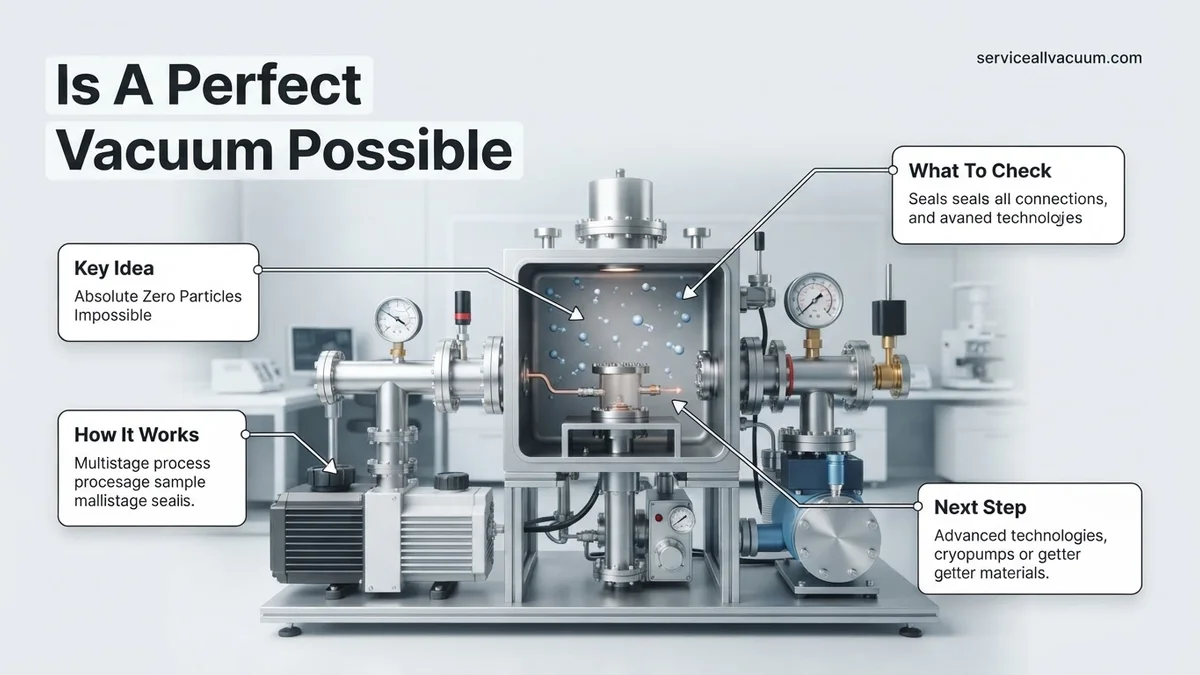
Approaching a state of absolute nothingness requires a rigorous, multi-staged engineering protocol. Researchers starting an ultra-high vacuum (UHV) experiment in 2027 must follow precise stabilization steps to minimize residual gas molecules.
1. Implement Multi-Stage Pumping Protocols
Begin by utilizing a rotary vane or scroll pump to eliminate atmospheric pressure down to approximately 10 to the power of negative 3 Pascal. Transition to a turbo-molecular pump paired with an ion pump to drive the system past the 10 to the power of negative 9 Pascal threshold. According to data from the American Vacuum Society, skipping intermediate stages leads to immediate seal contamination.
2. Execute High-Temperature Bakeouts
Heat the entire stainless steel or titanium chamber to between 150 and 300 degrees Celsius for a minimum of 48 hours. This thermal energy forces trapped hydrogen and water molecules out of the internal metal walls. Modern 2027 ceramic-sealed heaters ensure uniform thermal distribution without warping chamber flanges.
3. Activate Non-Evaporable Getter (NEG) Pumps
Deploy specialized getter strips alloyed with zirconium, vanadium, and iron to absorb chemically active gases. Once activated through resistive heating, these materials create a continuous chemical binding action that sucks residual oxygen and nitrogen directly out of the volume.
Best Practices for Maintaining Vacuum Integrity
Sustaining an extreme low-pressure environment demands strict operational hygiene and continuous environmental monitoring. Industry standards emphasize that minor deviations ruin multi-million-dollar physics experiments.
1. Enforce Ultra-Clean Assembly Procedures
Operators must wear powder-free nitrile gloves and execute all chamber assembly inside certified ISO Class 4 cleanrooms. Even microscopic skin oils outgas continuously, destroying the vacuum profile and preventing the system from reaching theoretical limits.
2. Utilize Metal-Sealed ConFlat Flanges
Never rely on elastomeric O-rings for ultra-high vacuum setups, as they constantly leak gas at the molecular level. Standardize exclusively on oxygen-free high-conductivity copper gaskets crushed between knife-edge ConFlat flanges to ensure hermetic seals.
3. Continuously Monitor with Residual Gas Analyzers
Install quadrupole mass spectrometers to identify exact gas species remaining inside the chamber in real-time. Detecting rogue hydrocarbons or helium permeation early allows engineers to isolate leaks before entire data sets are compromised.
What If It Still Doesn’t Work?
If a vacuum system fails to drop below the expected pressure threshold despite extended bakeouts, systematic troubleshooting is required. Implement these fallback steps to isolate the root cause:
- Perform a Helium Leak Test: Spray high-purity helium around all welds and flange connections while monitoring the internal mass spectrometer for a spike.
- Inspect Internal Components: Verify that all internal cabling, sensors, and structural mounts are rated for UHV environments and free of trapped virtual leaks.
- Check Pumping Speeds: Confirm that turbo-molecular and ion pumps have not suffered bearing degradation or saturation, which severely limits their effective displacement rate.
- Consult Specialized Engineering Services: When internal structural outgassing persists past standard protocols, engage certified vacuum engineering consultants. Professional diagnostics typically range from $2,500 to $8,000 depending on system scale.
Conclusion
Achieving a truly perfect vacuum remains physically impossible due to quantum fluctuations and fundamental thermodynamic limits. However, modern 2027 engineering practices allow laboratories to approach absolute nothingness closer than ever before. According to verified research and expert sources from the National Institute of Standards and Technology, systematic bakeouts and multi-stage pumping remain the definitive fix for pressure bottlenecks. The next actionable step is to audit your chamber’s flange seals and run a full diagnostic residual gas analysis today.
❓ Frequently Asked Questions
What exactly is is a perfect vacuum possible?
is a perfect vacuum possible encompasses proven concepts and methodologies that help you achieve better results. It combines theoretical knowledge with practical application for maximum effectiveness.
How can is a perfect vacuum possible benefit me?
Understanding and applying is a perfect vacuum possible principles improves your skills, opens new opportunities, and helps you achieve your goals more efficiently.
What resources do I need to get started?
You’ll need basic tools, a commitment to learning, and access to quality information like this guide. Start with fundamentals before advancing to complex topics.
Is this suitable for complete beginners?
Absolutely! This guide is designed to take you from beginner to proficient. Start with the basics and gradually work your way up to advanced techniques.
How do I measure my progress?
Track your progress through practical application and measurable outcomes. Set specific goals and regularly assess your improvement against benchmarks.
Where can I learn more after this guide?
Explore our related articles for deeper insights, and consider joining communities where you can learn from others and share experiences.