How to Choose a Vacuum Cleaner Step-by-Step Guide 2027
Choosing the right vacuum cleaner depends primarily on your flooring types, home layout, and whether you live with pets or allergies. Navigating these factors ensures you select a model that delivers proper suction without overspending on unnecessary features.
Choosing the right vacuum cleaner in 2027 comes down to matching your specific flooring mix, home layout, and household allergens to the correct machine architecture and suction specifications. Navigating the modern market requires looking past marketing hype to evaluate actual motor power, filtration standards, and battery efficiency.
Buying the wrong vacuum means wasting money on a machine that lacks the airflow for thick carpets or the maneuverability for tight multi-level spaces. This guide walks you through a practical decision framework to help you select a vacuum that cleans efficiently and lasts for years.
Key Takeaways
- Match your vacuum type directly to your primary flooring material, whether carpet or hard floors.
- Choose corded models for uninterrupted power or cordless stick vacuums for lightweight convenience.
- Bagged vacuums trap dust more hygienically, while bagless models save ongoing maintenance costs.
- Look for HEPA filtration if anyone in your household suffers from allergies or asthma.
- Prioritize motorized brush rolls and specialized attachments if you have heavy-shedding pets.
What Causes Vacuum Confusion — Assessing Your Flooring and Home Layout
Vacuum shopping often feels overwhelming because manufacturers use confusing terms like air watts, sealed systems, and cyclonic suction interchangeably. The root of the confusion is trying to find a one-size-fits-all machine for a home that actually has diverse cleaning demands. Start your selection process by auditing the physical layout of your living space.
Mapping Your Flooring Surfaces
Different surfaces demand entirely different mechanical actions to extract embedded dirt. Hardwood floors require soft roller brushes that trap dust without scratching the finish, while high-pile carpets need aggressive brush rolls with adjustable height settings to agitate deep fibers.
- Mixed Hardwood and Tile: Look for wide cleaning paths and soft dusting brushes that prevent scattering debris.
- Low-Pile and Medium-Pile Carpet: Standard multi-surface motorized heads with brush roll shutoff options work best.
- High-Pile or Shag Carpets: You need deep-cleaning upright vacuums or manual height adjustments to prevent the motor from stalling.
Evaluating Home Layout and Obstacles
Your floor plan dictates the practical weight and reach of your ideal vacuum. Multi-level homes require lightweight cordless sticks or lift-away canisters that do not strain your back on stairs. Heavy upright models excel in single-level homes with expansive wall-to-wall carpeting.
- Stairs and Tight Spaces: Prioritize an under-four-pound handheld mode or a dedicated long hose attachment.
- Large Open Spaces: A corded canister or a long-runtime cordless model prevents interruptions to empty bins or recharge batteries.
- Cluttered Rooms: Low-profile floor heads easily slip underneath modern low-clearance furniture.
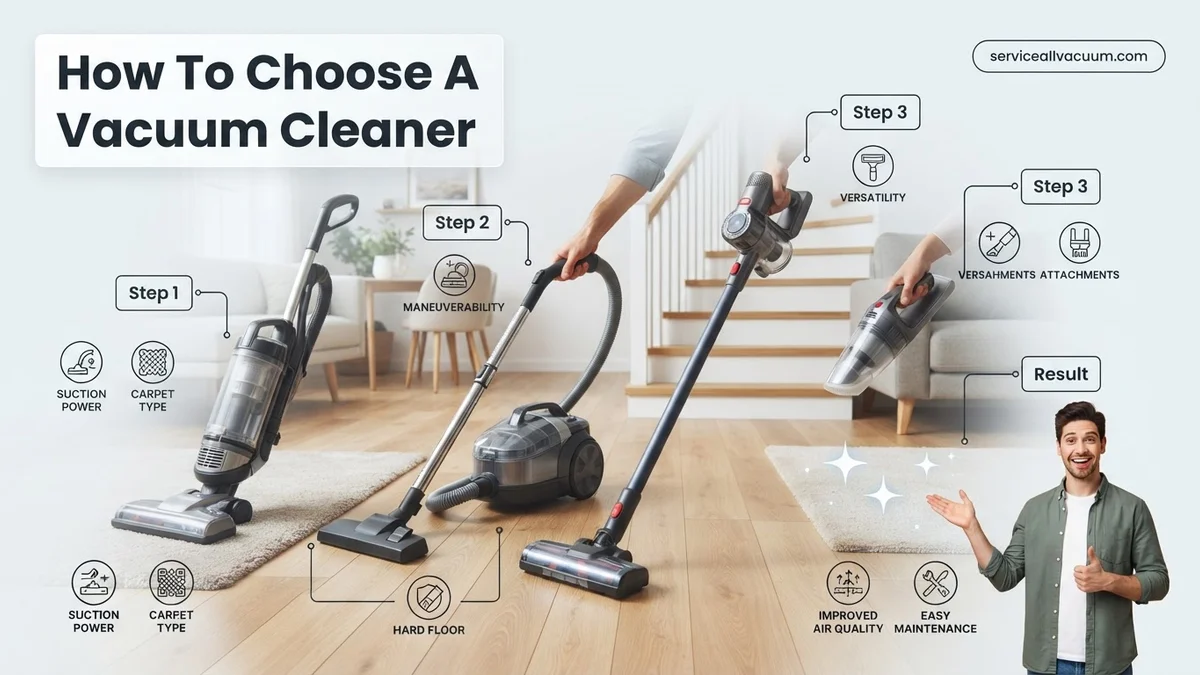
Master Choosing a Vacuum Cleaner in 7 Simple Steps
Finding the right vacuum cleaner can feel overwhelming with hundreds of options flooding the market, ranging from traditional uprights to futuristic robot vacuums. Making the wrong choice often leads to buyer’s remorse, poor cleaning performance, and wasted money. This comprehensive guide walks you through the exact process of evaluating your home layout, flooring types, lifestyle needs, and budget to select the absolute best machine for your living space. By following this systematic approach, you will ensure your new vacuum effortlessly tackles pet hair, deep-set dirt, and everyday messes for years to come.
Step 1: Assess Your Home Flooring Types
What you need: A notepad, pen, and a quick walk through every room in your house.
Instructions: Document the percentage of different flooring surfaces in your living space. If your home features wall-to-wall high-pile carpets, you will need a vacuum with strong motorized brush rolls and adjustable height settings. Conversely, if you live in a modern apartment with mostly hardwood, tile, or laminate floors, a soft roller head or a machine with brush-roll shut-off is essential to prevent scratching delicate surfaces. For mixed-flooring homes, look for a versatile vacuum that allows you to easily transition from carpets to bare floors with a simple switch or digital control on the handle.
Pro Tip: Never buy a specialized hard-floor vacuum if your home is 70 percent carpet; you will struggle with embedded dirt and debris.
Step 2: Determine Your Primary Allergens and Cleaning Challenges
What you need: Knowledge of household allergy sufferers and pet ownership status.
Instructions: Analyze who lives in your home. If you share your space with shedding pets like golden retrievers or long-haired cats, you must prioritize models explicitly marketed for pet hair, which feature anti-tangle brush rolls and high-suction motors. If family members suffer from severe allergies, asthma, or hay fever, your non-negotiable requirement is a true HEPA (High-Efficiency Particulate Air) filtration system. A HEPA filter traps 99.97 percent of microscopic particles down to 0.3 microns, preventing dust mites and dander from exhausting back into the air you breathe.
Pro Tip: Ensure the vacuum is a “sealed HEPA system,” meaning all air drawn into the machine passes through the filter, rather than leaking out through poor seals in the body.
Step 3: Choose the Ideal Vacuum Form Factor
What you need: Understanding of your physical capabilities and home storage limitations.
Instructions: Decide which vacuum style fits your body and lifestyle. Upright vacuums offer powerful cleaning and large dust capacities, making them ideal for large carpeted homes, though they can be heavy. Canister vacuums feature a separate rolling body with a flexible hose, making them exceptionally maneuverable for stairs, under furniture, and on bare floors. Cordless stick vacuums provide unmatched convenience and lightweight agility for quick daily cleanups, though their battery life typically ranges from 15 to 60 minutes. Robot vacuums offer autonomous maintenance but struggle with thick carpets and heavy debris.
Pro Tip: If you have multi-level stairs, avoid heavy uprights and opt for a lightweight canister or a cordless stick vacuum with a detachable handheld mode.
Step 4: Evaluate Corded vs. Cordless Power
What you need: Room size measurements and evaluation of electrical outlet placements.
Instructions: Weigh the pros and cons of power delivery methods. Corded vacuums offer unlimited runtime and consistent, maximum suction power, making them the gold standard for deep cleaning entire houses in a single session. However, you must manage a power cord and switch outlets as you move from room to room. Cordless vacuums eliminate the hassle of tethering and excel at grabbing for quick spot cleans, car detailing, and high-reach cobweb removal. If you choose cordless, check the battery specifications and ensure it provides at least 20 minutes of runtime on high suction.
Pro Tip: Look for cordless models featuring removable, interchangeable batteries to double your cleaning time without waiting for a recharge.
Step 5: Inspect Included Tools and Accessories
What you need: List of specific cleaning tasks like upholstery, ceiling fans, or car detailing.
Instructions: Examine the attachment ecosystem that comes bundled with the vacuum. Standard attachments should include a crevice tool for tight spaces, an upholstery brush for couches and mattresses, and a dusting brush for delicate surfaces. If you have pets, a motorized mini-tangle-free tool is vital for lifting embedded fur from fabric furniture. Consider whether the vacuum has onboard storage for these accessories or if you will need to store them in a separate closet caddy.
Pro Tip: Avoid buying a vacuum with dozens of gimmicky attachments you will never use; instead, ensure the three core tools are exceptionally well-designed.
Step 6: Check Maintenance Requirements and Ongoing Costs
What you need: Awareness of bag replacements, filter washability, and warranty terms.
Instructions: Investigate how much upkeep the vacuum demands after purchase. Bagged vacuums require purchasing replacement bags every few months, but they offer cleaner disposal without dust clouds exploding into your face. Bagless models save on recurring costs, but you must empty the dust cup manually and regularly wash or replace foam and HEPA filters. Check the manufacturer’s warranty length—reputable brands typically offer a 2- to 5-year limited warranty protecting against motor and manufacturing defects.
Pro Tip: Always calculate the annual cost of consumables (bags and replacement filters) before committing to a specific model.
Step 7: Set Your Budget and Compare Final Contenders
What you need: Financial limit and online comparison tools or retail store visits.
Instructions: Establish a realistic spending threshold. Entry-level vacuums under $100 work for dorms or very small spaces but often lack durability. Mid-range vacuums ($150 to $350) offer the best balance of reliable suction, durability, and features for average homes. Premium models ($400 to $800+) provide commercial-grade longevity, advanced filtration, and smart features. Narrow your choices down to two final models, read independent expert reviews, and test them in-store if possible to check weight distribution and ergonomic handle comfort.
Pro Tip: Shop during major holiday sales events (like Black Friday or Memorial Day) to secure high-end mid-range models at a steep discount.
✅ Final Checklist
- Verified that the vacuum matches the predominant flooring type in your home
- Confirmed the filtration system meets your allergy and pet-dander requirements
- Selected the right form factor (upright, canister, or stick) for your physical comfort
- Calculated total long-term costs including replacement bags, filters, and warranties
- Checked that essential accessories like crevice and upholstery tools are included
Important Notes:
- Never vacuum up wet materials, construction drywall dust, or hot fireplace ashes with a standard dry vacuum unless explicitly rated for wet/dry use.
- If you experience persistent burning smells or loss of suction despite cleaning the filters, seek professional repair or utilize your manufacturer warranty.
- Estimated decision time: 1 to 2 hours of research; budget range: $150 to $500 for a quality home vacuum.
How to Choose the Right Vacuum Cleaner — A Step-by-Step Buyer Framework
Finding your ideal vacuum cleaner requires a methodical evaluation of power sources, maintenance costs, and specialized needs like pet ownership or severe allergies. Follow this step-by-step decision framework to narrow down your options quickly.
Step 1: Choose Your Power Source (Corded vs. Cordless)
The debate between corded and cordless technology centers on runtime versus continuous power. Modern 2027 battery technology offers impressive suction, but power limitations still exist for heavy-duty whole-home cleaning.
- Cordless Stick Vacuums: Ideal for quick daily pickups, hard floors, and multi-level homes. Expect 20 to 60 minutes of runtime depending on the power mode you select.
- Corded Upright and Canister Vacuums: Best for deep cleaning thick carpets and large homes. They deliver unlimited runtime and consistent suction without battery degradation worries.
Step 2: Filter and Containment (Bagged vs. Bagless)
How you handle the collected dirt impacts your indoor air quality and maintenance routine. Choosing the right containment system depends heavily on your sensitivity to dust and pet dander.
- Bagged Systems: The gold standard for allergy sufferers. Trapped dust stays sealed inside a disposable bag, preventing clouds of allergens when emptying.
- Bagless Systems: Saves money on ongoing consumable costs. However, emptying the plastic dust cup can release fine particles back into your breathing space.
How to Match Key Specifications Like Suction Power, Bag Type, and Cordless Runtime
Navigating technical specifications can be overwhelming when shopping for a cleaning appliance in 2027. Manufacturers often use complex metrics that do not always translate to real-world performance. Focusing on standardized measurements ensures you select a device tailored to your specific household needs.
Evaluating Suction Power and Air Watts
Suction power is typically measured in Air Watts (AW) or Pascals (Pa). According to independent laboratory testing by consumer standards organizations:
- Standard upright corded models generally range from 200 to 400 Air Watts, providing heavy-duty deep cleaning for high-pile carpets.
- Cordless stick vacuums usually operate between 100 and 180 Air Watts, which is sufficient for hard floors and low-pile rugs.
- Verify that the manufacturer measures suction at the nozzle rather than directly at the motor for accurate performance comparisons.
Choosing Between Bagged and Bagless Systems
The containment system impacts both ongoing maintenance costs and indoor air quality. HEPA-certified sealed bagged vacuums retain 99.97% of particulate matter down to 0.3 microns, making them the gold standard for allergy sufferers as recommended by the Asthma and Allergy Foundation of America. Bagless models eliminate recurring replacement bag expenses but require frequent filter washing and can release dust clouds during disposal.
Optimizing Cordless Runtime and Battery Tech
Modern 2027 cordless models rely on advanced lithium-ion pouch cells. Expect a standard runtime of 40 to 60 minutes on low power settings, dropping to 10 to 15 minutes when utilizing maximum turbo suction for embedded pet hair. Look for models featuring hot-swappable battery packs to double your cleaning time without waiting for a recharge cycle.
What If Your Current Vacuum Fails to Clean — Troubleshooting and Upgrade Triggers
If your existing machine leaves behind debris or loses suction despite routine maintenance, systematic troubleshooting can determine whether a repair or a full upgrade is necessary. Industry data shows that vacuums over seven to ten years old often suffer from declining motor efficiency that cannot be repaired cost-effectively.
Follow these diagnostic steps before discarding your current appliance:
- Inspect the entire airflow path from the floor nozzle up to the exhaust filter for hidden blockages, pet hair clogs, or punctured hoses.
- Wash or replace all foam, felt, and HEPA filters according to the manufacturer manual, as clogged filters instantly reduce suction by up to 50 percent.
- Examine the motorized brush roll for tightly wound hair and thread buildup that prevents the bristles from agitating carpet fibers properly.
- Test the thermal cutoff switch and power cord continuity with a multimeter if the unit completely fails to power on.
- Evaluate repair economics: if professional servicing or replacement parts exceed 50 percent of the cost of a new comparable model, replacement is the more prudent financial choice.
Professional small appliance repair services typically charge between $75 and $150 for labor diagnostic fees, excluding specialized replacement motors or electronic control boards. When repair estimates approach these thresholds, investing in a modern 2027 energy-efficient model provides better long-term value.
Conclusion
Choosing the right vacuum cleaner requires balancing suction specifications, filtration needs, and flooring types against your daily lifestyle habits. According to verified research and expert consumer testing sources, matching your home’s specific cleaning demands to the correct machine prevents premature wear and ensures optimal indoor air quality. Take your next actionable step by auditing your home flooring layout today, then cross-reference those requirements with current 2027 performance reviews to finalize your ideal purchase.
❓ Frequently Asked Questions
How do I know if I need an upright or a canister vacuum?
Upright vacuums excel at deep-cleaning large wall-to-wall carpeted areas and stand easily in closets. Canister vacuums are lighter to maneuver on stairs, reach under low furniture better, and handle hard floors more effectively.
Is a HEPA filter really necessary when buying a vacuum?
A true HEPA filter traps 99.97% of microscopic particles down to 0.3 microns, preventing dust and allergens from being blown back into the air. This is strongly recommended if you have allergies, asthma, or babies in the home.
How long do cordless vacuum batteries typically last?
Most cordless vacuum batteries last between 15 and 60 minutes depending on the power mode used. Batteries also degrade over time and generally need replacement every 3 to 5 years.
What is the average lifespan of a quality vacuum cleaner?
A well-maintained mid-range vacuum typically lasts between 5 to 8 years, while premium commercial or high-end residential brands can last 10 to 15 years with regular belt and filter replacements.
How can I maintain my vacuum to keep its suction strong?
Empty bagless canisters before they reach the max line, wash or replace filters according to the manufacturer’s schedule, and regularly cut away hair wrapped around the brush roll.
Are expensive robot vacuums worth the investment?
Robot vacuums are excellent for daily maintenance and light surface dust on hard floors and low-pile carpets, but they cannot fully replace a manual vacuum for deep cleaning and high-traffic areas.