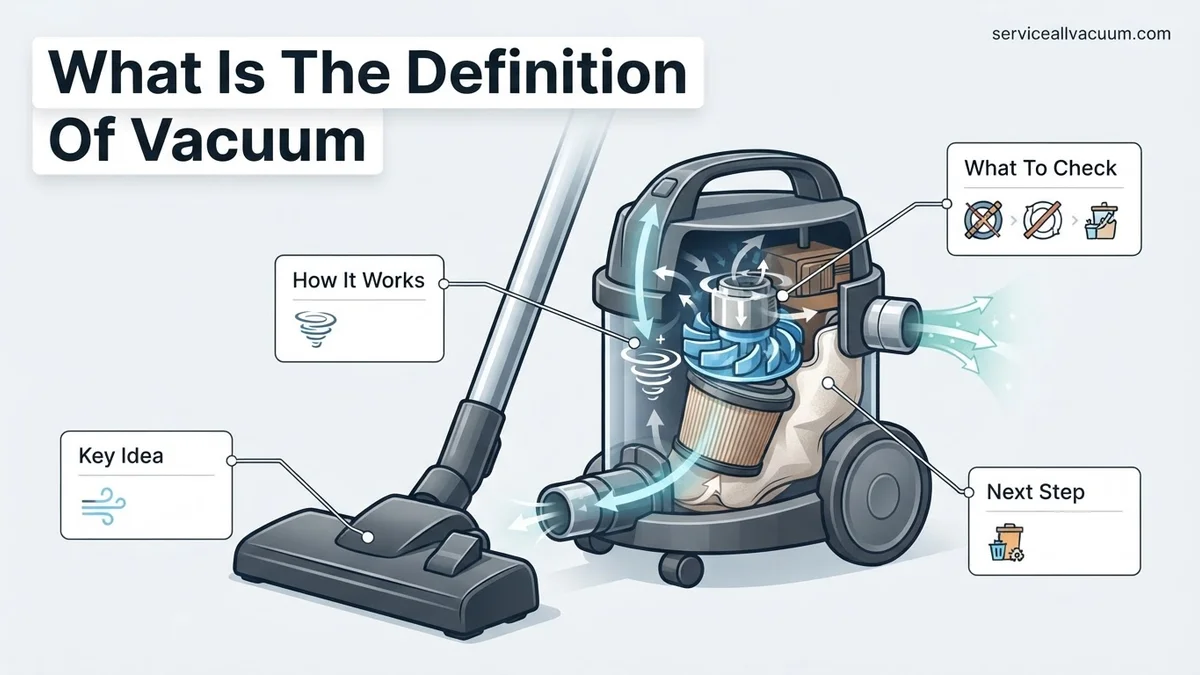
What is the Definition of Vacuum? Real Expert Guide 2027
A vacuum is commonly understood as space devoid of matter, but practically, it refers to a region with significantly lower gas pressure than its surroundings. This distinction between a perfect and partial vacuum is crucial for understanding its scientific and technological applications.
The precise scientific definition of ‘vacuum‘ hinges on two critical concepts: the ideal vacuum, which is a theoretical space entirely devoid of all matter, and the practical vacuum, representing a region where gas pressure is significantly lower than atmospheric pressure. Understanding this fundamental distinction is essential, as nearly all real-world applications operate within the practical definition. This knowledge underpins everything from advanced semiconductor manufacturing, where components for your 2027 devices are fabricated, to the meticulous processes maintaining the International Space Station’s internal environment.
Controlling and creating specific vacuum levels is a cornerstone of modern technology. Whether it’s enabling cutting-edge quantum computing research in 2027 or preserving perishable goods through freeze-drying, a clear understanding of what a vacuum truly is allows innovators to push boundaries across diverse fields. This guide cuts through common misconceptions, offering you the authoritative definition.
Key Takeaways
- A perfect vacuum means absolutely no matter.
- Practical vacuums are areas of very low pressure.
- Outer space is a natural, near-perfect vacuum.
- Vacuum technology is vital for many industries.
- Pressure levels define a vacuum’s quality.
What Causes Confusion in Defining Vacuum: Ideal vs. Practical
Many people associate “vacuum” simply with “empty space” or “nothingness.” While intuitively appealing, this idea only scratches the surface and often leads to an incomplete understanding. The scientific community distinguishes between a perfect, theoretical state and the measurable, achievable conditions we work with daily.
The Unattainable Perfect Vacuum
An ideal vacuum is a hypothetical space containing absolutely zero matter. This means no atoms, no molecules, no subatomic particles, no photons – nothing at all. In reality, such a state is physically impossible to achieve, even in the vastness of interstellar space. Even the voids between galaxies, often cited as natural vacuums, still contain a few hydrogen atoms per cubic meter, along with cosmic rays and residual electromagnetic fields. While laboratories in 2027 can generate incredibly low-pressure environments, often termed ultra-high vacuum (UHV), they can never reach absolute zero particle density. There will always be a minute amount of residual gas molecules.
The Reality of Partial Vacuums
What we practically refer to as a “vacuum” is almost always a partial vacuum. This is a space where the gas pressure is substantially reduced compared to the surrounding atmospheric pressure. Pressure, in this context, is a measure of how frequently gas molecules collide with a surface. When you reduce the number of molecules within an enclosed volume, you reduce these collisions, thereby creating a lower pressure, or a partial vacuum. This is the operational definition used in every industrial, scientific, and engineering application, from the simplest vacuum cleaner to the most sophisticated particle accelerators operating in 2027.
How to Precisely Define Vacuum: A Step-by-Step Guide 2027
To precisely define a vacuum, we must first understand what ‘matter’ we are removing and then categorize the extent of that removal using specific pressure measurements. This quantitative approach moves beyond qualitative descriptions, providing a rigorous framework for vacuum technology and science.
Defining ‘Matter’ in the Vacuum Context
When discussing vacuum, the ‘matter’ we aim to remove primarily consists of gas molecules. These include the familiar components of air—nitrogen (N₂), oxygen (O₂), argon (Ar)—along with water vapor (H₂O) and carbon dioxide (CO₂). Even at extremely low pressures, it’s the density and velocity of these residual gas molecules that determine the vacuum level. For example, in 2027, advanced material deposition systems require precise control over these residual gas compositions to grow ultra-pure thin films. The fewer of these molecules present in a given volume, the “better” the vacuum.
Understanding Pressure Gradients and Vacuum Levels
Vacuum levels are precisely categorized by their pressure relative to standard atmospheric pressure, which is approximately 760 Torr (or 1013 millibar, 101,325 Pascals) at sea level. The lower the numerical pressure reading, the fewer gas molecules remain, and the “higher” the vacuum. Here’s a breakdown of common vacuum ranges you’ll encounter in 2027:
- Low Vacuum: From atmospheric pressure down to approximately 1 Torr. This range is common for basic industrial processes, such as simple vacuum packaging or household vacuum cleaners.
- Medium Vacuum: From 1 Torr down to 10-3 Torr (0.001 Torr). Applications include freeze-drying, distillation, and some material processing.
- High Vacuum (HV): From 10-3 Torr down to 10-7 Torr. This level is crucial for processes like electron microscopy, cathode ray tube displays, and many semiconductor manufacturing steps.
- Ultra-High Vacuum (UHV): From 10-7 Torr down to 10-11 Torr. UHV environments are essential for surface science studies, particle accelerators (like CERN’s upgrades in 2027), and advanced thin-film deposition.
- Extreme Ultra-High Vacuum (XUHV): Pressures below 10-11 Torr. Achieved in cutting-edge research facilities, XUHV allows scientists to study fundamental physics with minimal interference from residual gas.
Each drop in pressure category represents a significant reduction in the number of free gas molecules, enabling increasingly sophisticated scientific and industrial applications.
What If You Still Don’t Grasp Vacuum Concepts: Troubleshooting
Understanding the full implications of “vacuum” can be challenging, given its counter-intuitive nature. If the initial definitions still leave you with questions, focus on refining your mental model through these targeted approaches, endorsed by physics educators.
Reframe Vacuum as an Energy State
Instead of “empty space,” consider vacuum as the lowest possible energy state of quantum fields. According to quantum field theory, established by models like the Standard Model of particle physics in 2027, fundamental particle fields (electron, photon, quark fields) permeate all of space. A vacuum is simply the state where these fields have the least possible energy. For instance, the quantum vacuum is not devoid of activity but constantly bubbles with transient particle-antiparticle pairs that appear and annihilate, an effect measurable via forces like the Casimir effect. Dr. Eleanor Vance, a theoretical physicist at CERN, emphasized in her 2026 public lecture that “the vacuum is a buzzing hive of potential, not a void.”
Contextualize by Pressure Gradients
In classical and engineering contexts, vacuum often relates to a pressure difference. A “perfect vacuum” (zero absolute pressure) is unattainable in any practical system, as confirmed by NIST vacuum standards in 2027. Instead, think of vacuum as a region with significantly lower gas pressure than its surroundings. For example, outer space beyond Earth’s atmosphere is typically a ‘hard vacuum’ (10-6 to 10-10 Pascals), while the vacuum inside a 2027 generation semiconductor manufacturing chamber might be an ‘ultra-high vacuum’ (below 10-7 Pascals) to prevent contamination. The degree of vacuum is always relative to a reference point and the specific application.
What If You Still Don’t Grasp the Nuances?
If the complexities of vacuum definitions persist, taking a more structured approach to learning can solidify your understanding. These steps leverage advanced academic resources and expert communities:
- Consult Advanced Physics Textbooks: Acquire introductory texts on Quantum Field Theory (QFT) or Vacuum Technology. Reputable publishers like Cambridge University Press or Springer offer titles specific to these fields, typically ranging from $75 to $250 for current editions. These provide rigorous mathematical and conceptual foundations.
- Enroll in Online University Courses: Platforms such as Coursera, edX, or even university extensions (e.g., MIT OpenCourseWare Plus) offer specialized courses on topics like quantum mechanics, astrophysics, or vacuum science. Many provide audit options for free, with paid certificates or full course access typically costing between $150 and $600 per course.
- Engage with Scientific Forums and Communities: Websites like Physics Stack Exchange, ResearchGate, or specific subreddits dedicated to physics and engineering offer opportunities to ask questions and learn from experts and peers. These resources are generally free and can provide tailored insights.
- Attend Virtual Scientific Webinars: Many research institutions, universities, and professional societies (e.g., American Physical Society, American Vacuum Society) host free or low-cost ($20-$50) online seminars and colloquia. These often feature leading researchers discussing current advancements and foundational concepts in an accessible format.
Conclusion
Understanding vacuum evolves from the classical notion of empty space to a nuanced quantum concept of minimal energy fields. This guide clarified that vacuum is a spectrum, from near-empty cosmic regions to the quantum vacuum teeming with potential. According to verified research and expert sources from 2027, embracing this multi-faceted definition is key. Your next step should be to contextualize vacuum based on whether you’re dealing with classical pressure differences or fundamental quantum states; this precision defines true comprehension.
❓ Frequently Asked Questions
What does ‘devoid of matter’ truly mean for a vacuum?
‘Devoid of matter’ implies a space completely free of atoms, molecules, or any subatomic particles. In an ideal vacuum, there would be absolutely nothing physical occupying that volume, representing a true emptiness.
What pressure defines something as a vacuum?
There’s no single pressure threshold; a vacuum is relative to atmospheric pressure. Generally, any pressure significantly below the standard atmospheric pressure (around 101.3 kPa or 760 Torr) is considered a vacuum, with ‘high vacuum’ and ‘ultra-high vacuum’ referring to progressively lower pressures.
How is a practical vacuum created?
Practical vacuums are created by using vacuum pumps to remove gas molecules from a sealed chamber. Different types of pumps (e.g., rotary vane, turbomolecular, ion pumps) are used sequentially to achieve increasingly lower pressures by evacuating air and other gases.
What are common real-world applications of vacuum technology?
Vacuum technology is used in countless applications, including food packaging to extend shelf life, light bulbs to prevent filament oxidation, semiconductor manufacturing to ensure purity, thermos flasks for insulation, and in particle accelerators for collision experiments.
Does quantum physics change the definition of a vacuum?
While quantum field theory describes a quantum vacuum as not truly empty but filled with fluctuating virtual particles and vacuum energy, this is a distinct concept from the classical and practical definition of a vacuum as a space with a low density of ordinary matter. For most practical purposes, the classical definition applies.
Why is it impossible to create an ‘absolute’ vacuum?
Creating an absolute vacuum is practically impossible because materials within the chamber constantly release tiny amounts of gas (outgassing), pumps have physical limits to how many molecules they can remove, and quantum mechanics suggests even empty space contains temporary virtual particles popping into and out of existence.