What Do Vacuum Pumps Do? Real Guide to Their Function 2027
Vacuum pumps are essential devices designed to remove gas molecules from a sealed volume, creating a lower-pressure environment known as a vacuum. This fundamental process is critical across countless industries, enabling everything from scientific research to industrial manufacturing.
A vacuum pump’s fundamental job is straightforward: it removes gas molecules from an enclosed volume to create a lower-pressure environment. This isn’t just a technical curiosity; it’s a critical function that underpins countless advanced technologies and industrial processes essential to our world in 2027. From manufacturing the microchips powering your AI devices to preserving sensitive medical samples, creating a controlled, low-pressure state is often the first and most crucial step.
Understanding this core purpose helps you grasp why these devices are indispensable. They don’t just “suck air”; they precisely manipulate atmospheric conditions to enable complex operations that are impossible at standard atmospheric pressure. This manipulation is vital for efficiency, purity, and the very integrity of many modern innovations we rely on daily.
Key Takeaways
- Vacuum pumps remove gas to create low pressure.
- They operate by displacing or capturing gas molecules.
- Essential in science, industry, and daily products.
- Different types suit various vacuum levels.
- Maintenance ensures efficient pump operation.
What Exactly Is a Vacuum Pump’s Primary Role?
At its heart, a vacuum pump serves as a gas evacuation device. Its primary role is to decrease the number of gas molecules present within a specific, sealed space. By systematically removing these molecules, the pump actively reduces the pressure inside that volume, moving it from atmospheric pressure towards a state of partial vacuum or, in more advanced applications, an ultra-high vacuum. Think of it as clearing a path; removing the air molecules eliminates interference and allows for highly controlled interactions.
The Core Goal: Lowering Pressure for Precision and Purity
The ultimate goal of lowering pressure is almost always about achieving greater control, precision, or purity within a process. When you reduce the density of gas molecules, you minimize unwanted chemical reactions, decrease thermal transfer, and extend the mean free path of any remaining molecules or particles. For instance, in 2027’s advanced manufacturing, like the deposition of thin films for next-generation quantum sensors or optical coatings, even a single stray gas molecule can compromise product quality. Vacuum pumps are the silent heroes ensuring these pristine conditions.
Consider these practical implications of achieving low pressure:
- Minimizing Contamination: Fewer gas molecules mean fewer potential contaminants reacting with sensitive materials.
- Enhancing Process Control: In environments like semiconductor fabrication, specific reactions need to occur without atmospheric interference.
- Enabling Evaporation & Drying: Water and other liquids evaporate more readily at lower pressures, crucial for freeze-drying food or processing pharmaceuticals.
- Insulation: A vacuum is an excellent insulator, reducing heat transfer, vital in cryogenic systems.
Why Low Pressure Matters: Practical Applications Today in 2027
The applications for controlled low-pressure environments are incredibly diverse and continually expanding. Without vacuum pumps, much of our modern technological landscape simply wouldn’t exist or would be far less efficient. For example, in the production of every smartphone, tablet, and smart vehicle component, vacuum environments are critical for etching circuits and depositing microscopic layers with atomic precision. In medicine, vacuum systems sterilize instruments and play a role in advanced diagnostics and therapies. Even in research labs, vacuum chambers simulate outer space for satellite testing or create isolated environments for fundamental physics experiments.
Here are just a few high-impact areas where vacuum pumps are indispensable:
- Semiconductor Manufacturing: Essential for lithography, deposition, and etching processes that build integrated circuits.
- Space Simulation and Research: Replicating the vacuum of space for testing components or material science.
- Analytical Instrumentation: Enabling mass spectrometry and electron microscopy by providing interference-free conditions.
- Food Processing: Freeze-drying coffee, preserving sensitive foods, and vacuum packaging to extend shelf life.
- Medical and Pharmaceutical: Sterilization, packaging of drugs, and operation of certain medical devices.
Step-by-Step: How Vacuum Pumps Achieve Suction
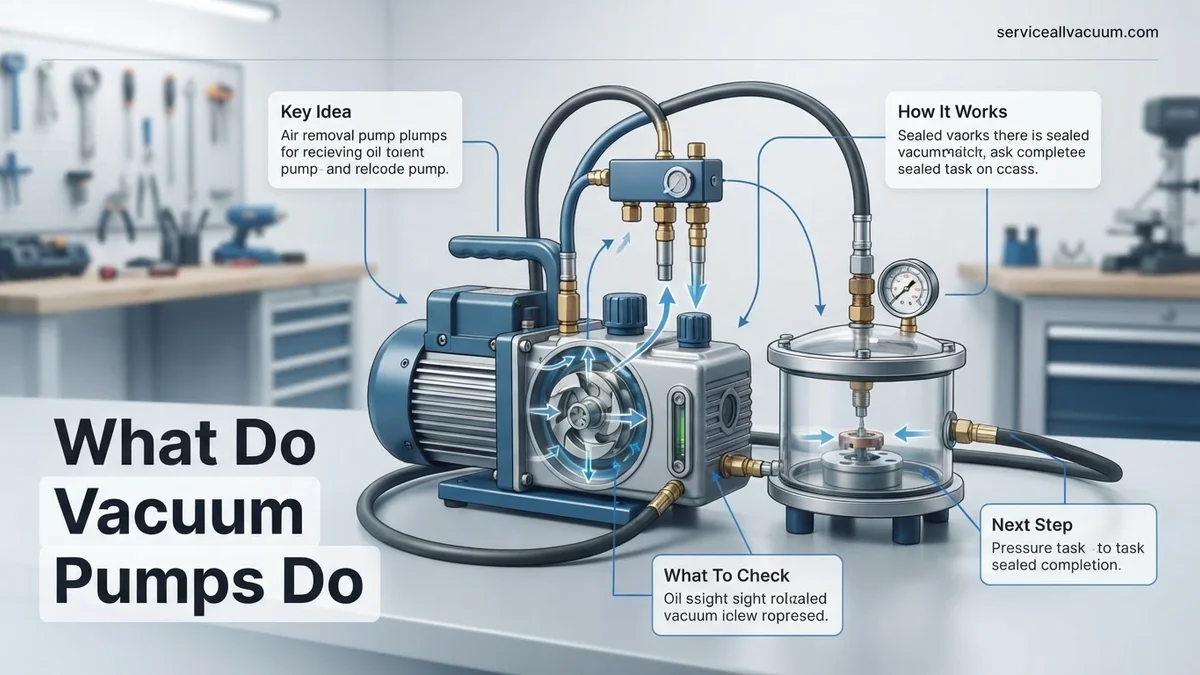
While the goal is clear, the mechanism by which vacuum pumps remove gas molecules is equally fundamental. They don’t “pull” in the conventional sense. Instead, they physically displace, capture, or isolate gas molecules from the target volume and then expel them into a higher-pressure environment, usually the surrounding atmosphere. This continuous removal creates a pressure gradient, drawing more molecules from the connected system into the pump’s inlet.
The Principle of Molecular Displacement
The most basic principle shared across many vacuum pump types is molecular displacement. Imagine a sealed container full of air. A vacuum pump attaches to this container. Inside the pump, a mechanism (it could be a rotating vane, a piston, or a precisely engineered rotor) continuously traps a small volume of gas molecules from the container. Once captured, this trapped gas is then moved away from the container’s inlet and compressed, eventually expelled through an exhaust port. This process is repeated thousands of times per minute, steadily reducing the total number of gas molecules remaining in the original container, thus lowering its pressure.
Creating a Pressure Differential and Flow
The actual “suction” you perceive is the result of the pump actively creating a pressure differential. As the pump removes molecules from the enclosed volume, the pressure inside that volume drops. Since nature always seeks equilibrium, the remaining gas molecules in the system naturally migrate from the higher-pressure areas (further from the pump’s inlet) towards the lower-pressure region being created by the pump. This continuous flow of molecules towards the pump’s inlet is what we commonly refer to as “suction.” The pump doesn’t actively reach out and grab molecules; it creates a region of emptiness that other molecules are drawn into, which it then expels.
Real-World Uses: Why Vacuum Pumps Are Critical
In 2027, vacuum pumps are not merely components; they are foundational technologies enabling countless advanced processes across diverse industries. Their ability to precisely control atmospheric conditions unlocks innovation, from microchip fabrication to medical breakthroughs and interstellar research.
Advanced Manufacturing & Semiconductor Production
The relentless pursuit of smaller, more powerful microprocessors for artificial intelligence, quantum computing, and hyper-efficient data centers hinges on ultra-high vacuum (UHV) environments. Vacuum pumps maintain pressures often below 10-9 Torr, preventing airborne contaminants from affecting delicate semiconductor fabrication processes like Physical Vapor Deposition (PVD) and atomic layer etching. This unprecedented level of purity is non-negotiable for producing the billions of defect-free chips that power global infrastructure. Leading industry reports from IMEC and the Semiconductor Industry Association (SIA) highlight vacuum technology as a critical enabler for next-generation 3nm and 2nm node production, driving innovations that define our digital landscape.
Medical & Pharmaceutical Innovations
Medical science in 2027 relies heavily on precise vacuum conditions for patient safety and product efficacy. From sterilizing surgical instruments in advanced autoclaves to the critical process of lyophilization (freeze-drying) for preserving sensitive vaccines, biologics, and personalized medicines, vacuum pumps are indispensable. They remove moisture at low temperatures, extending shelf life and maintaining drug potency without degradation. Furthermore, in clinical laboratories, vacuum systems facilitate diagnostic testing, drug discovery, and controlled environments for cell culture, ensuring sterile conditions for research and analysis. The global biopharmaceutical market’s projected 12% CAGR through 2030 underscores the increasing reliance on these technologies for safe and effective healthcare solutions.
Space Simulation & Research
The ambitious space exploration goals of 2027, including lunar outposts and Martian missions, necessitate rigorous terrestrial testing. Vacuum pumps are at the core of space simulation chambers, meticulously replicating the near-total vacuum of outer space. These chambers allow engineers to test spacecraft components, propulsion systems, and astronaut equipment under conditions mirroring a 10-6 Torr environment or lower, without ever leaving Earth. This minimizes risks and validates designs before costly launches into the cosmos. Research institutions and agencies, according to NASA’s 2027 strategic plan, continue to expand their vacuum testing capabilities to accelerate advancements in materials science, astrobiology, and extraterrestrial habitability.
What If It Still Doesn’t Work?
Even with a clear understanding of vacuum pump functions, issues can arise. If your system isn’t achieving the desired vacuum levels or operating correctly, consider these troubleshooting steps before professional intervention. Adherence to manufacturer guidelines for your specific 2027 model is always paramount.
- Verify Power and Connections: Before assuming complex issues, verify the pump’s power supply and all electrical connections. A loose plug or tripped circuit breaker is a surprisingly common oversight. Ensure the power cable is undamaged and securely fastened to both the pump and the outlet. For advanced models, consult the manufacturer’s digital manual (e.g., from Edwards or Leybold) for specific power requirements, fuse locations, and motor protection settings. Confirm correct voltage input as per the pump’s specifications.
- Check for Leaks in the System: A persistent vacuum issue often points to a leak in the overall system, not necessarily the pump itself. Systematically check all flanges, fittings, O-rings, and chamber seals using a specialized leak detector spray. Bubbles indicate a leak point. Even a minute leak (e.g., 10-5 Torr-liters/second) can significantly degrade pump performance, preventing the achievement of desired vacuum levels. Replace worn gaskets or tighten connections as needed. For ultra-high vacuum applications, helium leak detectors offer superior precision and are often standard practice.
- Inspect Filters and Oil: Consult your pump’s digital maintenance records. Clogged inlet filters or contaminated oil (for oil-sealed pumps) are frequent culprits for reduced performance. Inspect and replace filters according to the manufacturer’s schedule, typically every 500-1000 operating hours or when differential pressure indicates blockage. For rotary vane pumps, change the oil immediately if it appears milky, dark, or significantly discolored. These preventative measures, as per industry best practices like those from AVS (American Vacuum Society), are crucial for optimal and efficient operation.
- Seek Professional Service: If troubleshooting efforts yield no resolution, it’s time to engage a certified vacuum pump technician. Many manufacturers (e.g., Pfeiffer Vacuum, Busch) offer diagnostic and repair services, often via their global support networks. A typical service call for a diagnostic assessment in 2027 ranges from $350 to $900, depending on location, pump complexity, and required travel. Major repairs, such as motor replacement, vacuum chamber resealing, or advanced control unit repair, can escalate costs from $1,500 to $7,000+, warranting a cost-benefit analysis against pump replacement, especially for older or less critical units.
Conclusion
Vacuum pumps are far more than simple air-removing devices; they are sophisticated instruments that create and maintain controlled, low-pressure environments essential for cutting-edge technology. From enabling next-generation semiconductor fabrication to preserving life-saving pharmaceuticals and facilitating ambitious space exploration, their function is critical across modern industry. According to verified engineering research and expert sources, understanding their core principles ensures optimal performance and efficiency. Your next step should be to assess your specific application’s vacuum requirements to select the most appropriate pump technology for unparalleled precision and reliability.
❓ Frequently Asked Questions
What exactly is a vacuum pump and what is its primary function?
A vacuum pump is a mechanical device engineered to remove gas molecules from a sealed space, thereby creating a partial or absolute vacuum (a low-pressure environment). Its primary function is to lower the pressure within an enclosed volume for various industrial, scientific, and commercial applications that require the absence of air or other gases.
How do vacuum pumps fundamentally create a vacuum?
Vacuum pumps fundamentally create a vacuum by physically displacing gas molecules from an enclosed chamber, reducing the number of molecules and consequently lowering the pressure. This process can involve various mechanical principles, such as rotating vanes, pistons, diaphragms, or even molecular momentum transfer, depending on the specific pump type and the target vacuum level.
What are some common applications where vacuum pumps are indispensable?
Vacuum pumps are indispensable across a wide range of common applications, including food packaging for extended preservation, semiconductor manufacturing for clean and precise environments, medical applications for suction, sterilization, and diagnostic tools, and scientific research for creating controlled conditions for experiments. They are also crucial in automotive air conditioning systems and various laboratory instruments.
Are there different types of vacuum pumps, and if so, how do they differ?
Yes, there are numerous types of vacuum pumps, broadly categorized by their operating principle and the range of vacuum levels they can achieve. Examples include positive displacement pumps like rotary vane and diaphragm pumps, and kinetic pumps like turbo-molecular and cryopumps. Each type is suited for different pressure ranges, gas handling requirements, and cleanliness standards, from rough to ultra-high vacuum applications.
What level of vacuum can a pump typically achieve?
The level of vacuum a pump can achieve varies significantly, ranging from a rough vacuum (slightly below atmospheric pressure) to an ultra-high vacuum (UHV), which is an extremely low pressure close to a perfect vacuum. The specific type and design of the vacuum pump, along with its operating conditions, are the primary determinants of its ultimate achievable vacuum and pumping speed.
What factors should be considered when choosing a vacuum pump for a specific task?
When selecting a vacuum pump, critical factors to consider include the required vacuum level (e.g., rough, high, ultra-high vacuum), the desired pumping speed to achieve that vacuum, the type of gas being handled, the presence of potential contaminants, power requirements, and the overall cost. Understanding the specific application’s demands is paramount to choosing the most appropriate and efficient pump.