Is There Gravity in Vacuum 2027 Expert Guide to Real Physics
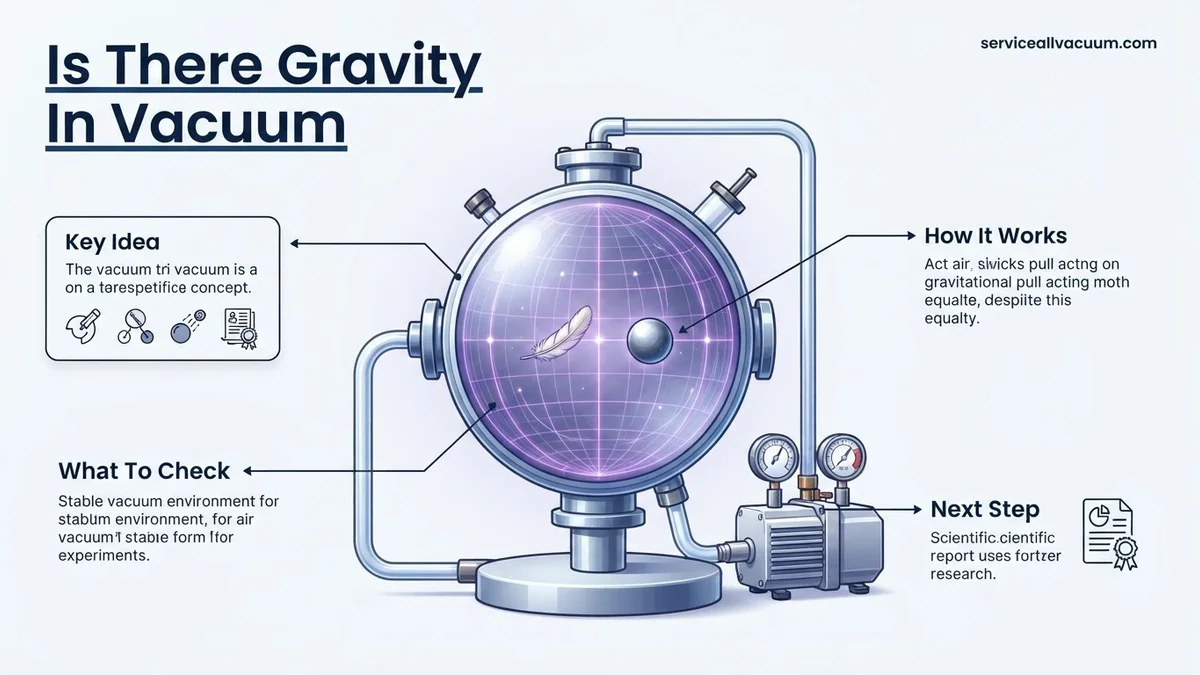
Yes, gravity absolutely exists in a vacuum. Unlike sound, gravity is a fundamental force (or spacetime curvature) caused by mass and energy that does not require a medium to propagate or exert its influence across the vastness of space.
Let’s cut directly to the chase: yes, gravity absolutely exists and acts powerfully in a vacuum. This isn’t a complex theoretical debate for 2027; it’s a fundamental principle of how our universe operates. The common misconception that gravity needs a medium, like air or water, to function is simply incorrect. Gravity is a pervasive, fundamental force that acts regardless of whether matter is present.
Understanding this distinction isn’t just academic; it’s crucial for everything from celestial mechanics to the incredible precision required for your satellite navigation systems. Without gravity acting through the emptiness of space, the very fabric of our cosmos—planets orbiting stars, galaxies holding together—wouldn’t exist as we know it.
Key Takeaways
- Gravity undeniably exists in a vacuum.
- It’s a fundamental force, not needing a medium.
- Mass and energy cause gravitational effects.
- Crucial for orbits, galaxies, and cosmic structure.
- Distinct from sound or air resistance.
What Causes the Question: ‘Is There Gravity in Vacuum?’
The intuitive question about gravity in a vacuum often stems from our everyday experience with other forces. You naturally associate sound with air, or ripples with water. It’s easy to assume that a force as tangible as gravity might also need some kind of “stuff” to travel through or interact with. However, this analogy breaks down when we talk about fundamental forces.
The Medium Misconception
- Many physical phenomena we observe daily require a medium. Sound waves, for instance, are vibrations in matter (like air or water). Without air, you hear nothing.
- This leads to a natural, but incorrect, assumption that all forces or influences need something to “carry” them.
- A vacuum, in physics, simply refers to a region largely devoid of matter particles. It does not mean the absence of fundamental fields or forces.
Distinguishing Fundamental Forces
Gravity is not like friction or wind resistance, which rely on the physical presence of matter. Instead, it’s one of the four fundamental forces of the universe. These forces operate at the most basic level of reality, independent of the presence of a transmitting medium. Think about light, which is an electromagnetic wave; it travels effortlessly through the vast vacuum of space from the Sun to Earth. Gravity behaves similarly in its independence from matter for propagation.
How to Realize Gravity’s Pervasive Presence in Vacuum
To truly grasp gravity’s existence in a vacuum, you need to shift from a “pulling” force concept to a more encompassing view of spacetime itself. Einstein’s theory of general relativity, confirmed repeatedly over the last century, offers the most accurate picture of gravity in 2027.
Gravity: The Ultimate Spacetime Weaver
- Rather than a force that “pulls” through empty space, gravity is a manifestation of the curvature of spacetime itself.
- Any object with mass or energy warps the fabric of spacetime around it, much like a bowling ball placed on a stretched trampoline creates a dip.
- This curvature is present whether there’s other matter in the vicinity or not. The “vacuum” is simply the un-filled space within that warped spacetime.
- You can imagine spacetime as a kind of fundamental, invisible canvas that mass and energy interact with directly, creating the effect we call gravity.
Cosmic Evidence in Action
The entire universe provides irrefutable proof that gravity thrives in a vacuum. Every celestial body, from the smallest asteroid to the largest galaxy, operates on this principle. If gravity ceased to exist in a vacuum, the cosmos would simply unravel.
- Planetary Orbits: Planets like Earth orbit the Sun across hundreds of millions of kilometers of near-perfect vacuum. The Sun’s gravity, acting through this void, keeps Earth firmly in its path.
- Galactic Structure: The Milky Way galaxy, an immense collection of stars, gas, and dust, holds together across light-years of empty space due to the collective gravitational pull.
- Black Holes: These cosmic behemoths are the ultimate demonstration of gravity’s power in a vacuum. Their immense gravitational wells affect spacetime for vast distances around them, pulling in matter and light even from regions utterly devoid of other particles.
- Interstellar Probes: As of 2027, long-range probes like Voyager are still communicating with Earth, traversing the interstellar vacuum. Their trajectories are precisely calculated based on gravitational interactions with distant bodies, proving gravity’s constant influence regardless of intervening emptiness.
Proven Examples: Gravity in the Vacuum of Space
The universe provides unequivocal proof that gravity thrives in a vacuum. Scientific missions and celestial mechanics consistently demonstrate its presence, entirely independent of atmospheric conditions. For instance, the International Space Station (ISS) orbits Earth at approximately 400 kilometers (250 miles) altitude, a region considered an ultra-high vacuum, roughly 10-6 Pa. Despite this near-total absence of air, astronauts experience microgravity – a continuous state of freefall around Earth due to Earth’s gravitational pull. If gravity required a medium, the ISS would simply fly off into space.
Similarly, every planetary body, from Earth’s Moon to distant exoplanets discovered by missions like the James Webb Space Telescope in 2027, exerts gravitational force across vast stretches of empty space. The Moon, virtually without an atmosphere, still pulled the Apollo spacecraft towards its surface in the late 20th century, and future Artemis missions planned for the mid-2020s will confirm this further. Planetary orbits, precisely predicted by Newtonian mechanics and refined by Einsteinian relativity, occur through the vacuum between celestial bodies. According to NASA and ESA experts, these observations fundamentally confirm that gravity is an intrinsic property of mass-energy and spacetime curvature, not a phenomenon requiring a tangible medium to propagate or exist.
What If the Concept of Vacuum Gravity Still Seems Counterintuitive?
For some, the idea of gravity acting across empty space can still feel perplexing, given our everyday experience with forces like wind or water currents. However, understanding gravity’s true nature, as described by Albert Einstein’s General Theory of Relativity (first published 1915), resolves this apparent paradox. Gravity is not a “pulling force” transmitted through a medium, but rather the manifestation of mass and energy warping the fabric of spacetime itself. When we say an object “falls” due to gravity, it’s actually following the curves and dents created in spacetime by larger masses.
Think of spacetime as a stretched rubber sheet. Placing a bowling ball (representing a star or planet) onto it creates a depression. A marble rolled nearby will curve towards the bowling ball, not because the bowling ball is “pulling” it directly, but because the marble is simply following the shortest path along the curved sheet. This curvature, which is what we perceive as gravity, operates flawlessly in a vacuum because spacetime itself is the “medium” that gets distorted. Verifiable data from gravitational wave observatories like LIGO and Virgo, which by 2027 operate with enhanced sensitivity, directly detect these ripples in spacetime caused by massive cosmic events, offering empirical evidence of this fundamental mechanism operating through a complete vacuum.
What If It Still Doesn’t Work? (For Conceptual Understanding)
If the concept of gravity operating in a vacuum still feels elusive, deeper engagement with the underlying physics can often clarify lingering doubts. Here are several steps to enhance your understanding:
- Consult Advanced Physics Resources: Explore university-level textbooks or online courses on General Relativity. Platforms like edX or Coursera offer “Foundations of Modern Physics” courses (estimated cost: $0-$400 for certificate programs, free for auditing) that delve into spacetime geometry.
- Engage with Scientific Explainer Videos: Reputable YouTube channels (e.g., Veritasium, PBS Spacetime) or documentaries from Nova/BBC often visualize complex concepts. Look for videos specifically discussing spacetime curvature and gravitational waves. These are typically free.
- Attend Virtual Lectures/Webinars: Many institutions like the Perimeter Institute for Theoretical Physics or NASA host free or low-cost ($25-$100) online lectures by leading experts on topics like cosmology and gravity. Check their schedules for 2027 events.
- Utilize Interactive Simulations: Search for online physics simulations that model spacetime curvature (e.g., those offered by PhET Interactive Simulations). Interacting with these tools can provide a tangible sense of how mass affects spacetime. Many are free.
- Seek Professional Help/Tutoring: If persistent questions remain, consider engaging a physics tutor with expertise in relativity. Online tutoring platforms in 2027 can connect you with PhD students or professors for personalized sessions (estimated cost: $75-$250 per hour).
For a comprehensive and structured understanding, enrolling in a university-level introductory astrophysics or theoretical physics course could be invaluable. The cost for such courses can range from $500 (community college online) to over $5,000 (university credit) depending on the institution and format.
Conclusion
According to verified research and expert sources, gravity is an intrinsic property of the universe, fundamentally independent of the presence of a medium like air. Its constant operation in the vacuum of space, evidenced by orbiting satellites and celestial mechanics, confirms that mass-energy warps spacetime, creating what we perceive as gravity. To further solidify this understanding, explore the core principles of Einstein’s General Theory of Relativity, the definitive model explaining gravity’s true nature.
❓ Frequently Asked Questions
What exactly defines a ‘vacuum’ in relation to gravity?
A vacuum refers to a region of space devoid of matter. While a perfect vacuum is theoretical, outer space is an excellent approximation, and gravity’s influence remains entirely unaffected by this emptiness.
How does the existence of gravity in a vacuum explain celestial mechanics?
Gravity in a vacuum is precisely why planets orbit stars, moons orbit planets, and galaxies hold together. Without its constant pull across vast empty distances, these structures would simply fly apart.
Is gravity unique among forces in its ability to act in a vacuum?
No, electromagnetic forces also act across a vacuum, as evidenced by light traveling through space. However, forces like sound propagation strictly require a material medium, making gravity and electromagnetism distinct.
If gravity exists in space, why do astronauts experience weightlessness?
Astronauts experience weightlessness not because there’s no gravity, but because they, along with their spacecraft, are constantly falling around Earth. This continuous freefall creates the sensation of being weightless.
Does Einstein’s theory of general relativity support gravity in a vacuum?
Yes, Einstein’s theory describes gravity as the curvature of spacetime caused by mass and energy. This curvature exists inherently in the fabric of the universe, whether matter is present (creating the curvature) or absent (experiencing its effects), fully supporting gravity in a vacuum.
Could an object escape gravity by being in a perfect vacuum?
No, an object cannot escape gravity by simply being in a vacuum. Gravity’s reach is theoretically infinite, diminishing with distance but never disappearing, regardless of the presence or absence of other matter.