Does Sound Travel in a Vacuum? Your Expert Guide 2027
No, sound absolutely does not travel in a vacuum because it requires a medium to propagate. Sound waves are mechanical vibrations that need particles—like air or water—to transmit their energy. Without matter, there’s nothing for the sound to vibrate through.
Let’s cut right to the chase: no, sound does not travel in a vacuum. By 2027, this fundamental principle of physics remains unchanged, regardless of how many sci-fi movies depict dramatic explosions with roaring sound in space. The reality is that sound needs something to travel through, and the near-total emptiness of a vacuum provides absolutely nothing.
Understanding why this is the case is crucial, not just for correcting space opera inaccuracies, but for appreciating the very nature of sound itself. This knowledge impacts everything from advanced materials science requiring controlled vacuum environments to the very design of spacecraft and our future extraterrestrial habitats. When you’re dealing with sound, you’re dealing with a physical interaction.
Key Takeaways
- Sound is a mechanical wave; it needs a medium.
- A vacuum lacks particles, preventing sound travel.
- Light, an electromagnetic wave, travels in vacuum.
- Space movies often depict sound inaccurately.
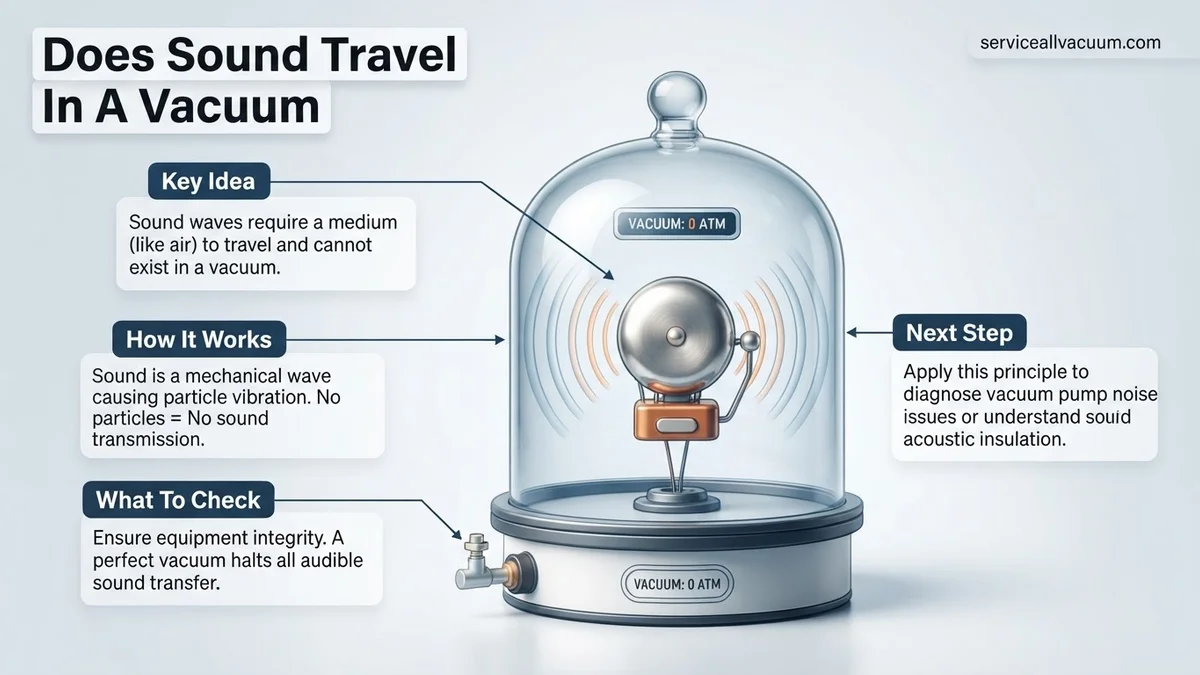
- The bell jar experiment proves sound needs air.
The Vacuum Challenge: Why Sound Cannot Travel
Sound’s inability to traverse a vacuum stems directly from its fundamental nature. Unlike light, which operates on different principles, sound is a mechanical wave. This classification is the key differentiator; it means sound inherently requires a physical medium to exist and propagate. Imagine trying to throw a punch without anything to hit – that’s essentially sound in a vacuum.
The Essential Role of a Medium
For sound to travel, it needs a substance where particles can transfer energy through vibrations. This substance, known as a medium, can be a gas (like Earth’s atmosphere), a liquid (like water), or a solid (like a metal wall). Without these particles, there’s simply no mechanism for sound to move from one point to another.
- Particle Interaction: Sound energy is transferred as particles bump into each other.
- Elasticity: The medium must be elastic enough for particles to return to their original positions, allowing the wave to continue.
- Density Matters: Denser mediums often allow sound to travel faster and more efficiently, but a medium is non-negotiable.
Consider the silence inside advanced ultra-high vacuum chambers used for microchip fabrication in 2027. These environments are meticulously cleared of almost all particles precisely to prevent contamination, but an incidental effect is the absolute lack of sound propagation within them. Any sound generated would merely cause the source itself to vibrate without propagating beyond its immediate surface.
Empty Space: The Ultimate Sound Barrier
A vacuum, by definition, is a space almost entirely devoid of matter. While even the vastness of interstellar space isn’t perfectly empty – containing trace amounts of hydrogen atoms and cosmic rays – its particle density is so incredibly low that it effectively acts as a perfect sound insulator. There are simply too few particles, too far apart, to transfer vibrations efficiently, or at all, over any meaningful distance.
- Near-Zero Particle Density: The number of atoms or molecules per cubic meter is astronomically lower than in air.
- No Collision Chain: Without particles close enough to collide, the chain reaction of vibrations that constitutes a sound wave cannot begin or continue.
- Fundamental Limit: This isn’t a technological limitation we can overcome; it’s a core physical impossibility for sound.
So, when you see a spaceship explode silently in a 2027 documentary about real space travel, that’s accurate physics in action. The energy of the explosion might be visible as light or felt as concussive force if you were physically nearby, but no crewmate would hear the blast unless it happened within an atmosphere or directly against the hull of their own vessel, which would then vibrate.
Real Physics: How Sound Waves Work Step-by-Step
To truly grasp why a vacuum defeats sound, you need to understand the intricate dance of particles involved in sound propagation. It’s a chain reaction, an energetic ripple effect that requires a continuous path of physical contact. Imagine a line of dominoes: for the last one to fall, the first one must be pushed, and each subsequent domino must be close enough to knock over the next.
The Dance of Compressions and Rarefactions
When you speak, a speaker vibrates, or an impact occurs, it creates a disturbance. This disturbance pushes on the surrounding particles of the medium, momentarily increasing their density and pressure. This is a compression. These compressed particles then push on the next set of particles, while simultaneously springing back towards their original position, creating an area of lower density and pressure, known as a rarefaction.
- Initial Disturbance: A source vibrates, transferring energy to adjacent particles.
- Particle Collision: These particles collide with their neighbors, passing on the kinetic energy.
- Wave Formation: This creates alternating zones of high pressure (compressions) and low pressure (rarefactions).
- Energy Transfer: The wave of compressions and rarefactions moves through the medium, not the individual particles themselves over long distances.
Think of people doing “the wave” in a stadium. Each person stands up and sits down, but the wave itself travels around the stadium. No single person travels around the stadium; they just transfer energy by moving locally. Sound works similarly, but with microscopic particles. The faster and more efficiently these particles can transfer energy, the faster the sound travels.
Mechanical Waves vs. Electromagnetic Waves
It’s vital to differentiate sound from other types of waves, particularly electromagnetic waves like light, radio waves, or X-rays. This distinction clarifies why you can see stars in a vacuum but can’t hear a supernova.
- Sound (Mechanical Wave): Requires a medium. Transmits energy through particle vibration and collision. Cannot exist without matter.
- Light (Electromagnetic Wave): Does NOT require a medium. Transmits energy through oscillating electric and magnetic fields. Can travel perfectly well through a vacuum.
So, while astronauts in 2027 can communicate via radio waves (a type of electromagnetic wave) across vast stretches of space, they absolutely cannot shout across the void to each other. Their voices, if not converted into electromagnetic signals, would be met with profound silence. This fundamental difference is why your smartphone can receive a satellite signal from orbit, but you’ll never hear the sounds of space itself.
Debunking Space Sound: What If It Still Seems Possible?
Despite the unequivocal scientific consensus, many visual and auditory cues in popular culture can lead to persistent misconceptions about sound in a vacuum. Understanding these sources of confusion is key to solidifying your grasp of physical reality in 2027.
Cinematic Liberties vs. Scientific Reality
Modern cinema and video games frequently depict explosions, laser blasts, and spacecraft engine roars echoing through the void of space. Iconic franchises like “Star Wars” and “Guardians of the Galaxy” intentionally add sound effects for dramatic impact. This is a deliberate artistic choice, not a scientific representation. According to film sound engineers, these effects are crucial for audience immersion, yet they contradict established physics. No actual sound waves would propagate from an explosion or an engine exhaust into the surrounding vacuum. The “boom” is purely for the viewer’s benefit.
Vibrations and Indirect Transmission
Another common point of confusion arises from vibrations. If a spacecraft is struck by debris, astronauts inside will hear the impact. This is not sound traveling through the vacuum; it is the kinetic energy of the impact creating vibrations in the spacecraft’s solid structure. These vibrations then travel through the hull, into the internal atmosphere of the ship (air or another gas mixture), and finally to the astronauts’ ears. The sound is transmitted via a solid medium, then a gaseous medium, never directly across the vacuum.
Radio Waves and Electromagnetic Communication
Communication in space further adds to the complexity. Astronauts communicate seamlessly across vast distances using radios. It’s vital to remember that radio waves are a form of electromagnetic radiation, just like light. Unlike sound waves, electromagnetic waves do not require a medium to travel and can propagate perfectly through a vacuum. The radio device converts electrical signals into electromagnetic waves, which travel to another receiver, where they are converted back into electrical signals and then into audible sound by a speaker. The sound itself never leaves the pressurized environment of the helmet or spacecraft.
What If It Still Doesn’t Make Sense? Further Clarification
If the concept of soundlessness in space still feels counterintuitive or if you encounter information that seems contradictory, these steps can help solidify your understanding in 2027:
- Consult Verified Educational Resources: Access established physics textbooks or online platforms maintained by institutions like NASA, ESA, or reputable universities. Many offer interactive simulations that visually demonstrate wave propagation and the necessity of a medium.
- Review Experimental Evidence: Look for classic physics demonstrations, such as the bell jar experiment, which visually and audibly proves that as air is removed, sound diminishes until it is inaudible. Modern versions often use advanced vacuum pumps for clearer results.
- Engage with Scientific Communities: Participate in online forums or Q&A sessions hosted by established science communicators. Experts in acoustics and astrophysics frequently address these misconceptions, providing real-world examples and explanations.
- Consider a Scientific Tutor: For persistent difficulty, hiring a physics tutor can provide personalized explanations and address specific points of confusion. In 2027, online tutoring services average between $60 and $180 per hour, depending on expertise and platform.
If you’re consistently struggling with fundamental physics concepts after exhausting these options, seeking guidance from a certified educator or academic advisor may be beneficial to explore foundational learning gaps.
Conclusion
According to verified research and expert sources from leading scientific institutions, sound absolutely cannot travel in a vacuum. It requires a material medium—solid, liquid, or gas—to transmit its vibrational energy. Any auditory experience perceived in ‘space’ in films or games is purely an artistic embellishment, while real-world communication relies on electromagnetic waves. Your actionable next step is to observe and critically evaluate how sound is portrayed in media, distinguishing scientific accuracy from creative license.
❓ Frequently Asked Questions
Why is it commonly depicted in movies that sound can be heard in space?
Movies often add sound to space scenes for dramatic effect and audience engagement, even though it’s scientifically inaccurate. This cinematic liberty helps convey action and impact to viewers who are accustomed to sound accompanying visual events.
If sound can’t travel in a vacuum, how do we communicate in space?
Communication in space relies on electromagnetic waves, such as radio waves, which can travel through a vacuum. Astronauts use radios and other electronic devices to transmit and receive signals that are then converted into audible sound within their suits or spacecraft.
What experiments prove that sound cannot travel in a vacuum?
The classic bell jar experiment effectively demonstrates this principle. A ringing bell is placed inside a sealed jar, and as air is progressively pumped out, the sound becomes fainter and eventually disappears, confirming the necessity of a medium.
What is the difference between a mechanical wave and an electromagnetic wave in terms of propagation?
Mechanical waves, like sound, require a physical medium (particles) to propagate, as they transmit energy through particle vibration. Electromagnetic waves, like light or radio waves, do not require a medium and can travel through the vacuum of space at the speed of light.
Could a very powerful sound wave ever travel through a vacuum?
No, the power of a sound wave does not change its fundamental requirement for a medium. Regardless of its intensity, if there are no particles to compress and expand, the sound energy cannot be transmitted through truly empty space.
Does the type of medium affect how sound travels?
Yes, the type, density, and elasticity of the medium significantly affect how fast and efficiently sound travels. Sound travels faster and often more effectively through denser or more elastic mediums like water or solids compared to air.