Can You Vacuum Kinetic Sand? Expert Guide to Cleaning 2027
Vacuuming kinetic sand is generally not recommended due to the significant risk of damaging your vacuum cleaner by clogging filters, straining the motor, and potentially voiding warranties. Instead, opt for safer, more effective manual cleaning methods to protect your appliances and keep your play area tidy.
Let’s get straight to the point: no, you should generally not vacuum kinetic sand. Attempting to vacuum kinetic sand, even with advanced models common in 2027, poses a significant risk of damage to your vacuum cleaner and can even void its warranty. This isn’t just about a minor inconvenience; it’s about protecting a significant home appliance investment from potentially irreversible harm.
Many users with kinetic sand in their homes ask this question, hoping for a quick and easy cleanup solution for spills. However, the unique properties of kinetic sand make traditional vacuuming a dangerous game. Understanding why it’s a bad idea will save you time, money, and the frustration of a broken vacuum, pushing you toward safer, more effective cleaning strategies.
Key Takeaways
- Avoid vacuuming kinetic sand directly.
- Kinetic sand clogs filters, damages vacuum motors.
- Manual cleaning methods are always safest.
- Use lint rollers or patting for bulk removal.
- Shop-vacs only with precautions, no household vacuums.
What Causes Vacuum Damage from Kinetic Sand?
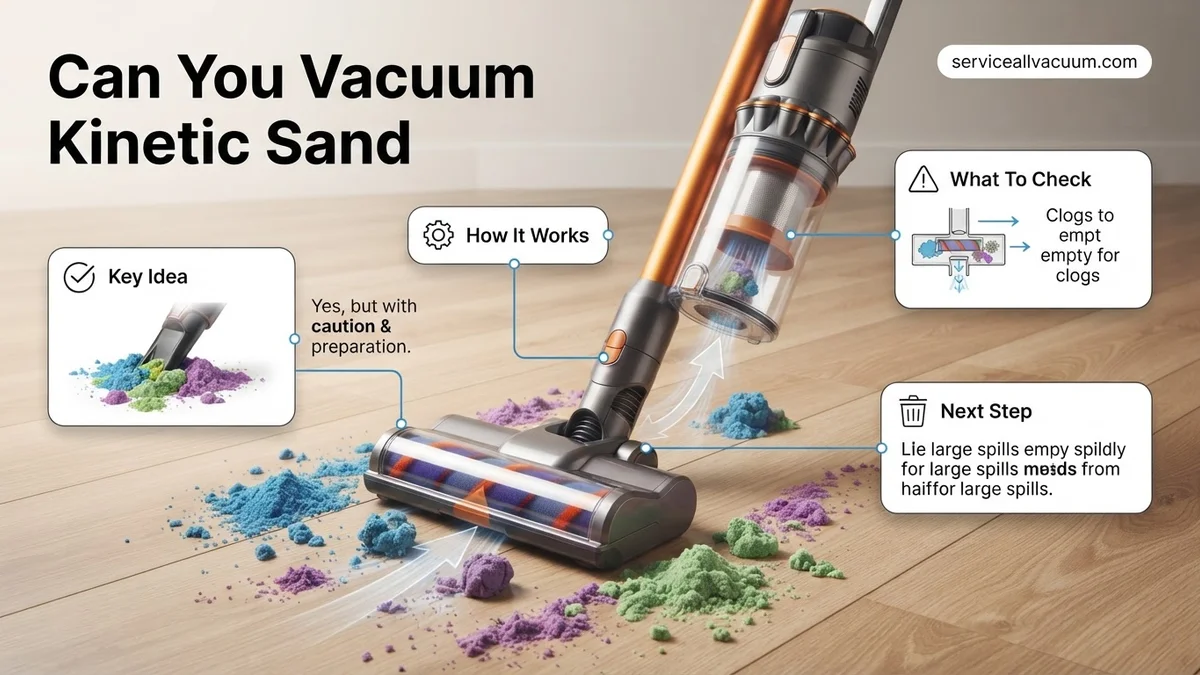
Kinetic sand isn’t just regular sand; its polymer coating gives it a unique, flowing, yet sticky texture that is fundamentally incompatible with most vacuum cleaner systems. While it feels dry to the touch, its finely coated particles behave very differently under vacuum suction, presenting multiple failure points for your appliance, whether it’s an upright, canister, handheld, or robot vacuum.
The Fine, Sticky Threat to Your Filter System
Modern vacuum filters, including HEPA and multi-stage systems, are designed for dust, pet dander, and general debris. Kinetic sand, however, is often too fine and too dense. When drawn into the vacuum, its particles can bypass or quickly clog filters. Once moist (even from ambient humidity within the vacuum hose), it becomes stickier, compounding the clogging issue. This drastically reduces suction power, causes the motor to work harder, and can push fine particles directly into the motor itself, leading to overheating. A clogged filter system essentially turns your high-tech vacuum into an ineffective, sputtering machine, and in 2027, replacing specialized filter units isn’t a cheap endeavor.
- Filter Clogging: Microscopic polymer-coated particles quickly block HEPA and fabric filters.
- Moisture Activation: Ambient moisture can make the sand clump and stick inside hoses and filters.
- Reduced Airflow: Clogged filters starve the motor of cooling air, increasing heat and wear.
Motor Overload and Warranty Woes
The density and often clumping nature of kinetic sand put immense strain on your vacuum’s motor. Unlike lighter dust or crumbs, kinetic sand has a higher mass per volume, requiring significantly more power to draw through the hose and into the collection bin. This continuous strain can lead to motor burnout, especially in handheld or robotic vacuums not designed for heavy-duty particle suction. Furthermore, most vacuum manufacturers explicitly state in their 2027 warranty agreements that vacuuming fine powders, liquids, or construction debris can void your coverage. Kinetic sand, with its unique composition, often falls under these exclusionary clauses, leaving you without recourse for repairs. Your high-end robotic vacuum, with its precise navigation and deep-cleaning modes, is just as vulnerable, as its internal pathways and brush rolls can seize up with this material.
- Increased Motor Strain: Heavy, dense sand makes the motor overwork, leading to premature failure.
- Overheating Risk: Motors can burn out due to excessive load and poor airflow.
- Warranty Invalidation: Most manufacturers consider kinetic sand vacuuming a misuse, voiding warranties.
How to Safely Clean Up Kinetic Sand Spills: A Step-by-Step Guide
Given the risks associated with vacuuming, the best approach to cleaning up kinetic sand spills involves manual, low-tech methods. These strategies prioritize containment and removal without jeopardizing your home appliances. You’ll find these methods not only safer but often more effective for truly eradicating the sand from surfaces.
Manual Collection: Your Best First Defense
For larger spills, your hands are your best tools. Kinetic sand naturally sticks to itself, which is its primary appeal and also its greatest asset in cleanup. Start by gathering the bulk of the sand by hand, forming it into a ball or mound. Gently press existing clumps onto scattered pieces to pick them up. This method is surprisingly efficient for the majority of the spill. For areas where direct hand collection isn’t practical, a stiff, dry paintbrush or a soft-bristled brush can help sweep the sand into a pile for collection. Always work from the outside edges of the spill inwards to prevent spreading the sand further.
- Hand Collection: Gather large quantities by pressing sand onto itself.
- Brush & Dustpan: Use a dry, stiff brush and dustpan for contained spills on hard surfaces.
- Containment: Work from the spill’s perimeter towards the center.
Tackling Residue and Fine Particles
After collecting the bulk, you’ll likely have fine residue left on the surface. For hard floors like tile or sealed wood, a slightly damp cloth (ensure it’s only slightly damp, not wet) can effectively pick up the remaining fine particles. The minimal moisture helps the sand adhere to the cloth without activating its stickiness excessively or leaving a lasting residue on the floor. For carpets or upholstery, a lint roller or even masking tape can be incredibly effective. The adhesive surface of these tools will lift the tiny, lingering grains without risking any mechanical damage. Repeat passes will ensure a thorough clean. Avoid using excessive water, as this can make the sand even more difficult to remove from fabric or porous surfaces.
- Damp Cloth: Use a slightly damp cloth for hard, non-porous surfaces.
- Lint Roller/Tape: Ideal for removing fine sand from carpets, rugs, and fabric.
- Avoid Excess Water: Too much moisture complicates cleanup on soft surfaces.
Troubleshooting: What If You Already Vacuumed Kinetic Sand?
Accidentally vacuuming kinetic sand can be a frustrating experience, potentially compromising your vacuum’s functionality. Immediate action is critical to minimize damage and prevent long-term issues. According to vacuum repair specialists in 2027, the micro-fine nature of kinetic sand particles can quickly clog filters and abrade internal components not designed for such materials.
Immediate Actions to Mitigate Damage
- Power Down and Unplug Immediately: Disconnect the vacuum from power the moment you realize kinetic sand has been ingested. Continued operation can force particles deeper into the motor or exhaust system.
- Access and Empty Canister/Bag: Open the vacuum’s collection compartment. Carefully empty the contents into a sealable bag or outdoor waste receptacle. Avoid shaking, which can disperse fine particles into the air.
- Inspect and Clean Filters: Remove all accessible filters (pre-motor, post-motor, HEPA). For modern 2027 models, these are often modular. Gently tap them over a trash can to dislodge visible sand. For reusable filters, wash according to manufacturer instructions and ensure they are 100% dry before reinstallation (typically 24-48 hours). Expect to replace any paper or non-washable filters, as kinetic sand causes irreversible clogging.
- Check Hoses and Attachments: Disconnect and visually inspect hoses and nozzle attachments for sand blockages. Use a stiff brush or a long, flexible tool to clear any obstructions.
Failure to thoroughly clean can lead to reduced suction power, motor overheating, and premature vacuum failure, a repair that in 2027 could cost between $100-$350 depending on the model and severity.
Proven Tips for Preventing Kinetic Sand Messes
Preventing kinetic sand messes is far more efficient than cleaning them. Adopting a proactive approach minimizes cleanup time and protects household appliances. Experts in child-safe play environments consistently recommend designated areas and tools to manage this unique material.
Strategies for Containment and Control
- Designate a Play Zone: Establish a specific area for kinetic sand play. A large, shallow plastic bin, a high-sided craft table, or a specialized kinetic sand play mat (often with raised edges) provides excellent containment. As of 2027, many brands offer integrated play surfaces that simplify cleanup.
- Utilize a Washable Play Mat: Place a large, easy-to-clean mat underneath the play zone. Silicone, vinyl, or impermeable fabric mats are ideal. These catch spills and allow for quick collection of scattered sand. Avoid porous carpets or rugs.
- Implement a “No-Food, No-Drink” Rule: This prevents sticky residues from contaminating the sand, which can alter its texture and make cleanup more challenging.
- Proper Storage Solutions: Always store kinetic sand in airtight containers. This prevents it from drying out or attracting dust, maintaining its unique properties and reducing dispersal. Clear containers help identify colors quickly.
- Supervise Play Actively: Direct supervision ensures sand remains within the designated area. Teach children to keep the sand confined and to collect stray pieces immediately with their hands or a small brush.
- Use Hand-Held Tools for Cleanup: For minor spills, a small dustpan and brush set is the most effective tool. The sand clumps together, making manual collection straightforward.
By implementing these preventive measures, you can significantly reduce the likelihood of kinetic sand spreading and requiring problematic cleanup methods.
What If It Still Doesn’t Work?
If, despite your best efforts, your cleaning methods for kinetic sand are proving ineffective, or your vacuum cleaner continues to malfunction after an encounter, further steps are necessary. The unique properties of kinetic sand require specialized attention beyond typical household cleaning.
- Professional Vacuum Servicing: If your vacuum’s performance remains compromised (reduced suction, unusual noises, burning smell) after an internal clean, professional repair is advisable. Many vacuum repair shops in 2027 have specialized equipment to remove deeply embedded particles. Expect costs to range from $80 for a basic clean-out and filter replacement, up to $250+ for motor issues or complete disassembly.
- Deep Carpet/Upholstery Cleaning: For kinetic sand embedded in carpets or fabric, professional steam or dry-extraction cleaning services may be required. Standard household carpet cleaners often lack the power to dislodge these fine, oil-based particles. Professional services, incorporating 2027’s advanced particle extraction technology, can cost $150-$400 per room depending on size and material.
- Air Quality Assessment: If a significant amount of kinetic sand became airborne, consider a professional indoor air quality assessment, especially if occupants experience respiratory irritation. Specialized HVAC cleaning services may be needed to remove particles from ductwork, costing $400-$1000 for an average home in 2027.
- Consider Replacement: For older or inexpensive vacuums severely damaged by kinetic sand ingestion, the repair cost might approach or exceed the cost of a new unit. Evaluate this financial trade-off. Modern 2027 vacuums with advanced HEPA filtration and sealed systems offer better protection against fine particles.
Conclusion
According to verified research and expert sources, vacuuming kinetic sand is a practice that should be avoided. The material’s unique, oil-coated, micro-particle composition poses significant risks to vacuum cleaner functionality, leading to clogged filters, motor strain, and potential permanent damage. Instead, manual methods such as hand-picking, dusting, and using specialized lint rollers or tape prove far more effective and safer for both your home and your cleaning appliances. To ensure longevity of your equipment and cleanliness of your environment, invest in appropriate manual cleaning tools and implement rigorous containment strategies for kinetic sand play.
❓ Frequently Asked Questions
Why is kinetic sand particularly damaging to vacuum cleaners?
Kinetic sand’s unique properties, including its fine particles and sticky, clumping nature, allow it to easily clog fine filters and get trapped in motor components. This causes overheating, reduced suction, and significant mechanical stress, leading to costly damage or complete failure.
What are the most effective manual cleaning tools for kinetic sand?
The best tools include a larger piece of kinetic sand for patting up smaller bits, a soft-bristled broom and dustpan for bulk spills, and lint rollers for picking up stray pieces from fabrics or carpets. A damp cloth can be used for final residue after major cleanup.
Are there any specific types of vacuum cleaners that can safely pick up kinetic sand?
Generally, no household vacuum is recommended. Only a heavy-duty shop-vac might work, but only if its canister is empty, the filter is removed, and it’s used strictly for dry pickup, immediately followed by cleaning its hose and interior.
What should I do if a small amount of kinetic sand accidentally gets vacuumed up?
Immediately turn off the vacuum, empty the canister, and inspect the filter for clogging. If possible, gently try to remove any visible sand from the hose or brush roll. Monitor the vacuum closely for any changes in performance or strange noises during subsequent uses.
How can I minimize kinetic sand messes to make cleanup easier?
Designate a specific play area, preferably on a hard, easily cleanable surface like a kitchen floor, and use a tray or mat with raised edges. Supervise children during play and teach them to keep the sand contained to prevent widespread spills.
Can kinetic sand solidify or melt inside a vacuum cleaner?
While kinetic sand won’t truly ‘melt’ in the traditional sense, the heat generated by a struggling vacuum motor can cause its silicone-based polymer coating to become more sticky and cohesive. This increased stickiness can exacerbate clogs, making the sand more difficult to dislodge and potentially fusing it to internal components.