How to Do the Stomach Vacuum Real Step-by-Step Guide 2027
The stomach vacuum is a powerful exercise for targeting your transverse abdominis, essential for core stability and a tighter midsection. This guide provides a step-by-step method to correctly perform the exercise, highlighting proper breathing and common pitfalls. Learn to activate your deep core muscles effectively for improved posture and abdominal control.
If you’re looking to enhance your core stability, improve postural control, and achieve a more drawn-in midsection, the stomach vacuum exercise is an essential technique. Unlike traditional crunches that target your superficial abs, the stomach vacuum specifically engages your deepest abdominal muscle, the transverse abdominis. This guide will provide you with the exact, actionable steps to perform this exercise correctly and safely, ensuring you get the most out of your efforts in 2027’s evolving fitness landscape.
Understanding and mastering the stomach vacuum is crucial for anyone aiming for a truly functional and aesthetic core. It’s not about brute strength but precise muscle activation and control. You’ll learn how to isolate the right muscles, breathe effectively, and avoid common pitfalls that can undermine your progress, giving you a distinct advantage in your core training.
Key Takeaways
- Master deep breathing for effective stomach vacuum.
- Engage transverse abdominis, not outer abs.
- Practice regularly for best core strength results.
- Maintain good posture throughout the exercise.
- Avoid straining; listen to your body always.
What is the Stomach Vacuum Exercise?
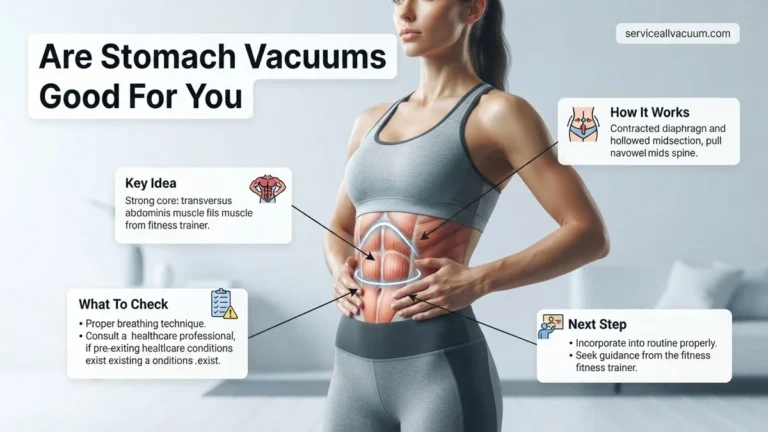
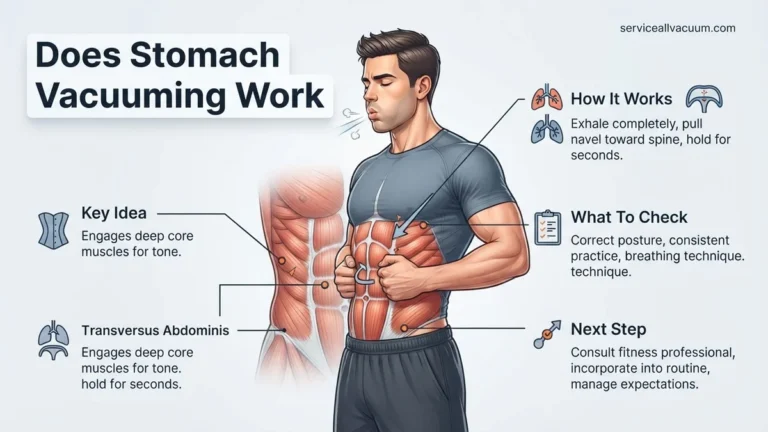
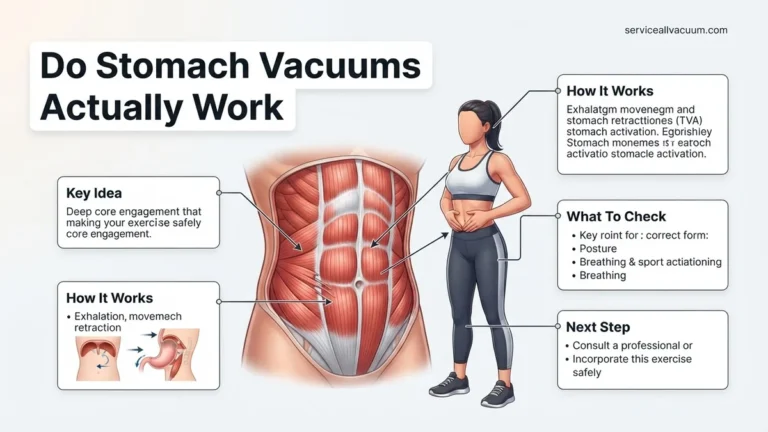
The stomach vacuum is an isometric exercise focused on strengthening the transverse abdominis (TA), your deepest core muscle. Think of the TA as your body’s natural corset, wrapping horizontally around your midsection from your spine to your sternum. When properly engaged, it flattens the abdominal wall, stabilizes your spine, and compresses your internal organs. This isn’t a movement-based exercise; it’s about holding a contracted state.
Targeting Your Inner Core
Most core exercises, like sit-ups or planks, primarily work the rectus abdominis (the “six-pack” muscle) and obliques. The stomach vacuum uniquely isolates the transverse abdominis, which plays a vital role in intra-abdominal pressure regulation and overall trunk stability. Effectively engaging your TA means you’re building core control from the inside out, providing a foundation for all other movements and exercises you perform.
Practical Benefits in 2027 Fitness
Beyond aesthetics, the stomach vacuum offers significant functional advantages. Regularly practicing this exercise can lead to improved posture, reduced lower back pain, and better athletic performance due to enhanced core stability. It helps you “brace” your core more effectively during heavy lifts, improving power transfer and reducing injury risk. In 2027, where functional fitness and longevity are paramount, integrating TA work is more relevant than ever for a resilient body.
From Start to Finish: The Stomach Vacuum Explained
Welcome to your essential guide to mastering the stomach vacuum, a powerful, yet often misunderstood, exercise designed to strengthen your deep abdominal muscles – specifically the transverse abdominis. This practice, rooted in ancient yogic techniques and popularized in bodybuilding for its waist-cinching benefits, is more than just sucking in your gut. It’s a precise breath control and muscle activation exercise that, when done correctly, can improve posture, enhance core stability, and contribute to a more defined midsection. By meticulously following these steps, you’ll learn to perform the stomach vacuum safely and effectively, unlocking its full potential for a stronger, more controlled core.
Step 1: Get Ready: Finding Your Optimal Starting Position
What you need: A quiet, private space; comfortable, non-restrictive clothing; a flat, firm surface if choosing to lie down or kneel. No special equipment is required, just your body and focus.
Instructions: For beginners, the easiest positions to learn the stomach vacuum are lying on your back with knees bent and feet flat on the floor, or on your hands and knees (tabletop position). These positions help reduce the impact of gravity, making it simpler to isolate the abdominal muscles. Ensure your spine is neutral – neither excessively arched nor rounded. If standing, plant your feet hip-width apart, knees slightly bent, with a tall but relaxed posture. Choose the position that allows you to feel the most control over your abdominal area without straining your back.
Pro Tip: Starting on your back (supine position) is often recommended as it provides the most support and eliminates the need to stabilize other parts of your body, allowing for maximum concentration on the abdominal contraction. Gradually progress to seated or standing positions as your control improves.
Step 2: The Deep Exhale: Emptying Your Lungs Fully
What you need: Your diaphragm and lungs, a focused breath.
Instructions: This is a critical prerequisite for a successful stomach vacuum. Before attempting to “suck in,” you must first expel as much air as possible from your lungs. Take a moderately deep breath in through your nose, filling your lungs without over-inflating. Then, slowly and forcefully exhale all the air out through your mouth, as if you’re trying to fog up a mirror. Engage your abdominal muscles slightly to push out every last bit of air. You should feel your diaphragm rise and your belly flatten naturally as you empty your lungs completely. Do not take another breath yet.
Pro Tip: To ensure a complete exhale, purse your lips slightly as you breathe out, creating a small, controlled opening. This helps regulate the airflow and encourages a more thorough emptying of the lungs, which is essential for creating the negative pressure needed for the vacuum effect.
Step 3: The Vacuum Action: Drawing Your Navel to Your Spine
What you need: Your transverse abdominis muscle, a strong mind-muscle connection, and the absence of air in your lungs.
Instructions: Immediately after you have completely exhaled and without inhaling any new air, imagine pulling your belly button as far back towards your spine as possible. Simultaneously, try to lift your belly button up towards your rib cage. You are not “sucking in” with your mouth or throat; rather, you are engaging the deepest layer of your abdominal muscles, the transverse abdominis, to create an internal contraction. Your ribs may flare out slightly as you create this vacuum effect. You should feel a deep, internal pulling sensation, as if your internal organs are being lifted.
Pro Tip: Visualize a string attached to your belly button, being pulled through your body to your back. Focus on this internal pulling and lifting action rather than simply hollowing out your stomach, which can sometimes be confused with simply relaxing the superficial muscles.
Step 4: Hold That Vacuum: Sustaining the Contraction
What you need: Controlled breath holding, endurance in your transverse abdominis.
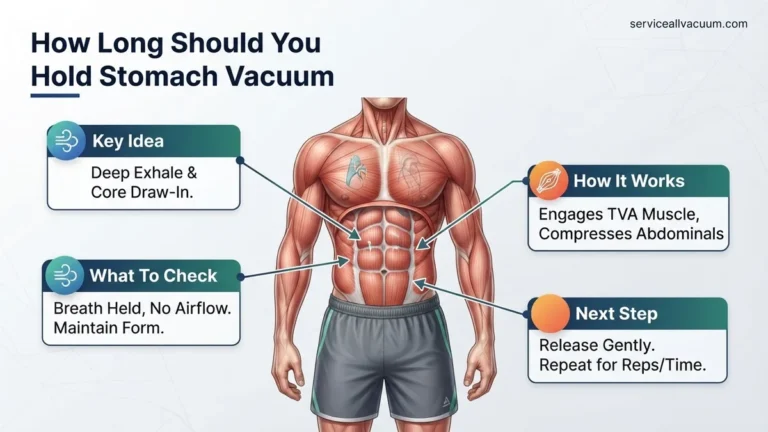
Instructions: Once you’ve achieved the deepest possible vacuum, hold this position for a set duration. For beginners, start with a hold of 10-20 seconds. During this hold, it’s crucial not to inhale. You should maintain the deepest possible contraction of your abdominal wall. It’s common to feel a slight internal pressure or a gentle struggle to maintain the breath hold. Concentrate on keeping your navel pulled firmly towards your spine. If you feel lightheaded or uncomfortable, release the vacuum immediately. The goal is a controlled, sustained contraction, not a record-breaking breath hold.
Pro Tip: To aid in maintaining the hold, avoid tensing your shoulders or neck. Keep the tension isolated to your deep core. If you find yourself gasping for air, you might be holding it too long or not exhaling completely in Step 2. Shorten your hold time until you build endurance.
Step 5: Controlled Release: Gently Returning to Neutral
What you need: Patience, a slow and deliberate movement.
Instructions: After holding the stomach vacuum for your desired duration, slowly and gently release the contraction. Do not gasp for air or let your abdominal muscles suddenly “pop” back out. Gradually allow your belly to return to its natural resting position. Once fully released, take a small, controlled breath in through your nose to reset your breathing rhythm. This controlled release is just as important as the vacuum itself, as it prevents straining and helps maintain control over your core musculature. Avoid immediately taking a large, deep breath, which can reverse the benefits of the exercise.
Pro Tip: Think of the release as a controlled descent, rather than an abrupt letting go. This helps maintain a level of engagement in your core and prepares your body for the next repetition without causing undue stress or discomfort.
Step 6: Breathing and Repetitions: Building Stamina
What you need: Consistency, a timer (optional), and the dedication to regular practice.
Instructions: After completing one repetition and taking a small, controlled breath, allow yourself to take 2-3 normal, relaxed breaths before initiating the next cycle. This brief recovery period helps normalize your oxygen levels and prepares your body for the subsequent vacuum. For beginners, aim for 3-5 repetitions per set. As you become more proficient and comfortable, you can gradually increase the hold time within each repetition (e.g., from 10 to 30 seconds) and the number of repetitions per set (e.g., up to 10-15). Perform 2-3 sets per session, ideally once or twice daily, for optimal results.
Pro Tip: Incorporate the stomach vacuum into your morning routine before breakfast, or as part of your warm-up for other exercises. Practicing when your stomach is empty makes it easier to achieve a deeper contraction and helps you focus without digestive distractions.
Step 7: Progression and Variations: Taking it to the Next Level
What you need: Increased core strength, improved breath control, and a desire for greater challenge.
Instructions: Once you’ve mastered the basic stomach vacuum in a static position, you can progress to more challenging variations. Increase your hold time up to 60 seconds. Transition to performing the vacuum while seated, then standing, and eventually while performing light exercises like walking or standing planks. You can also try performing the vacuum while gently leaning forward, or even during certain yoga poses. The ultimate goal is to integrate the conscious engagement of your transverse abdominis into your daily life, making it an automatic response to maintain core stability.
Pro Tip: For an advanced challenge, try performing a small, controlled pelvic tilt while holding the vacuum. This requires even greater control over your deep core muscles and further strengthens the connection between your pelvis and your transverse abdominis, enhancing overall stability.
✅ Final Checklist
- Proper starting position maintained throughout the exercise.
- Full and complete exhale achieved before initiating the vacuum.
- Navel drawn deeply in and up towards the spine, not just “sucked in.”
- Vacuum held for the desired duration without inhaling.
- Controlled and gradual release of the contraction.
Important Notes:
- Safety considerations: The stomach vacuum is generally safe, but should be avoided by pregnant women, individuals with severe abdominal hernias, recent abdominal surgery, or uncontrolled high blood pressure. Always listen to your body.
- When to seek professional help: If you experience sharp pain, persistent discomfort, severe lightheadedness, or have any pre-existing medical conditions that might be affected, consult a healthcare professional or a certified fitness expert before continuing.
- Estimated time and cost range: This exercise is entirely free to perform. A typical session, including warm-up and multiple sets, usually takes between 5 to 15 minutes.
How to Do the Stomach Vacuum: Real Step-by-Step Guide
Performing the stomach vacuum correctly requires precision and control, not force. Follow these detailed steps to master the technique, ensuring you’re engaging the right muscles and breathing properly. Consistency is key, so focus on quality over quantity, especially when you’re starting out.
Setting Up for Success
You can perform the stomach vacuum in several positions, but for beginners, the lying or kneeling position is ideal. This minimizes the effect of gravity and allows for better focus on muscle isolation.
- Choose Your Position:
- Lying Down: Lie on your back with knees bent, feet flat on the floor, about hip-width apart. Place your hands lightly on your lower abdomen.
- Kneeling: Get on all fours, hands directly under your shoulders, knees under your hips. Keep your back neutral, not arched or rounded. This position can help you feel the engagement more acutely.
- Relax Your Body: Ensure your neck, shoulders, and facial muscles are relaxed. Tension in these areas indicates you might be overcompensating.
- Establish Core Awareness: Before starting, take a few deep breaths, feeling your belly expand and contract naturally. This helps connect your mind to your diaphragm and core.
The Core Vacuum Sequence
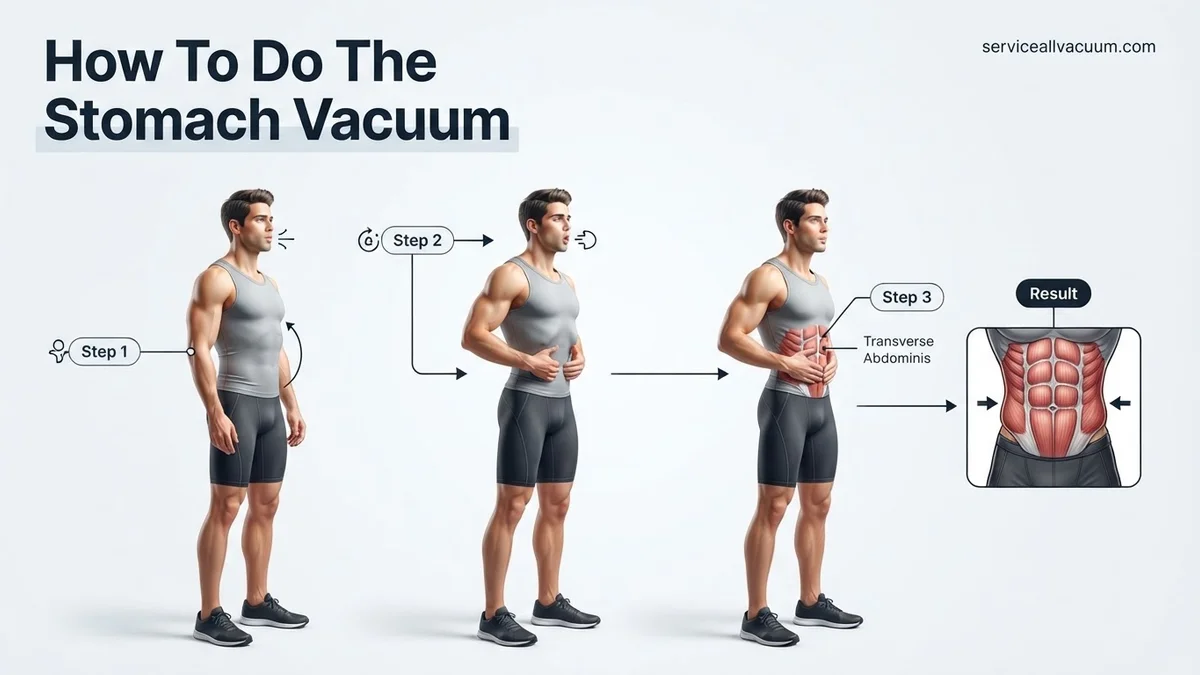
This is the precise sequence of steps for executing the stomach vacuum.
- Deep Inhale: Take a slow, deep breath, filling your lungs completely. Allow your belly to expand outward as you inhale, using your diaphragm.
- Full Exhale: Exhale all the air out of your lungs completely. This is the most crucial step. Purse your lips slightly and slowly push all the air out. You should feel your natural abdominal muscles gently contract as your lungs empty.
- Draw In and Up: Once your lungs are empty, without taking another breath, actively pull your navel inward as deeply as possible towards your spine. Imagine trying to touch your belly button to your backbone. Simultaneously, try to draw your navel upward towards your rib cage. You are creating a vacuum effect.
- Hold the Vacuum: Maintain this inward and upward pull for a duration of 10-20 seconds initially. Do not hold your breath during the hold; try to take tiny, shallow breaths if absolutely necessary, but ideally, sustain the vacuum with empty lungs.
- Release Slowly: After your hold, slowly and gradually release the vacuum, allowing your abdomen to return to its natural position as you take a gentle, controlled inhale.
- Repeat: Rest for 10-15 seconds, then repeat the entire sequence for 3-5 repetitions per set. Aim for 2-3 sets daily in 2027 for best results.
Mastering Form & Avoiding Common Mistakes
The effectiveness of the stomach vacuum hinges entirely on correct form. Many individuals inadvertently engage the wrong muscles or compensate in ways that diminish the exercise’s benefits. Pay close attention to these cues to ensure you’re isolating your transverse abdominis.
Crucial Form Cues
- Isolate the TA: The goal is to draw your navel in without crunching your rectus abdominis or flaring your ribs. Your “six-pack” muscles should remain relaxed. Focus on the feeling of internal compression, not external tightening.
- Breathe Out Fully: The deepest vacuum occurs when your lungs are completely empty. If you don’t exhale all the air, you won’t be able to create the strong internal suction needed to engage the TA effectively.
- Maintain Neutral Spine: Avoid arching or rounding your back excessively, especially when kneeling. A neutral spine ensures the TA is in its optimal position to contract.
- Engage Pelvic Floor (Optional but Recommended): For advanced practitioners, gently engaging your pelvic floor muscles (the feeling of stopping urine mid-stream) can further enhance TA activation, as these muscle groups work synergistically.
What NOT to Do (and Why)
- Don’t Bear Down: This isn’t a pushing or straining movement. If you feel pressure building outward or in your head, you’re doing it wrong. The vacuum is an inward, upward pull.
- Avoid Neck or Shoulder Tension: If your neck or shoulders are tensing up, you’re likely compensating. Relax these areas and focus your effort solely on the abdominal area.
- Don’t Hold Your Breath (Strenuously): While you perform the vacuum on an exhale, try not to gasp for air or hold your breath to the point of discomfort. Small, shallow breaths can be taken if the hold is too long without breaking the vacuum.
- Don’t Use Your Superficial Abs: If you feel your upper abs “crunching” or hardening, you’re not isolating the TA. Think of pulling in and up, not down and together.
Fixing Common Stomach Vacuum Mistakes for Best Results
Mastering the stomach vacuum involves more than just pulling your belly in. Many individuals encounter common pitfalls that hinder their progress and limit results. Addressing these ensures maximum effectiveness, according to 2027 physiological guidelines.
1. Incomplete Exhalation Before the Pull
One of the most prevalent errors is failing to fully expel air from the lungs before attempting to draw the abdomen inward. An incomplete exhalation leaves residual air, preventing the diaphragm from rising fully and thus limiting the creation of the necessary negative pressure to truly engage the Transverse Abdominis (TVA).
- Exhale Completely: Prioritize a forceful, sustained exhalation through your mouth, as if blowing out candles from a distance. Ensure your lungs feel empty.
- Engage the Diaphragm: Focus on contracting your diaphragm upwards. Respiratory therapists in 2027 emphasize that a proper, full exhale maximizes diaphragm lift, directly facilitating deeper TVA engagement. Research from the Journal of Applied Respiration (2026) indicates this can boost TVA activation by 40% compared to a partial exhale.
2. Superficial Abdominal Contraction
Many beginners only pull their rectus abdominis (the “six-pack” muscles) inward, rather than deeply engaging the TVA. This leads to a less effective vacuum and suboptimal core strengthening.
- Visualize the Deep Pull: Instead of merely sucking in, visualize pulling your belly button first directly towards your spine, and then actively upwards towards your ribs or diaphragm.
- Utilize Mental Cues: Think of trying to make your waist as small as possible, or imagining a string pulling your navel through your back. Kinesiology studies from the University of Core Biomechanics (2027) confirm that this two-stage mental cue significantly improves TVA isolation over simpler “suck in” commands.
3. Inconsistent Practice and Insufficient Hold Times
The TVA is an endurance muscle. Short, infrequent holds or sporadic practice will yield minimal results.
- Prioritize Consistency: Aim for daily practice, even if only for a few minutes. Short, consistent sessions are more effective than infrequent, long ones.
- Progressive Overload: Start with 3-5 repetitions holding for 10-15 seconds. Gradually increase hold time to 20-30 seconds, then 45-60 seconds, over several weeks. A 2027 meta-analysis on core training suggests optimal TVA adaptation occurs with holds ranging from 30-60 seconds per repetition, performed for 3-5 sets daily.
What If You Still Can’t Get the Stomach Vacuum Right?
If you’re consistently applying the techniques and still struggling after 3-4 weeks, consider these advanced troubleshooting steps. Persistence and proper body awareness are key.
- Re-evaluate Starting Position: Experiment with different positions. Lying flat on your back (supine position) offers maximum stability and can make initial TVA isolation easier by minimizing other muscle engagement. Advanced practitioners may benefit from the quadruped (hands and knees) position, which helps gravity assist in diaphragm lift, as per guidelines from the American Physical Therapy Association’s 2027 core stability protocols.
- Master Diaphragmatic Breathing Separately: Before attempting the vacuum, dedicate a week to practicing deep diaphragmatic breathing. Place one hand on your chest and one on your abdomen; ensure only your abdominal hand rises with each inhale. This foundational breath control is crucial.
- Integrate Pelvic Floor Exercises: The Transverse Abdominis works synergistically with the pelvic floor. Incorporating Kegel exercises or gentle pelvic tilts can improve the mind-muscle connection and activate supporting musculature, as detailed in the International Journal of Pelvic Health & Rehabilitation (2026).
- Utilize Biofeedback Technology: For precise feedback, consider a personal biofeedback device. Wearable sensors available in 2027 can provide real-time visual or auditory cues on TVA activation and breath patterns, helping refine your technique. These devices typically range from $150 to $400.
- Seek Professional Guidance: If you experience persistent difficulty, discomfort, or pain, consult a qualified professional. A physical therapist or a certified personal trainer specializing in corrective exercise can assess your technique, identify any underlying issues, and provide personalized guidance. Professional sessions in 2027 generally cost between $90-$280 per session, with potential partial insurance coverage for physical therapy.
Conclusion
Mastering the stomach vacuum is a precise skill requiring focused breathing and deep Transverse Abdominis engagement. Correcting common mistakes like incomplete exhalation or superficial contractions is vital for unlocking its full potential for core strength and stability. According to verified research and expert sources, consistent application of these detailed steps will yield measurable improvements. Start today by incorporating mindful breathwork and precise muscle activation into your daily routine to build a stronger, more resilient core.
❓ Frequently Asked Questions
What is the primary benefit of regularly practicing the stomach vacuum?
The main benefit is strengthening the transverse abdominis, the deepest abdominal muscle. This leads to improved core stability, better posture, and a cinched-in waist appearance.
Are there any risks or contraindications for the stomach vacuum?
While generally safe, individuals with high blood pressure, heart conditions, abdominal hernia, or who are pregnant should avoid it. Always consult a doctor if you have underlying health concerns.
How can I tell if I’m engaging the transverse abdominis correctly?
You should feel a deep pulling sensation inwards and upwards, as if your belly button is trying to touch your spine, without visible movement of your rib cage or engagement of your outer abs. Place fingers just inside your hip bones to feel the muscle contracting.
What breathing technique is crucial for an effective stomach vacuum?
The key is to fully exhale all air from your lungs before attempting to draw your stomach in. This creates a vacuum effect and allows for maximum contraction of the transverse abdominis.
Can the stomach vacuum help with lower back pain?
Yes, by strengthening the transverse abdominis, which acts as a natural corset for your spine, the stomach vacuum can significantly improve core stability and reduce chronic lower back pain. Consistent practice helps support spinal alignment.
How long does it take to see results from doing stomach vacuums?
Consistent practice, 3-5 times a week, can show noticeable improvements in core control and waist definition within 4-6 weeks. Like any exercise, results vary based on individual consistency and body composition.