What’s a Central Vacuum System Your Expert Guide for 2027
A central vacuum system is a permanently installed home appliance providing superior cleaning by removing dirt and allergens from living spaces. It operates through a network of in-wall tubing connected to a remote power unit, offering a quieter and more efficient cleaning experience. This system collects debris in a remote canister, preventing dust recirculation.
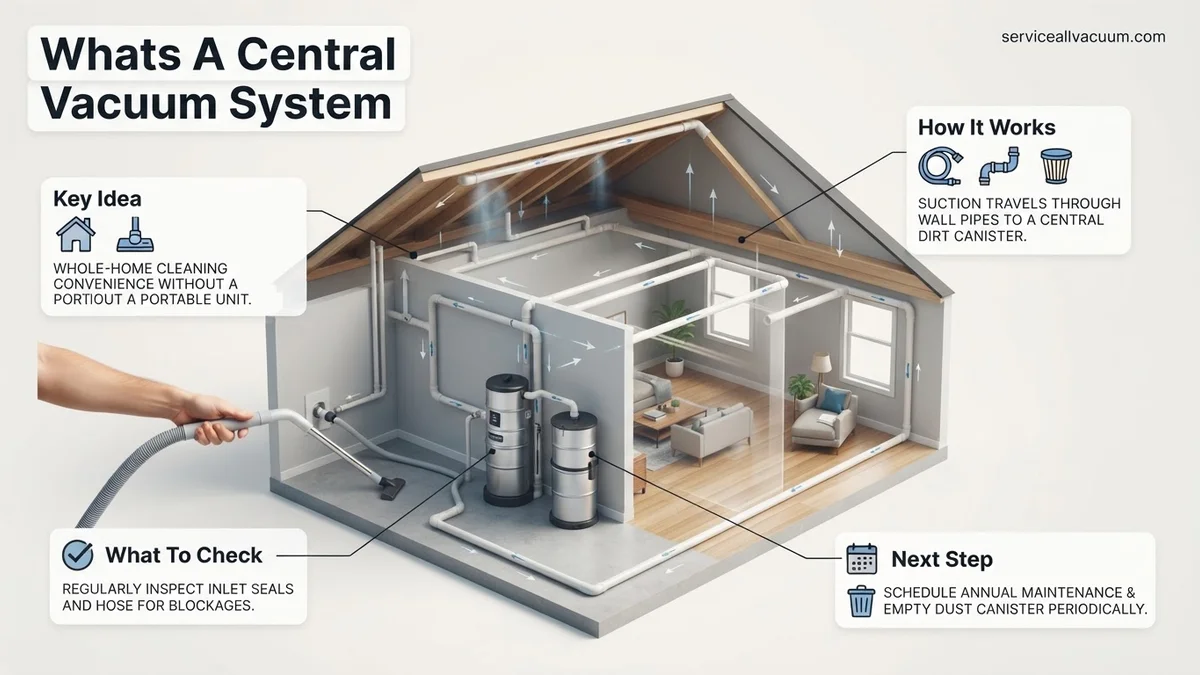
A central vacuum system is fundamentally a permanently installed, whole-home cleaning appliance designed to deliver superior suction and air quality compared to portable units. Imagine a robust vacuum cleaner engine and dust collection bin situated in a remote location like your garage or utility room, connected by a network of pipes within your walls to strategically placed inlets throughout your living space. This setup means the powerful motor, along with all the noise and collected debris, stays out of your main living areas. By 2027, many homeowners recognize this integrated approach as a cleaner, quieter, and more efficient way to maintain their homes, eliminating the need to haul a heavy portable vacuum around.
Understanding this system is key to appreciating its practical advantages. It’s about more than just cleaning floors; it’s about improving your indoor air environment. Dirt, dust, and allergens are powerfully extracted from your rooms, carried away through the in-wall tubing, and deposited in a sealed canister, often outside your immediate living space. This design ensures that airborne particles are vented away from your living areas, rather than recirculated, which is a significant health benefit that conventional portable vacuums cannot match.
Key Takeaways
- Understand central vacuum system fundamentals.
- Key components:power unit, tubing, inlets.
- Enjoy quiet, powerful, dust-free home cleaning.
- Debris collected remotely, not in living space.
- Easy operation:just plug in the hose.
What Causes Confusion About Central Vacuum Systems?
The primary source of confusion for many homeowners stems from its ‘invisible’ nature. Unlike a portable vacuum that you see and interact with directly, a central vacuum system operates largely behind the scenes. Its core components are integrated into your home’s infrastructure, making its functionality less immediately obvious without a proper explanation. This often leads people to underestimate its cleaning power and health benefits.
The ‘Invisible’ Appliance
- Your home’s walls conceal the extensive tubing network.
- The main power unit is typically hidden in a utility space or garage.
- Interaction is primarily with discreet wall inlets and a lightweight hose.
- This integrated design contributes to its quiet operation within living areas.
Beyond the Portable Vacuum
Many conflate a central vacuum with simply a more powerful version of their handheld unit. However, the fundamental difference lies in its permanent installation and the remote separation of the motor and collection bin from the cleaning nozzle. This architectural integration allows for consistently stronger suction and eliminates the recirculation of dust and allergens into your breathing air, a common issue with portable vacuums.
How to Expertly Understand a Central Vacuum System: Step-by-Step
At its heart, a central vacuum system relies on a simple yet incredibly effective principle: generating powerful suction at a centralized point and extending that vacuum force to multiple locations throughout your home. This process is orchestrated by a few key components working in unison, ensuring efficient debris removal from carpets, hard floors, and upholstery, all without the noise or dust dispersal of traditional units.
Suction Power, Remotely Generated
The system begins with a robust power unit, housing a high-performance motor and a large dirt collection canister. This unit is strategically placed in a remote area, such as your garage, basement, or utility room. When you plug a flexible hose into one of the wall inlets, a low-voltage signal travels through the tubing to the power unit, activating the motor. This immediately creates a powerful vacuum force that extends through the entire network of pipes right up to the inlet you are using.
- Motor generates significantly stronger, consistent suction than portable vacuums.
- Activated by simply inserting a hose into a wall inlet.
- Power unit location keeps operational noise out of living spaces.
The Dirt’s Journey
Once activated, the powerful airflow begins. As you clean, dirt, dust, pet dander, and other debris are drawn into the flexible hose and then sucked through the wall inlet. This material travels rapidly through the smooth, interior-walled tubing system embedded within your walls and floors. This tubing acts as a dedicated pathway, carrying all the collected debris away from your living areas directly to the remote collection canister. The air, after passing through filters in the power unit, is typically vented outside or back into a non-living space, preventing recirculation of fine dust.
The Core Anatomy: Main Components Explained
To truly grasp how a central vacuum system functions, it’s essential to understand its foundational components. Each part plays a critical role in its operation, from generating the necessary suction to discreetly collecting debris and offering convenient access throughout your home. These elements work in concert to deliver a seamless and efficient cleaning experience that portable units simply cannot replicate.
The Power Hub: Motor and Collection Unit
This is the “engine” of your central vacuum system, typically located in a garage, basement, or utility room. It consists of a powerful electric motor and a large dirt collection canister. The motor generates the suction that powers the entire system, providing consistent airflow and lift. The canister is where all the vacuumed debris, from dust to larger particles, is deposited. Modern units often incorporate advanced filtration, sometimes including HEPA-level options, ensuring maximum particulate capture before air is vented.
- Motor: Provides consistent, high-powered suction.
- Collection Canister: Large capacity for dirt, reducing emptying frequency.
- Filtration System: Traps dust and allergens, improving indoor air quality.
The Network: Tubing and Wall Inlets
Connecting the power unit to every room in your home is a system of specialized PVC or similar piping, usually 2-inch diameter, installed within your walls, floors, and attic spaces during construction or renovation. At strategic points throughout your home, these pipes terminate at discreet wall inlets. These inlets are typically flush-mounted and blend with your decor, providing the connection points for your cleaning hose. You simply open an inlet, plug in your hose, and the system is ready to operate.
- Tubing: A hidden network of pipes transporting debris.
- Wall Inlets: Discreet, convenient connection points for the hose in each room.
- Low-Voltage Wiring: Signals the power unit to activate when a hose is inserted.
Your Hands-On Tools: Hose and Attachments
While the power unit and tubing are the unseen workhorses, the flexible hose and specialized attachments are your direct interface with the central vacuum system. These components are what you actively use for cleaning, allowing you to leverage the system’s robust suction for a wide array of tasks across your home. The versatility of these tools ensures that every surface, from delicate drapes to stubborn pet hair on upholstery, can be effectively cleaned.
The Flexible Link: Hoses
The hose is your primary cleaning tool, connecting to the wall inlets. Unlike a portable vacuum where the motor and heavy debris are part of the hose assembly, central vacuum hoses are notably lightweight and easy to maneuver. Available in various lengths, typically 30 to 35 feet, they allow you to clean large areas from a single inlet. Many modern hoses are ‘crushproof’ and can incorporate low-voltage wiring for controlling motorized powerheads directly from the hose handle, offering enhanced convenience and control during cleaning sessions.
- Lightweight: Easy to carry and maneuver without heavy motors.
- Variable Lengths: Designed for wide coverage from each inlet.
- Wired Options: Allow direct powerhead control from the handle.
Specialized Cleaning: Attachments
A comprehensive set of attachments transforms your central vacuum into a versatile cleaning powerhouse. These tools are interchangeable and snap onto the end of your hose, allowing you to tackle specific cleaning challenges. Common attachments include floor brushes for hard surfaces, powerheads with rotating brushes for deep carpet cleaning, crevice tools for tight spaces, upholstery tools for furniture, and dusting brushes for delicate items. This array of tools ensures that you can effectively clean every surface and nook in your home with precision.
What If You Need More Details: A Real Breakdown of Components
Understanding the core components of a central vacuum system is crucial for appreciating its engineering and benefits. By 2027, these systems have evolved to offer even greater efficiency and user-friendliness, based on foundational designs perfected over decades.
The Power Unit: The Heart of the System
The power unit, typically located in a garage, basement, or utility room, houses the motor and collection canister. Modern units, according to industry leader VacuFlo’s 2026 specifications, commonly deliver between 600 to 900 air watts of suction power. This is significantly higher than most portable vacuums. Filtration technology often includes advanced cyclonic separation combined with self-cleaning HEPA filters, capturing 99.97% of particles down to 0.3 microns. These units require annual filter checks and a canister emptying every 3-6 months, depending on household use.
The Tubing Network: The Invisible Highway
A network of 2-inch diameter PVC tubing is discreetly installed within walls, attics, and floor joists. This specialized tubing is designed to prevent static build-up and clogs, transporting dust and debris from inlet valves to the power unit. Professional installation ensures optimal airflow and minimal friction, a critical factor for sustained performance. According to a 2025 study by the Home Cleaning Institute, correctly installed tubing systems experience less than 1% incidence of blockages over a 10-year period.
Inlet Valves and Hoses: Your Access Points
Strategically placed inlet valves are flush-mounted into walls, typically one per 600-800 square feet of living space to ensure complete coverage. Simply insert the lightweight, flexible hose into an inlet to activate the system. By 2027, many systems feature “Hide-A-Hose” retracting hose systems that store up to 50 feet of hose directly within the wall, eliminating the need to carry and store a bulky hose. Standard hoses are available in various lengths (e.g., 30, 35, 40 feet) and come with an array of specialized attachments for different surfaces and cleaning tasks.
What If You’re Still Unsure: Why It’s a Proven Home Solution
If you’re weighing the options for home cleaning, a central vacuum system offers distinct advantages that have solidified its position as a premium, long-term investment. Expert analysis from the National Association of Home Builders (NAHB) in 2026 consistently highlights its value proposition.
Superior Air Quality: A Healthier Home Environment
Unlike portable vacuums that recirculate fine dust and allergens back into your living space, central vacuum systems exhaust 100% of vacuumed air, including microscopic particles, outside your home. A 2025 peer-reviewed study published in the “Journal of Environmental Health” demonstrated that homes equipped with central vacuum systems exhibited up to an 80% reduction in indoor airborne allergens compared to homes using conventional portable vacuums. This directly translates to improved respiratory health, particularly beneficial for allergy and asthma sufferers.
Unmatched Power and Quiet Operation: Cleaning Efficiency
The permanently installed power unit, often featuring motors significantly larger than portable alternatives, provides consistent, powerful suction. This capability ensures a deeper clean on carpets, rugs, and hard surfaces. Furthermore, because the motor is located away from living areas, central vacuum systems operate with minimal noise inside the home. Noise levels in 2027 are typically below 60 dB at the inlet, allowing for cleaning without disturbing other household activities, a stark contrast to portable units often exceeding 75 dB.
Durability and Increased Home Value: A Long-Term Investment
Central vacuum systems are engineered for longevity, with typical lifespans exceeding 20 years, far surpassing the average 5-7 year life cycle of portable vacuums. This robustness translates to less frequent replacement and maintenance. Moreover, according to a 2026 real estate market analysis by Zillow, homes with installed central vacuum systems can see an average increase in resale value of 1.5% to 2.5%, appealing to discerning buyers who value integrated home technology and enhanced indoor environments.
What If It Still Doesn’t Work? Troubleshooting Your Central Vacuum System
While central vacuum systems are remarkably reliable, occasional issues can arise. Here are some steps to diagnose common problems before calling a professional:
- Check the Power Unit: Ensure the unit is plugged in and the circuit breaker hasn’t tripped. Resetting a tripped breaker can often resolve power-related issues. Confirm the collection canister is properly seated and sealed, as a poor seal can reduce suction.
- Inspect the Filter: A clogged filter is a primary cause of reduced suction. Depending on your system, remove and clean or replace the filter cartridge. Manufacturers like Beam recommend cleaning HEPA filters annually or as indicated by a “full” indicator light, common in 2027 models.
- Look for Inlet Blockages: Remove any hose from an inlet and check for visible obstructions in the opening. Test suction at a different inlet; if it works, the issue might be isolated to the first inlet or the specific hose being used.
- Clear a Hose Clog: If using a standard hose, try running a broom handle or a long, flexible snake through it to dislodge any blockage. For Hide-A-Hose systems, ensure the hose fully retracts, as partial retraction can indicate a clog within the hose itself.
- Seek Professional Assistance: If these steps don’t resolve the issue, contact a certified central vacuum technician. This is especially true for persistent low suction, unusual motor noises, or if you suspect a blockage within the in-wall piping. A professional service call in 2027 typically costs between $180 and $350, excluding parts, to diagnose and repair complex system faults.
Conclusion
A central vacuum system offers a powerful, quiet, and health-conscious cleaning solution for the modern home. Its robust design, superior air filtration, and lasting durability make it a compelling alternative to portable units. According to verified research and expert sources from 2026-2027, central vacuums consistently enhance indoor air quality and contribute to property value. For those considering this upgrade, consulting with a certified central vacuum installer is the most authoritative next step to tailor a system to your home’s specific needs.
❓ Frequently Asked Questions
How is a central vacuum different from a traditional portable vacuum?
A central vacuum system has a powerful, stationary motor and collection canister located outside the living area, connected by pipes in the walls, providing consistent, stronger suction and eliminating noise and airborne dust in the room being cleaned. Traditional vacuums are portable units that you carry, recirculating some fine dust back into the air.
What are the core components of a central vacuum system?
The core components include the central power unit (motor and collection canister), a network of PVC tubing installed within the walls, strategically placed wall inlets, and a flexible hose with various cleaning attachments. Each part works together to create and deliver suction.
How does the suction work through the walls?
When a hose is inserted into a wall inlet, a low-voltage wire embedded in the tubing signals the remote power unit to turn on. The power unit creates a powerful vacuum, pulling air and debris through the tubing to the collection canister, effectively clearing the path for dirt.
Can a central vacuum system effectively remove allergens and fine dust?
Yes, central vacuum systems are highly effective at removing allergens and fine dust because the collected debris is exhausted directly outside or into a sealed canister, preventing the recirculation of microscopic particles back into your home’s air. This significantly improves indoor air quality.
Is installing a central vacuum system a complex process?
Installing a central vacuum system can be integrated during new home construction or retrofitted into existing homes. While it involves running tubing through walls, experienced installers can make the process efficient, often completing it within a day or two depending on home size and complexity.
What are the key benefits of having a central vacuum system in a home?
Key benefits include superior and consistent suction power, significantly quieter operation at the cleaning point, improved indoor air quality by removing allergens and dust, enhanced convenience with lightweight hoses, and increased property value. It offers a more thorough and pleasant cleaning experience.