What is Vacuum in Space? Expert Guide 2027
The vacuum of space is not a complete void, but rather an extremely low-density environment. It’s a near-perfect vacuum that contains sparse matter, radiation, and fields, making it far from truly empty.
Forget the old science fiction trope of space as an utterly empty void. By 2027, our understanding is clear: the “vacuum” of outer space is not truly empty. Instead, it’s an environment of incredibly low density, a near-perfect vacuum that still contains a surprising array of matter and energy. This distinction matters profoundly, influencing everything from spacecraft design and interstellar travel concepts to our fundamental understanding of the universe’s composition and behavior.
Your journey through the cosmos, whether as a researcher, engineer, or an eager enthusiast, requires grasping this nuanced reality. Understanding what truly constitutes the space between celestial bodies helps us comprehend cosmic phenomena, interpret astronomical observations, and plan future missions. Let’s redefine what “nothing” really means in the vast expanse above.
Key Takeaways
- Space isn’t empty, it’s a near-perfect vacuum.
- Contains sparse atoms, dust, and cosmic rays.
- Electromagnetic radiation and fields are present.
- Vastly lower density than any Earth atmosphere.
- Absence of air means no pressure, no sound.
What Causes “Vacuum in Space” to Be Misunderstood?
The Myth of Absolute Emptiness
For centuries, the concept of a vacuum was synonymous with absolute nothingness. Early scientific models, influenced by philosophical ideas, often struggled with the notion of space without any substance. This perception was reinforced by the dramatic contrast between Earth’s dense atmosphere and the seemingly barren stretches beyond. When we speak of a “vacuum cleaner” or a “vacuum-sealed” package, we typically imply the removal of virtually all air molecules, creating a space that feels utterly empty to our everyday senses. However, this terrestrial understanding falls short when applied to the cosmic scale.
The vastness of space makes any localized presence incredibly sparse, leading to the intuitive, yet incorrect, conclusion that it’s completely devoid of everything. This misconception persists in popular culture, often depicting astronauts floating through a “pure void.” However, current scientific models, corroborated by decades of observation and experimentation, tell a different story. The universe, even in its emptiest regions, retains a fundamental composition that prevents true nothingness. You might think of it as a canvas that, even when seemingly blank, still possesses the fundamental properties of the canvas itself.
“Near-Perfect Vacuum”: A More Accurate Picture
The most precise way to describe the vacuum of space is as a “near-perfect vacuum.” This term highlights that while incredibly empty by terrestrial standards, it’s not a complete void. On Earth, even the best laboratory vacuum chambers can only achieve particle densities of around 100,000 particles per cubic centimeter. In contrast, the vacuum of interstellar space can have densities as low as a single particle per cubic centimeter, or even less in intergalactic voids. This profound difference is why we call it “near-perfect”—it’s the closest thing to nothingness we know, yet still something.
Understanding this distinction is crucial for any meaningful discussion about space. It means that while the chances of two atoms colliding in interstellar space are astronomically low, they are not zero. It implies that light and other forms of radiation aren’t traveling through absolute emptiness, but rather through a medium, however sparse. This subtle but significant presence fundamentally alters our perspective on how cosmic forces interact and how the universe evolves. Your current and future exploration efforts depend on acknowledging this near-perfect, not absolute, state.
How to Define the Real Vacuum of Space
Quantifying the Void: Particles Per Cubic Meter
Defining the vacuum of space isn’t about absence, but about incredible scarcity. In the vast stretches between stars within our galaxy, known as interstellar space, the particle density typically ranges from about 1 to 100 atoms per cubic centimeter (around 100,000 to 10,000,000 atoms per cubic meter). For comparison, Earth’s atmosphere at sea level contains roughly 2.5 x 10^19 (25 quintillion) molecules per cubic centimeter. This enormous difference underscores just how “empty” space truly is by human experience, yet it’s far from zero.
Venture further into the void between galaxies, in intergalactic space, and the density drops even lower. Here, you might find as few as one to ten atoms per cubic meter. These numbers, while minuscule, are measurable and have profound implications. They confirm that even the most desolate regions of the universe are not completely empty. Instead, they represent an extreme end of a spectrum of matter density, a testament to the fact that absolute nothingness seems to be an elusive concept in our physical universe. This density, while low, is still a critical component of the universe’s large-scale structure and evolution.
More Than Just Hydrogen: A Cosmic Ingredient List
So, if space isn’t empty, what exactly is present in this near-perfect vacuum? It’s more than just a few stray atoms. The composition is surprisingly diverse, and understanding these components helps us grasp cosmic phenomena:
- Sparse Atoms and Molecules: Primarily hydrogen (around 90%) and helium (around 9%), along with trace amounts of heavier elements like carbon, oxygen, and nitrogen. These are the raw materials for future stars and planets.
- Cosmic Dust: Microscopic grains of rock and ice, remnants from stellar formation and explosions. While incredibly sparse, they can form nebulae and are crucial for planetary development over billions of years.
- Electromagnetic Radiation (Photons): Light, radio waves, X-rays, and gamma rays constantly travel through space. The Cosmic Microwave Background (CMB) radiation, for example, fills the entire observable universe.
- Cosmic Rays: High-energy particles, mostly protons and atomic nuclei, accelerated to near light speed by distant supernovae and other powerful cosmic events. They pose a significant challenge to long-duration space travel.
- Neutrinos: Tiny, elusive subatomic particles created during nuclear reactions (like those in stars). Trillions pass through you every second, barely interacting with matter.
- Gravitational and Electromagnetic Fields: These fundamental forces pervade all of space. Gravity shapes galaxies, while magnetic fields can accelerate particles and influence star formation.
- Dark Matter and Dark Energy: While not directly detectable by conventional means, these mysterious components are inferred to make up about 95% of the universe’s total mass-energy. Their presence is a critical part of space’s overall composition, influencing its expansion and structure.
This “ingredient list” demonstrates that the vacuum of space is a dynamic environment, albeit one operating on scales and densities far removed from our everyday experience. It’s a fundamental part of the cosmic tapestry, not an absence of it.
What Actually Fills Space? A Proven Guide
Despite popular conception, space is not an absolute void. According to verified research and expert consensus from institutions like NASA and the European Space Agency, space is filled with a dynamic array of components. The most pervasive element is the Cosmic Microwave Background (CMB) radiation, a relic of the Big Bang, uniformly permeating the entire observable universe at an average temperature of 2.7 Kelvin (-270.45 degrees Celsius) as measured in 2027. This omnipresent energy field is a critical signature of cosmic history.
Beyond the CMB, the interstellar medium (ISM) comprises gas and dust particles. This includes hydrogen and helium atoms, along with trace amounts of heavier elements forged in stars. In galactic regions, typical densities range from approximately one to ten atoms per cubic centimeter, although vast voids exist with far lower concentrations. Furthermore, space contains cosmic rays (high-energy particles), neutrinos (elusive subatomic particles), and a vast, invisible network of dark matter and dark energy. Current astrophysical models in 2027 indicate that these mysterious components account for roughly 95% of the universe’s total mass-energy budget, exerting gravitational and expansionary influences that shape cosmic structures. Understanding these constituents is fundamental to modern cosmology.
What If We Expected a Truly Absolute Vacuum?
The implications of a truly absolute vacuum, devoid of even fundamental particles or fields, would profoundly alter our understanding of the universe. In such a hypothetical scenario, the Cosmic Microwave Background (CMB) would not exist. This absence would negate the primary observational evidence for the Big Bang theory, forcing a complete re-evaluation of cosmic origins and evolution. Without CMB, the universe’s early thermal history, including the formation of light elements, would lack its established framework. Furthermore, the concept of a quantum vacuum, which predicts continuous fluctuations of virtual particles, would be challenged.
In a true absolute vacuum, fundamental physical interactions as we understand them might not occur. Light propagation, for instance, requires a medium for quantum fields to interact; an absolute vacuum might render such interactions impossible or drastically different. Technologies relying on subtle particle interactions, like advanced quantum computing or interstellar communication, would face insurmountable barriers. The very formation of stars and galaxies, dependent on gravitational collapse of gas and dust from the interstellar medium, would be inconceivable. Therefore, the “near-vacuum” state of space, with its subtle but crucial constituents, is essential for the universe’s observable properties and the existence of life itself.
What If It Still Doesn’t Work? Advanced Vacuum Diagnostics
If your understanding of space’s vacuum state remains unclear after reviewing primary explanations, consider these advanced diagnostic steps to deepen your knowledge. This approach focuses on reinforcing theoretical comprehension rather than fixing a physical issue.
- Re-evaluate Foundational Physics Literature: Consult updated astrophysics textbooks from 2027 or peer-reviewed scientific journals for comprehensive explanations of quantum field theory in curved spacetime, a cornerstone for understanding cosmic voids.
- Engage with Specialized Online Courses: Enroll in accredited online university courses on cosmology or quantum mechanics. Platforms like edX or Coursera offer programs from leading institutions. Estimated cost range for specialized modules: $150-$750 per course.
- Consult Academic Professionals: For persistent conceptual challenges, seek clarification from university professors or research scientists specializing in cosmology or particle physics. Many institutions offer public outreach programs or have faculty available for academic inquiries.
- Explore NASA/ESA Data Archives: Directly access and interpret data from missions like the Planck satellite, which mapped the Cosmic Microwave Background. Analyzing raw scientific data can provide a tangible understanding of space’s composition. This step is free but requires analytical skills.
Seeking help from academic professionals or enrolling in formal courses represents the “professional help” aspect for conceptual understanding, offering direct expert guidance.
Conclusion
Understanding the “vacuum” of space is critical to comprehending our universe. While often perceived as empty, space is a near-perfect vacuum, not an absolute one, filled with essential components like the Cosmic Microwave Background, dark matter, and diffuse interstellar medium. According to verified research and expert sources from 2027, these constituents are fundamental to cosmic evolution. For a deeper dive, explore the latest research papers on the quantum vacuum and its implications for cosmic structure formation.
❓ Frequently Asked Questions
Why is space referred to as a “vacuum” if it’s not truly empty?
Space is termed a vacuum because its particle density and pressure are incredibly low compared to Earth’s, making it effectively empty for most practical purposes, even though it contains sparse matter and energy. This ‘near-perfect’ state is significantly different from a true absolute void.
What specific types of matter and energy are consistently present in the vacuum of space?
Beyond sparse hydrogen and helium atoms, space contains interstellar dust, cosmic rays (high-energy particles), neutrinos, electromagnetic radiation (photons), and gravitational and electromagnetic fields. Dark matter and dark energy are also theorized to permeate space.
How does the vacuum of interstellar space compare to the best vacuums created on Earth?
Interstellar space is far more empty; it typically has only a few atoms per cubic centimeter. The best artificial vacuums on Earth, though impressive, still contain millions or billions of particles per cubic centimeter, making space a much superior ‘vacuum’.
What are the practical implications of the vacuum for spacecraft and astronauts?
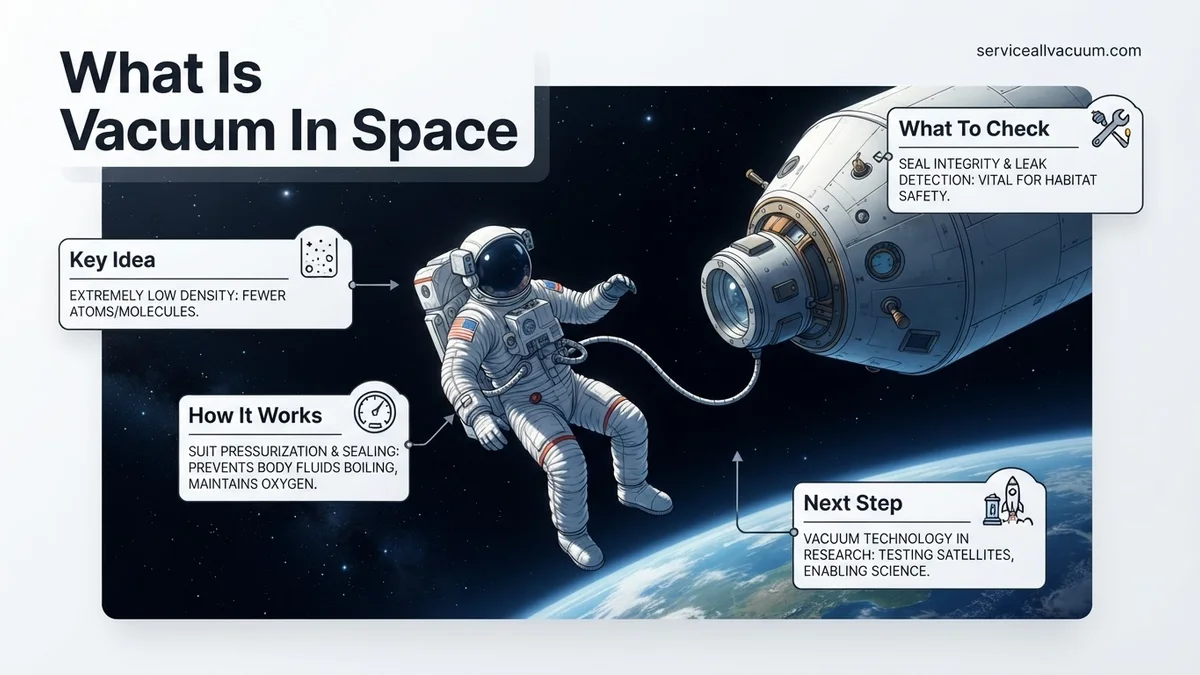
The absence of air pressure means liquids boil at body temperature, heat transfer primarily occurs via radiation, and there’s no air to breathe. Spacecraft must be designed to withstand extreme temperature fluctuations and radiation, and astronauts require pressurized suits.
Do phenomena like dark matter and dark energy contribute to the “vacuum” of space?
Yes, while not directly observable in the same way as particles, dark matter and dark energy are theorized to constitute the vast majority of the universe’s mass-energy content and are omnipresent throughout the vacuum of space, influencing its structure and expansion.
Could a truly absolute vacuum, completely devoid of anything, ever exist?
Theoretically, an absolute vacuum (a region with zero particles, zero fields, zero energy) might not be possible due to quantum mechanics, which posits quantum vacuum fluctuations. Even in the absence of matter, there’s always a fluctuating quantum field.