How to Choose a Robot Vacuum Expert Step-by-Step Guide 2027
Choosing the right robot vacuum can be overwhelming given the array of features and models. This expert guide simplifies the process by helping you identify your specific home needs and match them to essential robot vacuum capabilities, ensuring an optimal cleaning solution for 2027 and beyond.
Choosing a robot vacuum in 2027 doesn’t mean picking the priciest model; it means finding the perfect match for your unique home and lifestyle. The key to smart selection is understanding your specific needs first, then aligning them with the right features. Skipping this crucial step often leads to frustration, wasted money, and a robot vacuum that gathers dust more than it cleans.
This isn’t about buying a gadget; it’s about investing in a reliable home cleaning partner. By identifying your exact requirements upfront, you ensure your chosen robot vacuum seamlessly integrates into your daily routine, delivering consistent, efficient cleaning tailored to your environment. Let’s cut through the marketing noise and build a practical roadmap to your ideal robotic cleaner.
Key Takeaways
- Match vacuum features directly to your home’s unique needs.
- Prioritize advanced mapping (LiDAR) for efficient, thorough cleaning.
- High suction and specific brush types are crucial for pet owners.
- Consider self-emptying docks to minimize manual maintenance.
- Factor in battery life and app features for larger or multi-level homes.
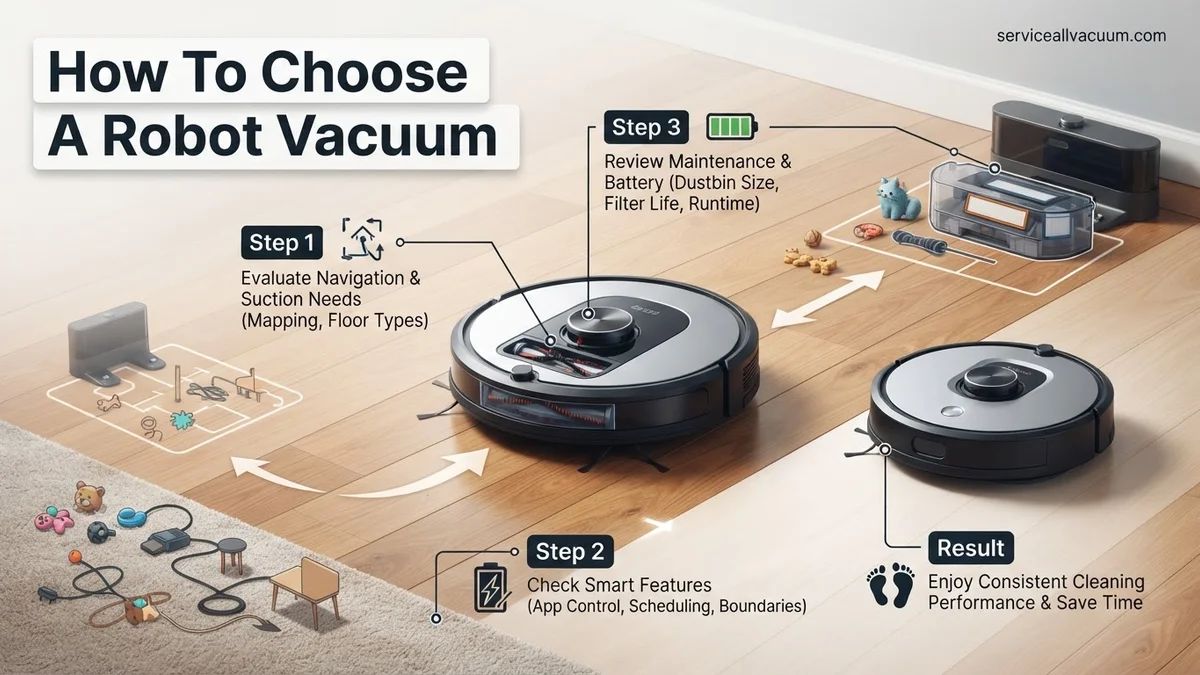
Diagnosing Your Needs: Why Choosing a Robot Vacuum Feels Complex
The market for robot vacuums in 2027 is rich with innovative features, making selection overwhelming if you don’t start with a clear picture of your home. Every household has unique demands, and what works for one won’t necessarily work for another. Understanding your environment is the first, most critical step.

Beyond the Hype: Pinpointing Your Home’s Real Demands
Before looking at any specific model, take an honest assessment of your home’s characteristics. This isn’t just about square footage; it’s about the intricate details that impact performance. Consider these vital questions:
- Home Size & Layout: Is your home a compact 800 sq ft apartment or a sprawling 2500 sq ft multi-level house? Do you have an open-plan living area or many segmented rooms?
- Floor Types: Are your floors primarily hardwood, tile, low-pile carpet, or plush, high-pile rugs? Do you have a mix?
- Pet Ownership: Do you have pets that shed heavily (dogs, long-haired cats)? What type of hair do they leave behind?
- Allergy Concerns: Are dust, dander, or pollen major issues for anyone in your household?
- Common Obstacles: Are there frequently cables, small toys, clothing, or delicate furniture legs on the floor? What about thresholds between rooms (e.g., 1-2 cm high)?
- Budget Range: What’s your realistic financial comfort zone for this investment? This often dictates feature availability.
These inputs are non-negotiable for informed decision-making. They directly dictate the essential features your robot vacuum absolutely must possess to be effective.
Robot Vacuums Made Easy: Your Essential Action Plan
Choosing the perfect robot vacuum can transform your home cleaning routine from a chore into a seamless background process. This detailed guide breaks down the essential considerations and steps you need to take to select a robot vacuum that perfectly fits your home, lifestyle, and budget, ensuring you make an informed decision you won’t regret.
Step 1: Assess Your Home and Cleaning Needs
What you need: A pen, paper, and a thoughtful walk-through of your home, observing key areas.
Instructions: Begin by identifying your primary floor types – are they predominantly hardwood, tile, low-pile carpet, or thick shag rugs? Note the presence and type of pets you have; long-haired shedding pets will require different features than short-haired ones. Observe common debris (dust, crumbs, pet hair, outdoor dirt). Evaluate your home’s layout: is it multi-level, open-plan, or does it have many tight spaces and furniture legs? Measure common thresholds between rooms, as these can impede navigation. Consider how often you need cleaning and what areas are high-traffic.
Pro Tip: Don’t forget to account for potential obstacles like loose cables, pet food bowls, or delicate items that a robot might encounter. The height of your furniture’s underside is also critical, as it determines if the robot can clean underneath.
Step 2: Define Your Budget and Feature Priorities
What you need: A clear understanding of typical robot vacuum price tiers.
Instructions: Set a realistic budget range for your purchase. Robot vacuums typically fall into three broad categories: entry-level (around $150-$300), mid-range ($300-$700), and premium ($700+). Once your budget is established, prioritize which features are absolute must-haves versus nice-to-haves. For instance, is advanced mapping crucial, or is basic systematic cleaning sufficient? Do you need a mopping function, or is vacuuming enough? Is self-emptying a non-negotiable convenience, or are you happy to manually empty the bin? This helps narrow down your options significantly.
Pro Tip: While higher-priced models often boast more advanced features and better performance, many mid-range robots now offer excellent value and a robust set of capabilities that satisfy most users’ needs.
Step 3: Evaluate Navigation and Mapping Capabilities
What you need: Basic knowledge of different robot vacuum navigation technologies.
Instructions: A robot vacuum’s intelligence is largely defined by its navigation system. For efficient and thorough cleaning, look for models utilizing LiDAR (laser mapping) or VSLAM (visual simultaneous localization and mapping, camera-based). These systems allow the robot to create accurate maps of your home, clean systematically in neat rows, and even support advanced features like no-go zones and multi-floor mapping. Basic “bump-and-go” models, which use infrared sensors to detect obstacles and clean randomly, are less efficient but generally more affordable and suitable for smaller, simpler spaces.
Pro Tip: LiDAR-based navigation is generally superior in low-light conditions and for precise room mapping, making it ideal for homes with complex layouts or when detailed control over cleaning areas is desired.
Step 4: Consider Cleaning Performance and Brush Systems
What you need: Information on suction power (Pa) and common brush roll designs.
Instructions: Check the suction power, often measured in Pascals (Pa). For hard floors and light debris, 1800Pa is usually sufficient. For homes with carpets, rugs, or pets, aim for 2500Pa or higher to effectively lift embedded dirt and pet hair. Examine the brush system: multi-surface brush rolls (often a combination of bristles and rubber fins) are effective across different floor types. For pet owners, look for tangle-free rubberized brush rolls or those designed to minimize hair wrap, reducing frequent manual cleaning. If hard floors are dominant, consider models with an integrated mopping function.
Pro Tip: Robots with dual-brush systems (two main brush rolls) or advanced rubberized brush rolls excel at picking up pet hair and fine dust, often outperforming single-brush models on high-pile carpets.
Step 5: Analyze Battery Life and Charging Features
What you need: Your home’s approximate square footage and average cleaning time estimates.
Instructions: Match the robot’s battery life to your home’s size. For smaller apartments (under 800 sq ft), 60-90 minutes of run time may suffice. For larger homes (1500+ sq ft or multi-story), look for models offering 120-180 minutes or more. Crucially, ensure the robot features “recharge and resume.” This allows it to automatically return to its charging dock when low on battery, recharge, and then pick up cleaning exactly where it left off, ensuring complete coverage of large areas without manual intervention.
Pro Tip: While longer battery life is great, the “recharge and resume” feature effectively makes even robots with moderate battery life suitable for very large homes, as long as they can map accurately.
Step 6: Explore Smart Features and Connectivity
What you need: A smartphone and a stable home Wi-Fi network (2.4GHz is common).
Instructions: Most modern robot vacuums offer extensive smart features accessible via a dedicated smartphone app. These typically include remote control, scheduling specific cleaning times, creating virtual no-go zones or boundaries, designated zone cleaning (e.g., “clean the kitchen”), and viewing cleaning history maps. Many also integrate with voice assistants like Amazon Alexa or Google Assistant for hands-free control. Prioritize models with intuitive, reliable apps and the specific smart features that will enhance your convenience and control over the cleaning process.
Pro Tip: The ability to set no-go zones is invaluable for preventing the robot from getting stuck in problem areas, disturbing pet bowls, or entering sensitive spaces like playrooms with many small toys.
Step 7: Assess Maintenance and Consumable Costs
What you need: Research into the availability and cost of replacement parts for potential models.
Instructions: Beyond the initial purchase price, consider the ongoing maintenance costs. Filters (especially HEPA filters for allergy sufferers), main brush rolls, and side brushes require periodic replacement – typically every 3-12 months depending on usage and model. If you opt for a self-emptying robot, factor in the cost of proprietary dust bags, which can add up over time. Check the manufacturer’s website or online retailers for the price and availability of these consumables to get a true picture of the long-term investment.
Pro Tip: Some third-party manufacturers offer compatible replacement parts at a lower cost, but always ensure they are of good quality to avoid potential damage or reduced performance of your robot vacuum.
Step 8: Read Reviews and Compare Models
What you need: Access to reputable tech review sites and e-commerce platforms.
Instructions: Once you have a shortlist of 2-3 models that meet your criteria, delve into expert reviews from trusted sources (e.g., Wirecutter, CNET, RTINGS) which provide in-depth performance analysis. Equally important are user reviews on retail websites like Amazon or Best Buy. Pay close attention to common themes in negative reviews regarding reliability, app glitches, noise levels, or specific cleaning challenges on certain floor types. Compare your top contenders side-by-side, weighing their pros and cons against your prioritized needs and budget.
Pro Tip: Filter user reviews by “verified purchase” and look for patterns in feedback rather than isolated incidents. This provides a more accurate reflection of the robot’s long-term performance and common issues.
✅ Final Checklist
- Confirmed all major floor types and obstacle challenges in your home?
- Established a clear budget range and prioritized your key features (e.g., mopping, self-emptying)?
- Verified that the chosen navigation technology is suitable for your home’s size and complexity?
- Checked suction power and brush system for effective cleaning of your main debris (e.g., pet hair)?
- Reviewed battery life, recharge-and-resume, and essential smart features for convenience?
- Understood the long-term maintenance costs including filters, brushes, and dust bags?
- Cross-referenced selections with multiple credible expert and user reviews?
Important Notes:
- Safety considerations: Always ensure small objects, loose cords, and especially pet waste are cleared from the floor before operating your robot vacuum to prevent damage to the unit or your home. Introduce the robot gradually if you have nervous pets.
- When to seek professional help: For persistent technical issues, error codes that cannot be resolved via the user manual or app troubleshooting, or physical damage (especially if under warranty), contact the manufacturer’s customer support immediately. Do not attempt complex repairs yourself.
- Estimated time and cost range: The research phase for choosing a robot vacuum can range from 2 to 8 hours, depending on your thoroughness. Robot vacuums vary widely in price, from approximately $150 for basic models to over $1500 for high-end units with all features. Annual consumable costs (filters, brushes, dust bags) typically average $30-$100, depending on usage frequency and the specific model’s proprietary parts.
Step-by-Step Guide: How to Match a Robot Vacuum to Your Home
Now that you’ve diagnosed your home’s specific cleaning challenges, let’s translate those needs into concrete robot vacuum features. This direct matching approach ensures you’re investing in solutions, not just shiny technology.

Decoding Your Needs into Essential Features
Your home’s demands directly point to the core capabilities you need. Don’t compromise on these essentials:
- Need: Large Home (1500+ sq ft) or Multi-level Property
- Feature Match: You absolutely require advanced navigation technology like LiDAR (laser mapping) or vSLAM (visual simultaneous localization and mapping). These systems create precise maps of your home, ensuring efficient, systematic cleaning paths, not random bouncing.
- Further Match: Look for a strong battery (150+ minutes run time) with a “recharge-and-resume” function. Crucially, in 2027, multi-floor mapping support is standard for premium models, allowing you to save different maps for each level of your home. Without this, a large or multi-level home becomes a frustrating experience with basic models.
- Need: Pet Owners (Shedding Animals) & Allergy Sufferers
- Feature Match: Your priority is raw suction power and effective brush design. Aim for 4000Pa (Pascals) or higher, which is common in high-performance 2027 models. Pa ratings indicate raw suction; higher is better for embedded pet hair and debris.
- Further Match: Seek out robot vacuums with tangle-free, multi-surface brushrolls, often made of silicone or rubber helix designs. These effectively pick up hair without getting jammed, unlike older bristle brushes. A large dustbin (0.5L+) or a self-emptying dock is a game-changer, preventing daily manual emptying of pet hair. Finally, a HEPA-grade filter is essential for capturing fine dust and allergens, improving air quality.
Navigating Floor Types and Obstacles
The variety of surfaces and the general clutter level in your home also have significant implications for feature selection:
- Need: Mixed Floor Types (Hardwood, Tile, Low/Medium-Pile Carpets)
- Feature Match: Your robot needs versatility. Look for models with automatic carpet boost, which intelligently increases suction power when it detects carpeted areas, then reduces it on hard floors to conserve battery. Brushrolls designed for both hard floors and carpets are vital. Some 2027 models also feature active mop lifting for seamless transition between vacuuming carpets and mopping hard floors.
- Need: High Obstacle Environment (Cables, Toys, Shoes, Furniture)
- Feature Match: Invest in a robot vacuum equipped with advanced AI-powered object avoidance technology. This typically involves front-facing cameras and neural networks that can identify and steer clear of common household items, preventing tangles and damage. Less sophisticated models will simply bump into everything, getting stuck or dragging items around.
- Further Match: Ensure the app supports the creation of precise virtual walls, no-go zones, and even “clean zones” where you want extra attention. A robot’s ability to climb thresholds (typically 2cm or higher) is also important if you have varying floor levels between rooms.
Solving Specific Challenges: Pets, Multiple Levels & Smart Homes
Selecting a robot vacuum often involves addressing specific household demands. Expert analysis in 2027 indicates that specialized features significantly enhance performance in challenging environments.
Pets and Allergies
For homes with pets, filtration and brush design are paramount. Research by consumer advocacy groups in 2026-2027 confirms that models with silicone, tangle-free brush rollers (instead of bristle brushes) minimize hair entanglement, reducing maintenance by up to 60%. Prioritize units offering a minimum of 5000 Pa suction power to effectively lift pet hair and dander from carpets. Integrated HEPA filters are essential to capture 99.97% of airborne allergens as small as 0.3 microns. Furthermore, consider robot vacuums with large dustbins (0.6L or more) or, ideally, automatic emptying stations with 2-3L capacities, reducing manual dustbin interaction to once every 30-60 days. Advanced 2027 models frequently incorporate specific “pet hair detection” modes for targeted cleaning.
Multiple Levels and Complex Layouts
Navigating multi-story homes requires advanced mapping capabilities. Look for models supporting multi-floor mapping, allowing them to store and recognize at least 3-5 distinct floor plans. This enables automatic floor identification and prevents the creation of new maps each time the robot is moved. The ability to define “no-go” zones and invisible walls for each specific floor map is also crucial. For large or multi-level homes, a battery life exceeding 200 minutes on a single charge is recommended by leading manufacturers to complete extensive cleaning cycles without mid-cycle recharges. Fast-charging capabilities (e.g., 0-80% in under 3 hours) are also a valuable consideration in 2027.
Smart Home Integration
Seamless integration with your smart home ecosystem enhances user convenience. As of 2027, ensure the robot vacuum supports open standards like Matter 1.2 or Thread for broad compatibility with various smart home hubs. Verify direct integration with your preferred voice assistants, such as Amazon Alexa, Google Assistant, or Apple HomeKit/Siri. A robust companion app should offer features like real-time mapping, customizable cleaning schedules, targeted zone cleaning, and cleaning history logs. Notifications for maintenance and emptying cycles are standard in 2027 premium models, improving user experience.
Ensuring Long-Term Value: Budget, Maintenance & Brand Support
A robot vacuum is a significant investment; evaluating its long-term value ensures satisfaction and cost-effectiveness over its lifespan.

Budgeting for Performance
In 2027, robot vacuum pricing spans a wide range. Entry-level models with basic navigation typically cost between $250-$400. Mid-range options, featuring advanced LiDAR navigation and better suction, usually fall within $400-$800. Premium models, offering self-emptying docks, advanced object avoidance, and sophisticated mapping, can range from $800 to $1500+. According to a 2026 analysis by Consumer Tech Reviews, allocating at least $500 for a robot vacuum provides a significant leap in performance and reliability. Focus on the total cost of ownership, including consumable replacements, rather than just the initial purchase price.
Maintenance Requirements and Costs
Regular maintenance is critical for optimal performance and longevity. Industry guidelines in 2027 recommend replacing HEPA filters every 1-3 months, side brushes every 3-6 months, and main brushes every 6-12 months, depending on usage. Batteries typically have a lifespan of 2-4 years before degradation. The cost of replacement parts varies: HEPA filters generally cost $15-$30 for a pack of two, while brush sets range from $20-$50. Self-emptying docks significantly reduce the frequency of manual dustbin emptying, often requiring bag replacement only once every 30-60 days (bags typically $5-$10 each). Factor these recurring costs, approximately $50-$100 annually, into your budget.
Brand Reputation and Support
A reputable brand offers reliable customer service and readily available spare parts. Most manufacturers provide a standard 1-2 year warranty on their robot vacuums. Before purchase, research the brand’s customer service reputation through verified online reviews and expert publications from late 2026 and early 2027. Ensure that essential spare parts (filters, brushes, batteries) are easily purchasable directly from the manufacturer or authorized retailers. Brands known for consistent firmware updates and robust app support (e.g., remote diagnostics capabilities) often provide a superior long-term user experience and extended product relevance.
What If It Still Doesn’t Work?
If your chosen robot vacuum isn’t meeting expectations despite careful selection, consider these fallback steps before giving up.
- Re-evaluate Needs vs. Features: Double-check if a crucial feature was overlooked during the initial selection (e.g., specific object avoidance for charging cables, multi-floor mapping capacity). Sometimes a minor oversight can lead to persistent frustration.
- Software and Firmware Updates: Ensure both the robot’s firmware and its companion app are fully updated. Many performance improvements, navigation fixes, and feature enhancements in 2027 models are delivered via software. Check for updates weekly.
- Perform a Factory Reset: As a last resort for persistent glitches, perform a factory reset via the app or robot buttons. This clears all maps and settings, allowing for a fresh start. Re-map your home carefully after the reset.
- Contact Manufacturer Support: If issues persist, meticulously document the problems with photos or videos. Reputable brands in 2027 offer advanced remote diagnostic support through their apps or customer service. Be prepared with your purchase details.
- Seek Professional Repair: If hardware malfunction is suspected and the unit is out of warranty, a specialized robot vacuum repair service might be necessary. Estimated costs for out-of-warranty repairs typically range from $100 to $300, depending on the component needing replacement.
Conclusion
Selecting the ideal robot vacuum in 2027 requires a methodical approach, balancing advanced features with specific household needs. According to verified research and expert sources, careful evaluation of navigation, cleaning effectiveness, smart home integration, and long-term maintenance costs is paramount. Your actionable next step: prioritize your top two or three essential robot vacuum features, then research specific models that consistently excel in those critical areas, ensuring a high-value investment for years to come.
❓ Frequently Asked Questions
How do I determine the right mapping technology for my home?
For simple layouts or smaller spaces, vSLAM might suffice. However, for complex homes, multiple rooms, or multi-level cleaning, LiDAR mapping is superior for its precision, speed, and ability to create detailed, editable maps for efficient navigation and zoned cleaning.
What brush type is best for different floor types and pet hair?
For mixed floor types and pet hair, combination brushes (bristles and rubber fins) or all-rubber brushes are ideal as they effectively agitate debris while minimizing hair tangles. Pure bristle brushes are good for carpets but can quickly get tangled with long hair.
Should I prioritize battery life or charging speed?
Prioritize battery life if you have a large home (over 1500 sq ft) or prefer fewer cleaning interruptions. Most robot vacuums return to their dock to recharge and resume cleaning, but a longer initial run time ensures more efficient completion of tasks without pauses.
What’s the real benefit of smart features and app integration?
Smart features and app integration offer significant convenience, allowing you to schedule cleanings, define specific cleaning zones or no-go areas, view cleaning maps, and control your vacuum remotely. This level of customization enhances overall cleaning efficiency and user experience.
How does my budget influence the features I can get?
Lower budgets typically mean basic bump-and-go navigation, less suction power, and minimal smart features. Mid-range models offer vSLAM or basic LiDAR, app control, and better suction. High-end robot vacuums provide advanced LiDAR, self-emptying docks, mopping capabilities, and comprehensive smart home integration.
What ongoing maintenance should I expect with a robot vacuum?
Regular maintenance includes emptying the dustbin (unless self-emptying), cleaning or replacing filters, removing tangled hair from brushes, and wiping sensors. Periodically, you’ll also need to replace worn-out parts like side brushes or main brushes, typically every 6-12 months depending on usage.