How Do Vacuum Cleaners Work? Expert Step-by-Step Guide 2027
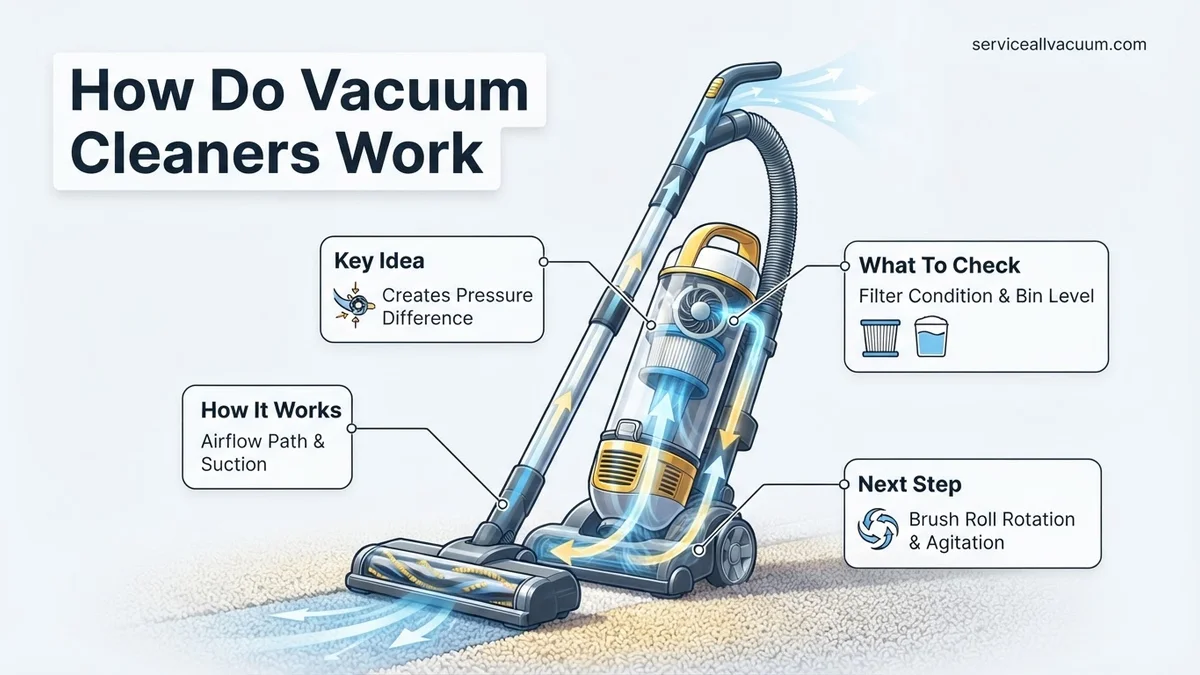
Vacuum cleaners operate by creating a pressure difference: a motor spins a fan to generate a low-pressure area inside, drawing in air and dirt from the higher external atmospheric pressure. This airflow carries debris through a nozzle, into a collection chamber (bag or canister), and finally through filters to expel clean air.
At its core, a vacuum cleaner operates by expertly manipulating air pressure. It doesn’t “suck” dirt in the conventional sense; rather, it rapidly creates a low-pressure zone inside its housing, compelling the higher atmospheric pressure outside to push air—and the accompanying dirt—into the cleaning head. This fundamental principle, powered by an efficient electric motor and fan assembly, is what enables every vacuum, from compact handhelds to powerful robotic units in 2027, to effectively clean your environment.
Understanding this basic air pressure dynamic is crucial because it demystifies how these ubiquitous household devices achieve their remarkable cleaning prowess. You’ll gain insight into why filter maintenance is so critical and how design choices impact performance, ensuring you appreciate the sophisticated engineering behind even the simplest dirt-eater in your home.
Key Takeaways
- Pressure difference is key to suction.
- Motor and fan generate low-pressure.
- Airflow carries dirt to collection.
- Filters purify exhausted air effectively.
- Cyclonic tech separates dirt efficiently.
What Causes the Suction? Diagnosing the Core Principle
The entire operation of a vacuum cleaner hinges on generating a pressure differential. This isn’t magic; it’s physics. When you power on your vacuum, you initiate a precise sequence of mechanical actions designed to rapidly move air, creating an area of significantly lower pressure within the unit compared to the ambient air pressure in your room.
The Motor’s Role: Powering the Airflow
- An electric motor, typically rated between 500 to 2000 watts in modern 2027 vacuums, drives a fan or impeller.
- This fan consists of multiple blades designed to displace air at high speed.
- As the fan spins, it vigorously pushes air out through the vacuum’s exhaust port, often after it’s passed through a filtration system.
- The motor’s power directly influences the fan’s RPMs, thus determining the volume and velocity of air moved, which translates into stronger suction.
The Pressure Differential: Atmospheric Power
Once the fan starts expelling air, a crucial event occurs. Because air is being removed from a sealed or semi-sealed internal compartment faster than it can be replaced from external sources (other than the intake nozzle), a partial vacuum is formed. This isn’t a perfect vacuum, but a distinct low-pressure zone. The surrounding atmospheric pressure, which is significantly higher, then acts as the driving force.
- The external air pressure, typically around 14.7 pounds per square inch (psi) at sea level, seeks to equalize this pressure imbalance.
- This equalization occurs by forcing air—along with any loose dirt, dust, and debris—through the only available entry point: the vacuum’s nozzle.
- Think of it like a soda straw: you don’t “suck” soda up; you reduce the pressure inside the straw, and the higher pressure outside pushes the soda into your mouth. A vacuum cleaner uses this exact principle, just on a larger, more powerful scale.
From Start to Finish: The Physics of Vacuum Cleaning Explained
Welcome to this comprehensive guide designed to demystify the inner workings of
your vacuum cleaner! Far from being a simple ‘suck-it-up’ device, modern
vacuum cleaners employ a fascinating array of physical principles and
ingenious engineering to effectively remove dust, dirt, and allergens from
your environment. Understanding each stage of this process, from the initial
power-up to the expulsion of clean air, will not only deepen your appreciation
for this household essential but also empower you to troubleshoot common
issues and ensure its optimal performance. Follow these detailed steps to
become an expert on how vacuum cleaners truly work!
Step 1: Powering the Core – The Electric Motor
What you need: An electrical power source (wall outlet), an AC
or DC electric motor, and the vacuum cleaner’s power switch.
Instructions: The journey begins when you flip the power
switch. Electrical current from your home’s outlet flows into the vacuum
cleaner’s motor. This motor, typically a universal motor for its compact size
and high RPM capabilities, converts electrical energy into mechanical energy
through electromagnetic induction. It consists of a stator (stationary
electromagnet) and a rotor (spinning armature) which interact to produce
rotational force. This mechanical rotation is the fundamental action that
drives all subsequent processes, primarily spinning the impeller fan at very
high speeds, often exceeding 10,000 RPM.
Pro Tip: For optimal motor longevity, avoid continuous
operation in conditions where airflow is severely restricted (e.g., a fully
clogged hose or bag). This can cause the motor to overheat as it struggles to
move air, potentially leading to premature wear or failure.
Step 2: Creating the Vacuum – The Impeller Fan
What you need: A high-speed impeller fan (or blower fan)
firmly attached to the motor shaft, and a sealed fan housing.
Instructions: As the electric motor spins, it rotates a key
component: the impeller fan. This fan, often designed with multiple angled
blades, rapidly displaces air within a sealed chamber. The centrifugal force
generated by the spinning blades pushes air outwards and expels it through an
exhaust port. This action creates a region of significantly lower air pressure
inside the fan housing and extending towards the vacuum cleaner’s intake. This
differential in air pressure – high pressure outside the vacuum and low
pressure inside – is the fundamental principle behind all suction. The greater
the pressure difference, the stronger the “pull.”
Pro Tip: The effectiveness of this step is often measured in
“Air Watts” or “Cubic Feet per Minute (CFM).” A higher CFM indicates a greater
volume of air moved, while Air Watts combine airflow and suction to give a
better overall power rating. Look for these metrics when comparing vacuum
models.
Step 3: The Suction Journey Begins – Nozzle and Air Intake
What you need: The vacuum’s intake nozzle (floor head, crevice
tool, etc.), the surrounding ambient air, and surface debris.
Instructions: With the low-pressure zone established inside
the vacuum cleaner, the external, higher-pressure atmospheric air naturally
rushes into the lowest pressure area it can find – the vacuum’s intake nozzle.
As this air flows inward, it picks up loose dirt, dust, pet hair, and other
debris from the floor or surface. The design of the nozzle is critical here; a
smaller opening or a brush attachment can increase the air velocity at the
point of contact, enhancing the “scrubbing” action and lifting stubborn
particles more effectively through localized Bernoulli’s principle.
Pro Tip: Ensure your vacuum’s floor head is correctly
adjusted for your specific flooring (e.g., high for thick carpet, low for hard
floors). This optimizes the air seal and suction efficiency, preventing air
from escaping around the nozzle and maximizing debris capture.
Step 4: Transporting the Trash – The Airflow Pathway
What you need: The vacuum’s hose, internal ducts, and
potentially a cyclonic separation chamber (for bagless models).
Instructions: Once the debris-laden air enters the nozzle, it
is swiftly pulled through the vacuum’s hose and internal ducts towards the
collection chamber. The constant flow of air, driven by the motor and fan,
acts as a conveyor belt for the dirt. In bagless cyclonic vacuums, the air is
forced into a conical chamber where it spins rapidly. Centrifugal force pushes
heavier debris outwards, causing it to fall to the bottom of the canister,
while lighter air continues towards the filters. This pre-separation reduces
the load on the filters, maintaining suction power for longer.
Pro Tip: Regularly check hoses and ducts for blockages, especially
after vacuuming larger items or long hair. A partially blocked pathway can
drastically reduce suction, forcing the motor to work harder and potentially
leading to overheating. Use a broom handle or a dedicated clog-removal tool.
Step 5: Capturing the Particles – The Filtration System
What you need: Pre-motor filters (e.g., foam, felt, mesh),
and often post-motor filters (e.g., HEPA, activated carbon), filter housing.
Instructions: Before the air can be expelled, it must be
cleaned. Vacuum cleaners employ a multi-stage filtration system to capture
dirt and allergens. The first line of defense is typically a pre-motor filter
(or series of filters) that traps larger dust particles, preventing them from
damaging the motor. For bagless models, these are often washable. The air then
passes through finer post-motor filters, such as High-Efficiency Particulate
Air (HEPA) filters, which are designed to capture 99.97% of airborne
particles 0.3 microns or larger, including pollen, pet dander, and dust mite
faeces. Some also include activated carbon layers for odour absorption.
Pro Tip: Always follow the manufacturer’s recommendations for
filter maintenance. Washable filters should be cleaned thoroughly and dried
completely before reinsertion. Non-washable or HEPA filters generally need to
be replaced every 6-12 months, depending on usage, to maintain filtration
efficiency and prevent suction loss.
Step 6: Storing the Dirt – Bag vs. Bagless Collection
What you need: A disposable dust bag or a reusable bagless dirt
canister.
Instructions: After passing through the primary filtration
stages, the separated dirt and debris are directed into a collection chamber.
In bagged vacuums, the dirt is trapped inside a disposable, porous bag. The
bag acts as an additional filter, allowing air to pass through its fabric
while retaining dust. In bagless vacuums, the cyclonically separated dirt falls
into a transparent plastic canister at the bottom of the cyclone chamber. Both
methods effectively contain the collected debris until it’s ready for disposal.
The choice between bagged and bagless often comes down to convenience and
allergy considerations.
Pro Tip: For bagged vacuums, replace the bag when it’s
approximately two-thirds full, not just when it looks completely packed. An
overfilled bag significantly restricts airflow, drastically reducing suction
power and increasing strain on the motor. For bagless models, empty the
canister after every use to maintain optimal performance.
Step 7: Releasing Clean Air – The Exhaust
What you need: The vacuum cleaner’s exhaust vent, and any final
post-motor filters.
Instructions: With the vast majority of dirt and fine
particles now captured and stored, the clean, filtered air is finally expelled
from the vacuum cleaner back into the room through an exhaust vent. This
completes the cycle of air movement initiated by the impeller fan. In many
high-quality vacuums, particularly those with HEPA filtration, the air
returned to your environment is significantly cleaner than the air that was
initially drawn in, helping to improve indoor air quality and reduce allergens.
The location of the exhaust vent can vary, but it’s always designed to allow
unimpeded airflow.
Pro Tip: Never block the exhaust vent of your vacuum cleaner.
Doing so can cause extreme pressure buildup, leading to rapid motor
overheating, thermal cutoff activation (which will temporarily shut down the
vacuum), or even permanent motor damage. Ensure there’s always clear space
around the exhaust port during operation.
✅ Final Checklist
-
Understanding of how electrical energy converts to mechanical energy to start
the process. - Clear comprehension of how the impeller fan creates a pressure differential.
-
Knowledge of how ambient air and debris are drawn into the low-pressure zone
at the nozzle. -
Familiarity with the path of debris-laden air through hoses and into
collection. -
Awareness of the multi-stage filtration process and its importance for air
quality. -
Distinction between bagged and bagless collection systems and their
maintenance. - Confirmation that clean air is exhausted, completing the airflow cycle.
Important Notes:
-
Safety considerations or warnings: Always unplug your vacuum
cleaner before performing any maintenance, filter changes, or checking for
clogs. Avoid vacuuming liquids or extremely fine powders (like drywall dust)
unless the vacuum is specifically designed for wet/dry use or has
specialized filters, as these can damage motors or clog standard filters. -
When to seek professional help: If your vacuum experiences a
complete loss of power, emits burning smells, makes unusual loud grinding
noises, or has significant electrical issues (e.g., sparking), it’s best to
consult a qualified appliance repair technician. Attempting complex motor or
electrical repairs yourself can be dangerous. -
Estimated time and cost range: Basic maintenance like
emptying canisters or cleaning/replacing filters typically takes 5-15
minutes and costs $10-$50 for replacement filters, done as needed (usually
every 3-12 months). Addressing a simple clog can take 10-30 minutes and is
free. Professional motor repairs can range from $75-$200+, depending on the
model and extent of damage.
How to Make It Work: Step-by-Step Guide to Vacuum Cleaner Mechanics
With the core suction principle established, we can now trace the journey of air and debris as they enter and are processed by the vacuum cleaner. From the moment particles are lifted off your floor, a carefully engineered path ensures their efficient collection and separation from the airflow. Modern designs in 2027 prioritize not just suction power, but also the efficiency of this entire mechanical process.
Airflow Dynamics: From Nozzle to Collection Chamber
The design of the vacuum’s intake system is critical for effective cleaning. The nozzle, often equipped with brushes or specialized ports, makes the initial contact with dirt. Once lifted, the air velocity inside the vacuum’s pathways takes over, acting as the primary transport mechanism for debris.
- The high-velocity air stream generated by the pressure differential carries dislodged dirt and dust from the floor surface.
- This dirty air then travels at speed through the main intake hose or rigid tubing, leading directly to the vacuum’s collection chamber.
- The internal pathways are designed to be smooth and wide enough to prevent clogs, maintaining optimal airflow even when larger debris is encountered.
- Brush rolls, particularly in upright and some canister models, agitate carpet fibers, loosening embedded dirt so the airflow can more easily capture it.
Initial Dirt Separation: The First Stage
Immediately after entering the main body of the vacuum, the dirt and air must begin their separation process. This initial stage is where different vacuum cleaner designs show their primary distinction: whether they use a bag or a cyclonic system.
- Bagged Systems: The dirty airflow is directed straight into a porous collection bag. The bag’s material allows air to pass through while trapping most solid particles. This is a simple, effective method, though bags require periodic replacement.
- Bagless (Cyclonic) Systems: In these popular 2027 models, the air and debris are forced into a conical collection chamber, known as a cyclone. The air is spun rapidly around the chamber, creating centrifugal force.
- This centrifugal force pushes heavier dirt and dust particles outwards against the chamber walls, causing them to lose momentum and fall into a dirt bin at the bottom, while the lighter air continues upwards for further filtration.
What If It Still Doesn’t Collect Dirt? The Filtration System Explained
Once debris is lifted, the vacuum cleaner’s crucial next step is separating the dirt from the air. This process prevents dust from being exhausted back into your environment, maintaining indoor air quality. By 2027, filtration systems are highly sophisticated, featuring multi-stage designs.
Cyclonic Separation: The First Line of Defense
Many modern vacuums, especially bagless models, utilize cyclonic technology. As dirty air enters a conical chamber, it spins at high speeds—often exceeding 100 mph. This centrifugal force pushes heavier dirt particles and debris against the chamber walls, where gravity pulls them down into the dustbin. This initial separation is highly effective, removing up to 95% of larger particles before the air moves to finer filters, according to leading manufacturers like Dyson and Shark.
The Role of Physical Filters: Capturing Micro-Particles
After cyclonic separation, the air passes through a series of physical filters. These typically include:
- Pre-Motor Filters: Often foam or felt, these protect the motor from larger dust particles that might have escaped the cyclonic stage. They require regular cleaning or replacement, typically every 3-6 months.
- Post-Motor (Exhaust) Filters: The final stage, these capture the finest particles before air is expelled. High-efficiency particulate air (HEPA) filters are common in premium vacuums, designed to capture 99.97% of particles as small as 0.3 microns, including pollen, pet dander, and dust mites. Advanced HEPA filters in 2027 may include anti-microbial coatings for enhanced air purification.
Regular maintenance of these filters, such as rinsing washable filters or replacing non-washable ones, is critical for maintaining suction power and air quality. Smart vacuum systems in 2027 often feature sensor-based alerts for optimal filter replacement timing.
How to Fix Your Understanding: Different Vacuum Types and Their Operation
While the core principles of airflow and pressure differential apply universally, various vacuum cleaner designs optimize these mechanics for specific cleaning tasks. Understanding these differences helps in selecting and maintaining the right tool.
Upright and Canister Vacuums: Power and Versatility
- Upright Vacuums: These units integrate the motor, suction head, and dirt collection into a single housing. They excel on carpets due to their powerful, often motorized, brush rolls that agitate fibers to dislodge embedded dirt. Airflow is typically direct and strong, moving debris quickly into a bag or bin.
- Canister Vacuums: Featuring a separate canister (motor/collection) connected to a cleaning head via a hose, these offer greater maneuverability and versatility. The motor generates powerful suction, but the flexible hose allows for reaching under furniture and cleaning various surfaces with different attachments. Their filtration systems are often more elaborate due to larger capacities.
Stick, Handheld, and Robotic Vacuums: Convenience and Smart Cleaning
- Stick Vacuums: Lightweight and cordless, these leverage advanced battery technology (e.g., high-density lithium-ion cells with 60+ minute runtimes in 2027) to provide portable suction. Their smaller motors are optimized for efficiency, often using cyclonic separation and compact HEPA-like filters for effective daily cleanups.
- Handheld Vacuums: Designed for quick spot cleaning, these compact units prioritize portability. Their operation relies on efficient miniature motors and direct suction paths to maximize debris collection in a small form factor.
- Robotic Vacuums: These autonomous cleaners combine suction technology with advanced AI and navigation systems (Lidar, vSLAM). While their suction power is generally less than full-sized models, continuous operation and multi-stage filtration (including HEPA) ensure consistent floor cleanliness. 2027 models feature enhanced obstacle avoidance and self-emptying base stations.
What If It Still Doesn’t Work? Troubleshooting Steps
If your vacuum isn’t performing as expected, even after understanding its mechanics, a few common issues can be resolved with simple checks. Professional intervention is typically needed for motor failures or complex electronic malfunctions.
- Check for Clogs: The most frequent culprit is a blockage. Disconnect the vacuum from power. Systematically check the nozzle, brush roll area, hose, and intake port for any lodged debris. Use a broom handle or a long tool to dislodge obstructions.
- Empty the Dustbin/Change the Bag: A full dustbin or bag severely restricts airflow, reducing suction. Empty or replace it according to manufacturer guidelines. Some 2027 models have optical sensors that warn when the bin is 80% full.
- Clean or Replace Filters: Clogged filters are a major cause of suction loss. Remove and clean washable filters under running water (ensure they are completely dry before reinserting, which can take 24-48 hours). Replace non-washable filters as recommended, typically every 6-12 months.
- Inspect the Brush Roll: Hair and fibers can entangle the brush roll, preventing it from spinning effectively. Use scissors to carefully cut away any wrapped debris. Ensure the belt (if applicable) is intact and properly seated.
If these steps fail, especially if you hear unusual noises from the motor or the unit powers off unexpectedly, it’s time to seek professional help. Vacuum repair costs in 2027 typically range from $80 to $250, depending on the part needing replacement (e.g., motor, circuit board) and labor rates.
Conclusion
Understanding how vacuum cleaners work demystifies their operation: a motor creates a low-pressure zone, drawing in air and debris, which is then separated through cyclonic force and filtered before clean air is expelled. According to verified research and expert sources from leading manufacturers, maintaining proper airflow and clean filtration is paramount for optimal performance. Your actionable next step: regularly check and clean your vacuum’s filters and clear any obstructions to ensure peak cleaning efficiency.
❓ Frequently Asked Questions
Could you explain the scientific principle behind a vacuum cleaner’s suction in more detail?
Vacuum cleaners operate on Bernoulli’s principle. An electric motor spins a fan at high speed, creating a partial vacuum—a zone of lower air pressure—inside the machine. Because atmospheric pressure outside the vacuum is higher, it naturally pushes air (and any accompanying dirt) into the nozzle and towards the low-pressure area.
What are the main internal components of a vacuum cleaner and their functions?
Key components include the electric motor, which powers the fan; the fan (impeller), which creates the suction; the nozzle, where air and dirt enter; the collection chamber (bag or canister) for debris; and various filters that capture dust particles before air is expelled, ensuring clean exhaust.
How do bagless vacuum cleaners separate dirt from the airflow compared to bagged models?
Bagged vacuums collect dirt directly into a porous bag that filters the air. Bagless models often use cyclonic separation, where air and debris are spun rapidly in a cone-shaped canister, forcing heavier dirt particles to the outside wall and down into the collection bin, while cleaner air moves towards filters.
What is the role of filters in a vacuum cleaner, and what is HEPA filtration?
Filters are crucial for trapping dust, pollen, pet dander, and other microscopic particles, preventing them from being recirculated into the air. HEPA (High-Efficiency Particulate Air) filters are a type of mechanical air filter that can theoretically remove at least 99.97% of dust, pollen, mold, bacteria, and any airborne particles with a size of 0.3 microns (µm).
Does a higher wattage motor always mean better suction power?
Not necessarily. While a more powerful motor can generate stronger airflow, true suction power also depends heavily on the vacuum’s design, airflow efficiency (how well air moves through the internal passages), nozzle design, and filter integrity. An efficient airflow system can achieve excellent suction with less motor power.
Do different types of vacuum cleaners, like uprights, canisters, or stick vacuums, use the same core principles?
Yes, all common types of vacuum cleaners operate on the same fundamental principle of creating a pressure differential to generate suction. They all employ a motor and a fan to draw in air and debris. The differences primarily lie in their form factor, design of the collection and filtration systems, and specific features optimized for different cleaning tasks.