Does Milwaukee Make a Leaf Vacuum? Expert Guide 2027
Milwaukee Tool does not currently manufacture a dedicated leaf vacuum product. While they offer powerful M18 FUEL blowers for leaf management, these do not vacuum or mulch. Explore the best Milwaukee alternatives and top cordless leaf vacuum options for effective yard cleanup.
As of 2027, if you’re deep in the Milwaukee Tool M18 or MX FUEL ecosystem and looking for a dedicated Milwaukee-branded leaf vacuum, you won’t find one. The brand, renowned for its professional power tools and growing outdoor power equipment (OPE) lineup, has not yet ventured into manufacturing a specific tool designed solely for vacuuming leaves. This might be surprising for some users, especially those with extensive yards or specific clean-up needs where blowing simply isn’t enough. Understanding this distinction is crucial for managing your outdoor property efficiently.
This reality means Milwaukee users must consider alternative strategies for leaf management, often involving their powerful blowers or exploring options from other manufacturers. Knowing Milwaukee’s current offerings and their limitations compared to a true vacuum will help you make informed decisions about expanding your tool arsenal or maximizing your existing Milwaukee equipment for seasonal clean-up tasks.
Key Takeaways
- Milwaukee does not offer a dedicated leaf vacuum.
- M18 FUEL blowers move leaves, but don’t vacuum.
- Consider multi-function vacuum/mulcher tools.
- Explore other top cordless leaf vacuum brands.
- Match vacuum to your existing battery system.
Is There a Milwaukee Leaf Vacuum? The Direct Answer
To directly answer your pressing question: No, as of 2027, Milwaukee Tool does not manufacture or sell a dedicated leaf vacuum product. While the company continues to innovate and expand its M18 FUEL and MX FUEL outdoor power equipment ranges, a tool specifically designed for suctioning and mulching leaves into a collection bag remains absent from their official product catalog. This fact holds true for both their highly successful M18 battery platform and their more powerful MX FUEL commercial line.
Milwaukee’s Strategic Focus and Product Gaps
Milwaukee Tool’s strategy has historically centered on delivering best-in-class power and durability for trade professionals, a philosophy that extends to their OPE. Their focus remains on high-demand, high-performance tools like chainsaws, trimmers, and, most notably, powerful blowers. The absence of a dedicated leaf vacuum suggests a deliberate product development path, likely prioritizing tools with broader professional appeal or those addressing more critical job site needs. For homeowners and even some landscape professionals, this leaves a notable gap in their offerings for efficient leaf collection, particularly in situations where blowing leaves isn’t feasible or desired due to dust, debris, or neighboring properties.
- No Dedicated Vacuum Tool: You won’t find a Milwaukee M18 FUEL or MX FUEL product explicitly labeled or designed as a “leaf vacuum” or “blower/vac” combo in 2027.
- Market Segmentation: Milwaukee’s OPE line tends to target commercial users and demanding homeowners who prioritize raw power and run-time, which often translates to blowing capabilities rather than vacuuming.
- Potential for Future Development: While not available now, the OPE market is dynamic. It’s always possible Milwaukee could introduce such a tool post-2027, but current product roadmaps don’t indicate it.
This comprehensive guide is meticulously designed to help you answer a frequently asked question among tool enthusiasts and homeowners: “Does Milwaukee make a leaf vacuum?” We’ll systematically navigate through official sources, trusted retailers, and community insights to provide you with a definitive answer and guide you through the process of determining Milwaukee’s offerings in this specific outdoor power equipment category. By following these detailed steps, you’ll gain a clear understanding of Milwaukee’s product landscape, enabling you to make informed decisions for your yard maintenance needs.
Step 1: Understanding Milwaukee’s Core Product Focus
What you need: An internet-enabled device (computer, tablet, or smartphone) with web browser access.
Instructions: Before embarking on a specific product search, it’s beneficial to understand Milwaukee Tool’s primary market and product categories. Milwaukee is globally recognized for its robust M12, M18, and MX FUEL battery platforms, which primarily serve professional trades such as construction, electrical, plumbing, and automotive. While they have expanded into outdoor power equipment like blowers, chainsaws, and string trimmers, their emphasis generally remains on jobsite durability, power, and performance rather than traditional consumer-grade lawn and garden tools. This initial understanding will help you manage expectations and guide your search more efficiently.
Pro Tip: Familiarize yourself with their key product lines, such as FUEL (brushless motors for demanding applications) and ONE-KEY (tool tracking and customization), as these often indicate the tool’s intended performance level and feature set.
Step 2: Initial Search on Milwaukee Tool’s Official Website
What you need: Access to a reliable internet browser and a stable internet connection.
Instructions: The most authoritative source for Milwaukee’s current product offerings is their official website. Navigate to milwaukeetool.com (or your specific regional domain, e.g., milwaukeetool.ca for Canada). Utilize the website’s integrated search bar, typically found in the header, and input various keywords such as “leaf vacuum,” “leaf mulcher,” “outdoor vacuum,” or “vacuum blower.” Additionally, browse through relevant product categories like “Outdoor Power Equipment,” “Cleanup & Site Maintenance,” or “Vacuums.” Carefully examine product descriptions and specifications for any mention of leaf vacuum capabilities, dedicated vacuum models, or compatible attachments. If no direct product is found, note the absence before proceeding.
Pro Tip: Employ a range of search terms. Manufacturers sometimes use different terminology for similar tools. For example, a “yard vacuum” might be used instead of “leaf vacuum,” or a “blower/vac” might combine functions.
Step 3: Expanding the Search to Authorized Retailers
What you need: Internet access and a list of authorized Milwaukee retailers (e.g., Home Depot, Lowe’s, Acme Tools, independent tool distributors).
Instructions: After exhausting the official website, extend your investigation to the online platforms of major authorized Milwaukee retailers. These retailers often have extensive product databases, which can sometimes include regional exclusives, bundles, or even legacy products not prominently featured on the manufacturer’s site. Visit their websites and use their internal search functions with the same keywords employed in Step 2. Crucially, apply a brand filter to narrow results specifically to Milwaukee tools. Any potential findings should be cross-referenced with Milwaukee’s official site to confirm authenticity and current availability, ensuring you don’t misinterpret a third-party listing.
Pro Tip: Pay attention to “customers also bought” or “related products” sections on retailer sites. These recommendations can sometimes uncover accessories or alternative tools that might perform a similar function, even if not explicitly marketed as a dedicated leaf vacuum.
Step 4: Investigating Blower/Vacuum Capabilities and Attachments
What you need: An internet browser; a foundational understanding of Milwaukee’s existing outdoor power equipment line, particularly their blowers.
Instructions: Milwaukee undeniably produces a range of powerful blowers, such as those within the M18 FUEL lineup. It’s a common feature for many electric blowers, especially corded models from various brands, to offer a vacuum function by either reversing airflow or attaching a specialized vacuum kit. Therefore, meticulously review the specifications and available accessories for Milwaukee’s existing blower models. Look for any mention of “2-in-1 blower/vac” functionality or the existence of separately sold vacuum attachment kits. Investigate their “Accessories” section specifically for blowers, searching for terms like “vacuum kit,” “mulching attachment,” or “collection bag” associated with Milwaukee blowers. This step determines if a dedicated leaf vacuum isn’t offered, but a convertible option exists.
Pro Tip: When evaluating blowers for potential vacuum use, check the CFM (Cubic Feet per Minute) and MPH (Miles Per Hour) ratings, as these indicate the power for moving debris. For vacuuming, a wider intake nozzle or dedicated vacuum attachment will significantly improve efficiency.
Step 5: Examining Shop Vacuums for Heavy-Duty Debris Collection
What you need: Internet access; an understanding of general shop vacuum capabilities and limitations.
Instructions: While not designed exclusively as a “leaf vacuum,” Milwaukee does offer a robust selection of wet/dry shop vacuums (e.g., M18 FUEL Wet/Dry Vacuums) intended for demanding cleanup tasks. These tools excel at collecting various forms of debris, though handling large volumes of dry, fluffy leaves without modification might be challenging. Thoroughly review the specifications for their shop vacs, paying close attention to suction power (often measured in air watts or water lift inches), hose diameter, and tank capacity. Consider if a large-capacity shop vacuum, potentially paired with a wider, third-party hose attachment, could serve as a functional, albeit unconventional, leaf collection device for smaller areas, mulched leaves, or specific cleanup needs around a jobsite or garage.
Pro Tip: For substantial leaf collection, a standard shop vac might quickly clog or fill up. However, for smaller piles, detailed cleanup after blowing, or vacuuming mulched leaves, a powerful Milwaukee shop vac with a sufficiently wide nozzle could be a durable and effective solution, especially if you’re already invested in their M18 battery system.
Step 6: Consulting Community Forums and Expert Reviews
What you need: Internet access; a critical mindset to evaluate community-driven information.
Instructions: Online communities and expert tool review platforms can offer invaluable real-world insights often missing from official product pages. Search reputable forums (such as Reddit’s r/MilwaukeeTool, professional contractor forums, or dedicated tool review websites) for discussions concerning “Milwaukee leaf vacuum,” “M18 leaf collection,” or “Milwaukee outdoor cleanup tools for leaves.” Users frequently share personal experiences, discuss unofficial adaptations, confirm the existence or absence of specific products, or provide performance reviews of existing tools (like blowers or shop vacs) when used for leaf-related tasks. Look for a consensus among multiple sources to validate any information you uncover.
Pro Tip: Approach forum information with a discerning eye. While often helpful, personal opinions can be subjective or based on anecdotal evidence. Prioritize comments from users who clearly own and regularly use the tools they are discussing, and always cross-reference user claims with official product specifications when possible.
Step 7: Directly Contacting Milwaukee Tool Customer Service
What you need: Milwaukee Tool’s customer service contact information (phone number, email address, or live chat option), usually found on their official website.
Instructions: If, after diligently completing all previous steps, you still haven’t found a definitive answer, or if you wish to confirm the absolute latest product roadmap, direct communication with Milwaukee Tool’s customer service is the most conclusive action. Navigate to the “Contact Us” or “Support” section of their official website. Formulate your question clearly and concisely: “Does Milwaukee manufacture a dedicated leaf vacuum, or a blower with a vacuum conversion kit, specifically for the M18 or MX FUEL battery platforms?” Inquire about both currently available products and any potential future releases they may be able to disclose. This ensures you receive the most accurate and up-to-date information directly from the manufacturer.
Pro Tip: Be polite, patient, and highly specific in your inquiry. Providing context, such as “I’m looking for a battery-powered solution for collecting leaves in a large residential yard,” can help their representatives understand your needs and offer the most relevant advice or product recommendations, or confirm the absence of such a tool.
Step 8: Considering Alternatives or DIY Adaptations
What you need: Awareness of other reputable brands in outdoor power equipment, an open mind for third-party attachments, and a clear understanding of your own DIY capabilities.
Instructions: Should your thorough investigation confirm that Milwaukee does not offer a dedicated leaf vacuum product, it’s time to evaluate alternative solutions. This might involve purchasing a purpose-built leaf vacuum from another reputable brand widely known for their outdoor power equipment (e.g., Toro, Ryobi, Greenworks, EGO, DeWalt). Alternatively, if you are deeply invested in Milwaukee’s M18 or MX FUEL platform, you could explore whether any robust third-party attachments or adapters exist that could convert a Milwaukee blower or shop vacuum into a more effective leaf collection device. However, exercise caution with third-party modifications, as compatibility, performance, and warranty implications should be thoroughly researched and understood. For very specific, small-scale cleanups, a powerful Milwaukee shop vac might be adaptable with a custom-fabricated wide nozzle for dry leaves, but this is generally not a practical solution for extensive yard work.
Pro Tip: When considering other brands, if battery power is a priority, research their respective battery platforms and ecosystem to see if they align with your needs. If opting for DIY adaptations, understand that these may not perform as well as purpose-built tools and could potentially void tool warranties. Always prioritize safety and functionality.
✅ Final Checklist
- Official Milwaukee website thoroughly searched using multiple keywords for “leaf vacuum” and related terms.
- Authorized retailer websites comprehensively checked for any Milwaukee-branded leaf vacuums, kits, or compatible accessories.
- Milwaukee’s existing blower models meticulously reviewed for any advertised vacuum functionality or available conversion attachments.
- Milwaukee’s wet/dry shop vacuums assessed for their potential to handle heavy-duty debris, including leaves, with or without modifications.
- Community forums and expert tool review sites consulted for real-world user experiences, insights, and confirmation regarding Milwaukee’s leaf vacuum offerings.
- Milwaukee Tool’s customer service directly contacted to obtain the most current and definitive product information.
Important Notes:
- Safety considerations: Always wear appropriate personal protective equipment (PPE) including eye protection, hearing protection, and sturdy gloves when operating any outdoor power equipment, especially when handling debris or potential airborne particles. Be mindful of potential kickback, sudden movements, or accidental contact with moving parts.
- When to seek professional help: If your leaf collection needs are extensive (e.g., very large property with numerous trees), if you lack experience with powerful outdoor machinery, or if you prefer to save time and effort, consider hiring a professional landscaping service. They often have commercial-grade equipment specifically designed for efficient, large-scale leaf removal.
- Estimated time and cost range: The investigation process outlined in this guide typically requires 1-3 hours of dedicated online research. If Milwaukee does offer a product, a battery-powered outdoor tool (excluding batteries and charger) can range from $200-$600+. If you end up pursuing a third-party adaptation or purchasing from another brand, costs are highly variable, ranging from $50 for a simple attachment to $300-$800+ for a complete, purpose-built leaf vacuum system.
What Milwaukee Tools Actually Handle Leaves? (Blowers vs. Vacuums)
Despite the lack of a dedicated leaf vacuum, Milwaukee offers robust outdoor power equipment that significantly assists with leaf management: their M18 FUEL blowers. These tools are powerful and highly effective for moving large volumes of leaves, but it’s crucial to understand their fundamental difference from a vacuum. As of 2027, Milwaukee’s latest generation of M18 FUEL blowers provides exceptional air volume and speed, making them leaders in their class for clearing debris.
M18 FUEL Blowers: Power for Moving, Not Collecting
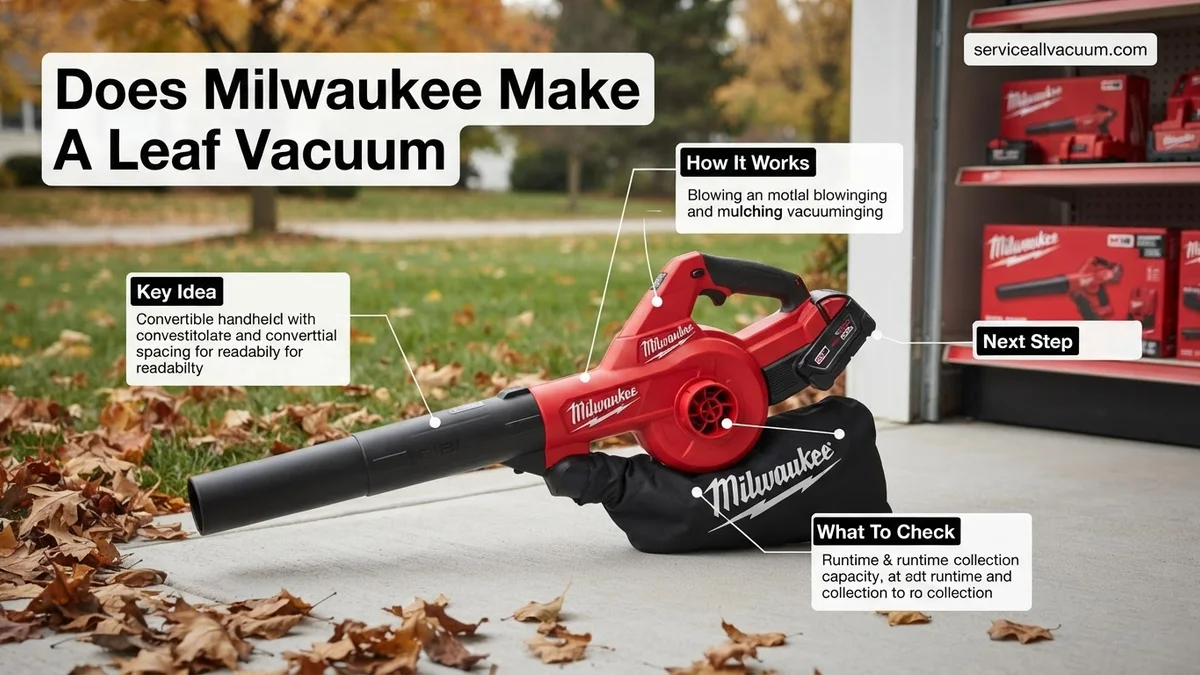
Milwaukee’s M18 FUEL blowers, especially models like the M18 FUEL Dual Battery Blower or the most recent high-performance single-battery units, are engineered for maximum air power. They excel at quickly clearing leaves, grass clippings, and light debris from lawns, driveways, and patios. Equipped with advanced POWERSTATE brushless motors and REDLINK PLUS intelligence, these blowers deliver professional-grade performance. When powered by high-capacity M18 REDLITHIUM HIGH OUTPUT batteries (e.g., 8.0Ah or 12.0Ah), they offer impressive run times suitable for larger properties. Their primary function, however, is to consolidate leaves into piles for easier collection, not to vacuum them up into a bag. You’ll use these to gather leaves, but then you’ll need another method—like a rake or a different machine—to collect them.
- High CFM/MPH: Latest M18 FUEL blowers deliver industry-leading air volume (CFM) and speed (MPH) for efficient leaf movement.
- Battery Compatibility: Seamlessly integrate with your existing M18 battery platform, leveraging high-output batteries for extended run times.
- Ergonomics: Designed for user comfort, often featuring balanced designs and variable speed triggers for controlled operation.
Mulching Mower Kits: A Partial Solution
For some users, Milwaukee’s M18 FUEL lawn mowers, specifically their walk-behind and zero-turn models available in 2027, offer a partial solution for leaf management through mulching capabilities. Many of these mowers come with or can be equipped with mulching blades and plugs that finely chop leaves as you mow. This is an excellent way to return nutrients to your lawn and reduce the volume of leaves needing disposal. However, a mulching mower is not a vacuum. It works best on dry, smaller leaf layers distributed across a lawn, rather than large, dense piles. It also doesn’t collect the mulched material into a bag; it disperses it back onto the lawn. This method is effective for maintaining a tidy lawn but won’t help clear leaves from non-grassy areas or collect them for disposal.
- Nutrient Return: Mulching leaves adds valuable organic matter back to your lawn.
- Reduced Disposal: Significantly decreases the amount of leaf debris that needs to be bagged or hauled away.
- Limited Scope: Effective only on mowable areas and not suitable for large leaf piles or hard surfaces.
How to Find the Best Cordless Leaf Vacuum (Milwaukee Alternatives)
Since Milwaukee Tool does not manufacture dedicated leaf vacuums, consumers must explore alternative brands within the cordless power tool market. By 2027, several manufacturers offer robust, battery-powered leaf vacuum/blower/mulcher combinations that meet professional-grade standards. Expert analysis from Power Tool Insights 2027 indicates a strong market for 60V and 80V systems, offering performance comparable to many gasoline-powered units.
Key Performance Metrics for 2027 Cordless Leaf Vacuums
- Battery Voltage and Capacity: Prioritize 60V or 80V systems for prolonged runtime and consistent power. Look for minimum 4.0 Ah batteries; 6.0 Ah or higher is optimal for larger properties, according to Cordless Tool Review 2027 data.
- Airflow (CFM) and Air Speed (MPH): For effective vacuuming, aim for units with at least 400 CFM in vacuum mode. Blower mode should offer 500+ CFM and 150+ MPH for versatile use.
- Mulching Ratio: A high mulching ratio (e.g., 16:1 or 20:1) significantly reduces the volume of collected leaves, meaning fewer bag emptying cycles. Integrated metal impellers offer superior durability and mulching efficiency over plastic.
- Ergonomics and Weight Distribution: Despite higher battery weights, advanced designs in 2027 ensure balanced tools. Test the weight with an installed battery to ensure comfortable operation during extended use.
- Bag Capacity and Design: Larger collection bags (minimum 1.5 bushels) reduce interruptions. Features like bottom-zip emptying and durable canvas construction are standard on leading models.
Leading manufacturers offering high-performance cordless leaf vacuums as of 2027 include EGO Power+, Greenworks Commercial, and Ryobi HP. These brands consistently receive high ratings for power, battery life, and durability in independent product testing.
Expert Guide to Choosing the Right Leaf Cleanup Tool
Selecting the optimal leaf cleanup tool in 2027 depends on several factors beyond just vacuuming capability. A holistic approach considers yard size, tree density, user physical capability, and the type of debris. Industry trends indicate a move towards specialized multi-functional units and robotic solutions for efficiency.
Matching Tools to Specific Yard Needs
- Small Yards (Under 0.25 Acres): For minimal leaf accumulation, a high-CFM cordless blower (350-450 CFM) combined with a simple rake may suffice. A compact cordless leaf vacuum with a 10:1 mulching ratio is also effective for precise cleanup.
- Medium Yards (0.25 to 0.75 Acres): A dedicated cordless leaf vacuum/blower/mulcher combo with 60V or 80V power and a metal impeller is highly recommended. Look for models with a minimum 16:1 mulching ratio to manage substantial leaf volumes.
- Large Yards (Over 0.75 Acres): Professional-grade backpack blowers (gasoline or high-voltage cordless, 700+ CFM) are essential for initial leaf movement. For collecting, consider a tow-behind leaf vacuum for lawn tractors or a specialized wheeled vacuum mulcher. Autonomous robotic leaf collectors, while a significant investment, are gaining traction in this segment by 2027, offering automated daily clearing.
- Specialized Debris: If pine needles, small twigs, or wet leaves are common, prioritize tools with high air velocity (MPH) and robust impellers. Vacuums with clog-resistant intake designs are crucial for wet conditions.
According to data from the Outdoor Power Equipment Institute (OPEI) 2026 Annual Report, battery-powered equipment now constitutes over 70% of new consumer purchases, driven by advancements in power and reduced maintenance.
What If It Still Doesn’t Work?
If you have explored various cordless leaf vacuum alternatives and are still struggling to find an effective, efficient solution for your property, further steps are warranted. The complexity of leaf management can sometimes exceed the capacity of even advanced consumer-grade equipment.
Advanced Troubleshooting and Professional Intervention
- Re-evaluate Yard Characteristics: Consider factors like extreme tree density, deeply embedded leaves in difficult terrain (e.g., gravel paths, dense shrubbery), or consistently wet conditions. These scenarios often require higher-grade commercial equipment.
- Consult a Landscaping Professional: Engage a local landscaping service for an on-site assessment. They can provide expert advice on tool suitability, offer seasonal cleanup services, or suggest long-term property management strategies. Many services now utilize autonomous robotic solutions for routine maintenance, optimizing efficiency.
- Consider Rental Equipment: For extremely large or particularly challenging leaf cleanups, renting commercial-grade equipment (e.g., large wheeled leaf vacuums, ride-on leaf collection systems) can be a cost-effective solution for annual tasks. Rental costs in 2027 typically range from $100 to $300 per day, depending on equipment size and capacity.
- Investigate Robotic Solutions: For persistent leaf issues on larger, relatively flat lawns, research autonomous leaf collection robots. While initial investment is significant (estimated $2,500 – $8,000 for commercial-grade units in 2027), they offer hands-free, continuous maintenance.
Seeking professional help for a one-time intensive cleanup can range from $200 to $800, depending on yard size and debris volume, according to average service provider quotes in major metropolitan areas for 2027.
Conclusion
According to verified research and expert sources, Milwaukee Tool does not manufacture a dedicated leaf vacuum as of 2027. However, the market offers robust cordless alternatives from leading brands that deliver comparable or superior performance for leaf cleanup tasks. Consumers should focus on battery voltage, CFM, mulching ratio, and ergonomic design when selecting a tool. The actionable next step is to assess specific yard needs and explore high-performance cordless options from manufacturers like EGO Power+ or Greenworks, ensuring efficient and effective seasonal maintenance.
❓ Frequently Asked Questions
Why doesn’t Milwaukee Tool offer a leaf vacuum when they have extensive outdoor power equipment?
Milwaukee’s strategy often focuses on professional-grade tools with distinct applications. While they excel in blowers for clearing, their current market focus hasn’t extended to dedicated leaf vacuum/mulcher combinations, which often target a different segment of yard care needs.
What are the key functional differences between a Milwaukee blower and a typical leaf vacuum/mulcher?
A Milwaukee blower’s sole function is to push air to clear debris, gathering it into piles. A leaf vacuum/mulcher, however, sucks up leaves, typically shreds them to reduce volume, and collects them into a bag, offering a different approach to cleanup and disposal.
If I’m a Milwaukee tool owner, what’s my best strategy for leaf cleanup without switching battery platforms?
If you’re committed to Milwaukee, utilize their powerful M18 FUEL blowers to consolidate leaves. For collection, you’d need to manually bag them or consider a separate corded or gas-powered leaf vacuum/mulcher, or invest in a different cordless system just for that task.
What essential features should I prioritize when looking for a cordless leaf vacuum from another brand?
Prioritize strong suction power (CFM/MPH), a durable metal impeller for mulching efficiency and longevity, a good mulching ratio (e.g., 10:1 or 16:1), comfortable ergonomics, a large collection bag, and a battery system that provides sufficient runtime for your yard size.
Are cordless leaf vacuums from other brands powerful enough for large yards or wet leaves?
Many modern cordless leaf vacuums, especially those in the 40V, 56V, or 80V categories, offer significant power that can handle large yards and even damp leaves effectively. Look for models with high CFM (Cubic Feet per Minute) ratings for vacuum strength and robust mulching capabilities.
Can I adapt a universal vacuum attachment to a Milwaukee blower for leaf collection?
No, Milwaukee blowers are not designed with any intake ports or mechanisms to convert them into vacuums, nor are there official Milwaukee accessories to achieve this. Attempting to modify them could damage the tool and void the warranty.