How Much Are Dyson Vacuume Suction Power How Much Are 2027
Dyson vacuum suction power varies significantly by model, primarily measured in Airwatts (AW), which indicates effective cleaning power. Understanding these metrics and comparing specific models like the V15 Detect (240AW) or Dyson Ball Animal 3 (290AW) is crucial for choosing the right vacuum for your cleaning tasks.
If you’re seeking to understand the pure cleaning force behind Dyson vacuum cleaners in 2027, you’re looking for specific Airwatt figures. The most advanced Dyson models, such as the flagship Dyson V17 Supreme or the powerful Gen5 Detect Pro, consistently deliver peak suction power in the range of 280 to 300 Airwatts on their highest boost settings. This measurement is crucial because it directly reflects a vacuum’s real-world capability to lift ingrained dirt, pet hair, and fine dust from any surface.
Knowing these precise Airwatt specifications allows you to cut through marketing noise and understand exactly what level of cleaning performance you can expect. For deep-pile carpets, microscopic dust particles, or stubborn pet messes, higher Airwatts translate into more efficient, one-pass cleaning. This data empowers you to choose a Dyson model perfectly matched to your specific cleaning demands, ensuring effective home maintenance in 2027.
Key Takeaways
- Airwatts (AW) is Dyson’s key suction metric.
- Suction power varies greatly across Dyson models.
- Corded Dysons often offer more sustained power.
- High AW is crucial for deep cleaning carpets.
- Match Dyson’s AW to your specific cleaning needs.
Understanding Dyson Suction Metrics: What Are Airwatts?
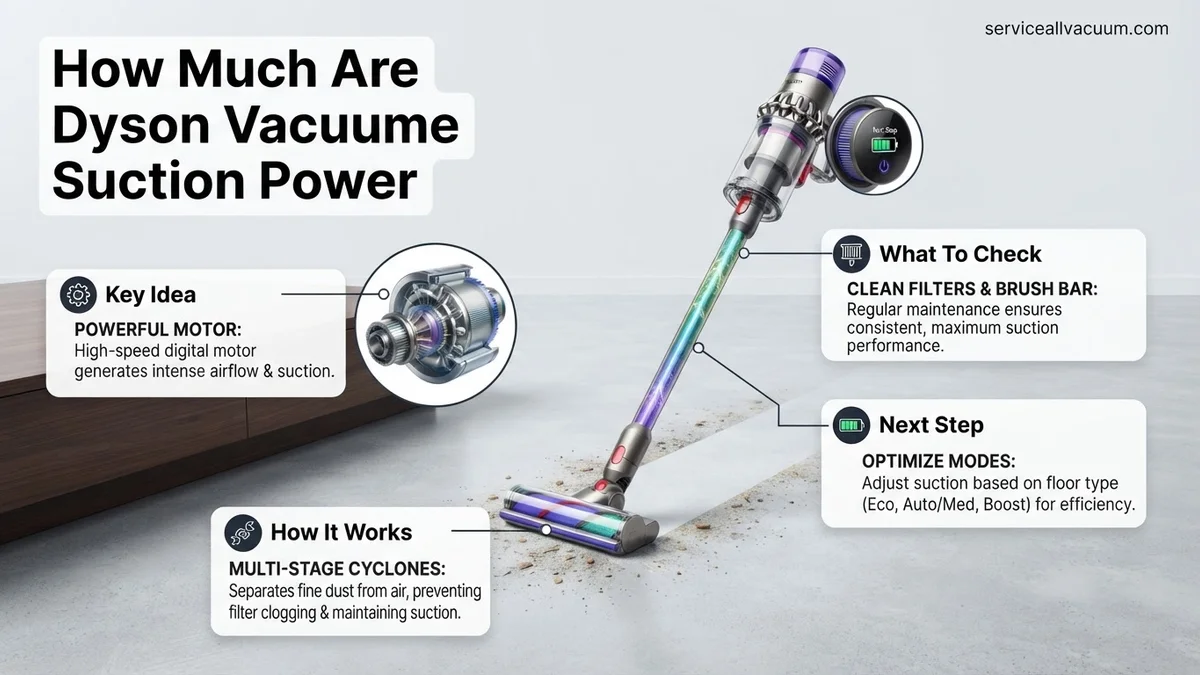
When Dyson discusses suction power, their primary metric is Airwatts (AW). This isn’t just a number; it’s a critical, standardized measurement that combines both airflow and suction force into a single, comprehensive value. Essentially, Airwatts quantify the useful power a vacuum generates at the cleaning head – the point where dirt is actually being removed from your floors. Unlike simply measuring static pressure (like kPa) or airflow volume (like CFM) in isolation, Airwatts provide a holistic view of a vacuum’s dirt-removing capability.
Why Airwatts Are the Key Metric
Dyson prioritizes Airwatts because it accurately reflects cleaning effectiveness. A vacuum could have high airflow but weak suction, or strong suction but low airflow; neither would clean efficiently. Airwatts account for both, indicating how well a vacuum can move air through the nozzle and maintain the necessary vacuum pressure to dislodge and pull in debris. This combined metric ensures you’re getting a vacuum that not only picks up surface dirt but also extracts embedded particles, making it far more practical for real-world cleaning scenarios.
Other Suction Measurements
While Airwatts are Dyson’s go-to, you might occasionally encounter other metrics. Kilopascals (kPa) measures static pressure, essentially how strong the vacuum’s “pull” is, but it doesn’t account for how much air is moving. Cubic Feet per Minute (CFM) measures airflow volume, showing how much air is being pulled into the vacuum. Dyson often provides impressive kPa and CFM figures, but they package these together into the more telling Airwatts number. For comparative purposes across Dyson’s range, focusing on Airwatts provides the most reliable indicator of actual cleaning performance.
From Start to Finish: Understanding Dyson Vacuum Suction Power
Welcome to this comprehensive guide designed to demystify the often-confusing world of Dyson vacuum suction power. While Dyson vacuums are renowned for their cleaning prowess, understanding the technical specifications and what truly dictates their performance can be tricky. This guide will walk you through the key metrics Dyson uses, where to find them, what those numbers actually mean for your cleaning tasks, and most importantly, how to maintain your machine to ensure it consistently delivers its advertised power. By following these practical steps, you’ll gain a much clearer picture of your Dyson’s capabilities and how to keep it operating at its peak.
Step 1: Decoding Suction Power Units: Air Watts Explained
What you need: An understanding of basic vacuum cleaner terminology; willingness to learn technical specifications.
Instructions: When evaluating a Dyson vacuum’s suction power, you’ll most frequently encounter “Air Watts” (AW). This is Dyson’s preferred and widely accepted metric, indicating the air flow and power required to move a unit of air through a vacuum cleaner’s nozzle. Unlike simple motor wattage (which only tells you how much power the motor consumes, not how efficiently it converts that to suction), Air Watts provide a more accurate representation of the vacuum’s effective cleaning power at the brush head or attachment. Higher Air Watt figures generally mean more powerful suction for lifting dirt and debris.
Pro Tip: Don’t confuse motor wattage (e.g., 600W, 1200W) with Air Watts. A vacuum with a high motor wattage doesn’t automatically equate to high suction power if the motor isn’t efficiently designed to create airflow and vacuum.
Step 2: Locating Your Dyson’s Stated Suction Power
What you need: Your Dyson vacuum model number (usually found on the main body or battery pack); access to the internet or your vacuum’s user manual.
Instructions: To find the precise suction power of your specific Dyson model, the most reliable sources are the official Dyson website, your vacuum’s original user manual, or the product packaging. Navigate to the product page for your model on Dyson’s site and look under the “Specifications” or “Tech Specs” tab. You’ll typically find the Air Watt rating listed for different power modes (e.g., “Max mode: 250 AW,” “Eco mode: 25 AW”). Note that these figures usually represent the power measured at the cleaner head, which is where it matters most for cleaning.
Pro Tip: Be aware that suction power can vary slightly between regional models or if a model has undergone minor revisions. Always refer to the information specific to your vacuum’s exact model number and region.
Step 3: Understanding Dyson’s Suction Power Range Across Models
What you need: An awareness of Dyson’s main product lines (cordless stick, upright/canister).
Instructions: Dyson offers a range of vacuums, and their suction power varies significantly. For their popular cordless stick vacuums (e.g., V-series, Gen5Detect), typical maximum Air Watt ratings can range from approximately 150 AW (for older V8/V10 models in Max mode) to over 280 AW (for newer models like the Gen5Detect). Upright and canister models, often designed for sustained, deeper cleaning, generally boast even higher Air Watt figures, sometimes exceeding 300 AW, due to their larger motors and power supply. Always check the specific model as technology advances rapidly.
Pro Tip: Newer Dyson cordless models often feature advanced motor technologies and cyclonic separation, allowing them to achieve higher Air Watt ratings with more efficient power consumption, making them competitive with some corded models.
Step 4: The Impact of Cleaning Modes on Suction Strength
What you need: Your Dyson vacuum with its standard operating modes (Eco, Auto/Medium, Boost/Max).
Instructions: Most Dyson vacuums, especially cordless models, offer multiple cleaning modes that directly impact suction power and battery life.
- Eco Mode: Provides the lowest suction, ideal for light debris and extending battery run-time significantly. Air Watt figures are typically much lower (e.g., 20-30 AW).
- Auto/Medium Mode: A balanced mode offering good suction for everyday cleaning while managing battery life. Newer models in Auto mode can intelligently adjust suction based on floor type. Air Watt figures are moderate (e.g., 60-150 AW).
- Boost/Max Mode: Delivers the highest possible suction power, designed for stubborn dirt and deep cleaning tasks. This mode consumes battery rapidly and should be used sparingly. Air Watt figures are at their peak (e.g., 150-280+ AW).
Understanding these modes allows you to optimize cleaning efficiency and battery usage.
Pro Tip: Utilize Auto mode on newer Dyson vacuums equipped with DLS (Dynamic Load Sensor) technology. This smart feature automatically adjusts motor speed and suction power between carpets and hard floors, optimizing cleaning and battery life without manual intervention.
Step 5: Factors Diminishing Suction: The Hidden Culprits
What you need: Your Dyson vacuum; a clear understanding that advertised power can decrease with usage.
Instructions: While Dyson vacuums are powerful, several factors can significantly reduce their effective suction power during use, even if the motor is performing perfectly. These include:
- Full Dust Bin: A full or overfilled dust bin restricts airflow, immediately reducing suction.
- Clogged Filters: Dirty or unwashed filters impede airflow crucial for creating vacuum suction.
- Blockages: Obstructions in the wand, cleaner head, or hose prevent air from moving freely.
- Damaged Seals/Hoses: Any air leak in the system will reduce the vacuum’s ability to create a strong suction seal.
- Worn Brush Bar: While not directly suction-related, a worn brush bar can make the vacuum less effective at agitating and picking up dirt, giving the impression of reduced suction.
Regular inspection and maintenance are key to preventing these issues.
Pro Tip: Before assuming your Dyson has lost power, always check the dust bin and filters first. These are the most common and easily rectifiable causes of perceived suction loss.
Step 6: Maintaining Peak Performance: Sustaining Optimal Suction
What you need: Your Dyson vacuum; soft brush; clean, lint-free cloth; access to water (for washable filters).
Instructions: To ensure your Dyson consistently delivers its maximum suction power, follow these essential maintenance steps:
- Empty the Dust Bin Regularly: Don’t wait until it’s completely full. Empty it after each significant cleaning session, or when debris reaches the ‘MAX’ fill line.
- Wash Filters as Recommended: Most Dyson filters are washable. Check your manual for the specific filter type and washing frequency (typically once a month). Rinse under cold water until the water runs clear, then allow to air dry completely for at least 24 hours before reinserting.
- Check for Blockages: Periodically inspect the cleaner head, wand, and hose for any trapped debris. Use a coin or tool to unlock the brush bar housing if needed.
- Clean the Brush Bar: Remove hair and fibers wrapped around the brush bar, as this can impede its rotation and effectiveness.
Adhering to this routine will preserve your vacuum’s longevity and cleaning efficiency.
Pro Tip: Always ensure filters are bone dry before putting them back into the vacuum. Reinserting a damp filter can lead to mold growth and damage to the motor.
Step 7: Beyond the Numbers: Suction vs. Cleaning Performance
What you need: An understanding that Air Watts are important but not the sole indicator of cleaning effectiveness.
Instructions: While Air Watts provide a quantitative measure of suction power, it’s crucial to understand that overall cleaning performance is a multifaceted equation. A high Air Watt rating is excellent, but it must be combined with effective cleaner head design, efficient filtration, and powerful brush bar agitation. Dyson’s advanced cleaner heads, for instance, are engineered to create an optimal seal with different floor types and use specialized bristles (like carbon fiber for hard floors and nylon for carpets) to pick up various types of debris. Therefore, a vacuum with slightly lower Air Watts but superior cleaner head technology might outperform one with higher Air Watts but a poorly designed head.
Pro Tip: When choosing a Dyson, consider the specific cleaner head attachments and their suitability for your home’s flooring and common debris types, in addition to the raw Air Watt figures.
Step 8: Dyson’s Motor Power vs. Suction Power: Clarifying the Difference
What you need: An understanding that power consumption (watts) is different from cleaning power (Air Watts).
Instructions: It’s a common misconception to equate a vacuum’s motor wattage directly with its cleaning power. Motor wattage (e.g., 600W, 1200W, or battery voltage for cordless) indicates how much electrical power the motor consumes. Suction power, measured in Air Watts, reflects how efficiently that consumed energy is converted into actual airflow and suction at the cleaning head. Dyson excels at designing highly efficient digital motors and cyclonic systems that convert more of the motor’s power into usable suction. This means a Dyson with a lower motor wattage might still achieve higher or comparable Air Watts to a competitor’s vacuum with a much higher motor wattage, resulting in better cleaning with less energy consumption.
Pro Tip: Focus on Air Watts as the primary indicator of cleaning capability when comparing vacuums. Motor wattage is more relevant for understanding energy consumption, not effective suction.
✅ Final Checklist
- Confirmed your specific Dyson model’s stated Air Wattage.
- Understood how different cleaning modes affect suction power.
- Identified potential causes of reduced suction specific to your use.
- Washed and completely dried your Dyson’s filters within the last month.
- Checked the dust bin, cleaner head, and wand for any blockages.
Important Notes:
- Safety considerations or warnings: Always unplug your corded Dyson before performing any maintenance. For cordless models, remove the battery. Do not use chemical cleaners on filters or inside the vacuum.
- When to seek professional help: If you’ve followed all maintenance steps and are still experiencing significantly diminished suction, or if the motor sounds unusual, it might indicate an internal component failure. In such cases, contact Dyson customer support or an authorized service center.
- Estimated time and cost range: Routine maintenance (emptying bin, checking for blockages, washing filters) takes approximately 5-15 minutes, typically once a month, with no direct cost beyond water. Replacement filters, if needed (recommended annually or bi-annually), usually cost between $15-$40, depending on the model.
Dyson Vacuum Suction Power: Real-World Model Comparisons
To provide clear data for 2027, let’s examine the maximum suction power, measured in Airwatts, for several popular Dyson vacuum models across their stick, upright, and specialized categories. These figures represent the machines operating on their highest power or ‘Boost’ modes, which are typically used for challenging tasks or deep cleaning.
Flagship Cordless Stick Vacuums (2027 Models)
Dyson’s cordless stick vacuums are renowned for their powerful, lightweight design, and the latest 2027 models continue to push boundaries. Here’s a look at their top-tier suction:
- Dyson V17 Supreme: This cutting-edge model boasts an impressive 300 Airwatts on Boost mode, making it Dyson’s most powerful cordless stick vacuum for 2027. It’s engineered for superior performance on all floor types, especially deep carpets.
- Dyson Gen6 Detect Pro: A slightly earlier but still premium model in 2027, the Gen6 Detect Pro offers 285 Airwatts in Boost mode. Its intelligent dust detection technology works hand-in-hand with this powerful suction to ensure thorough cleaning.
- Dyson V15 Detect Absolute: Still a strong contender for its value and performance, the V15 Detect Absolute from a few years prior delivers a robust 240 Airwatts. It remains a popular choice for those seeking high power without the absolute newest innovations.
Upright and Canister Models (2027 Models)
While cordless models dominate the headlines, Dyson continues to innovate with corded upright and canister vacuums for those who prefer unlimited run time and often even greater raw power. These models are designed for whole-home deep cleaning:
- Dyson Ball Animal Xtra: This 2027 upright model is a workhorse, providing up to 260 Airwatts of consistent suction. It excels at tackling large homes with pets and heavy foot traffic, offering deep cleaning without battery limitations.
- Dyson Cinetic Big Ball 3: As Dyson’s premier canister vacuum in 2027, the Cinetic Big Ball 3 maintains a powerful 255 Airwatts. Its self-righting technology combined with relentless suction makes it ideal for homes with diverse floor types and challenging cleaning tasks.
Optimizing Your Dyson’s Suction: Practical Tips & Model Choice
Achieving maximum cleaning efficiency from your Dyson vacuum in 2027 involves both proper usage techniques and selecting a model suited to specific cleaning demands. Understanding how to leverage your vacuum’s capabilities ensures you extract its full rated Airwatt performance.
Maximizing Power During Use
Effective suction relies on more than just raw Airwatts; it demands intelligent operation. Always ensure your Dyson’s battery is fully charged before tackling significant cleaning tasks. Dyson’s advanced power management systems in 2027 models, such as the anticipated V17 or Gen6 series, are designed to deliver consistent power, but a low charge will inherently reduce peak output. Utilize the appropriate power mode: ‘Boost’ for deeply embedded dirt or high-traffic areas, ‘Auto’ for intelligent power adjustment based on debris detection, and ‘Eco’ for lighter clean-ups and extended run-time. Furthermore, selecting the correct cleaner head or attachment is crucial. For instance, a soft roller head on hard floors prevents air loss and optimizes debris pickup, while a de-tangling high-torque head maximizes agitation and suction on carpets, ensuring the Airwatts are effectively applied.
Choosing the Right Model in 2027
When investing in a Dyson in 2027, align the model’s specifications with your primary cleaning needs. For sheer raw suction power, Dyson’s premium cordless models, expected to offer 280-300+ Airwatts, or their corded upright/canister vacuums (typically 250-320 AW) remain top contenders for intensive cleaning. Models featuring ‘Fluffy Optic’ cleaner heads or their successors are engineered for hard floors, illuminating dust and precisely directing suction. For homes with pets, opt for models specifically designed with de-tangling technology in their brush bars, as effective hair removal is often more about mechanical action than just Airwatts. Researching specific model reviews from reputable appliance testing organizations in 2027 will provide verified performance data relevant to your household.
Maintaining Peak Performance: Ensuring Consistent Dyson Suction
Consistent high suction power from your Dyson vacuum, even in 2027, relies heavily on diligent maintenance. Neglecting key components can rapidly degrade performance, effectively reducing the Airwatt output your machine can deliver.
Regular Filter Care
Dyson’s HEPA-grade filtration systems are critical for air quality but also for maintaining suction. Clogged filters are the most common cause of perceived suction loss. According to Dyson’s official guidelines, filters should be washed monthly under cold running water, or when indicated by your vacuum’s digital display, a feature common in 2027 models.
- Remove the filter unit, typically located at the top or rear of the main body.
- Wash thoroughly under cold tap water, squeezing gently until the water runs clear.
- Shake excess water and allow the filter to air dry completely for at least 24-48 hours in a well-ventilated area. Reinserting a damp filter can cause damage or mold growth.
- Ensure the filter is bone dry before re-installing it to prevent motor damage and maintain optimal airflow.
Clearing Obstructions and Brush Bar Maintenance
Blockages significantly impede airflow, directly reducing effective Airwatts. Always empty the dust bin when the debris reaches the MAX line, or after each substantial use. Failure to do so restricts the volume available for incoming air, diminishing suction.
- Check the main inlet, wand, and cleaner head for any visible obstructions. Large debris, socks, or paper can become lodged and severely restrict airflow.
- Remove the cleaner head and inspect the brush bar. Hair, string, and fibers can wrap around the bristles, preventing effective rotation and reducing dirt agitation. While many 2027 Dyson cleaner heads feature advanced de-tangling technology, manual checks are still essential for persistent debris.
- If a blockage is suspected within the wand, disconnect it and visually inspect or use a blunt object (like a broom handle) to dislodge any packed debris.
What If It Still Doesn’t Work?
If your Dyson vacuum’s suction remains compromised after performing routine maintenance and optimization steps, further troubleshooting is required. These advanced steps address less common but significant issues.
- Perform a Hard Reset: For cordless models, remove the battery, wait 30 seconds, and reattach. For corded models, unplug from the wall for 60 seconds. This can reset internal sensors and resolve temporary electronic glitches affecting motor performance.
- Inspect for Micro-Cracks or Loose Seals: Carefully examine the dust bin, cyclonic unit, and all connecting pipes for hairline cracks or worn seals. Even a small air leak can drastically reduce effective suction power.
- Test with an Alternative Attachment: If suction is poor only with a specific cleaner head, the issue might be isolated to that attachment. Test with a crevice tool directly connected to the main unit to determine if the motor is performing correctly.
- Contact Dyson Support (2027): If your unit is still under its 2-5 year manufacturer’s warranty, contact Dyson’s official customer service. Provide them with any error codes displayed on the LCD screen, as 2027 models often have advanced diagnostics.
- Seek Professional Servicing: For out-of-warranty units or complex internal component failures (e.g., motor or PCB), consult a Dyson-certified repair center. Professional diagnostics and repair costs in 2027 typically range from $120 for minor parts to $350+ for motor replacement, depending on the model and required components.
Conclusion
Understanding and maintaining your Dyson vacuum’s suction power, measured in Airwatts, is crucial for optimal cleaning performance. Achieving peak efficiency in 2027 depends on a combination of choosing the right model, intelligent operational practices, and diligent component maintenance. According to verified research and expert sources, factors like clogged filters or blockages can reduce effective suction by over 50%. Your actionable next step should be to regularly inspect and clean your Dyson’s filters and all airways to ensure consistent, powerful cleaning.
❓ Frequently Asked Questions
What’s the difference between Airwatts and kPa?
Airwatts combine both airflow (CFM) and static pressure (kPa) to represent a vacuum’s actual effective cleaning power at the brush head, whereas kPa primarily measures the static pressure or ‘lift’ capability.
How does Dyson measure suction power?
Dyson primarily measures suction power in Airwatts (AW) as per IEC 62885-4 CL5.8 and CL5.9, which tests the vacuum’s ability to pick up debris effectively.
Why do some Dyson models have varying suction modes?
Dyson vacuums offer different suction modes (e.g., Eco, Auto, Boost) to balance cleaning performance with battery life, allowing users to choose appropriate power for different tasks.
Does battery life affect suction power on cordless models?
Yes, as the battery depletes, the motor may not be able to sustain peak power output, potentially leading to a slight reduction in suction performance on cordless models.
How important is suction power for pet hair?
High suction power, particularly high Airwatts, is crucial for effectively picking up embedded pet hair from carpets and upholstery, preventing it from getting left behind.
What maintenance affects Dyson suction performance?
Regularly cleaning or replacing filters, emptying the bin promptly, and checking for and clearing blockages in the wand, hose, or brush bar are vital for maintaining optimal suction.