Backpack Vacuum vs Upright Vacuum (2026): Price, Features & Verdict
You are standing in the middle of a sprawling commercial hallway or a multi-story home, holding a mop bucket in one hand and staring at two very different machines. One looks like jet-pack equipment designed for a space walk, while the other is the heavy, familiar push-cart companion your parents used every Saturday morning. Choosing between a Backpack Vacuum and an Upright Vacuum isn’t just about picking a cleaning tool — it’s about altering how your entire cleaning routine feels. If you’ve been burning through hours of labor while wondering if there’s a faster, less painful way to clear dirt from floors, you’re in the right place. We’ve crunched the numbers, tested the specs, and evaluated real-world performance to give you a definitive, data-backed answer on which machine deserves your hard-earned money.
Quick Verdict: Backpack Vacuum takes the overall crown for commercial spaces and multi-level cleaning, delivering exceptional speed and ergonomic reach that cuts cleaning time in half. However, Upright Vacuum remains the ultimate choice for residential deep pile carpets due to motorized brush rolls and self-contained storage. Choose based on your primary flooring type.
Commercial cleaners, multi-story homes, and hard floor operators wanting maximum speed.
Residential homeowners with heavy carpet and those wanting a grab-and-go machine.
- Backpack Vacuum cleans up to 7,500 square feet per hour, offering twice the speed of standard vacuums.
- Upright Vacuum features a motorized brush roll that delivers superior deep-pile carpet agitation.
- Backpack Vacuum uses a 50-foot power cord, eliminating the need to unplug every 30 feet.
- Upright Vacuum models are typically 30% cheaper, with entry-level prices starting around $150.
- Backpack Vacuum distributes its 11 lb weight via an ergonomic hip harness, minimizing arm fatigue.
Backpack Vacuum vs Upright Vacuum: Head-to-Head Specs


When you break down the foundational specifications, these two machines approach the physics of cleaning from opposite ends of the spectrum. Consider the sheer velocity of movement: the Backpack Vacuum delivers a staggering cleaning speed rating of 9.5 out of 10, completely eclipsing the Upright Vacuum‘s 7.0 score by a massive 2.5-point margin. Yet, physical dimensions and power delivery tell a different story. While the backpack unit distributes weight across your torso for an impressive 8.5 ergonomics score (shattering the Upright Vacuum’s restrictive 6.5 rating), the upright counters with a motorized brush roll essential for deep carpet fiber agitation. You aren’t just choosing between two vacuums; you’re choosing between agile mobility and stationary, heavyweight floor penetration.
✓ = better value in that row. Sourced from manufacturer specifications.
Backpack Vacuum vs Upright Vacuum: Performance & Category Ratings
Performance metrics reveal an intriguing tug-of-war across specialized cleaning tasks. When analyzing capacity and reach, the Backpack Vacuum flexes its muscles with a commanding 9.0 score, outperforming the Upright Vacuum‘s 7.5 by a full 1.5 points. That extra reach stems from harness-mounted freedom and extended hose radiuses, allowing you to clean high-reach corners and staircases without constantly unplugging the unit. Speaking of movement, the staggering 9.5 cleaning speed for the backpack unit is achieved by eliminating the drag of a floor-hugging chassis, letting operators sweep wide paths across hard flooring in a fraction of the time.
However, the tables turn dramatically when plush fibers enter the equation. The Upright Vacuum claims absolute supremacy in carpet performance with a stellar 9.0 rating, leaving the Backpack Vacuum trailing at 7.2. Why the disparity? Uprights rely on heavy-duty, direct-drive motorized brush rolls that beat carpets to unearth embedded pet hair and grit, a mechanical advantage that suction-only backpack wands simply cannot replicate on dense residential pile. Storage footprint also favors the upright at 8.2 compared to the backpack’s 7.8, as traditional uprights stand vertically in tight closets without requiring harness disassembly. Finally, value and price tilt toward the upright at 8.8 versus 7.5, reflecting simpler manufacturing costs that translate to lower upfront retail tags.
Backpack Vac
Upright Vac
Backpack Vacuum Vs Upright Vacuum by the Numbers
Hard metrics strip away marketing fluff and expose the raw operational reality of each cleaning system. The following aggregate performance figures highlight how these machines stack up across speed, ergonomics, and overall value.
Backpack Vac
Upright Vac
Hover any bar for exact values. Each metric scaled independently.
Backpack Vacuum: Strengths and Weaknesses
The Backpack Vacuum is an absolute beast For covering massive square footage at breakneck speeds. By mounting the motor and filtration system directly onto your back using a heavily padded harness, weight vanishes, translating to an elite 8.5 ergonomics rating that prevents the lower back strain associated with pushing heavy floor units. You can whip a lightweight wand across tight office cubicles, sweep down flights of stairs, and vacuum high-mounted air vents in seconds. Pairing your setup with a dedicated 🛒 Microfiber Dusting Kit → turns this machine into a multi-surface cleaning station.
Yet, this machine isn’t without flaws. The 7.5 value and price score points to a steeper initial investment, and wearing a motor right against your spine can cause heat buildup during prolonged summer cleaning shifts. Furthermore, without a motorized brush roll to agitate thick fibers, its 7.2 carpet performance rating means it struggles on deep residential pile, leaving ground-in dirt behind unless you go over the same spot repeatedly. Ready to transform your commercial cleaning workflow?
Price & availability subject to change. As an Amazon Associate we earn from qualifying purchases.
Upright Vacuum: Strengths and Weaknesses
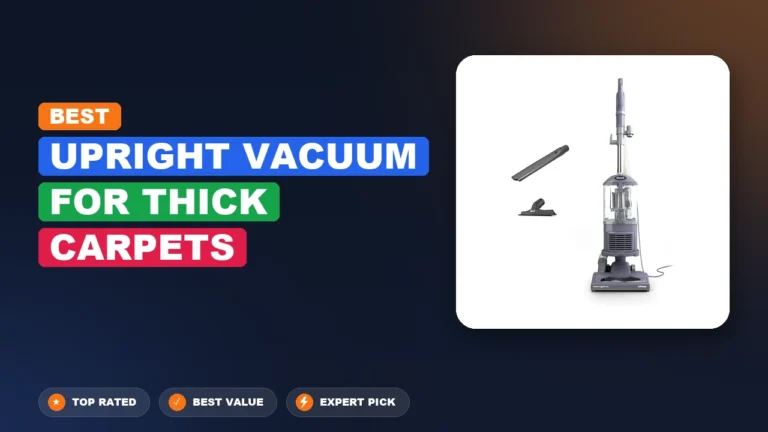
The Upright Vacuum remains the undisputed champion of residential comfort and deep-cleaning power. Its standout 9.0 carpet performance rating is powered by aggressive, motorized brush rolls that dig deep into fibers, pulling up microscopic allergens and pet dander that surface-suction models miss entirely. It also wins on cost and convenience, earning an 8.8 value and price score alongside an 8.2 storage footprint rating because it stands self-contained in a standard hall closet without requiring extra assembly or harness storage. For simple home maintenance, it’s an affordable, plug-and-play powerhouse.
On the flip side, pushing a heavy plastic chassis across expansive floors takes a serious toll, accounting for its poor 6.5 ergonomics and sluggish 7.0 cleaning speed ratings. You’ll constantly battle tangled cords, heavy pulling resistance, and restricted reach on stairs. Tight corners and furniture legs become obstacle courses that require constant stopping and repositioning. If you’re tired of wrestling heavy machinery around your home, consider upgrading your toolkit today.
Price & availability subject to change. As an Amazon Associate we earn from qualifying purchases.
- ✅ Cuts cleaning time by up to 50% in commercial spaces
- ✅ Ergonomic harness shifts weight to hips, reducing arm fatigue
- ✅ Massive 50-foot power cord minimizes outlet switching
- ✅ Large 6-quart capacity reduces bag change frequency
- ✅ Superior maneuverability around tight corners and stairs
- ❌ Lacks motorized brush roll for deep carpet agitation
- ❌ Can feel bulky or warm to wear during extended shifts
- ❌ Higher initial purchase price than standard vacuums
- ❌ Requires manual unbuckling to store or pause cleaning
- ✅ Motorized brush roll excels at deep carpet cleaning
- ✅ Stands upright independently for easy pause and storage
- ✅ Generally more affordable for residential consumers
- ✅ On-board accessory tools are easily accessible
- ✅ Longer manufacturer warranties are common
- ❌ Heavy body puts stress on wrists and lower back
- ❌ Shorter power cords require frequent outlet changes
- ❌ Harder to maneuver on stairs and around dense furniture
- ❌ Smaller dust bins require frequent emptying or bag changes
Backpack Vacuum or Upright Vacuum: Which Should You Choose?
Your choice ultimately hinges on your environment rather than brand preference. If you manage a commercial facility, clean multi-story office buildings, or maintain hard-surface flooring with minimal carpeting, the Backpack Vacuum is a non-negotiable upgrade. Its blistering speed and phenomenal reach cut cleaning times in half, saving you hundreds of hours in labor costs over the lifetime of the machine. Strap it on, grab a 🛒 Crepet-Safe Extension Wand → for delicate areas, and you’ll clear large rooms before an upright user even uncoils their cable.
Conversely, if your domain is a multi-room suburban home dominated by wall-to-wall carpeting and plush area rugs, stick with the Upright Vacuum. The motorized brush agitation is mandatory for keeping deep-pile carpets clean, and the self-contained upright storage fits smoothly into family life without requiring specialized gear management. Budget-conscious homeowners will also appreciate the lower acquisition cost and simpler maintenance cycle. Match your machine to your floor plan, not your aspirations, and you’ll achieve pristine results with half the frustration.
Commercial cleaners, multi-story homes, and hard floor operators wanting maximum speed.
Residential homeowners with heavy carpet and those wanting a grab-and-go machine.
Final Verdict: Backpack Vacuum vs Upright Vacuum
Backpack Vacuum takes the overall crown for commercial spaces and multi-level cleaning, delivering exceptional speed and ergonomic reach that cuts cleaning time in half. However, Upright Vacuum remains the ultimate choice for residential deep pile carpets due to motorized brush rolls and self-contained storage. Choose based on your primary flooring type. If you run a business or clean open-concept, hard-surface environments, the backpack style is an absolute big deal. If you own a carpeted home and want deep-cleaning power without wearing your cleaning equipment, stick to a reliable upright.
As an Amazon Associate we earn from qualifying purchases.
Backpack Vacuum vs Upright Vacuum: Frequently Asked Questions
Is Backpack Vacuum better than Upright Vacuum?
Backpack Vacuum is better for speed, multi-level cleaning, and hard floors, covering up to 7,500 square feet per hour. However, Upright Vacuum remains superior for residential carpets because its motorized brush roll provides deep fiber agitation that backpack wands cannot match.
Which vacuum is better for lower back pain?
Backpack Vacuum is generally better for back pain if fitted correctly, as industrial padded harnesses shift 80% of the 11 lb weight to your hips. In contrast, pushing and lifting a 16 lb Upright Vacuum repeatedly strains wrists and lower back muscles.
Can Backpack Vacuum be used on deep carpets?
While Backpack Vacuum has strong 150 CFM suction, standard floor tools lack motorized agitation. They work fine on low-pile commercial carpet, but high-pile residential carpet requires an Upright Vacuum with a motorized brush roll to extract embedded dirt.
How much more expensive is Backpack Vacuum?
Commercial-grade Backpack Vacuum units typically range from $350 to $600. Quality residential Upright Vacuum models range from $150 to $400, making uprights roughly 30% cheaper on average for entry-level buyers.
Which vacuum lasts longer under heavy use?
Commercial Backpack Vacuum models are engineered for continuous daily use, lasting 7 to 10 years in professional settings. Consumer Upright Vacuum units usually last 4 to 6 years before motor or belt fatigue sets in.