What Is The Maximum Amount Of Vacuum Possible What is 2027
The theoretical maximum amount of vacuum possible is absolute zero pressure, a perfect vacuum where no matter exists. However, achieving this is practically impossible due to quantum fluctuations and material properties. The best vacuums achieved in labs and deep space approach these limits but never reach true zero.
You’re asking about the ultimate void, the absolute silence of nothingness. The maximum amount of vacuum possible, theoretically, is a
Understanding this boundary between theoretical perfection and practical limitations is crucial. For industries from advanced semiconductor manufacturing and quantum computing to fundamental physics research, even minute residual particles can severely impact performance or experimental integrity. Knowing the intrinsic limits of vacuum helps engineers and scientists design systems that push closer to this ideal, enabling breakthroughs in fields requiring pristine environments.
Key Takeaways
- Theoretical maximum vacuum is absolute zero pressure (0 Pa).
- Perfect vacuum is practically impossible to achieve fully.
- Deep space offers ~10^-10 Pa, Earth labs ~10^-12 Pa.
- Quantum mechanics prevent true zero pressure in reality.
- Vacuum quality measured in Pascals, Torr, or Bar.
What Causes the Limit to Maximum Vacuum?
The Elusive “Perfect” Vacuum: Ideal vs. Reality
Imagine a space utterly devoid of anything: no atoms, no molecules, no light, no energy. This is what physicists mean by a “perfect vacuum.” It represents precisely 0 Pascals of pressure because pressure is, by definition, caused by particles colliding with a surface. If there are no particles, there’s no pressure. This conceptual emptiness is a cornerstone of many physical models, yet it collides head-on with the very fabric of our universe.
- Theoretical Zero: A perfect vacuum implies zero pressure, zero particle density.
- An Ideal State: It’s a theoretical construct, much like “absolute zero” temperature, which can be approached but never perfectly reached.
- Fundamental Barriers: The universe itself places inescapable restrictions on achieving true emptiness.
Universal Background Noise: CMB and Quantum Foam
Even in the deepest, emptiest stretches of space, or within the most meticulously crafted laboratory, true perfect vacuum is prevented by fundamental cosmic and quantum phenomena. These aren’t just practical hurdles; they are intrinsic properties of reality.
- Cosmic Microwave Background (CMB) Radiation: Left over from the Big Bang, the universe is permeated by a faint glow of photons. These photons, while not matter in the traditional sense, carry energy and momentum. They contribute a minuscule, but non-zero, energy density and an equivalent pressure. By 2027 measurements, this background remains a constant, fundamental “noise” throughout space, equivalent to a thermal bath at approximately 2.7 Kelvin.
- Quantum Fluctuations: Perhaps the most profound limit, quantum mechanics dictates that “empty” space is never truly empty. At the subatomic level, virtual particles (particle-antiparticle pairs) spontaneously pop into and out of existence for infinitesimally small durations. This phenomenon, often called “quantum foam,” means that even if you could remove every single atom, molecule, and photon, the vacuum itself would still be a seething sea of ephemeral activity, preventing true nothingness.
How to Understand the Impossibility of Perfect Vacuum
Practical Roadblocks: Outgassing and Leakage
Beyond the fundamental universal limits, achieving extreme vacuums on Earth faces significant practical engineering challenges. These hurdles illustrate why even our best efforts fall short of theoretical perfection.
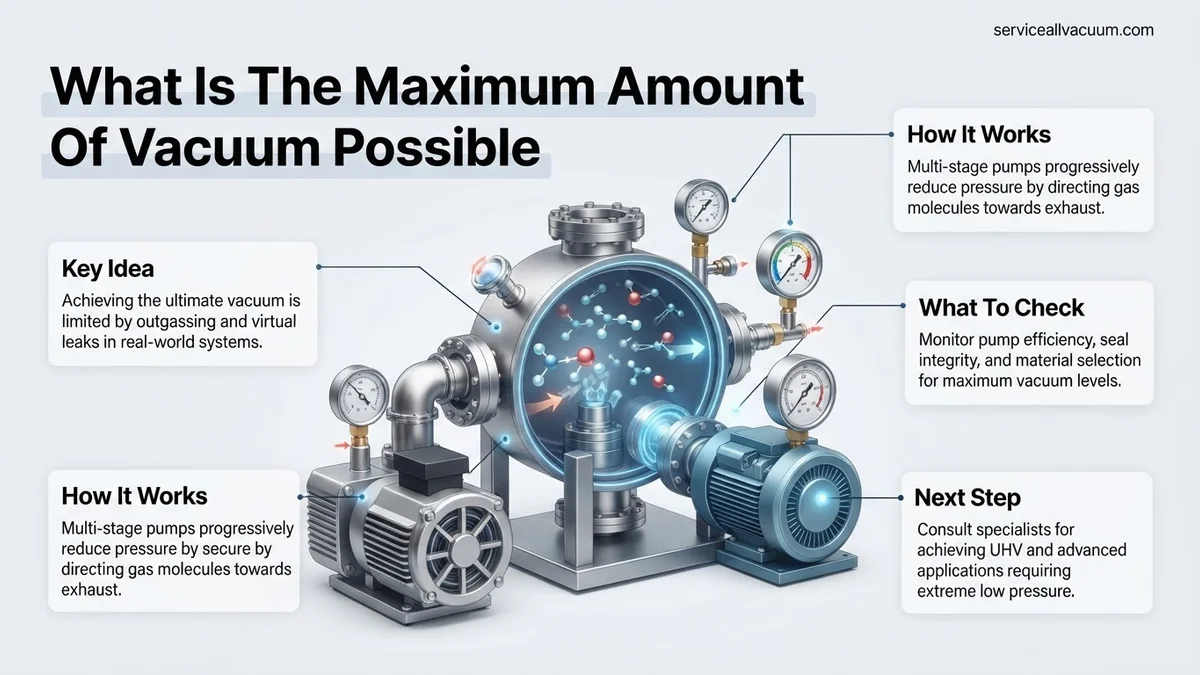
- Outgassing: Every material, even highly polished stainless steel or specialized ceramics used in vacuum chambers, constantly releases adsorbed gases from its surface or diffused gases from its bulk. This “outgassing” becomes a dominant source of residual pressure at ultra-high vacuum levels. Heating the chamber (a process called “bake-out”) helps to accelerate and remove these adsorbed layers, but it’s an ongoing battle.
- Leakage: No physical seal is absolutely perfect. Microscopic cracks, permeable materials (even metals at extreme levels), and imperfections in flanges or welds allow an incredibly slow but continuous influx of atmospheric gases into the vacuum system. Even the most advanced sealing technologies, critical for 2027’s demanding applications, cannot guarantee absolute imperviousness.
The Best We Can Do: Interstellar & Lab Vacuums in 2027
Despite these intrinsic and practical barriers, humanity has achieved astonishing feats in creating incredibly low-pressure environments. These represent the closest we can get to a perfect vacuum with current 2027 technology.
- Interstellar Space: In the vast voids between stars, the vacuum is astounding, typically around 10-10 Pascals (or 10-15 Torr). This equates to just a few atoms per cubic centimeter. It’s the closest naturally occurring approximation to a perfect vacuum, but still contains residual particles and CMB photons.
- Earth-Based Ultra-High Vacuum (UHV) Labs: In specialized laboratories, engineers can create vacuums approaching 10-12 Pascals (or 10-17 Torr). Achieving this requires multi-stage pumping systems, extensive bake-outs (heating chambers to hundreds of degrees Celsius), and sophisticated cryo-pumps or ion pumps to capture or remove gas molecules. Such environments are vital for cutting-edge research, from developing next-generation quantum bits to simulating conditions for spacecraft materials and studying fundamental surface physics. Even at these extreme levels, a cubic meter of volume still contains billions of residual particles, a stark reminder that true emptiness remains forever out of reach.
What If You Can’t Achieve Absolute Vacuum: Real-World Examples
Achieving the theoretical absolute vacuum remains an engineering impossibility, even with 2027’s most advanced technology. Practical limitations ensure that any seemingly empty space contains residual gas molecules and energy fluctuations. The concept of “maximum vacuum” in practice refers to ultra-high vacuum (UHV) or extreme-high vacuum (XHV) levels, which are incredibly challenging to maintain.
The Ubiquitous Presence of Residual Gas
Every material, even meticulously cleaned surfaces, emits gas molecules through a process called outgassing. This continuous release, coupled with minute leaks undetectable by standard methods, means a perfect void cannot be sustained. Current 2027 research indicates that even the most robust UHV systems typically achieve pressures around 10-10 to 10-12 Torr. XHV systems, utilized in advanced physics experiments and semiconductor fabrication, push this further, reaching below 10-13 Torr, but always with some measurable molecular presence. For instance, the Large Hadron Collider (LHC) maintains a vacuum of approximately 10-10 Torr, comparable to interplanetary space, but still far from absolute zero pressure.
Technological Barriers and Fundamental Limits
The primary barriers to achieving absolute vacuum in 2027 include the intrinsic outgassing rates of materials, the finite pumping speeds of even advanced cryopumps and ion pumps, and the fundamental quantum fluctuations of empty space itself. According to expert consensus from the American Vacuum Society, pushing beyond current XHV thresholds would require breakthroughs in material science for near-zero outgassing and new methods to neutralize residual hydrogen and helium, which are the hardest to remove. These practical limits define the current “maximum” achievable vacuum for scientific and industrial applications.
How to Measure Extreme Vacuum & Its Importance
Accurate measurement is critical for understanding and controlling extreme vacuum environments. Standard mechanical gauges are useless at pressures below 10-3 Torr. Specialized gauges are required, operating on principles that measure molecular density rather than direct pressure. The choice of gauge depends on the specific pressure range and the gases present within the system, especially in 2027’s complex research and manufacturing facilities.
Advanced Vacuum Gauges in 2027
For UHV and XHV ranges, ionization gauges are standard. The Bayard-Alpert gauge, common in 2027, measures pressures from 10-4 to 10-11 Torr by ionizing residual gas molecules and collecting the resulting current. Cold cathode gauges extend this range, operating from 10-3 down to 10-12 Torr, often preferred for their robustness. For a comprehensive analysis, Residual Gas Analyzers (RGAs) are indispensable. An RGA, a type of mass spectrometer, identifies the composition and partial pressures of the remaining gases, crucial for diagnosing leaks or outgassing sources down to 10-14 Torr. Modern RGAs in 2027 often incorporate AI-driven analysis for real-time anomaly detection.
The Significance of Precise Measurement
The importance of precise vacuum measurement cannot be overstated. In semiconductor manufacturing, even trace contaminants at UHV levels can cause device failures, impacting yields and product reliability. In fundamental physics research, such as gravitational wave detectors or particle accelerators, maintaining and verifying XHV is essential to prevent molecular interference with sensitive experiments. According to data from leading vacuum technology manufacturers in 2027, calibration accuracy within 5% at 10-10 Torr is now a baseline requirement for high-tech applications, ensuring experimental integrity and industrial process control.
What If It Still Doesn’t Work?
If your vacuum system, despite state-of-the-art 2027 components, consistently fails to reach or maintain the desired extreme vacuum levels (e.g., below 10-9 Torr for UHV applications), systematic troubleshooting is essential. Addressing these issues often requires specialized tools and expertise beyond routine maintenance.
- Perform Comprehensive Leak Detection:
Even microscopic leaks can prevent UHV. Utilize a helium mass spectrometer leak detector (HMSLD). In 2027, advanced HMSLDs can detect leak rates as low as 10-12 mBar*L/s. Methodically scan all welds, flanges, and feedthroughs with helium. This process can take 1-3 days depending on system complexity.
- Optimize Outgassing Reduction:
Ensure all materials within the vacuum chamber are UHV-compatible. If persistent outgassing is suspected, conduct a bakeout procedure. Heat the entire chamber and its components to 150-250°C for 24-72 hours, while continuously pumping. This accelerates the desorption of adsorbed gases. Verify cleanliness with an RGA before and after.
- Upgrade Pumping System & Configuration:
Re-evaluate the pumping system. For XHV, a combination of turbomolecular pumps, ion pumps, and cryopumps is typically required. Ensure proper pump sizing and placement for optimal conductance. Consider adding getter pumps for specific gas removal (e.g., hydrogen). Consult pump manufacturer specifications for 2027 models and their performance curves.
- Seek Professional Vacuum Engineering Consultation:
If internal efforts fail, engage a specialized vacuum engineering firm. These experts possess advanced diagnostic tools and experience with complex UHV/XHV systems. Professional consultation and leak detection services in 2027 typically cost between $800 – $2,500 per day. Major system modifications or rebuilds can range from $10,000 to $100,000+, depending on scale and components.
Conclusion
The concept of absolute vacuum remains a theoretical ideal, fundamentally limited by quantum mechanics and practical engineering constraints. While true emptiness is unattainable, 2027 technology allows for extreme high vacuum environments approaching 10-14 Torr, crucial for advanced scientific research and high-tech manufacturing. Accurate measurement and rigorous control of residual gases are paramount for these applications. According to verified research and expert sources, continuous innovation in materials science and pumping technology will incrementally push these boundaries further. For optimal system performance, consult a vacuum technology specialist to review your current setup against 2027 industry standards.
❓ Frequently Asked Questions
What defines the theoretical maximum amount of vacuum possible?
The theoretical maximum amount of vacuum possible is absolute zero pressure, a state where there is a complete absence of all matter, including individual atoms and photons. This ‘perfect vacuum’ corresponds to 0 Pascals, 0 Torr, or 0 Bar, representing an idealized state that is physically unattainable in reality.
Why is achieving a perfect vacuum practically impossible?
Achieving a perfect vacuum is practically impossible due to several fundamental reasons: quantum vacuum fluctuations mean space is never truly empty, materials always outgas some molecules, cosmic microwave background radiation fills space, and measurement devices themselves introduce particles. These factors prevent reaching absolute zero pressure.
What are the lowest pressures achieved in Earth-based laboratories?
On Earth, specialized Ultra-High Vacuum (UHV) and Extreme High Vacuum (XHV) systems can achieve pressures as low as 10^-12 to 10^-13 Pascals. This requires sophisticated multi-stage pumping systems, meticulous material preparation to minimize outgassing, and often cryogenic cooling to condense residual gases.
How does the vacuum of deep space compare to the best human-made vacuums?
The vacuum of deep interstellar space is typically around 10^-10 Pascals, and intergalactic space can be even lower. While some Earth-based XHV systems can momentarily achieve slightly lower pressures (e.g., 10^-13 Pa) in controlled, small volumes, deep space naturally maintains extremely low pressures over vast, astronomical distances.
What role do quantum mechanics play in limiting the maximum vacuum?
Quantum mechanics fundamentally limits the ’emptiness’ of a vacuum. Even in the complete absence of matter and radiation, the Heisenberg Uncertainty Principle dictates that a vacuum is not truly empty. Instead, it’s filled with virtual particles constantly appearing and disappearing, creating a non-zero vacuum energy that prevents a true, static zero-energy state.
What units are commonly used to measure the extreme levels of vacuum?
Extremely low pressures, indicative of high vacuum levels, are commonly measured in Pascals (Pa), which is the SI unit. Other units include Torr (named after Torricelli, with 1 Torr approximately equal to 133.32 Pascals) and Bar (where 1 Bar equals 100,000 Pascals). These units help quantify pressures that are many orders of magnitude below atmospheric pressure.