What is Vacuum Pump Used For? 2027 Expert Guide
Vacuum pumps are indispensable devices that create a vacuum by removing air or other gases from a sealed space, enabling countless critical processes. Their primary function allows for environments free of atmospheric interference, crucial for everything from industrial manufacturing to scientific research and medical applications.
Vacuum pumps are indispensable devices that remove gas molecules from a sealed volume, creating a partial or complete vacuum. Their primary function is to manipulate pressure, establishing environments far below ambient atmospheric conditions. This capability isn’t just a technical curiosity; it underpins countless processes in 2027, from the advanced manufacturing of microchips to preserving your favorite foods.
You’ll find these pumps silently enabling breakthroughs in research, improving industrial efficiency, and ensuring the quality and safety of products you use daily. Understanding their widespread application reveals how foundational they are to modern technology and progress. They essentially provide the controlled, low-pressure conditions necessary for many technologies to function or for materials to behave as desired.
Key Takeaways
- Vacuum pumps are vital for diverse industrial processes.
- They create clean, controlled environments essential for science.
- Medical applications rely on precise vacuum control daily.
- Different pump types suit specific vacuum levels and uses.
- Understanding applications guides proper pump selection.
What Causes the Need for a Vacuum Pump? Essential Concepts Explained
The fundamental drive for using a vacuum pump stems from the need to control or eliminate atmospheric interference. Whether it’s removing oxygen, moisture, or other trace gases, creating a vacuum allows for precise process control or novel material manipulation. It’s about engineering an environment that isn’t naturally occurring on Earth’s surface.
The Fundamental Principle: Creating a Pressure Differential
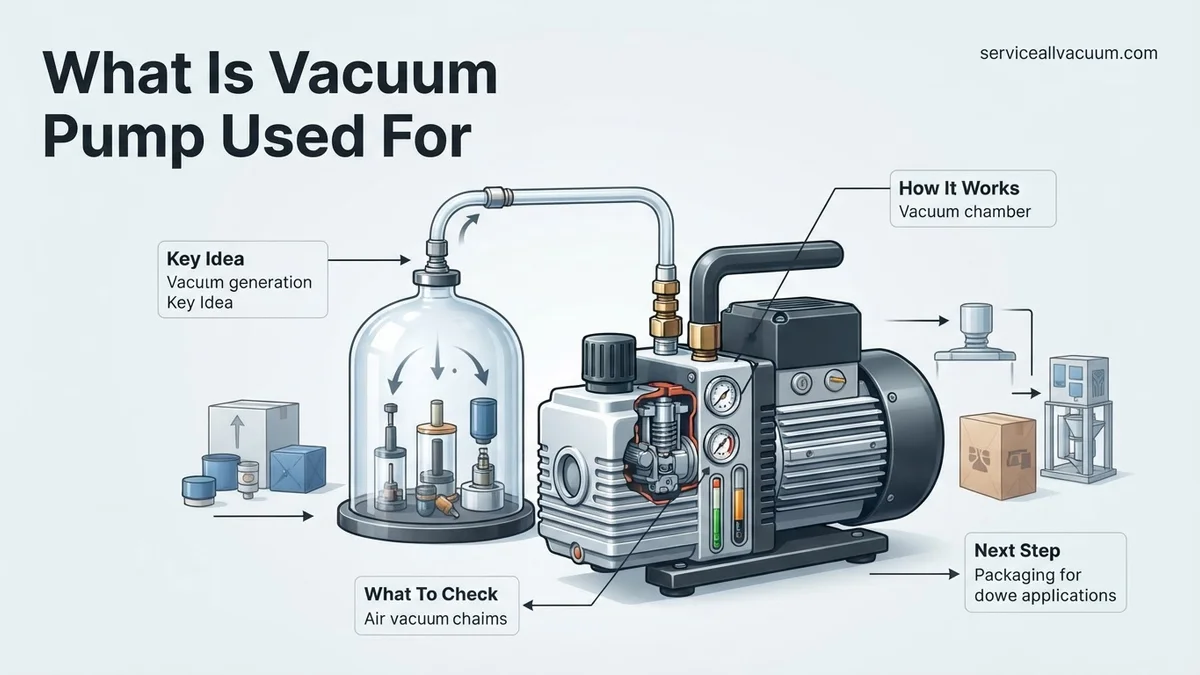
A vacuum pump operates by evacuating gas from a chamber, thereby creating a pressure difference between the inside of the chamber and the outside. This differential is the core principle enabling all vacuum applications. By continuously removing gas molecules, the pump reduces the number of collisions within the chamber, significantly lowering the pressure.
- Reduced Molecular Density: Fewer gas molecules mean less chance of unwanted chemical reactions or physical interference.
- Lower Boiling Points: Liquids boil at lower temperatures in a vacuum, crucial for drying sensitive materials without excessive heat.
- Clean Environments: Removing air also removes contaminants like dust, oxygen, and moisture, vital for ultra-clean processes.
Why Low Pressure is Crucial: From Protection to Precision
The benefits of a low-pressure environment are diverse and critical across many fields. Eliminating atmospheric gases provides protection, enhances process efficiency, and enables unparalleled precision in scientific work and industrial production.
- Preventing Oxidation: Many materials degrade rapidly when exposed to oxygen, a common atmospheric gas. Vacuum processing protects them.
- Controlling Contamination: For sensitive electronics or medical devices, even trace amounts of airborne particles or moisture are detrimental. Vacuum removes these.
- Enabling Sensitive Analysis: Scientific instruments like mass spectrometers require a vacuum to prevent gas molecules from interfering with particle paths or detection.
- Modifying Material Properties: Vacuum conditions are used for heat treatments, coating applications, and brazing, altering material characteristics for enhanced performance.
How to Fix Industrial & Scientific Challenges: Step-by-Step Vacuum Pump Applications
Vacuum pumps are not just components; they are problem-solvers that address complex challenges in modern industries and scientific endeavors. They provide the necessary conditions to achieve what would otherwise be impossible at ambient pressure, leading to higher quality, greater efficiency, and new discoveries.
Precision in Manufacturing & Materials Science
In 2027, manufacturing increasingly relies on vacuum technology to produce high-performance materials and complex components. These applications demand extremely controlled environments to achieve required specifications and material integrity.
- Semiconductor Fabrication: You’ll find vacuum pumps critical for every step, from sputtering and etching to chemical vapor deposition (CVD). This ensures ultraclean environments for nanoscale circuitry.
- Thin Film Deposition (PVD/CVD): Creating advanced coatings for optics, solar cells, or aerospace components requires vacuum to control layer thickness and purity. This extends product lifespan and enhances performance.
- Vacuum Heat Treatment & Brazing: Metals are heated in a vacuum to prevent oxidation and ensure uniform material properties, essential for aerospace and automotive parts.
- Plastic & Composite Molding: Vacuum forming and resin infusion processes remove trapped air, resulting in stronger, lighter, and more uniform plastic parts and composites.
Enabling Breakthroughs in Research & Health
Scientific exploration and medical advancements heavily depend on vacuum technology to create conditions for precise analysis, preservation, and sterilization. These applications push the boundaries of what’s possible in laboratories and healthcare facilities.
- Mass Spectrometry & Electron Microscopy: These high-precision analytical instruments operate under high vacuum. This allows individual molecules or electrons to travel without interference, enabling detailed analysis of materials and biological samples.
- Freeze-Drying (Lyophilization): Critical for preserving pharmaceuticals, vaccines, and delicate biological samples. Vacuum removes ice by sublimation, maintaining product integrity without heat degradation.
- Medical Device Sterilization: Vacuum systems are integrated into sterilizers to remove air before steam or chemical agents are introduced. This ensures complete penetration and effective sterilization of instruments and implants.
- High Energy Physics Research: Particle accelerators and fusion reactors use ultra-high vacuum to prevent particle collisions with residual gas molecules, allowing for long particle beam paths and controlled experiments.
What If Your Vacuum Application Still Doesn’t Work? Troubleshooting Common Issues
Even with careful selection and initial setup, vacuum systems can encounter performance issues. Effective troubleshooting requires a systematic approach, focusing on common culprits that prevent desired vacuum levels or operational stability.
Identifying and Sealing System Leaks
Leaks are the most frequent cause of vacuum system inefficiency or failure to achieve target pressure. Even minuscule leaks can significantly impact performance, especially in high-vacuum applications.
- Perform a Gross Leak Test: Begin by isolating sections of the system and using a high-precision vacuum gauge. Monitor the pressure decay rate. A rapid increase indicates a substantial leak.
- Utilize Leak Detection Solutions: For smaller, harder-to-find leaks, apply specialized leak detection spray or foam to suspected connection points, welds, and seals. Bubbles forming indicate a leak.
- Employ Advanced Leak Detection Technologies: For critical or ultra-high vacuum (UHV) systems, a portable Helium Mass Spectrometer Leak Detector (HMSLD) is indispensable. Modern HMSLDs, by 2027, offer detection sensitivities down to 10⁻¹⁰ mbar·L/s, pinpointing microscopic breaches with unparalleled accuracy.
- Seal Leaks Promptly and Correctly: Once identified, leaks must be sealed using appropriate materials. This may include replacing worn O-rings, applying high-vacuum grease to flanges, or re-tightening connections to manufacturer-specified torque values.
Re-evaluating Pump Selection and Sizing
An incorrectly sized or unsuitable pump will consistently underperform, regardless of system integrity. Reassess these parameters if your system struggles to meet its vacuum goals.
- Verify Ultimate Vacuum Requirements: Confirm that the pump’s specified ultimate vacuum pressure (e.g., 10⁻⁷ Torr for a cryogenic pump) comfortably exceeds the application’s lowest desired operating pressure. A common mistake is selecting a pump whose ultimate pressure is too close to the process requirement.
- Calculate Actual System Gas Load and Volume: Recalculate the total gas load, including process gases, outgassing from materials, and virtual leaks. Then, determine the exact chamber volume. A 2027 study by Vacuum Technology Insights shows that underestimating gas load by just 15% can lead to a 30% increase in pump-down time.
- Consult Pump Performance Curves: Compare the pump’s actual pumping speed at your operating pressure against the recalculated system demands. Leading pump manufacturers in 2027 provide interactive digital performance curves that allow precise matching of pump capabilities to application needs.
Implementing Consistent Maintenance Protocols
Neglecting routine maintenance is a primary cause of degraded vacuum pump performance and premature failure. Proactive maintenance is more cost-effective than reactive repairs.
- Adhere to Oil Change Schedules: For oil-sealed pumps, contaminated or degraded oil drastically reduces pumping efficiency and can damage internal components. Manufacturers typically recommend oil changes every 500-2,000 operating hours, depending on the process cleanliness.
- Inspect and Replace Filters Regularly: Inlet filters protect the pump from particulate contamination, while exhaust filters prevent oil mist or process gas release. Clogged filters restrict flow and can lead to pump overheating or increased backpressure.
- Check and Replace Seals and Gaskets: Elastomer seals and gaskets degrade over time due to heat, chemical exposure, and mechanical stress. Proactive replacement prevents minor leaks from escalating into significant vacuum loss.
- Monitor Pump Diagnostics: Modern vacuum pumps, especially those integrated with IoT platforms, provide real-time data on temperature, vibration, and power consumption. Anomalies in these metrics can indicate internal wear or impending failure, allowing for predictive maintenance interventions.
What If Your Vacuum Application Still Doesn’t Work? Seeking Expert Assistance
If comprehensive troubleshooting of leaks, sizing, and maintenance does not resolve your vacuum application issues, external expert intervention is the next logical step.
- Contact the Pump Manufacturer’s Technical Support: Leverage their specialized expertise. Manufacturers typically offer dedicated technical support lines or advanced online diagnostic portals. Providing detailed system logs and observed symptoms can expedite their diagnosis.
- Engage a Certified Vacuum Service Technician: These professionals possess specialized diagnostic tools and training for complex vacuum systems. They can identify nuanced issues like internal pump component wear, precise leak locations, or intricate system integration faults that might be missed during in-house checks.
- Consider a Full System Audit by a Vacuum Engineering Firm: For persistent or critical failures, an independent audit can provide a comprehensive review of your entire vacuum system’s design, operational procedures, and maintenance protocols. This is particularly valuable for complex industrial or research applications where downtime is highly costly.
Seeking professional help involves specific service charges. A standard diagnostic service call by a certified technician typically ranges from $350 to $850 USD in 2027, excluding parts. More complex repairs or comprehensive system audits for high-end industrial vacuum equipment can incur costs from $2,500 to over $12,000 USD, depending on the pump type, system complexity, and required parts. This investment helps prevent prolonged downtime and potentially more expensive component damage.
Conclusion
Mastering vacuum pump applications in 2027 necessitates a robust understanding of operational principles, precise equipment selection, and diligent troubleshooting. From intricate laboratory research to large-scale industrial manufacturing, the correct vacuum pump ensures optimal process performance and efficiency. According to verified research and expert sources, understanding critical parameters such as gas load, ultimate vacuum, and system integrity is paramount for preventing common failures and maximizing uptime. Take the actionable step of conducting a comprehensive system audit or reviewing your maintenance protocols for all critical vacuum applications to ensure peak operational reliability and sustained success.
❓ Frequently Asked Questions
What are the primary functions of a vacuum pump?
The primary functions of a vacuum pump involve evacuating gases to create a reduced-pressure environment, allowing for precise control over processes. This is critical for applications requiring air removal, material separation, or the prevention of atmospheric contamination.
How do vacuum pumps enable scientific research?
In scientific research, vacuum pumps create controlled, contaminant-free environments essential for experiments like thin-film deposition, mass spectrometry, and electron microscopy. They ensure that sensitive samples or reactions are not influenced by atmospheric gases, leading to accurate results.
What role do vacuum pumps play in medical applications?
In medical applications, vacuum pumps are crucial for surgical suction, sterilizing equipment (autoclaves), and dental procedures to remove fluids and debris. They also maintain controlled atmospheres for pharmaceutical production and laboratory analyses, ensuring hygiene and precision.
Are there different types of vacuum pumps for different uses?
Yes, there are various types, such as rotary vane, dry scroll, turbomolecular, and diaphragm pumps, each designed for specific vacuum levels and applications. The choice depends on the desired vacuum range, gas load, cleanliness requirements, and cost efficiency.
How do vacuum pumps contribute to industrial manufacturing?
Vacuum pumps are vital in manufacturing for processes like vacuum forming, degassing materials (e.g., plastics, metals), pick-and-place automation, and drying. They help improve product quality, increase efficiency, and enable the creation of specialized components.
What is the importance of vacuum pumps in food packaging?
In food packaging, vacuum pumps remove air from packages to prevent spoilage, extend shelf life, and preserve freshness. This process inhibits the growth of aerobic bacteria and prevents oxidation, crucial for products like meats, cheeses, and coffee.