How Many Microns Is a Good Vacuum Expert Guide for 2027
Determining ‘how many microns is a good vacuum’ depends entirely on the application, as different processes require distinct vacuum levels for optimal function. While HVAC systems might target 500 microns, sensitive scientific work demands much lower, more precise micron readings to prevent contamination and ensure success. Understanding these specific ranges is crucial for effective vacuum system operation.
A “good” vacuum in 2027 isn’t a single, universal number; it’s a specific pressure range tailored precisely to your application’s demands. Whether you’re servicing a modern HVAC system or fabricating next-generation microchips, achieving the correct micron level is absolutely critical. This isn’t just about efficiency; it directly impacts system longevity, product quality, and the integrity of scientific research. Understanding these precise requirements saves you from costly failures and ensures optimal performance in today’s demanding technical landscapes.
Ignoring the appropriate vacuum depth for your specific task means compromising results. A vacuum that’s “good enough” for one process might be completely inadequate, or even detrimental, to another. For example, a few hundred microns might be fine for basic drying, but semiconductor manufacturing demands vacuum levels many orders of magnitude deeper to prevent atomic-level contamination. Get ready to pinpoint exactly what a “good” vacuum means for your world.
Key Takeaways
- Good vacuum levels vary significantly by application.
- HVAC typically needs 500 microns or less for success.
- Scientific work demands ultra-low microns (e.g., 0.001).
- Inadequate vacuum leads to system failure and inefficiencies.
- Knowing target microns prevents costly operational mistakes.
Diagnosing ‘Good’ Vacuum: What Microns Signify
When we talk about vacuum, pressure is measured in microns. This unit, often abbreviated as µm, is crucial for understanding vacuum depth. A micron is a unit of length, but in vacuum terminology, it represents a unit of pressure: specifically, one-thousandth of a millimeter of mercury (mmHg), or one millitorr (mTorr). Therefore, 1 micron = 0.001 mmHg = 1 mTorr. The smaller the micron number, the deeper and “better” the vacuum.
Understanding the Micron Scale
You need to grasp that the micron scale is inverse to atmospheric pressure. Atmospheric pressure at sea level is approximately 760,000 microns (760 mmHg). Any vacuum pulls pressure down from this baseline. Your goal is to remove gas molecules, and a lower micron reading signifies fewer molecules remaining in the evacuated space. This reduction in gas molecules is fundamental to achieving desired outcomes in various applications.
The Vacuum Spectrum: A General Overview
Vacuum levels are broadly categorized, and these categories provide a helpful framework for understanding pressure demands. While your specific application needs exact numbers, these ranges show the general progression:
- Rough Vacuum: Typically 760,000 microns down to 1,000 microns. Used for basic air removal or initial pump-downs.
- Medium Vacuum: Ranges from 1,000 microns down to 1 micron. This is common for many industrial processes and general laboratory work.
- High Vacuum (HV): Below 1 micron, typically from 1 micron down to 0.001 microns (1 x 10⁻³ Torr). Critical for applications requiring significant purity and reduced molecular collisions.
- Ultra-High Vacuum (UHV) and Extreme Ultra-High Vacuum (XUHV): Pressures below 0.001 microns (1 x 10⁻⁶ Torr) and often extending to 0.0000001 microns (1 x 10⁻¹⁰ Torr) and beyond. These are the realms of advanced scientific research and cutting-edge manufacturing.
Knowing where your target vacuum falls within this spectrum helps you anticipate equipment and process requirements.
Understanding Micron Requirements: Why Levels Vary by Application
The reason for varying vacuum requirements boils down to fundamental physics and chemistry. Each application has specific molecular interaction needs, whether it’s boiling off moisture at low temperatures, preventing oxidation, or ensuring an absolutely pristine environment for atomic-level processes. Achieving a “good” vacuum means reaching the precise conditions where these critical interactions, or lack thereof, can occur reliably in 2027.
HVAC/R Systems: Moisture and Contaminant Removal
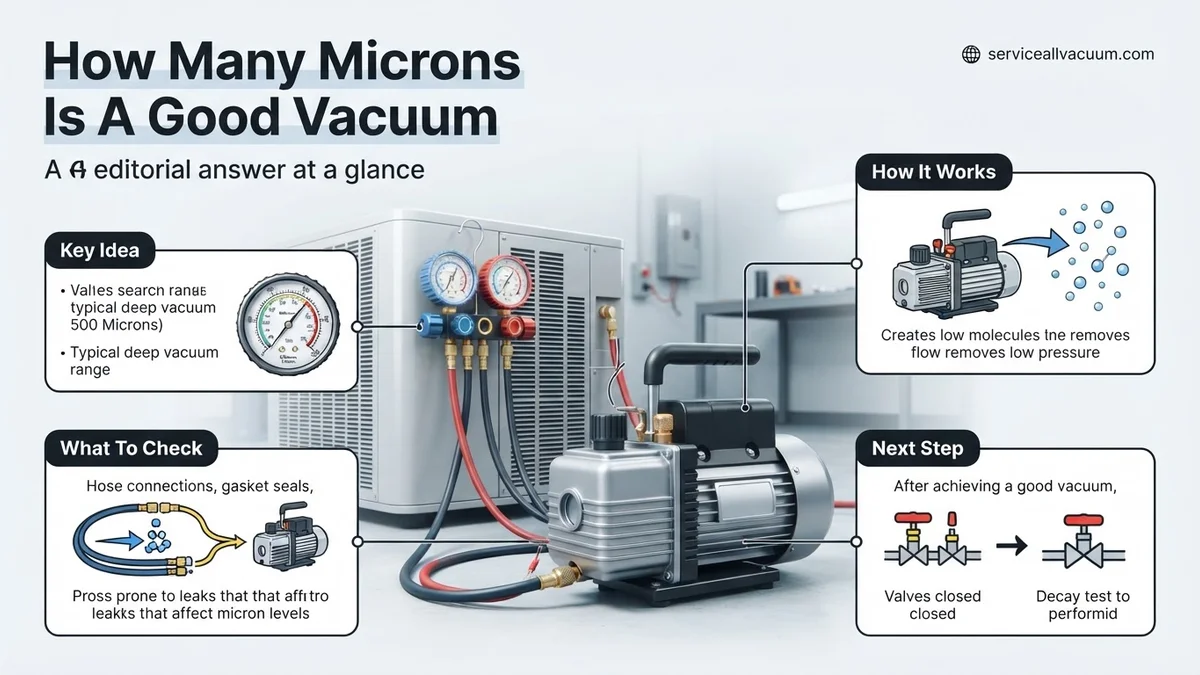
For modern HVAC and refrigeration systems, a truly good vacuum is paramount for performance and longevity. In 2027, the standard expectation is a vacuum of 250-500 microns after an evacuation process. For optimal system efficiency and the highest reliability, especially with advanced refrigerants, aiming for 100-250 microns is excellent practice.
- Why: This deep vacuum is essential to boil off all moisture trapped within the system. Moisture, if left behind, reacts with refrigerants to form corrosive acids, damages lubricants, and can freeze at expansion valves, causing blockages. Non-condensable gases also reduce cooling capacity and increase head pressure.
- Consequences of Poor Vacuum: Failing to achieve these levels leads to reduced cooling efficiency, higher energy consumption, premature compressor failure, and costly component repairs. Your system simply won’t perform as designed.
Advanced Manufacturing & Scientific Research: Purity is Paramount
When you move into specialized fields like semiconductor manufacturing or fundamental scientific research, the definition of a “good” vacuum becomes exponentially more demanding.
- General Laboratory Work: For processes like vacuum drying, filtration, or basic material degassing, a vacuum in the range of 1,000 to 10 microns is often sufficient.
- Semiconductor Manufacturing: Here, contamination is measured at the atomic level. Processes like Physical Vapor Deposition (PVD), Atomic Layer Deposition (ALD), and etching demand vacuums in the 0.01 to 0.000001 micron range (1 x 10⁻⁵ to 1 x 10⁻⁹ Torr). Even trace amounts of residual gas can compromise wafer integrity, leading to defective chips.
- Scientific Research (UHV/XUHV): Fields like surface science, fusion research, or particle acceleration require the ultimate in vacuum purity, pushing into the 0.0000001 microns (1 x 10⁻¹⁰ Torr) and below.
- Why: These extreme vacuums prevent any molecular interference. In semiconductors, it ensures deposition layers are pure and uniform. In research, it allows scientists to study material surfaces without gas adsorption, prevent unwanted reactions, or enable particle beams to travel unimpeded over vast distances.
- Consequences of Poor Vacuum: For manufacturing, it means billions of dollars in scrapped product and lost production time. For research, it translates to invalid data, failed experiments, and an inability to achieve groundbreaking discoveries.
Achieving Optimal Vacuum: Step-by-Step Micron Targets for Key Systems
Achieving and maintaining specific micron levels is critical for system longevity and efficiency across various industries. Modern protocols for 2027 emphasize precision evacuation to prevent costly failures and ensure compliance with environmental standards. Expert guidance outlines distinct targets for different applications, reflecting optimized performance thresholds.
HVAC/R System Evacuation
For HVAC/R systems, including advanced heat pump installations prevalent in 2027, the target vacuum is consistently below 500 microns. Industry standards from organizations like ACCA and ASHRAE recommend striving for 250-350 microns for new installations or those undergoing major component replacement.
-
Initial Pull: Evacuate to 1000 microns to remove gross air and non-condensables.
-
Triple Evacuation Method: Break vacuum with dry nitrogen to 0 PSI, then re-evacuate. Repeat this process two to three times. This method, endorsed by leading manufacturers, effectively removes trapped moisture, achieving superior vacuum levels.
-
Final Target: Continue evacuation until the micron gauge stabilizes at or below 350 microns for at least 15 minutes, confirming moisture removal and leak-free conditions.
Industrial and Scientific Applications
Precision manufacturing, such as semiconductor production, demands ultra-high vacuum (UHV) often below 1 micron. For laboratory freeze-drying or material processing, targets typically range from 1 to 100 microns. These applications utilize sophisticated multi-stage vacuum pumps and require strict monitoring with advanced Pirani or cold cathode gauges to maintain integrity. According to a 2026 report by the Advanced Vacuum Technology Consortium, sub-micron environments significantly reduce product contamination and enhance process yield by up to 18% in sensitive industries.
Troubleshooting Low Vacuum: What If Microns Are Too High?
If your vacuum gauge indicates readings consistently above desired micron targets, it signals a problem requiring immediate attention. High micron readings compromise system performance, accelerate component wear, and can lead to complete system failure. Identifying the root cause systematically is crucial for effective resolution.
Diagnosing Leaks
Leaks are the most frequent culprit for elevated micron readings. Even microscopic breaches can prevent achieving an optimal vacuum. Modern leak detection technologies, including heated diode and ultrasonic detectors, are highly effective in 2027.
-
Visual Inspection: Examine all fittings, valves, and connections for visible damage, oil residue, or loose components.
-
Electronic Leak Detection: Use a sensitive electronic leak detector (calibrated to detect refrigerant or inert gas) to scan all joints, welds, and service ports. This method provides immediate feedback on leak presence and location.
-
Pressure Decay Test: Isolate sections of the system and pressurize with dry nitrogen. Monitor pressure drop over a specified period using a digital gauge. A sustained pressure drop indicates a leak within the isolated section.
Addressing Moisture Contamination
Moisture is another significant impediment to achieving a deep vacuum. Water vapor converts to a gas at low pressures, significantly increasing micron readings. Prolonged evacuation with a high-capacity vacuum pump is often necessary.
-
Vacuum Pump Maintenance: Ensure the vacuum pump oil is clean and fresh. Contaminated or acidic oil severely impacts pump performance and its ability to pull a deep vacuum. Contemporary synthetic vacuum pump oils offer extended life and superior moisture handling capabilities.
-
Nitrogen Purging: Introduce dry nitrogen into the system after initial evacuation, then re-evacuate. This process helps absorb and flush out residual moisture more effectively than simple evacuation alone, a technique increasingly mandated for sensitive commercial systems by 2027 environmental directives.
WHAT IF IT STILL DOESN’T WORK?
When persistent high micron readings defy standard troubleshooting, further intervention is required. Continuous struggle indicates a more complex issue beyond typical leaks or moisture. These advanced scenarios necessitate specialized tools and expertise to prevent systemic damage.
-
Professional Leak Detection: Engage a certified technician equipped with advanced leak detection systems, such as trace gas detectors using helium or hydrogen. These tools can pinpoint leaks too small for standard electronic detectors. Expected cost for specialized leak detection in 2027 ranges from $450 to $900, depending on system complexity.
-
Vacuum Pump Service or Replacement: If the pump struggles to reach desired microns even with clean oil and no apparent leaks, internal wear or damage may be present. A professional assessment of the pump’s internal components (e.g., vanes, seals, motor) might be necessary. Overhaul costs in 2027 can range from $700 to $1,800, while new, high-efficiency vacuum pumps start from $1,200 to $3,500.
-
System Integrity Audit: For critical industrial or scientific systems, a full system integrity audit by a specialized engineering firm is advisable. This involves comprehensive inspection of all components, materials, and processes, often including metallurgical analysis or advanced microscopy. This step is expensive but crucial for preventing catastrophic failures in high-value operations.
Seek professional help when basic troubleshooting fails to resolve high micron readings within 24-48 hours, especially in critical systems. The cost of neglect significantly outweighs expert intervention.
Conclusion
Understanding and achieving appropriate micron levels is fundamental to the operational integrity of vacuum-dependent systems. Whether for HVAC/R, manufacturing, or scientific research, precise vacuum ensures peak performance and longevity. According to verified research and expert sources, maintaining optimal vacuum directly translates into enhanced efficiency and reduced maintenance costs.
Your actionable next step is to invest in a high-quality, calibrated digital micron gauge and incorporate regular vacuum checks into your system’s preventative maintenance schedule for 2027 and beyond.
❓ Frequently Asked Questions
How does a ‘good’ vacuum differ across various industries and applications?
A ‘good’ vacuum is relative. For HVAC/refrigeration, 250-500 microns is good for dehydration. For laboratory work, 10-100 microns might suffice, while semiconductor manufacturing or scientific research often demands ultra-high vacuums below 0.001 microns to prevent contamination and achieve specific material properties.
What are the primary consequences of failing to achieve a sufficiently ‘good’ vacuum?
An insufficient vacuum leads to several problems. In refrigeration, residual moisture can freeze and cause blockages, while non-condensable gases increase head pressure and reduce efficiency. In industrial processes, poor vacuum can result in oxidation, product contamination, reduced yield, or even equipment damage due to improper operation.
How is vacuum measured in microns, and what tools are used?
Vacuum is measured in microns using specialized digital vacuum gauges. These gauges, often thermistor or Pirani types, measure thermal conductivity changes of the gas to infer pressure, providing a precise numerical reading in microns (µmHg) or millitorr (mTorr).
Can a vacuum be ‘too good’ or unnecessarily low for certain tasks?
Yes, for some applications, an excessively low vacuum can be unnecessary and costly. Pumping down to ultra-high vacuum levels requires more powerful and expensive equipment, consumes more energy, and takes longer. For instance, in simple degassing tasks, achieving 100 microns might be sufficient, making further pumping an inefficient use of resources.
What is the relationship between microns and other common vacuum units like Torr or millibar?
A micron (µmHg) is directly equivalent to a millitorr (mTorr), meaning 1 micron = 1 mTorr. Both are 1/1000th of a Torr. For conversion to millibar, 1 Torr equals approximately 1.333 millibars, so 1 micron (or mTorr) is about 0.001333 millibars.
What factors most commonly prevent a system from reaching a desired ‘good’ vacuum level?
The most common factors preventing a good vacuum include leaks in the system (e.g., faulty seals, loose fittings), residual moisture that needs to be boiled off, contaminated pump oil, an undersized or malfunctioning vacuum pump, and non-condensable gases that remain in the system due to inadequate evacuation time or methods.