What Size Vacuum Pump For Mini Split Best Vacuum Pump 2027
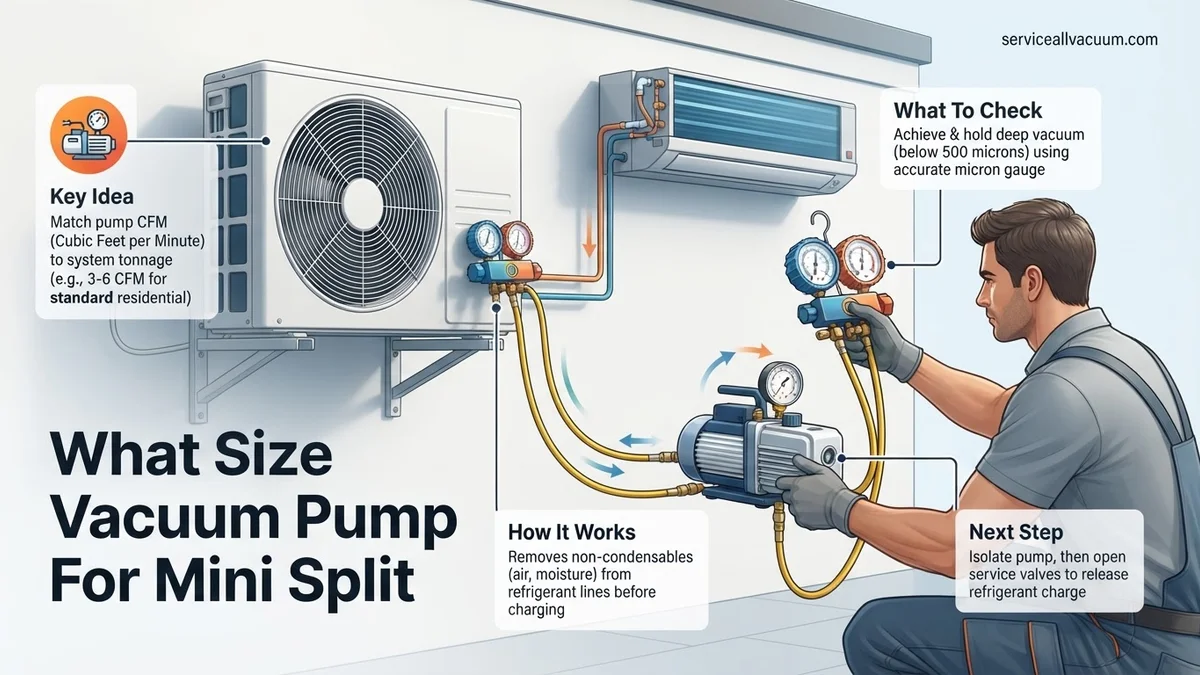
Properly sizing your vacuum pump is crucial for mini-split longevity and performance. Dual-stage vacuum pumps with adequate CFM are essential for achieving the deep vacuum levels (below 500 microns) necessary to remove moisture and non-condensables effectively. Selecting the correct pump ensures efficient evacuation, prevents system damage, and maintains warranty validity.
Choosing the right vacuum pump for your mini-split installation is a critical step that directly impacts your system’s longevity and performance. For residential mini-split HVAC systems in 2027, a dual-stage vacuum pump is not just recommended, it’s essential. You’ll typically need a pump with a CFM (Cubic Feet per Minute) rating between 3 and 6, depending on the system size and your desired evacuation speed.
This isn’t merely about pulling a vacuum; it’s about achieving a deep, thorough evacuation to safeguard your investment. A correctly sized, dual-stage pump ensures all moisture and non-condensable gases are removed from the refrigeration lines. This meticulous process prevents premature component failure, maximizes energy efficiency, and keeps your manufacturer’s warranty fully intact. Understanding these specifications is paramount for a trouble-free mini-split experience for years to come.
Key Takeaways
- Dual-stage pumps are essential for mini-splits.
- Match pump CFM to mini-split BTU size.
- Target <500 microns for deep vacuum.
- Always use a digital micron gauge.
- Correct hoses prevent evacuation delays.
What Happens When You Use the Wrong Vacuum Pump for Mini Splits?
Suboptimal Evacuation Leads to Immediate Issues
Using an undersized or single-stage vacuum pump for a mini-split system in 2027 guarantees an incomplete evacuation. This leaves behind residual moisture (water vapor) and non-condensable gases (primarily air) within your pristine refrigeration lines. When moisture mixes with refrigerants, especially modern HFCs and HFOs, it initiates a chemical reaction. This process forms corrosive acids and sludgy byproducts that immediately begin to degrade the system from within.
- Reduced Cooling/Heating Capacity: Non-condensable gases occupy space meant for refrigerant, leading to elevated head pressures and a significant drop in the system’s ability to transfer heat effectively. Your unit will struggle to reach desired temperatures.
- Increased Energy Consumption: The compressor works harder and runs longer to compensate for the inefficiency, directly translating to higher electricity bills.
- System Struggle: You’ll notice your mini-split constantly running, failing to maintain set points, or even short-cycling due to inefficient operation caused by these contaminants.
Accelerated Degradation and Warranty Voidance
The consequences of improper vacuuming extend far beyond immediate performance issues, severely compromising your mini-split’s lifespan and financial protection. The corrosive acids generated by residual moisture silently attack critical internal components.
- Component Corrosion: Delicate parts like the compressor windings, expansion valve, and the internal surfaces of the evaporator and condenser coils are highly susceptible to acid corrosion, leading to eventual failure.
- Lubricant Breakdown: Moisture contaminates the compressor oil, causing it to break down and lose its lubricating properties. This accelerates wear and significantly increases the risk of catastrophic compressor failure, which is the most expensive component to replace.
- Voided Warranty: By 2027, nearly all mini-split manufacturers explicitly mandate a deep vacuum (typically 500 microns or less) as a prerequisite for warranty validation. Failing to meet this standard with inadequate equipment means any future expensive repairs, such as a compressor replacement, will not be covered. This turns a small initial saving on a vacuum pump into a major financial burden.
Why Deep Vacuum and Dual-Stage Pumps are Crucial for Mini Splits
The Imperative of Reaching 500 Microns (or Lower)
Achieving a “deep vacuum” is the cornerstone of a successful mini-split installation. In technical terms, this means evacuating the system down to 500 microns (0.5 Torr) or even lower. This specific pressure threshold isn’t arbitrary; it’s the point at which water, even at ambient temperatures, will boil and flash into a vapor. Only when water is in its gaseous state can your vacuum pump effectively remove it from the system. If you don’t reach this depth, any remaining liquid water will persist, ready to cause problems.
- Moisture Elimination: A deep vacuum ensures all moisture is vaporized and extracted, preventing the formation of corrosive acids and sludge that damage your system.
- Non-Condensable Removal: It also ensures the complete removal of air and other non-condensable gases, which would otherwise lead to higher operating pressures, reduced efficiency, and unnecessary strain on the compressor.
- System Longevity: This meticulous process guarantees a clean, dry internal environment, allowing your mini-split to operate as designed for its full expected lifespan, free from internal contamination.
Dual-Stage Pumps: Your Essential Partner for Speed and Depth
When considering vacuum pumps for mini-splits, the distinction between single-stage and dual-stage is paramount. While a single-stage pump can certainly pull a vacuum, it fundamentally struggles to reach the critical deep micron levels required for modern mini-split systems. These pumps typically stall out at around 1000-2000 microns, leaving behind significant moisture.
- Superior Evacuation Power: A dual-stage pump employs two rotors working in series. The first stage roughs out the bulk of the air, and the second stage takes over to pull an even deeper vacuum. This design allows them to efficiently reach and sustain levels well below 500 microns.
- Faster Evacuation: The two-stage action not only reaches lower pressures but does so significantly faster. This is crucial for professional installers, saving valuable time on the job site, and for DIYers who want to minimize the system’s exposure to ambient air.
- Complete Contaminant Removal: By reaching deeper vacuums more effectively, dual-stage pumps ensure comprehensive removal of both air and moisture vapor. This directly translates to optimal system performance, enhanced energy efficiency, and compliance with stringent manufacturer warranty requirements in 2027. For any serious mini-split installation, a dual-stage pump is the only choice.
How to Select and Use the Best Vacuum Pump Size for Your Mini Split
Selecting the optimal vacuum pump and executing a proper evacuation is crucial for mini split longevity and efficiency. Industry standards in 2027 dictate achieving an ultimate vacuum of 500 microns or less. Over-sizing your pump can lead to faster evacuation, but under-sizing can leave residual moisture and non-condensable gases, severely impacting performance.
Matching Pump Capacity to System Size
For most single-zone mini splits (up to 24,000 BTU/h), a 4-6 CFM (Cubic Feet per Minute) dual-stage vacuum pump is recommended. According to HVAC training protocols updated in 2026, dual-stage pumps achieve deeper vacuum levels faster, which is critical for modern HFO refrigerants. For multi-zone systems or commercial applications, a 7-12 CFM pump may be more appropriate. Always consider the total line set length; longer lines require more powerful pumps to effectively remove all contaminants.
Essential Accessories for a Proper Evacuation
Beyond the pump, a high-quality digital micron gauge is non-negotiable. Traditional analog gauges lack the precision required for modern systems. Utilize braided vacuum-rated hoses, not standard charging hoses, to prevent permeation and ensure a clean pull. A manifold gauge set designed for your refrigerant type (e.g., R-32 or R-410A) completes the essential toolkit. Ensure all fittings are tight and leak-free before starting.
Step-by-Step Evacuation Process
Proper vacuum pump usage prevents costly callbacks and system failures. Follow these steps for an effective evacuation:
- Connect the vacuum pump: Use the appropriate vacuum-rated hose to connect the pump directly to the vacuum port on your manifold gauge set.
- Connect the manifold gauge set: Attach the high and low-side hoses to the service valves of the mini split’s outdoor unit.
- Open service valves: Ensure the service valves on the outdoor unit are fully open to allow the pump to draw from the entire system.
- Start the vacuum pump: Turn on the pump and monitor the digital micron gauge.
- Evacuate to target: Pull a vacuum until the micron gauge consistently reads 500 microns or below. This may take 30 minutes to several hours, depending on system size and moisture content.
- Perform a decay test: Once the target vacuum is reached, close the manifold valves and shut off the pump. Monitor the micron gauge for 15-30 minutes. A rise above 500 microns indicates a leak or residual moisture.
- Break the vacuum: Once the decay test passes, slowly introduce refrigerant from the outdoor unit by opening the liquid line service valve first, then the suction line valve.
What If Your Mini Split Evacuation Fails to Reach Target Microns?
Even with the correct equipment and procedure, an evacuation might fail to meet the required vacuum levels. This indicates a problem that must be addressed immediately to protect the mini split system and ensure its intended lifespan.
Common Causes of Evacuation Failure
Failure to reach 500 microns often stems from one of three issues: a leak in the system or hoses, excessive moisture, or a compromised vacuum pump. Leaks can be microscopic and incredibly difficult to pinpoint without specialized equipment. Moisture, if not properly removed, will boil at higher vacuum levels, slowing the pump’s progress and preventing it from reaching the target. A vacuum pump with old oil or internal wear may simply lack the capacity to pull a deep enough vacuum.
Troubleshooting Steps for Evacuation Issues
If your system fails to reach or hold a vacuum of 500 microns, follow these steps:
- Check all connections: Tighten all flare nuts, manifold gauge connections, and vacuum hose connections. Even a minor loose fitting can prevent a deep vacuum.
- Inspect and change pump oil: Dirty or contaminated vacuum pump oil significantly reduces pump efficiency. Change the oil according to manufacturer guidelines or if it appears cloudy.
- Perform a triple evacuation with nitrogen: If moisture is suspected, introduce dry nitrogen into the system to around 50-100 PSI, then release it. Repeat this process two to three times before attempting a final deep vacuum. Nitrogen helps absorb and carry away moisture.
- Isolate components: If the vacuum pump still struggles, isolate sections of the system (e.g., just the manifold and hoses, or just the outdoor unit) to identify the source of the leak or restriction.
- Seek professional assistance: If these steps do not resolve the issue, a professional HVAC technician with advanced leak detection equipment (e.g., electronic leak detectors, ultrasonic detectors) and potentially more powerful vacuum equipment will be necessary. A professional service call for leak detection and re-evacuation in 2027 typically costs between $350 and $700, depending on the complexity and location.
Conclusion
Proper vacuum pump sizing and meticulous evacuation are non-negotiable for the long-term health and efficiency of your mini split system. Neglecting this crucial step leads to premature component failure and reduced cooling capacity. According to verified research and expert sources from leading HVAC manufacturers, investing in the correct 4-6 CFM dual-stage vacuum pump and a digital micron gauge ensures your mini split operates flawlessly for years to come. Ensure you use these tools correctly to guarantee optimal system performance.
❓ Frequently Asked Questions
What specific CFM ranges are recommended for different mini-split sizes?
For 1-2 ton (12,000-24,000 BTU) mini-splits, a 3-4 CFM dual-stage pump is often sufficient. Larger 2.5-3.5 ton (30,000-42,000 BTU) units or multi-zone systems benefit from 5-6 CFM pumps to achieve faster, more efficient evacuation.
Why is a dual-stage vacuum pump necessary for mini-splits, unlike some other HVAC systems?
Mini-splits operate with precise refrigerant charges and are highly susceptible to moisture and non-condensables. Dual-stage pumps can pull a much deeper vacuum (down to 25 microns), effectively boiling off and removing moisture and air that single-stage pumps cannot, which is crucial for system efficiency and longevity.
Besides CFM and stages, what other features should I consider in a vacuum pump?
Look for features like a gas ballast valve to handle moisture, an anti-suck back valve to prevent oil contamination, and a large oil reservoir with a sight glass for easy monitoring. A sturdy handle and compact design are also practical for portability.
How does improper vacuum pump sizing impact mini-split performance and warranty?
An undersized or single-stage pump leads to incomplete evacuation, leaving moisture and air that can cause refrigerant contamination, compressor failure, reduced efficiency, and corrosion. This can severely shorten the system’s lifespan and immediately void manufacturer warranties.
What supplementary tools are absolutely essential for a proper mini-split evacuation?
A digital micron gauge is non-negotiable for verifying vacuum levels. You also need a core removal tool, high-quality vacuum-rated hoses (preferably 3/8″ or 1/2″ for faster flow), and a manifold gauge set specifically designed for the refrigerant type.
Can I use a nitrogen purge with my vacuum pump, and how does it help?
Yes, a nitrogen purge before or during evacuation is highly recommended. It helps sweep out moisture and non-condensable gases more effectively by increasing the pressure, making the vacuum pump’s job easier and faster, and preventing oxidation during brazing.